

Introduction: The Detection Arms Race
As AI writing tools become ubiquitous, understanding how detection systems work has become critical for content creators. Whether you're using AI to assist your writing or evaluating content quality, knowing the technical mechanisms behind detection helps you create better content.
This article explores the core technologies powering AI content detection: perplexity scoring, burstiness analysis, and the ensemble methods that combine multiple signals. We'll also examine why search engines like Google focus on content quality rather than origin.
Perplexity: Measuring Text Predictability
Perplexity is a metric from language modeling that measures how “surprised” a model is by a sequence of text. It quantifies the average uncertainty per word when predicting the next token in a sequence.
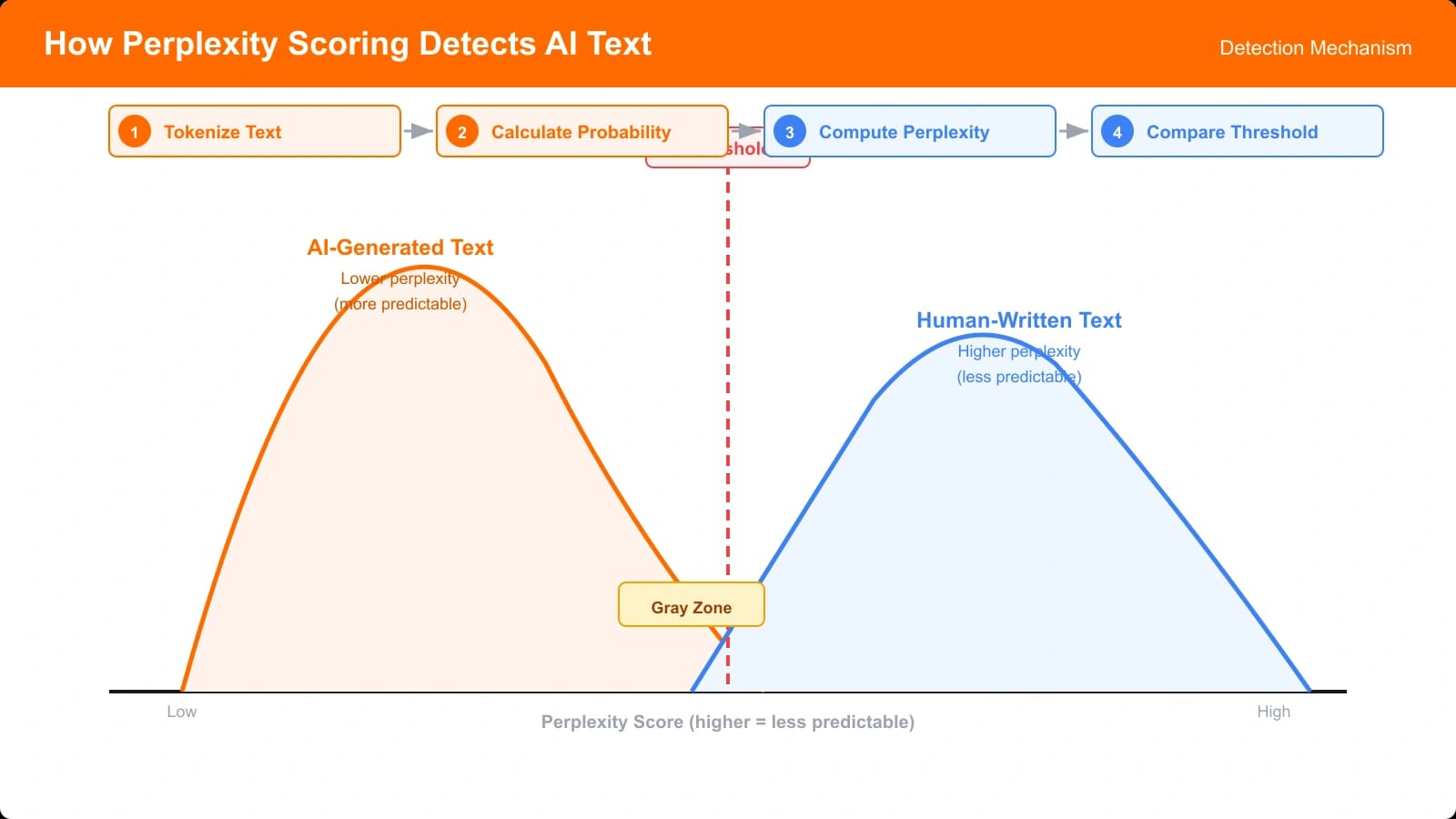
How Perplexity Detection Works
- 1Tokenization: The text is broken into tokens (words or subwords) that the detection model can process.
- 2Probability Calculation: For each token, the model calculates the probability of that token appearing given the previous context.
- 3Perplexity Score: The geometric mean of inverse probabilities across all tokens. Lower scores mean more predictable text.
- 4Threshold Comparison: Scores below certain thresholds flag content as potentially AI-generated.
Low Perplexity (AI-like)
- Highly predictable word choices
- Common phrases and structures
- Follows expected patterns
- Smooth, “correct” language
High Perplexity (Human-like)
- Unexpected word choices
- Creative phrasing
- Idiosyncratic expressions
- Occasional “imperfections”
Burstiness: Analyzing Structural Variation
Burstiness measures the variation in sentence length, structure, and style throughout a text. Human writing naturally exhibits “bursts”—some sentences are short and punchy, others long and complex. AI tends to produce more uniform text.
What Burstiness Measures
- Sentence Length Variance: Standard deviation of word counts per sentence. Higher variance = more human-like.
- Structural Diversity: Variety in grammatical patterns—questions, exclamations, fragments, complex sentences.
- Rhythm Changes: Transitions between short and long passages, varying paragraph lengths.
- Stylistic Shifts: Changes in formality, tone, or vocabulary density throughout the text.
// Simplified burstiness calculation
function calculateBurstiness(sentences) {
  const lengths = sentences.map(s => s.split(' ').length);
  const mean = lengths.reduce((a, b) => a + b) / lengths.length;
  const variance = lengths.reduce((sum, len) =>
    sum + Math.pow(len - mean, 2), 0) / lengths.length;
  return Math.sqrt(variance) / mean; // Coefficient of variation
}

// Low burstiness (AI-like): 0.1 - 0.3
// High burstiness (human-like): 0.4 - 0.8+
“AI-generated text usually shows smoother, more uniform structures with less variance. Human writing has natural rhythm changes that reflect thinking and emphasis patterns.”
Ensemble Detection: Combining Multiple Signals
Modern detection systems don't rely on any single metric. They combine multiple signals using ensemble approaches, achieving higher accuracy than individual methods.
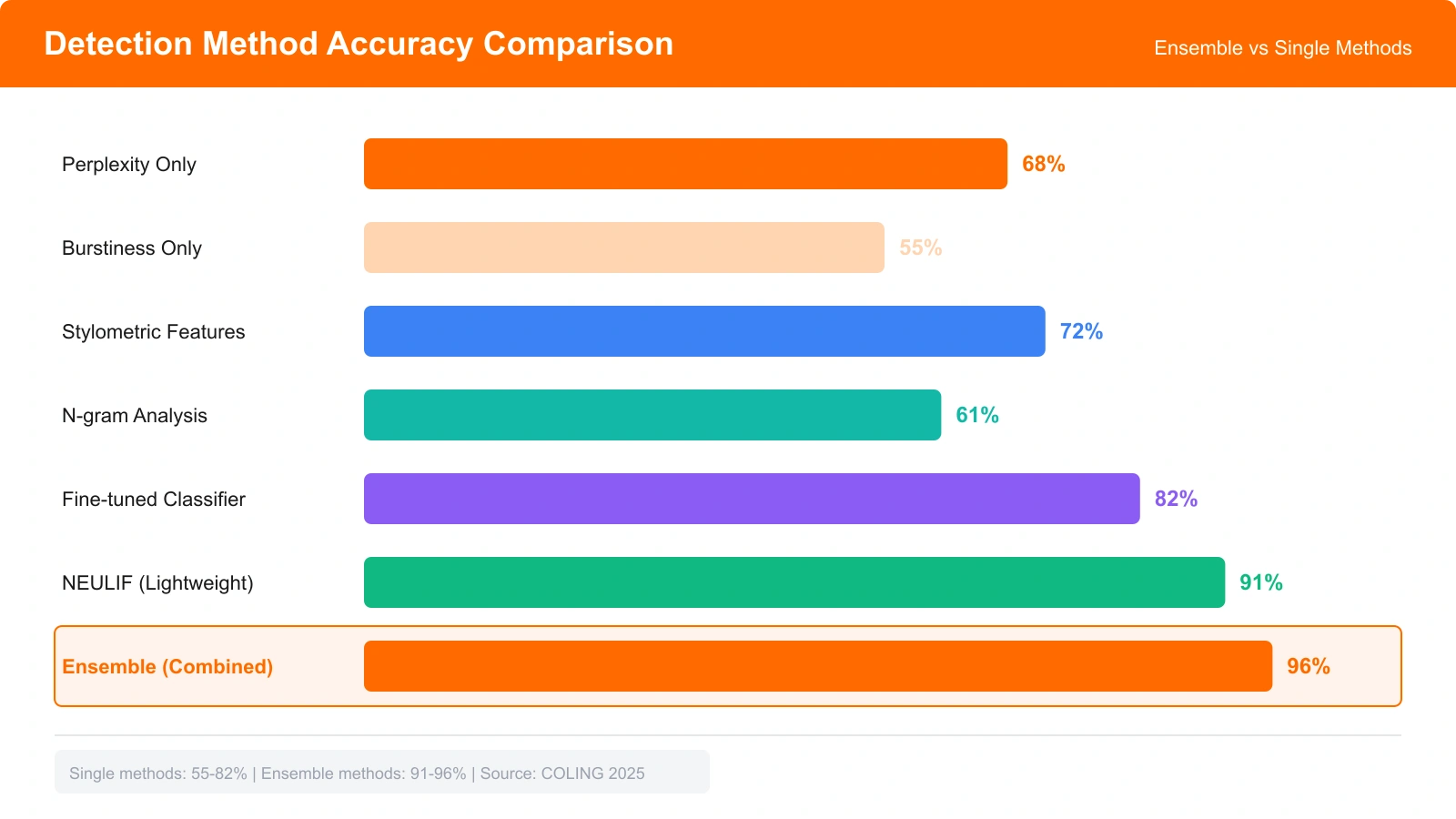
Key Detection Signals
Statistical Features
- Perplexity scores
- Burstiness metrics
- N-gram distributions
- Readability scores
Semantic Features
- Embedding analysis
- Stylometric patterns
- Lexical diversity
- Entity consistency
Recent Research Findings (2025)
- Inverse Perplexity Weighting: Research from COLING 2025 shows that weighting ensemble models by inverse perplexity improves detection in both normal and adversarial settings.
- NEULIF Detector: A lightweight detector using stylometric and readability features achieves F1 scores of 0.95-0.97, rivaling larger transformer ensembles.
- Cross-Domain Performance: Models trained on one domain (e.g., news) often struggle with others (e.g., academic writing), necessitating domain-aware approaches.
Limitations and Evasion Techniques
AI content detection is far from perfect. Understanding its limitations helps you create better content and avoid false positives.
Common False Positive Triggers
- Academic Writing: Formal, structured writing with low perplexity often triggers false positives.
- Non-Native English: Writers using simpler vocabulary and structures may be flagged incorrectly.
- Technical Documentation: Standardized formats and terminology reduce natural variation.
- Famous Texts: Well-known passages that language models have memorized score as highly predictable.
Known Evasion Techniques
- Paraphrasing: Rewriting AI output through another model or manually reduces statistical signatures.
- Injecting Burstiness: Deliberately varying sentence lengths and structures.
- Adding “Imperfections”: Including minor stylistic quirks that humans exhibit.
- Heavy Editing: Substantial human revision obscures original AI patterns.
How Search Engines Actually Handle AI Content
Here's the critical insight: Google does not penalize content purely for being AI-generated. The focus is on content quality, helpfulness, and user value—regardless of how it was created.
What Google Actually Evaluates
- E-E-A-T Signals: Experience, Expertise, Authoritativeness, Trustworthiness—who wrote it and why should we trust them?
- User Engagement: Click-through rates, time on page, bounce rates, and other behavioral signals.
- Content Depth: Does the content fully answer the query? Does it provide unique value?
- Originality: Is this duplicative of existing content or does it add new perspectives?
- Accuracy: For YMYL topics, factual correctness is paramount.
Thin, generic AI content fails not because it's AI-generated, but because it lacks the depth, expertise, and originality that quality content requires.
Best Practices for AI-Assisted Content
If you're using AI to assist your writing, here's how to create content that's both high-quality and unlikely to trigger detection issues:
- 1Add Original Insights: Use AI for research and drafting, but inject your unique expertise, examples, and perspectives.
- 2Vary Your Style: Deliberately include different sentence structures, rhetorical questions, and stylistic changes.
- 3Include Primary Sources: Link to original research, cite data, quote experts. This adds credibility AI can't fake.
- 4Edit Substantially: Don't just publish AI output. Rewrite sections, add transitions, adjust tone.
- 5Focus on Helpfulness: Ask: “Does this genuinely help my audience?” If yes, origin matters less.
“The goal isn't to evade detection—it's to create content so valuable that detection becomes irrelevant.”
Conclusion: Quality Over Origin
AI content detection technology continues to evolve, but so do AI writing tools. This arms race will likely continue indefinitely. The more important takeaway is this:
Search engines care about content quality, not content origin. Whether you write every word yourself or use AI as a starting point, the bar for ranking is the same: create content that genuinely helps users, demonstrates expertise, and provides unique value.
Use AI as a tool to enhance your productivity, but never as a replacement for the expertise, insights, and original thinking that define truly valuable content.
Related reading: Explore What is Answer Engine Optimization and GEO vs SEO vs AEO for more on how AI search systems work.

Product Manager at BestPage. Pioneer in AEO research since 2024, exploring the convergence of SEO and GEO (Generative Engine Optimization). Led multiple AI-powered content optimization projects that achieved 300%+ citation increases in ChatGPT and Perplexity.