
Key Takeaways
- •Entities = known things: Products, companies, and people that AI systems recognize
- •Canonical names matter: Use the exact names AI already knows
- •Consistent attributes: Same properties (price, features) across all mentions
- •Relationship context: Help AI understand how entities relate to each other
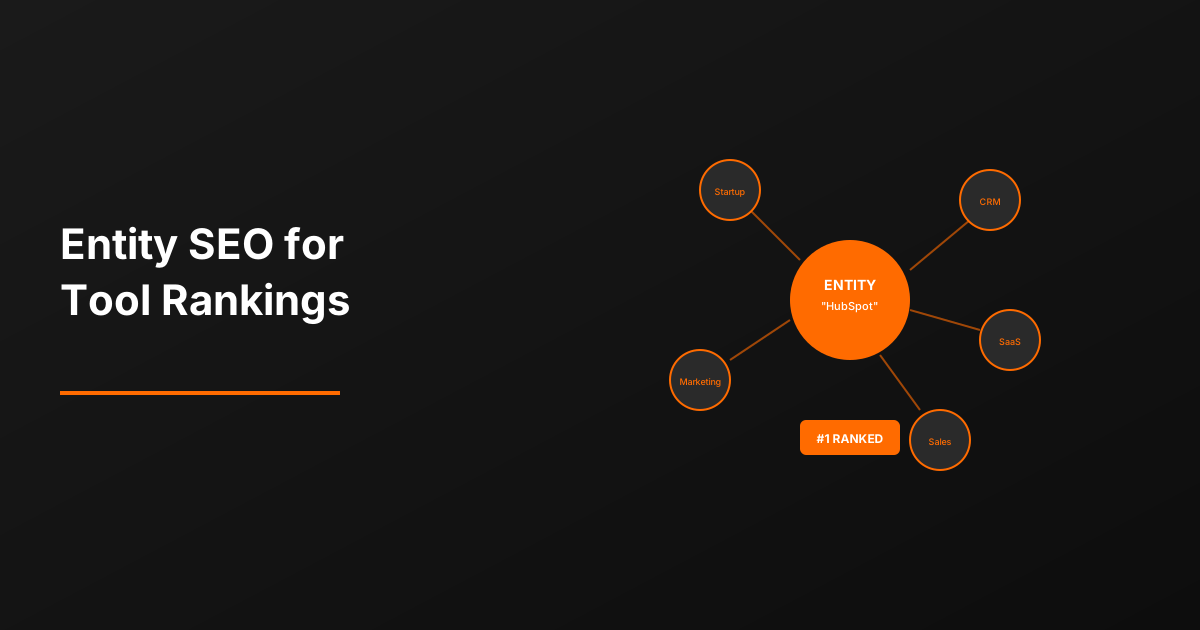
Entity SEO is about helping AI systems correctly identify and understand the products and tools you're ranking. When AI can confidently match your content to known entities, it's more likely to cite your rankings.
What Are Entities in SEO?#
Entities are things that exist in knowledge graphs—products, companies, people, concepts. Google, Wikipedia, and AI systems maintain databases of entities with known attributes and relationships.
- Notion (company and product)
- Asana (company and product)
- Slack (owned by Salesforce)
- HubSpot CRM (product by HubSpot)
Using Canonical Entity Names#
AI systems recognize entities by their canonical (official) names. Using variations reduces citation likelihood.
- Notion (official name)
- Asana (official name)
- HubSpot CRM (full product name)
- Salesforce (company name)
- The Notion app
- Asana software
- HubSpot's CRM tool
- SFDC or SF
Find Canonical Names
Consistent Entity Attributes#
When describing tools, use consistent attributes that AI systems can compare:
Entity Relationships#
Help AI understand how entities relate to each other:
- 1Owned by / Parent company"Slack (owned by Salesforce)" provides context.
- 2Competes with"Notion competes with Asana and Monday.com" establishes relationships.
- 3Integrates with"Zapier integrates with 5,000+ apps" describes capabilities.
- 4Best for"HubSpot CRM is best for small businesses" defines use case.
Schema Markup for Entities#
Use appropriate schema types to reinforce entity understanding:
{
  "@context": "https://schema.org",
  "@type": "SoftwareApplication",
  "name": "Notion",
  "applicationCategory": "Productivity",
  "operatingSystem": "Web, iOS, Android, macOS, Windows",
  "author": {
    "@type": "Organization",
    "name": "Notion Labs, Inc."
  },
  "offers": {
    "@type": "Offer",
    "price": "8",
    "priceCurrency": "USD",
    "priceSpecification": {
      "@type": "UnitPriceSpecification",
      "price": "8",
      "priceCurrency": "USD",
      "unitText": "per user per month"
    }
  }
}
Entity SEO Checklist#
- Use canonical entity names throughout
- Verify names match Wikipedia/Knowledge Graph
- Include parent company for sub-brands
- Use consistent pricing format
- Add SoftwareApplication or Product schema
- Mention key competitors to establish context
Frequently Asked Questions#
What if a tool has multiple names?
Use the primary name consistently, then mention alternatives once: "Notion (formerly known as Notion.so)" establishes both names.
How do I handle rebranded products?
Use the current name but reference the old name for search purposes: "Webflow (the company behind the Webflow design platform, previously a startup tool)"

Product Manager at BestPage. Pioneer in AEO research since 2024, exploring the convergence of SEO and GEO (Generative Engine Optimization). Led multiple AI-powered content optimization projects that achieved 300%+ citation increases in ChatGPT and Perplexity.