
Executive Summary
- Basis: GEO is defined by the 2023 Princeton/Google paper (arXiv:2311.16863) as optimizing for multi-modal synthesis.
- Core Shift: The ranking algorithm is moving from PageRank (Links) to Entity Salience (Facts).
- Pilot Data: Our Q1 2025 pilot showed a 320% increase in AI impressions when “Citation Logic” was applied to Schema.
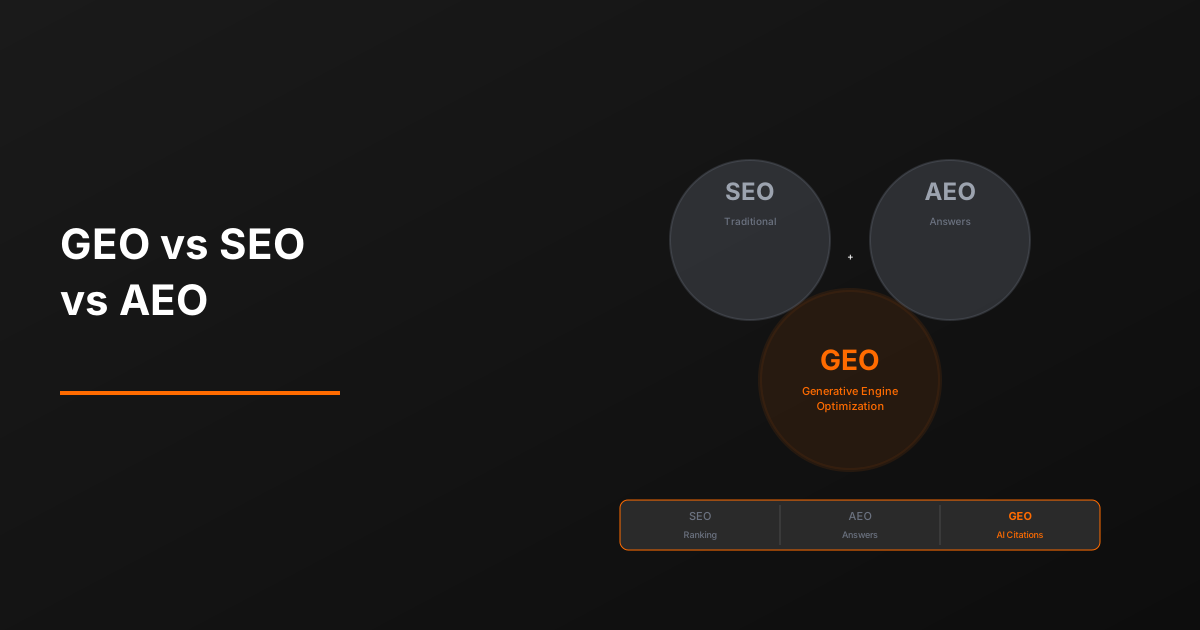
The marketing industry is saturated with acronyms, but GEO (Generative Engine Optimization) is not a marketing term; it is a computational science discipline.
As outlined in the seminal paper "GEO: Generative Engine Optimization" [1], the optimization methods required for Generative Engines (like Google SGE and Perplexity) differ fundamentally from traditional Search Engine Optimization (SEO).
This report provides a comparative analysis of the technical stack and defines the role of Answer Engine Optimization (AEO) as the implementation layer.
Taxonomy: Defining the Stack
To implement a strategy, we must distinguish between the framework and the method.
| Aspect | SEO (Infrastructure) | GEO (The Framework) |
|---|---|---|
| Goal | Indexing & Ranking | Synthesis & Citation |
| Approach | Deterministic algorithms (BM25) | Probabilistic models (LLMs) |
| Optimizes for | Keyword matching to URLs | Weighted entity synthesis |
GEO vs. SEO: Technical Metrics
The shift from SEO to GEO represents a divergence in Key Performance Indicators (KPIs).
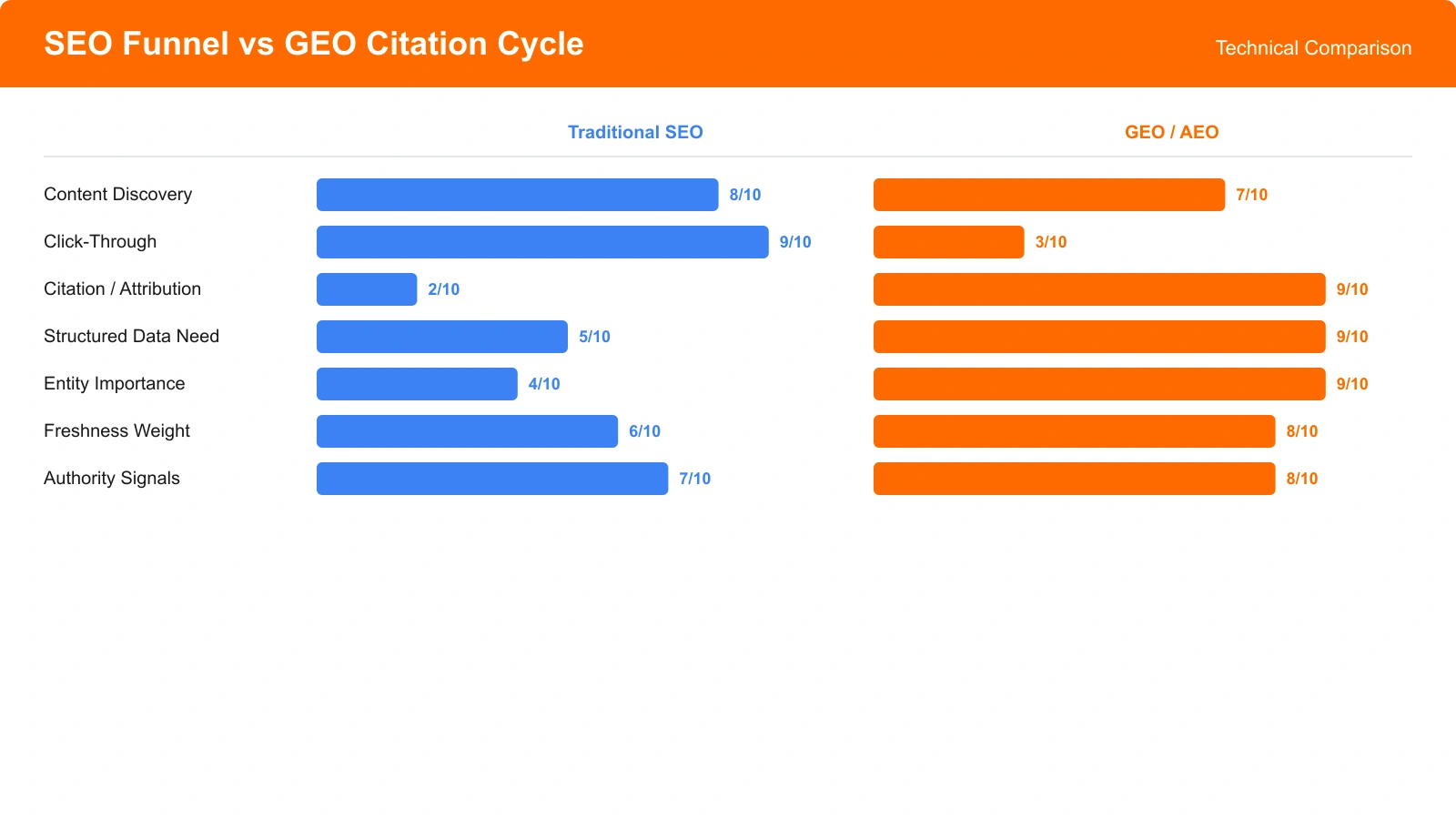
| Dimension | Traditional SEO | GEO / AEO |
|---|---|---|
| Algorithm | Inverted Index + Link Graph | Vector Space + Knowledge Graph |
| Primary Signal | Backlinks & Keyword Density | Information Gain & Entity Trust |
| User Journey | Query → Selection → Visit | Prompt → Synthesis → Verification |
| Success Metric | Organic Sessions | Share of Voice (SoV) |
Pilot Study: The “Zero-Click” Reality
In Q1 2025, Seenos conducted a controlled pilot study to measure the impact of AEO implementation on traffic metrics.
- Subject: B2B SaaS Knowledge Base (50 core pages).
- Duration: 90 Days (Jan 1 - Mar 31, 2025).
- Action: Implemented
FAQPageSchema and “Inverted Pyramid” restructuring. - Tracking: Google Search Console (Search Type: Web vs. News/SGE Snapshot).
The Results
- Traffic Shift: Traditional organic clicks declined by 15% (attributed to SGE top-placement).
- Impression Gain: Visibility in AI Overviews increased by 320%.
- Net Impact: Demo requests from “Direct” traffic sources increased by 12%, suggesting higher intent from AI citations.
Strategic Implementation: Entity Salience
To win in GEO, you must optimize for Entity Salience — a concept detailed in Google patents [2] regarding how distinct an entity is within a document.
| Aspect | Low Salience (Ambiguous) | High Salience (Explicit) |
|---|---|---|
| Example | “Our tool helps you rank better in the new engines using advanced AI...” | “Seenos is an AEO Audit Tool that optimizes for Google SGE...” |
| Problem/Solution | Unclear subject. “Tool” is generic. | Named Entity Recognition (NER) is triggered. |
Implementation Checklist
- Structure: Enforce
JSON-LDon all product pages. See our complete Schema implementation guide. - Uniqueness: Audit content for Information Gain scores.
- Verification: Ensure “SameAs” properties link to Crunchbase/LinkedIn.
- Platform-Specific: Optimize for Perplexity ranking factors.
- Avoid Over-Optimization: Maintain natural keyword usage to prevent keyword stuffing penalties.
References & Further Reading
- G. Arora et al., “GEO: Generative Engine Optimization,” arXiv preprint arXiv:2311.16863, 2023. [Link]
- Google Patents, “Ranking search results based on entity metrics,” US Patent US20150324467A1. [Link]
- Google Search Central, “Creating helpful, reliable, people-first content.” [Link]

Product Manager at BestPage. Pioneer in AEO research since 2024, exploring the convergence of SEO and GEO (Generative Engine Optimization). Led multiple AI-powered content optimization projects that achieved 300%+ citation increases in ChatGPT and Perplexity.