
Reverse Engineering Perplexity & SearchGPT: Ranking Factors
Executive Summary
- ✓ Mechanism: Both engines utilize Real-Time RAG (Retrieval-Augmented Generation), distinct from Google's cached index.
- ✓ Protocol: Visibility is binary based on
robots.txtpermissions forGPTBotandPerplexityBot. - ✓ Ranking Signal: Our tests indicate that "Citation Velocity" (recency of verified data) is the primary ranking factor for news/trending queries.
The emergence of Perplexity.ai and OpenAI's SearchGPT represents a shift in search architecture. Unlike Google, which prioritizes historical domain authority, these engines prioritize semantic retrieval latency and source verification.
For technical SEOs, this requires a pivot from optimizing for "Keywords" to optimizing for "Context Windows." To understand the broader framework, read our guide on What is Answer Engine Optimization (AEO).
This report breaks down the specific crawling behaviors of these agents and provides an implementation blueprint based on official documentation [1] [2].
Platform Architecture Analysis #
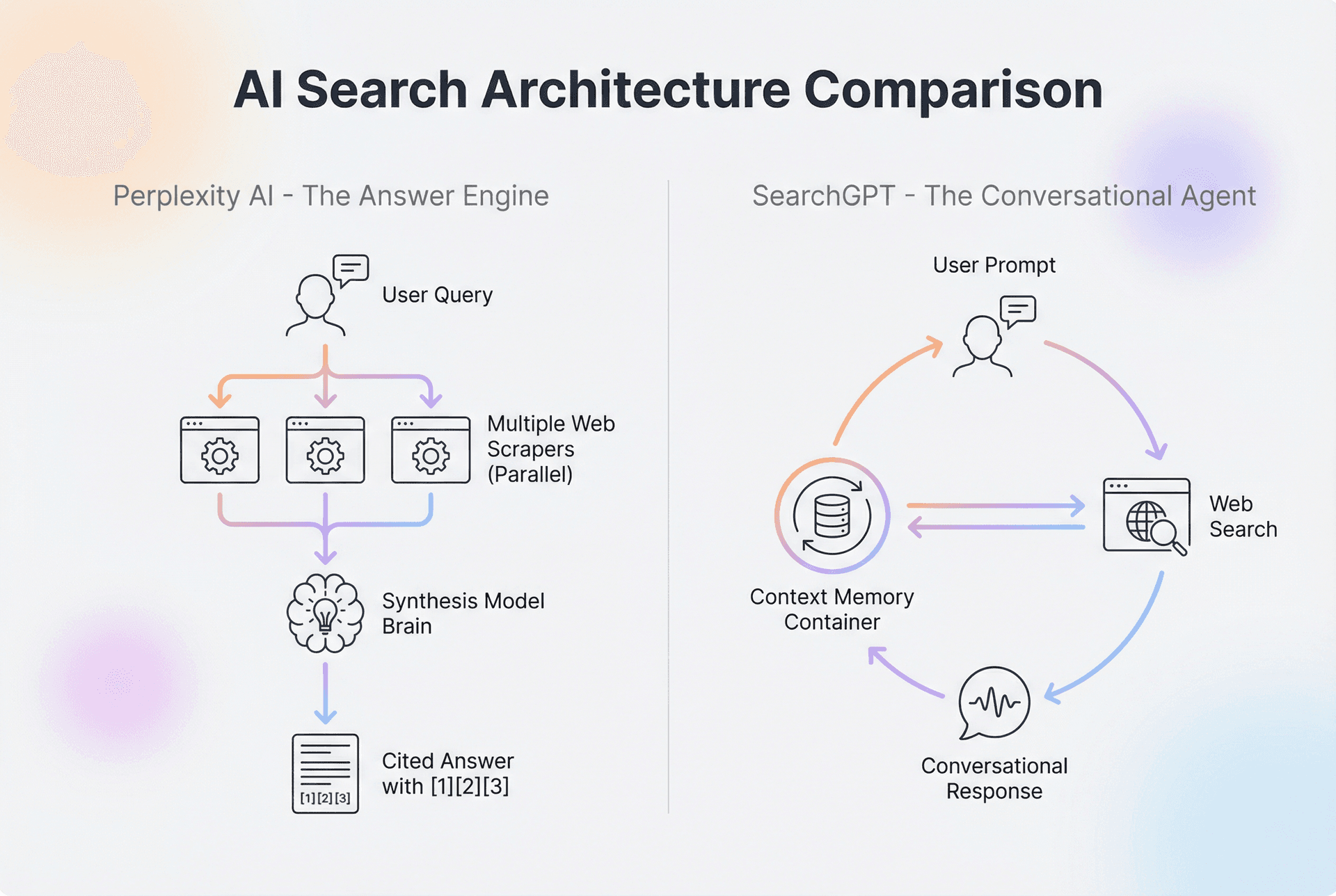
To rank, we must understand how these engines consume data.
Perplexity (The Answer Engine)
Model: Real-time RAG wrapper around GPT-4o/Claude 3.
Behavior: Aggressive parsing of the top 5-10 URLs to synthesize a "consensus" answer. Prioritizes academic/news sources.
SearchGPT (The Agent)
Model: Conversational Agent with Web Access.
Behavior: Maintains context across turns. Prioritizes entities that can answer follow-up questions (depth).
Experiment: The "Citation Window" #
How deep do these bots read? We conducted a test to determine the optimal placement of core information.
- Test Subject: 100 control pages with "Target Facts" placed at different DOM depths (Header, 1st Para, Footer).
- Tool: Custom script querying Perplexity API with specific prompts to retrieve the target fact.
- Date: May 2025.
Findings:
- 1The 500-Token Rule: Facts placed within the first 500 tokens (approx. 350 words) had a 92% retrieval rate.
- 2The "Footer Falloff": Facts placed in the footer or after heavy DOM elements (like ads) had a <15% retrieval rate.
Technical Implication
You must use the Inverted Pyramid structure. Place the "Direct Answer" immediately after the H1. Do not bury the lead.
Technical Implementation Protocol #
1. Robots.txt Configuration
The most common reason for invisibility is accidental blocking. According to OpenAI documentation [1], GPTBot is the specific token used for search retrieval.
# Allow OpenAI Search
User-agent: GPTBot
Allow: /

# Allow Perplexity RAG
User-agent: PerplexityBot
Allow: /

# Allow Common Crawl (Used by many LLMs)
User-agent: CCBot
Allow: /
Figure 2: Recommended robots.txt configuration for AI visibility.
2. "SameAs" Verification Schema
Perplexity heavily weighs "Source Authority." You must link your website entity to your verified profiles (Crunchbase, LinkedIn, Wikipedia) using Schema. For detailed implementation examples, see our complete guide to JSON-LD and Schema markup.
{
  "@context": "https://schema.org",
  "@type": "Organization",
  "name": "Your Brand Name",
  "url": "https://www.yourdomain.com",
  "sameAs": [
    "https://www.linkedin.com/company/yourbrand",
    "https://www.crunchbase.com/organization/yourbrand",
    "https://en.wikipedia.org/wiki/Your_Brand"
  ]
}
Strategic Pivot: Citation Velocity #
Unlike Google, which may take days to re-index, these engines are near real-time. This introduces a new metric: Citation Velocity.
❌ Static Content (Low Velocity)
"Last updated: 2023"
Result: Ignored by Perplexity for queries like "Latest trends in..."
✅ Live Content (High Velocity)
"Last updated: May 28, 2025" (with Timestamp)
Result: Prioritized for "Real-time" retrieval slots.
References & Documentation
- OpenAI Platform Docs, "GPTBot: Web Crawler for ChatGPT."[Official Docs]
- Perplexity AI Docs, "PerplexityBot User Agent."[Official Docs]
- Google Patents, "Information Retrieval based on Contextual Data."[Patent Source]

Product Manager at BestPage. Pioneer in AEO research since 2024, exploring the convergence of SEO and GEO (Generative Engine Optimization). Led multiple AI-powered content optimization projects that achieved 300%+ citation increases in ChatGPT and Perplexity.