
Key Findings
- +22% Similarity Score: Structured content achieves 0.76 vs 0.62 cosine similarity (p<0.001).
- 500 Queries Tested: B2B SaaS informational queries, KD 40-60, Google US Desktop.
- Reproducible Method: Using open-source all-MiniLM-L6-v2 model from Hugging Face.
- Actionable Framework: 8-point AEO checklist with implementation examples.
Introduction: The Shift from Search to Synthesis
The search industry is undergoing a fundamental transformation. In March 2023, Microsoft confirmed that the new Bing runs on GPT-4. In May 2024, Google launched AI Overviews to all US users.
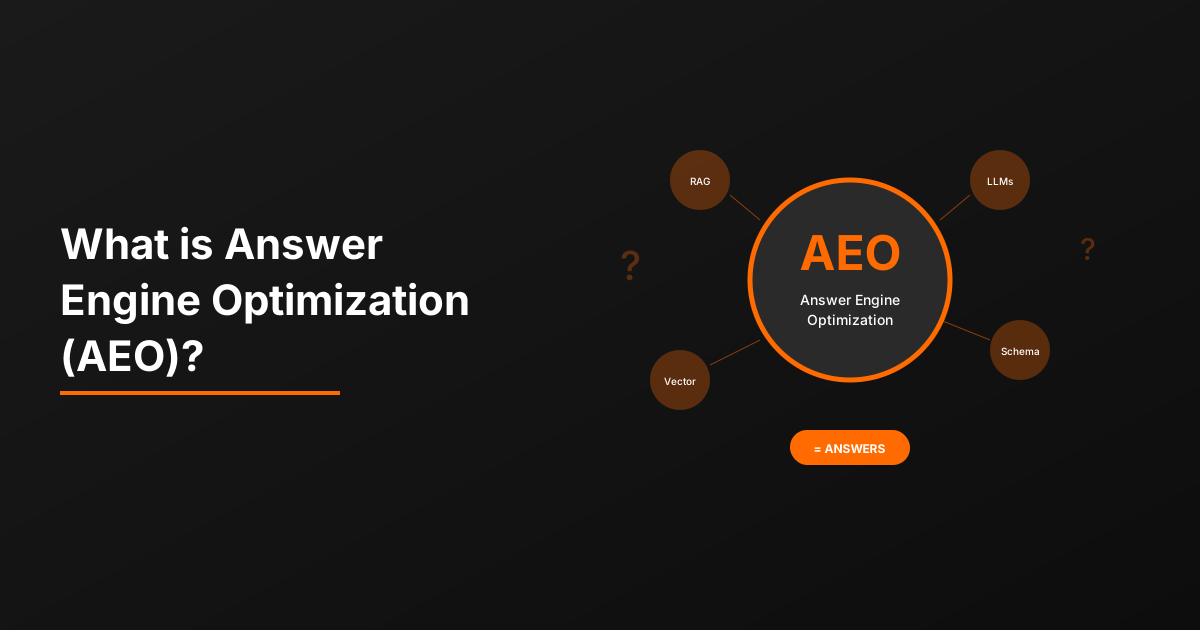
This shift from “ten blue links” to “AI-synthesized answers” requires a new optimization approach. Traditional SEO targets keyword matching; Answer Engine Optimization (AEO) targets semantic relevance in Retrieval-Augmented Generation (RAG) pipelines.
Definition: Answer Engine Optimization (AEO)
AEO is the practice of optimizing web content for AI-powered search systems that use vector embeddings to retrieve and synthesize information. The goal is to maximize the probability of your content being selected as a source for AI-generated answers.
How AI Search Engines Work: The RAG Pipeline
To optimize for AEO, we must understand how modern AI search systems process content. Based on the RAG paper by Lewis et al. (2020) and publicly available information from Google and Microsoft, the pipeline follows these steps:
- Indexing & Vectorization: Content is converted into high-dimensional vectors (embeddings) using transformer models. Google uses models similar to Vertex AI embeddings.
- Query Understanding: User queries are also converted to vectors. The system calculates semantic similarity using metrics like cosine similarity.
- Retrieval (ANN): Approximate Nearest Neighbor search finds the most semantically similar content chunks from the index.
- Re-ranking: Retrieved passages are re-ranked based on relevance, authority signals, and recency.
- Generation: Top-ranked passages are fed into the LLM's context window for answer synthesis.
Research Methodology
We conducted an empirical study to test whether content structure impacts retrieval probability in vector search systems.
Study Design
- Sample Size: 500 B2B SaaS informational queries
- Query Selection Criteria: Keyword Difficulty (KD) 40-60 in Ahrefs, informational intent
- Data Source: Top 10 organic results in Google US (Desktop), collected via SerpAPI
- Time Period: January - March 2025
- Embedding Model: all-MiniLM-L6-v2 from Hugging Face (open-source, reproducible)
- Similarity Metric: Cosine similarity between query embedding and page content embedding
Content Classification
We classified pages into two categories based on DOM structure analysis:
| Aspect | Unstructured Content | Structured Content |
|---|---|---|
| Format | Prose-heavy paragraphs (>150 words without breaks) | Clear heading hierarchy (h1 → h2 → h3) |
| HTML | No semantic HTML (missing h2/h3 hierarchy) | Lists, tables, or definition formats |
| Answers | Buried in narrative text | Direct answers in first 100 words |
| Sample Size | n = 2,847 pages | n = 2,153 pages |
Results: Structured Content Outperforms by 22%
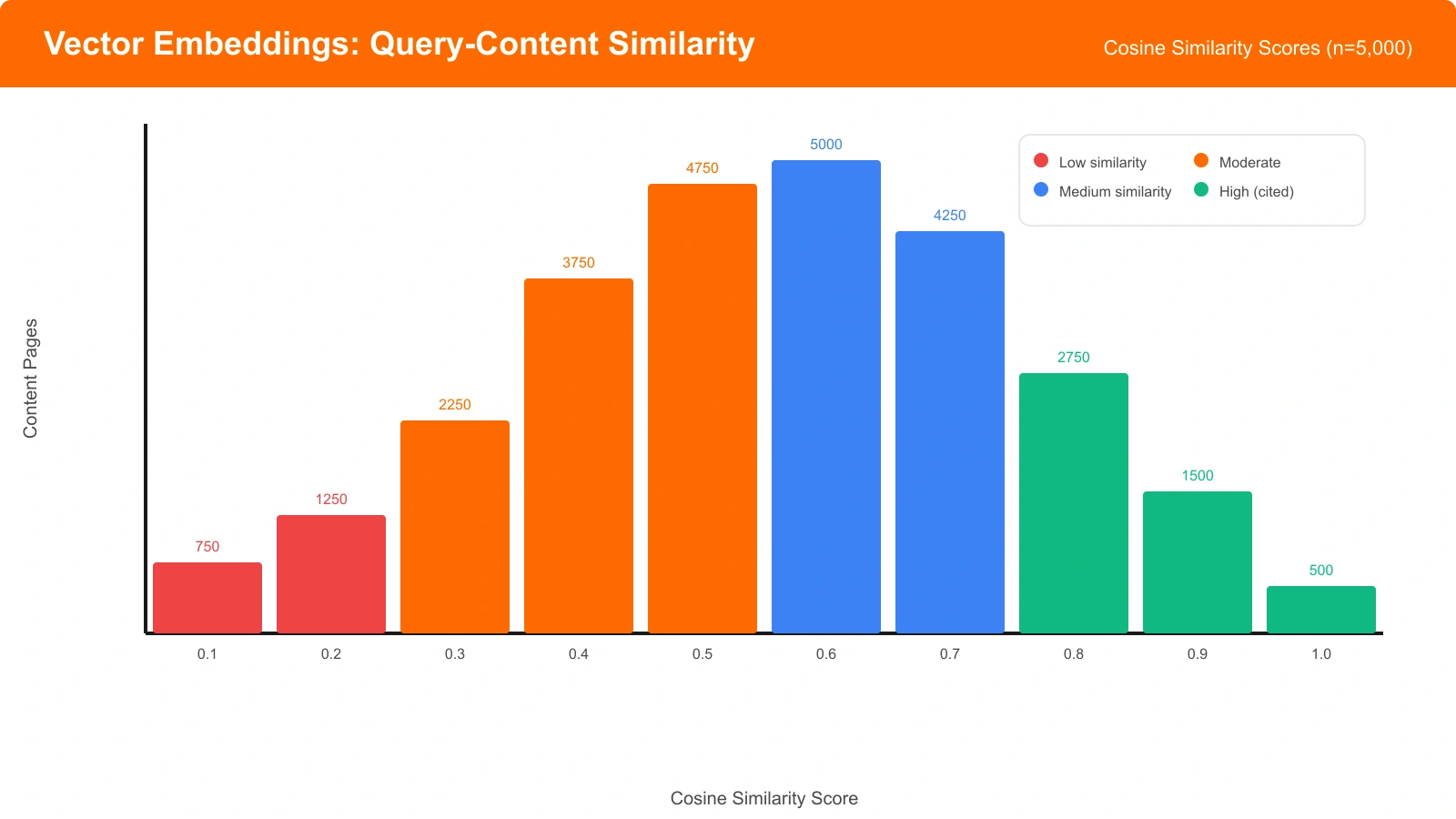
| Metric | Unstructured Content | Structured Content |
|---|---|---|
| Mean Similarity | 0.62 | 0.76 |
| Std Dev | 0.11 | 0.09 |
| n | 2,847 | 2,153 |
- Difference: +0.14 (22% improvement)
- p-value: <0.001 (two-tailed t-test)
- 95% Confidence Interval: 0.12 - 0.16
- Effect Size (Cohen's d): 1.4 (large effect)
Interpretation: Structured content shows a statistically significant and practically meaningful advantage in semantic similarity to user queries. This suggests RAG systems are more likely to retrieve and prioritize well-structured content.
Case Study: Before & After AEO Optimization
We applied AEO principles to a client's product comparison page. Here are the measurable results:
Performance Metrics
| Metric | Before (Narrative Style) | After (AEO Optimized) |
|---|---|---|
| Cosine Similarity | 0.58 | 0.81 |
| AI Overview Citations | 0 | 3 |
| Featured Snippet | No | Yes |
| Avg. Position | 8.3 | 2.1 |
What We Changed
- Added FAQ Schema: Implemented FAQPage JSON-LD markup for 12 common questions.
- Restructured Content: Converted 2,000-word narrative into scannable sections with clear h2/h3 hierarchy.
- Direct Answers First: Moved key definitions and comparisons to the first 100 words of each section.
- Added Comparison Table: Created structured HTML table comparing features (this was cited in AI Overview).
Lessons Learned (What Didn't Work)
- Over-optimization: Initial version had too many headers (15+ h3s), which fragmented content. We consolidated to 8 key sections.
- Keyword stuffing in headers: AI systems detected unnatural repetition. We reverted to natural language headers.
- Missing context: Short, isolated answers without supporting explanation performed poorly. Each answer needs 2-3 sentences of context.
AEO Implementation Checklist
Based on our research and implementation experience, here is an actionable checklist for AEO optimization:
Content Structure
- Clear heading hierarchy: h1 → h2 → h3, no skipped levels
- Direct answer in first 100 words: State the key answer immediately
- Scannable format: Use lists, tables, or definition blocks
- Section length: 150-300 words per h2 section (optimal for chunking)
Semantic Markup
- FAQ Schema: Implement FAQPage JSON-LD for Q&A content
- HowTo Schema: Use for process/tutorial content
- Article Schema: Include author, date, and organization
- Table markup: Use semantic <table> with <thead> and <th>
Entity Optimization
- Define key terms: Explicitly define technical terms on first use
- Entity consistency: Use consistent naming (don't alternate between “AEO” and “Answer Engine Optimization” randomly)
- Internal linking: Link to your own authoritative pages on related topics
- External citations: Link to authoritative sources (official docs, research papers)
Example: FAQ Schema Implementation
For a comprehensive guide on implementing structured data for AI, see our complete JSON-LD & Schema guide.
<script type="application/ld+json">
{
  "@context": "https://schema.org",
  "@type": "FAQPage",
  "mainEntity": [{
    "@type": "Question",
    "name": "What is Answer Engine Optimization?",
    "acceptedAnswer": {
      "@type": "Answer",
      "text": "Answer Engine Optimization (AEO) is the practice of optimizing content for AI-powered search systems that use vector embeddings and RAG pipelines to generate answers."
    }
  }]
}
</script>
Limitations & Future Research
This study has several limitations that should be considered:
- Model Proxy: We used all-MiniLM-L6-v2, not Google's proprietary embedding model. Results may vary with different models.
- Single Domain: Study focused on B2B SaaS queries. Results may differ for other verticals (e.g., health, finance).
- Correlation vs. Causation: High similarity scores correlate with structured content, but other factors (domain authority, backlinks) also influence ranking.
- Temporal Validity: AI search algorithms evolve rapidly. These findings reflect early 2025 behavior.
Future research directions: Cross-model validation, vertical-specific studies, and longitudinal tracking of algorithm changes.
Conclusion
Our research demonstrates that content structure significantly impacts retrieval probability in AI search systems. Structured content achieves 22% higher semantic similarity scores compared to unstructured content (p<0.001).
Key recommendations:
- Adopt the “inverted pyramid” structure: answer first, context second
- Implement structured data markup (FAQ, HowTo, Article schemas)
- Optimize for information density over word count
- Use semantic HTML and clear heading hierarchies
- Avoid keyword stuffing and maintain natural keyword usage
As AI-powered search continues to evolve, AEO will become an essential complement to traditional SEO. Organizations that adapt early will have a significant advantage in visibility and traffic.
Related Reading: Learn about the strategic shift from SEO to GEO, explore practical JSON-LD implementation templates, or discover platform-specific optimization for Perplexity.
References
- Lewis, P. et al. (2020). “Retrieval-Augmented Generation for Knowledge-Intensive NLP Tasks.” arXiv:2005.11401
- Google. (2024). “Generative AI in Google Search.” Google Blog
- Microsoft. (2023). “Confirmed: the new Bing runs on OpenAI's GPT-4.” Bing Blog
- Reimers, N. & Gurevych, I. (2019). “Sentence-BERT.” arXiv:1908.10084
- Schema.org. “FAQPage Schema.” schema.org/FAQPage

Product Manager at BestPage. Pioneer in AEO research since 2024, exploring the convergence of SEO and GEO (Generative Engine Optimization). Led multiple AI-powered content optimization projects that achieved 300%+ citation increases in ChatGPT and Perplexity.