
Editorial comparisons tell shoppers what you think. User-generated content tells them what real owners experience. Both have value, but UGC carries a credibility weight that's hard to manufacture.
The challenge is integrating UGC effectively. Simply dumping reviews onto a comparison page creates noise, not value. But strategic UGC integration—extracting insights, highlighting patterns, surfacing relevant voices—transforms commodity comparison content into something uniquely useful.
This playbook covers how to leverage reviews and other UGC in comparison pages. We'll explore extraction strategies, integration patterns, and quality control approaches that scale.
Types of UGC for Comparisons
Not all user content serves comparison purposes equally. Understanding what you're working with helps you deploy each type effectively.
Product Reviews
The most common UGC type. Reviews range from detailed multi-paragraph assessments to one-line reactions. For comparisons, you're typically looking for reviews that mention specific features, make comparisons themselves, or describe use cases clearly.
Useful review signals for comparison content:
- Mentions of competing products (“switched from X to Y”)
- Specific feature praise or complaints
- Use case descriptions (“as a photographer, I found...”)
- Longevity comments (“after 6 months of use...”)
Q&A Content
Many e-commerce platforms have product Q&A sections. These capture the exact questions shoppers have—often including direct comparison questions like “Is this better than [competitor]?”
Q&A content excels at:
- Surfacing real decision criteria
- Answering specific concerns
- Providing community wisdom on edge cases
User Photos and Media
User-submitted photos show products in real contexts—not the idealized studio shots from official marketing. For comparisons, user media can demonstrate size differences, real-world appearance, and usage scenarios that specs don't capture.
User-Created Comparisons
Some users naturally create comparison content in reviews or forum posts. “I had both the A and B model and here's what I found...” These are gold for comparison pages—genuine comparative assessments from people with actual experience.
Extraction and Processing
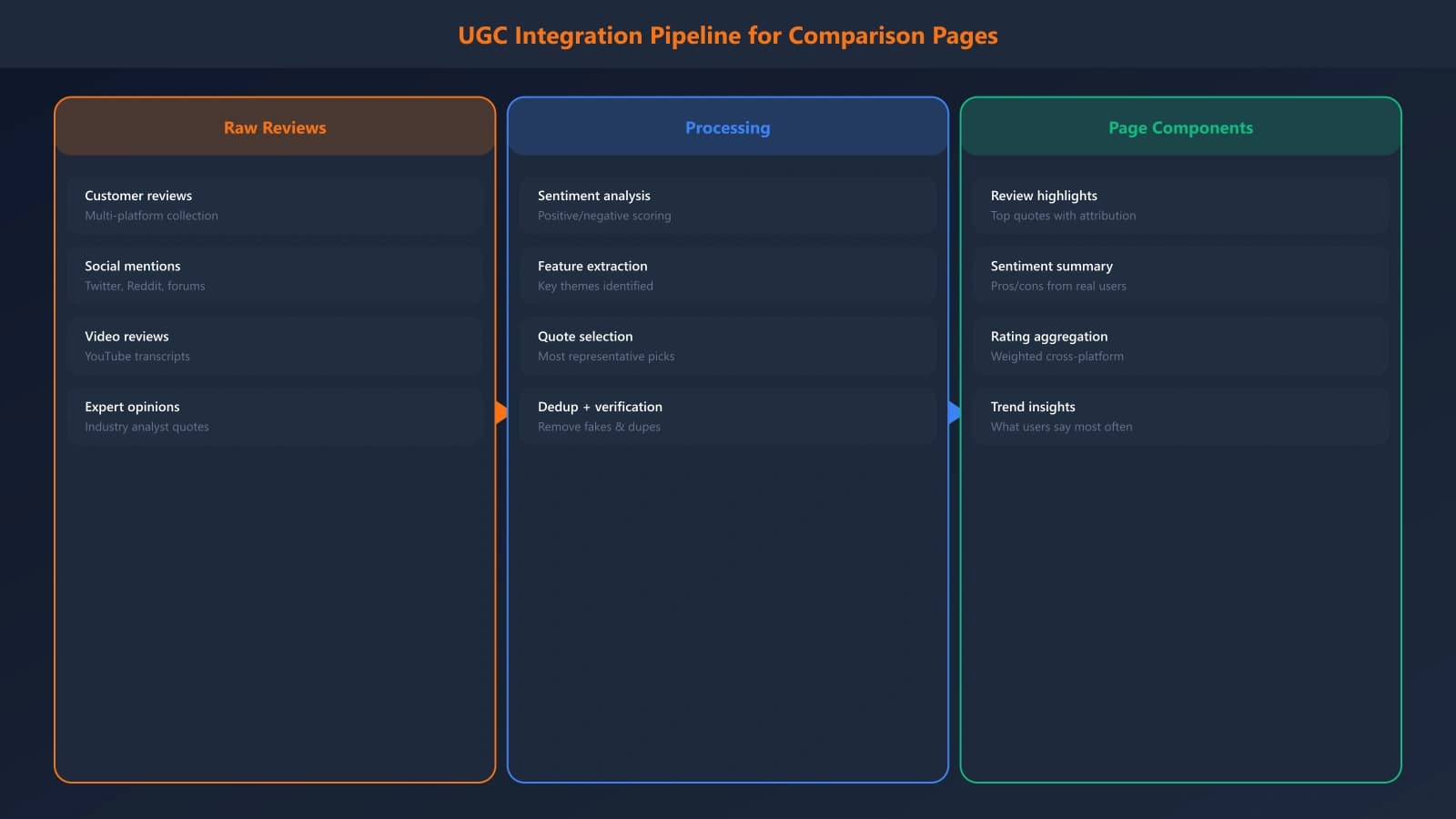
Raw UGC rarely fits directly into comparison templates. Processing transforms reviews into comparison-ready components.
Quote Extraction
Not every review sentence is quotable. Extract quotes that are specific, clear, and relevant to comparison criteria. A good quote is 1-2 sentences that make a concrete point about the product.
Quote extraction criteria:
- Mentions specific features or aspects
- Makes a clear positive or negative assessment
- Provides context (who the reviewer is, how they use the product)
- Is understandable without surrounding text
Avoid quotes that are purely emotional (“I love it!”), too long, or require context to understand.
Sentiment and Theme Analysis
Across hundreds or thousands of reviews, patterns emerge. Sentiment analysis identifies whether feedback is positive, negative, or mixed on specific aspects. Theme analysis groups comments by topic.
| Aspect | Sentiment | Theme Summary |
|---|---|---|
| Battery life | Mostly positive (82%) | “Lasts all day,” “Better than expected” |
| Build quality | Mixed (58%) | “Feels premium” vs “Scratches easily” |
| Software | Negative (41%) | “Buggy updates,” “Needs improvement” |
This aggregated view becomes a “What Users Say” section on comparison pages—summarizing authentic feedback without republishing entire reviews.
Comparative Statement Extraction
Specifically flag reviews that make comparisons. “The camera on this is way better than my old Pixel.” These statements directly support comparison content—real users comparing the exact products you're covering.
Integration Patterns
Once UGC is processed, it needs to enhance—not overwhelm—your comparison pages.
Inline Quote Integration
Place relevant quotes near the comparison criteria they address. If you're discussing battery life, include a user quote about real-world battery experience. This validates your editorial claims with user evidence.
“I was skeptical of the 2-day battery claim, but I routinely go 36 hours between charges with moderate use.” — Verified Buyer, Dec 2025
Always attribute quotes with verification status and timing. Fresh quotes from verified buyers carry more weight than anonymous, undated feedback.
Aggregated Insight Sections
Create dedicated sections that synthesize UGC into insights:
- “What Owners Love” — Top positive themes across reviews
- “Common Complaints” — Honest negative patterns
- “Real-World Comparisons” — Extracted user comparisons
- “Longevity Reports” — Feedback from long-term owners
These sections add significant unique value because they represent your curation and analysis of user data—not just republishing.
Generate Comparisons with UGC Integration
Build listicles that incorporate user reviews and authentic feedback at scale.
Try for Free
Quality and Freshness Control
UGC integration creates ongoing quality considerations that static editorial content doesn't have.
Spam and Fake Review Filtering
Not all reviews are genuine. Before integrating UGC, filter for signals of fake or incentivized reviews: similar phrasing patterns, burst timing, unverified purchases, extreme ratings without substantive content.
For comparison pages, prioritize reviews from verified purchasers with detailed feedback. Brief 5-star reviews with no content add noise, not signal.
Keeping UGC Current
Reviews age. A quote from 2022 about “the new interface” is confusing in 2026 when the interface has changed multiple times. Establish freshness policies:
- Prefer recent reviews (last 6-12 months)
- Update aggregated sentiment data regularly
- Retire quotes that reference outdated versions
- Display dates so users understand timing
Building UGC-Enhanced Comparisons
User-generated content transforms comparison pages from editorial opinion into community-validated guidance. Done well, UGC integration provides:
- Authenticity that builds trust
- Unique content that's hard to replicate
- Fresh signals that support SEO
- Real-world perspectives that specs miss
The key is processing and curation. Raw review dumps don't help anyone. But extracted quotes, aggregated sentiment, and synthesized insights add genuine value to every comparison page.
Start with your existing review data. Identify extraction patterns that work for your product categories. Build templates that incorporate UGC thoughtfully. Then scale the approach across your comparison content.

Product Manager at BestPage. Pioneer in AEO research since 2024, exploring the convergence of SEO and GEO (Generative Engine Optimization). Led multiple AI-powered content optimization projects that achieved 300%+ citation increases in ChatGPT and Perplexity.