

Key Takeaways
- •Methodology builds defensibility: A clear methodology lets readers agree or disagree with your logic rather than dismissing rankings as arbitrary
- •Be specific but concise: Include what matters (criteria, weights, testing approach) without drowning readers in unnecessary detail
- •Acknowledge limitations: Honest disclosure of what you couldn't test or might have missed increases credibility
- •Update when rankings change: Your methodology should explain why rankings shift, not just that they did
Methodology sections transform best-of pages from opinion pieces into defensible analysis. When readers understand how you arrived at your rankings, they can evaluate whether your approach matches their priorities. When search engines see transparent methodology, they recognize expertise signals. The challenge is providing enough detail to be credible without overwhelming readers.
This guide covers what to include in methodology sections, how to structure them for readability, and how to maintain them as your rankings evolve. Whether you're writing a single comparison or building templates for programmatic content, these principles ensure your methodology adds credibility without adding bloat.
Why Methodology Matters#
Methodology sections serve multiple audiences: skeptical readers, potential linkers, and search quality systems. Each finds different value in understanding your approach.
Essential Methodology Elements#
Effective methodology sections answer the questions readers have about your ranking process. Cover these elements to address the most common concerns.
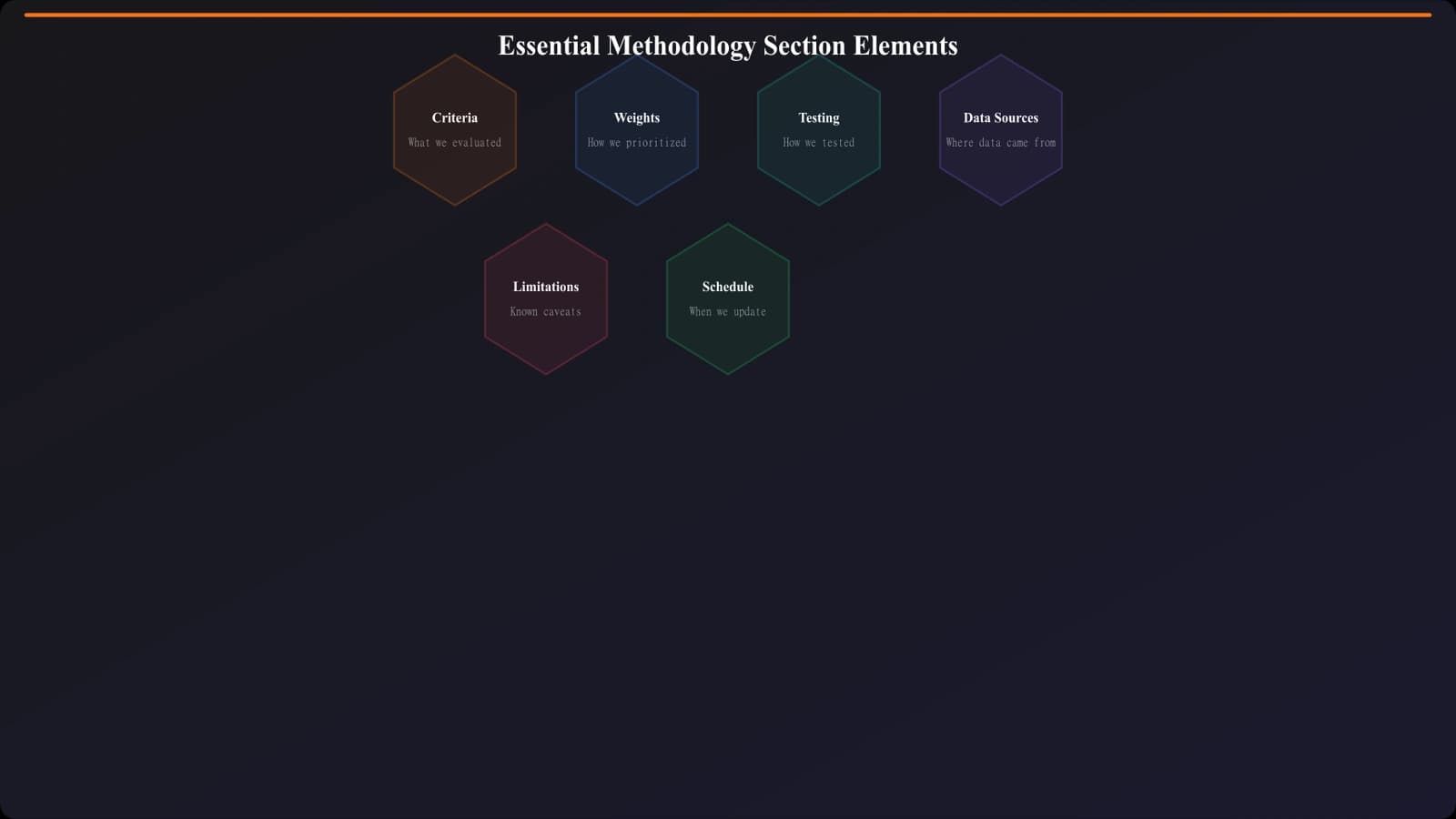
Figure 1: Core elements of a complete methodology section
- 1Evaluation CriteriaWhat factors did you consider? List them explicitly with brief explanations.
- 2Scoring WeightsHow much did each factor matter? Publish percentages or relative importance.
- 3Testing ApproachHow did you evaluate? Hands-on testing, data analysis, expert review?
- 4Data SourcesWhere did information come from? Primary testing, third-party reviews, vendor data?
- 5Scope and LimitationsWhat couldn't you test? What biases might exist?
- 6Update ScheduleWhen do you re-evaluate? What triggers ranking changes?
Structure and Placement#
How you present methodology matters as much as what you include. The section should be accessible without interrupting readers who just want rankings.
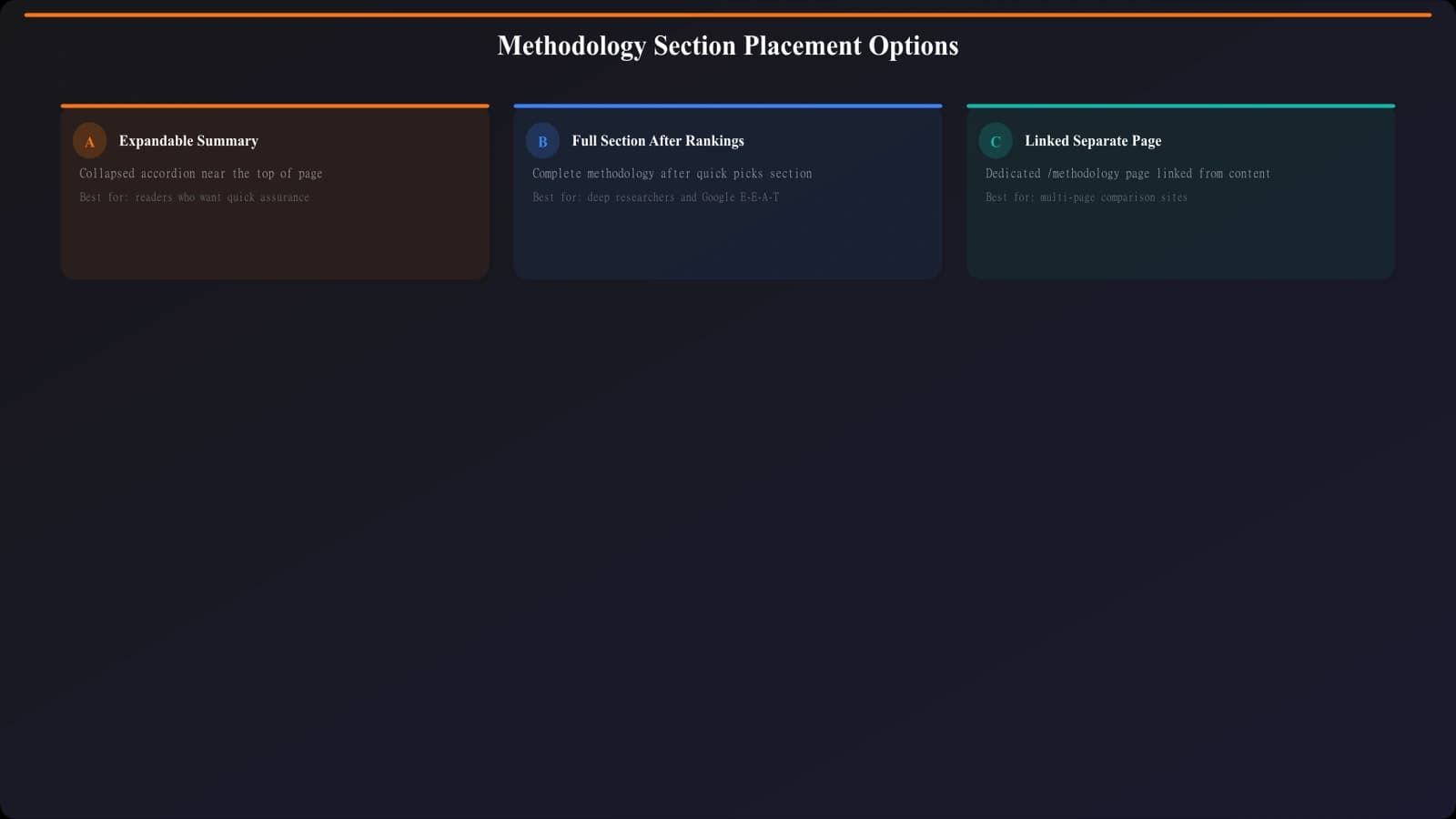
Figure 2: Methodology placement options
| Placement | Best For | Pros | Cons | |
|---|---|---|---|---|
| Collapsible summary | Long comparison pages | Accessible without scrolling | May be overlooked | |
| After rankings | Shorter comparisons | Natural reading flow | Readers may not reach it | |
| Separate linked page | Multiple comparison pages | Reusable, detailed | Extra click required | |
| Sidebar summary | Reference during reading | Always visible | Limited space |
Hybrid Approach
Writing Methodology That Gets Read#
Methodology sections often become unread walls of text. Write for accessibility: short sentences, bullet points, and clear structure help readers actually engage with your approach.
Do
- ✓Use bullet points for criteria lists
- ✓Lead with the most important information
- ✓Include specific numbers (weights, testing hours)
- ✓Acknowledge limitations honestly
Don't
- ✕Write dense paragraphs of justification
- ✕Hide important details in footnotes
- ✕Use jargon readers won't understand
- ✕Overexplain obvious decisions
The goal is clarity, not comprehensiveness. A methodology section that nobody reads provides no value. Prioritize the information readers actually need to trust your rankings.
Methodology Section Template#
Here's a template structure that covers essential elements while remaining readable:
## How We Evaluated

**Testing Period:** January 2025 (re-evaluated quarterly)

### Evaluation Criteria
We scored each tool on five factors:
- **Features** (30%) - Core functionality and capability depth
- **Usability** (25%) - Learning curve and daily workflow efficiency
- **Pricing** (20%) - Value relative to capabilities and competitors
- **Support** (15%) - Response quality and resource availability
- **Integrations** (10%) - Ecosystem compatibility and API quality

### Our Testing Process
- Hands-on testing with paid accounts (Pro/Business tiers)
- Minimum 2-week evaluation period per tool
- Standardized scenarios across all tools
- Third-party review data from G2 and Capterra

### Limitations
- Enterprise tiers evaluated via demos and documentation
- Pricing reflects published rates; enterprise pricing negotiable
- Testing focused on [use case]; other uses may differ

### Updates
Rankings updated quarterly or when major releases occur.
Changelog available at [link].
Maintaining Methodology Over Time#
Methodology isn't set-and-forget. As tools evolve and your evaluation approach matures, your methodology section needs updates too.
- Update testing dates with each re-evaluation
- Note when criteria weights change and why
- Add new criteria as category needs evolve
- Remove or explain dropped tools
- Maintain a changelog for significant methodology changes
- Re-verify third-party data sources periodically
Frequently Asked Questions#
How long should a methodology section be?
200-400 words for most comparisons. Enough to cover essential elements without overwhelming readers. Link to expanded details if needed for complex categories.
Should I explain every scoring decision?
No—explain your criteria and weights, not every individual score. Readers should understand your framework, not need justification for each point.
What if my methodology reveals I couldn't test everything?
Acknowledge it honestly. "We evaluated based on documentation and user reviews" is more credible than pretending you tested features you didn't.
Can I use the same methodology across multiple pages?
Yes—link to a central methodology page and note any category-specific adjustments. This creates consistency and reduces maintenance.
Conclusion#
Methodology sections are investments in credibility. They transform subjective rankings into defensible analysis, signal expertise to search systems, and give readers the context they need to trust your recommendations. The key is balance—enough detail to be transparent, presented clearly enough to actually be read.
- Include essentials: Criteria, weights, testing approach, limitations
- Place strategically: Accessible but not interrupting the main content
- Write for readability: Bullets, short sentences, clear structure
- Maintain actively: Update dates, changelog, evolving criteria
- Be honest: Acknowledged limitations increase trust
Sources & References
- Nielsen Norman Group. Content Credibility and Trust Research (2024)
- BetterEvaluation. Evaluation Methodology Best Practices (2024)

Product Manager at BestPage. Pioneer in AEO research since 2024, exploring the convergence of SEO and GEO (Generative Engine Optimization). Led multiple AI-powered content optimization projects that achieved 300%+ citation increases in ChatGPT and Perplexity.