
Key Takeaways
- •Unique Value: Each page must offer something genuinely useful and unique
- •Quality Data: Programmatic content is only as good as your underlying data
- •QA Rules: Build automated checks to prevent thin or broken pages
- •Gradual Scaling: Start small, validate, then scale—don't publish thousands at once
Introduction: The Promise and Peril of Scale#
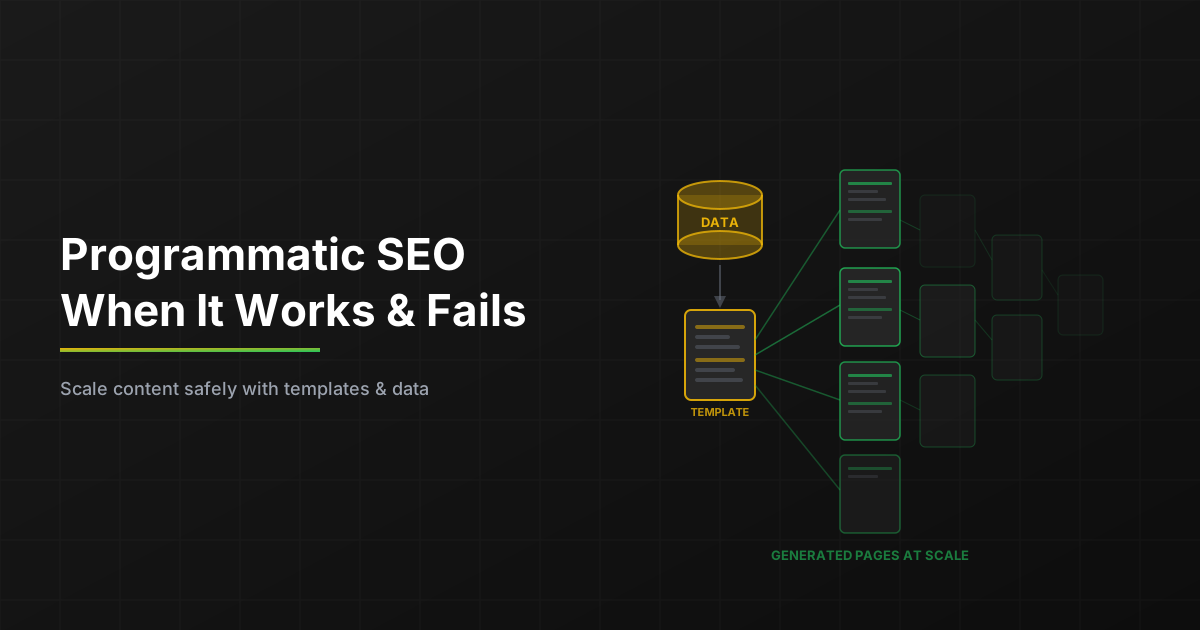
Programmatic SEO is the practice of creating large numbers of pages from templates and databases to target long-tail keywords at scale. When done right, it can capture massive search traffic efficiently. Done wrong, it creates spam that gets penalized.
This guide covers when programmatic SEO works, common failure modes, quality assurance rules, and how to scale safely.
Successful Examples
Zapier's “App A + App B integrations” pages, Nomad List's city pages, and Wise's currency conversion pages are programmatic SEO successes. Each page provides unique, valuable data.
When Programmatic SEO Works#
Programmatic SEO succeeds when each generated page genuinely helps users find unique information they can't get elsewhere.
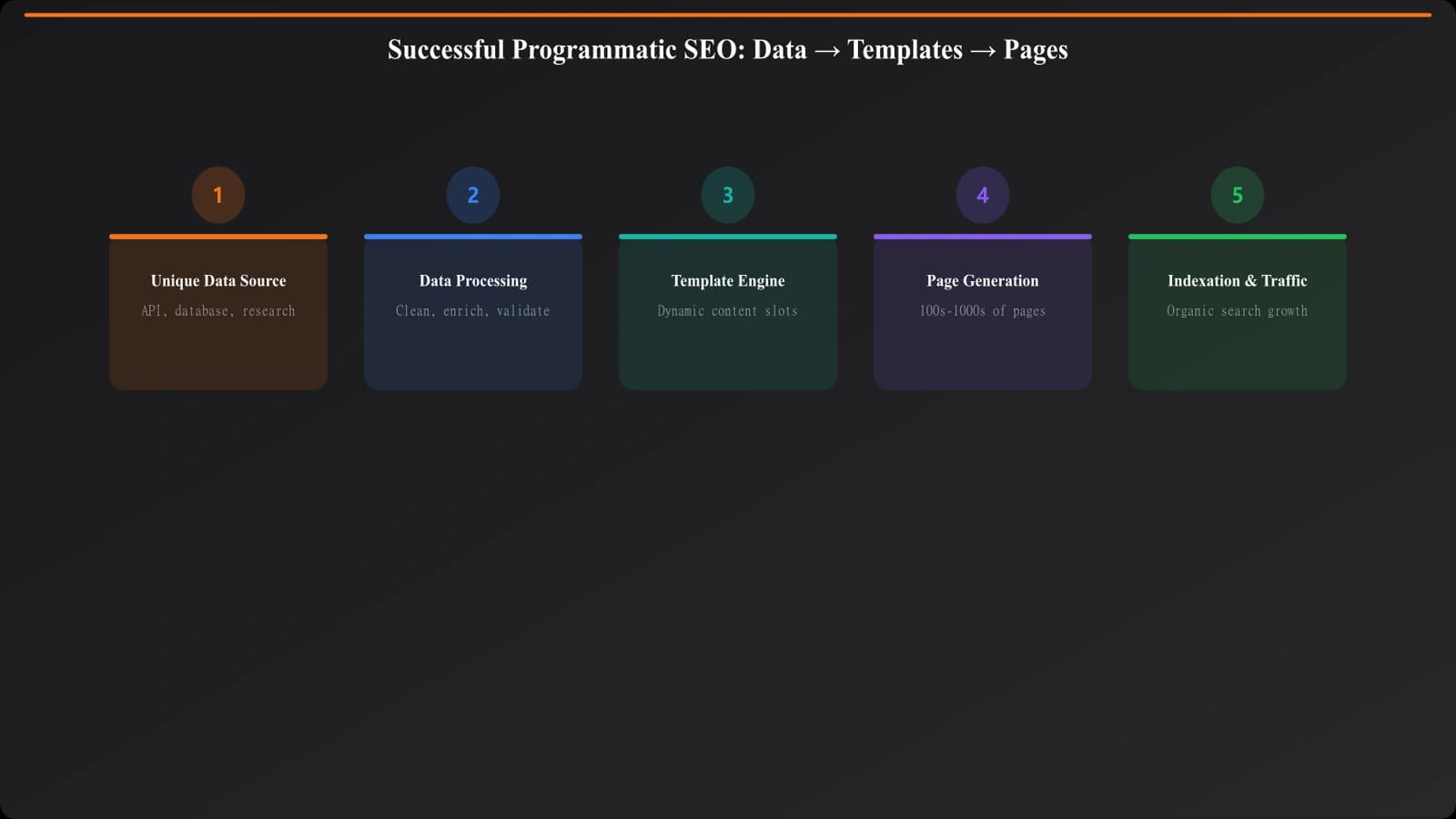
Success Criteria
- 1Unique data per page: Each page contains information specific to that entity (city, product, comparison)
- 2Real search demand: People actually search for these specific long-tail queries
- 3Helpful content: The page answers the query better than alternatives
- 4Quality data source: Data is accurate, complete, and regularly updated
Good Use Cases
Location Pages
- “[Service] in [City]”
- Unique local data required
- Local reviews/testimonials
- Area-specific information
Comparison Pages
- “[Product A] vs [Product B]”
- Actual comparison data
- Feature matrices
- Real differentiators
More Valid Use Cases
- Integration pages: “Connect [App A] to [App B]”
- Glossary/definition pages: Terms with unique explanations
- Stats/data pages: “[Topic] statistics for [Year]”
- Template/example pages: “[Type] template for [Use case]”
When Programmatic SEO Fails#
Most programmatic SEO failures stem from prioritizing scale over quality. Google is increasingly good at detecting and penalizing these patterns.
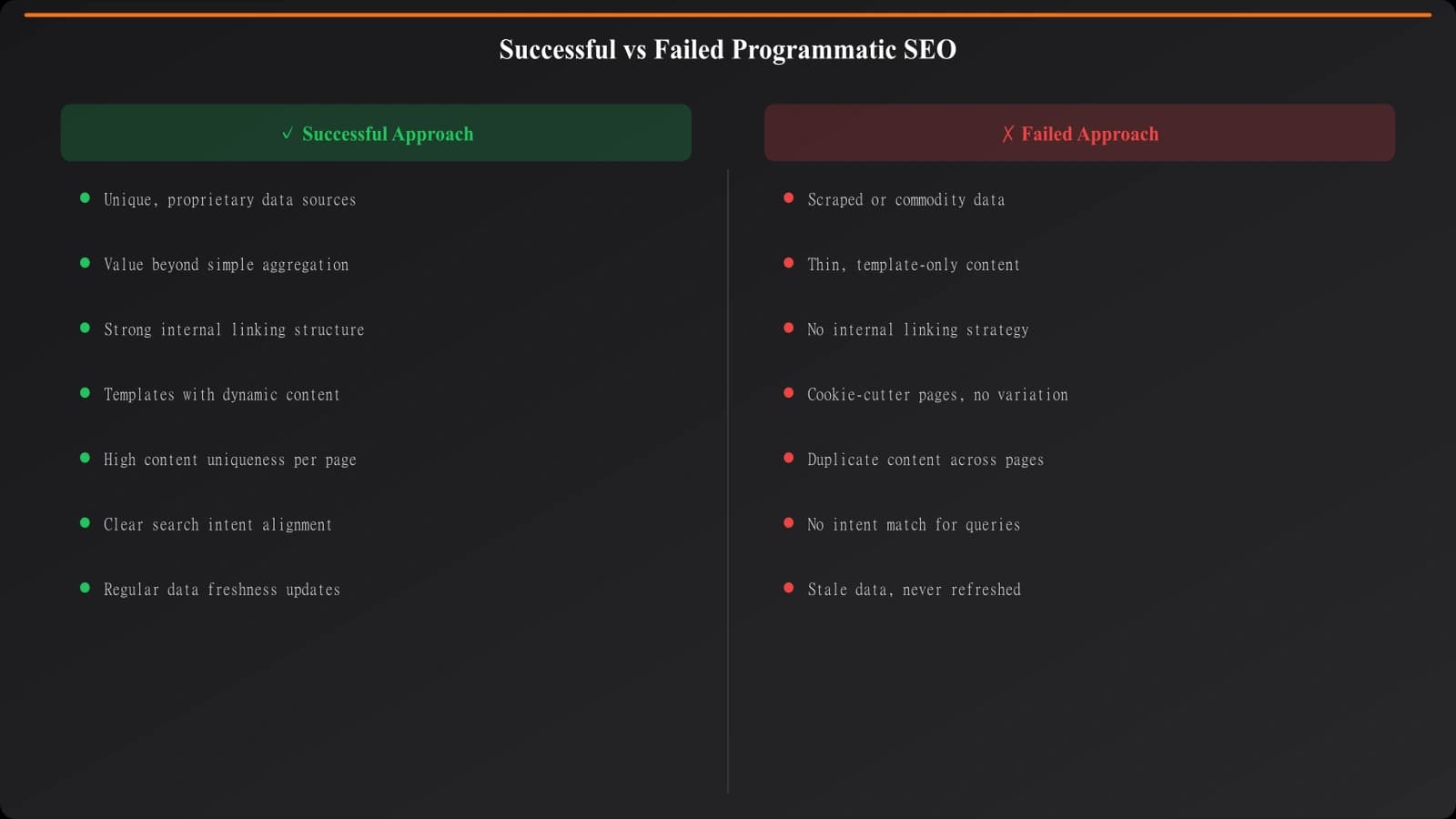
Common Failure Modes
- Thin content: Pages with minimal unique text, mostly template boilerplate
- Duplicate value: Pages that are 90% identical with only a city name swapped
- No search demand: Targeting keywords nobody searches for
- Poor data quality: Missing, outdated, or inaccurate data
- No human value: Pages that technically answer queries but aren't actually helpful
“The question isn't 'Can we generate this page?' It's 'Would a human find this page genuinely useful?'”
Red Flags to Avoid
- Less than 200 words of unique content per page
- More than 70% template text shared across pages
- Data that's publicly available elsewhere (no added value)
- No internal linking strategy for programmatic pages
- Publishing thousands of pages overnight
Quality Assurance Rules#
At scale, you can't manually review every page. Build automated QA checks into your publishing pipeline.
Automated Quality Checks
- 1Minimum content threshold: Block pages with less than X words of unique content
- 2Data completeness: Don't publish if required data fields are empty
- 3Duplicate detection: Flag pages too similar to existing pages
- 4Link validation: Check all internal/external links work
- 5Image validation: Ensure images exist and have alt text
Manual Sampling
Even with automation, manually review a sample:
- Review 5-10% of pages before launch
- Check pages across different data segments
- Test edge cases (minimum data, unusual inputs)
- Get feedback from someone unfamiliar with the project
Scaling Safely#
Don't publish everything at once. Gradual, monitored scaling reduces risk and allows course correction.
Phased Rollout
Phase 1: Pilot (50-100 pages)
- Test template and data
- Monitor indexation
- Check for errors
- Gather initial data
Phase 2: Scale (500-1000 pages)
- Expand if Phase 1 succeeds
- Refine based on learnings
- Monitor rankings/traffic
- Watch for quality signals
What to Monitor
- Indexation rate: What % of pages are being indexed?
- Crawl stats: Is Googlebot crawling these pages?
- Rankings: Are pages appearing for target keywords?
- User signals: Bounce rate, time on page, conversions
- Manual actions: Any messages in Search Console?
When to Stop or Pause
- Less than 50% of pages being indexed after 30 days
- Significant drops in overall site rankings
- Extremely high bounce rates (90%+)
- Any manual action warnings
Conclusion: Scale Responsibly#
Programmatic SEO is a powerful tool when used responsibly. The key is ensuring every generated page provides genuine value that users can't easily find elsewhere.
Start with unique, quality data. Build templates that surface that data helpfully. Implement automated QA checks. Scale gradually while monitoring signals. And always remember: the goal isn't maximum pages—it's maximum helpful pages.
For related methodology guides, see Tool Evaluation Framework for systematic ranking approaches, and Product Testing Methodology for credible review processes.

Product Manager at BestPage. Pioneer in AEO research since 2024, exploring the convergence of SEO and GEO (Generative Engine Optimization). Led multiple AI-powered content optimization projects that achieved 300%+ citation increases in ChatGPT and Perplexity.