
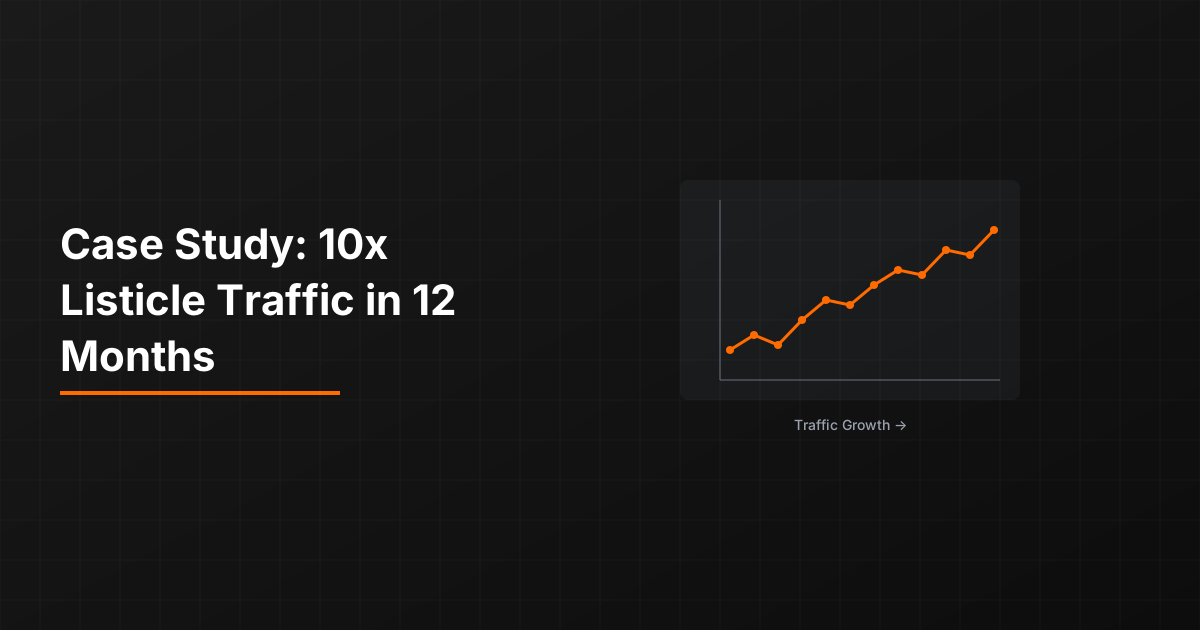
Traffic growth case studies often feel either unreplicable (backed by huge resources) or vague (missing the specific tactics). This case study aims for neither—it documents a real growth journey with specific numbers, actual strategies, and honest discussion of what worked, what didn't, and what we'd do differently.
The subject is a B2B software comparison site that grew from 5,000 monthly organic visitors to over 50,000 in 12 months. The team was small (3 people at peak), the budget was modest, and the approach was systematic rather than spectacular.
This isn't a story of viral content or massive link building campaigns. It's a story of consistent execution on fundamentals: the right content architecture, steady publishing velocity, quality standards, and systematic optimization.
The Starting Point
Understanding where we began contextualizes the growth.
Initial Metrics (Month 0)
| Metric | Starting Value |
|---|---|
| Monthly organic traffic | 5,200 visitors |
| Indexed pages | 47 pages |
| Domain Rating (Ahrefs) | 28 |
| Keywords ranking (top 100) | 312 |
| First-page rankings | 23 |
| Monthly affiliate revenue | $2,400 |
| Team size | 1 FTE |
Initial Challenges
Key problems to solve:
- Thin content: Existing listicles averaged only 1,200 words
- Shallow coverage: Only covering top-level categories
- No content architecture: Pages existed in isolation
- Stale content: Average content age was 14 months
- Weak internal linking: Minimal cross-linking between pages
Opportunity Assessment
Market analysis findings:
• Target category had ~150,000 combined monthly searches
• Top competitors were outdated or generalist sites
• VS queries (Product A vs B) were largely underserved
• Alternative queries had high volume, low competition
• Estimated potential: 80,000+ monthly visitors with full coverage
The Growth Strategy
The systematic approach that drove results.
Content Architecture Strategy
We designed a hub-and-spoke model:
| Content Type | Planned Count | Purpose |
|---|---|---|
| Category hubs | 6 | Main landing pages for category areas |
| Best-of listicles | 48 | Primary commercial intent targets |
| VS comparisons | 120 | High-intent product comparisons |
| Alternative pages | 40 | Capture users leaving competitors |
| Individual reviews | 80 | Deep product coverage, authority building |
| Buyer guides | 20 | Educational content, top-funnel |
Publishing Velocity Plan
Phased ramp-up of content production:
- Months 1-3: 20 pieces/month (foundation building)
- Months 4-6: 35 pieces/month (acceleration)
- Months 7-9: 45 pieces/month (peak production)
- Months 10-12: 40 pieces/month (including updates)
Quality Standards
Non-negotiable quality requirements:
- Minimum depth: 2,500+ words for best-of, 1,500+ for VS pages
- Unique content: No product description reuse between pages
- Fresh data: All pricing verified within 30 days
- Comparison tables: Required on every listicle
- Expert review: Every piece reviewed by category expert
Execution: Month by Month
The actual journey through the year.
Phase 1: Foundation (Months 1-3)
| Month | Content Published | Traffic | Key Actions |
|---|---|---|---|
| 1 | 18 | 5,400 | Core listicles, template development |
| 2 | 22 | 5,900 | First VS pages, internal link structure |
| 3 | 24 | 7,100 | Category hubs launched, first rankings |
Key learnings from Phase 1:
- VS pages ranked faster than expected (less competition)
- Internal linking showed immediate crawl improvements
- Template standardization saved significant time
Phase 2: Acceleration (Months 4-6)
| Month | Content Published | Traffic | Key Actions |
|---|---|---|---|
| 4 | 32 | 9,800 | Second writer hired, VS page focus |
| 5 | 38 | 14,200 | First #1 rankings, alternatives pages launched |
| 6 | 36 | 19,100 | Individual reviews added, update cycle started |
Key learnings from Phase 2:
- Traffic growth accelerated as topical authority built
- Alternatives pages converted better than expected
- Needed to start updates before planned (pricing changes)
Phase 3: Peak Production (Months 7-9)
Months 7-9 results:
Month 7: 45 pieces, 25,400 traffic
Third writer (contractor) added, process fully systematized
Month 8: 48 pieces, 32,600 traffic
Multiple #1 rankings, featured snippets appearing
Month 9: 44 pieces, 38,900 traffic
Content consolidation of thin pages, quality focus
Phase 4: Optimization (Months 10-12)
| Month | Content (New/Updated) | Traffic | Key Actions |
|---|---|---|---|
| 10 | 25/18 | 43,200 | Major update cycle, consolidation |
| 11 | 22/22 | 47,100 | Link building initiative, guest posts |
| 12 | 20/25 | 51,800 | Optimization focus, process documentation |
Accelerate Your Content Growth
Generate comparison content at scale to achieve similar growth trajectories.
Try for Free
Final Results
What the 12-month effort achieved.
Traffic Growth Summary
| Metric | Month 0 | Month 12 | Change |
|---|---|---|---|
| Monthly organic traffic | 5,200 | 51,800 | +896% |
| Indexed pages | 47 | 378 | +704% |
| Domain Rating | 28 | 44 | +57% |
| Keywords (top 100) | 312 | 4,850 | +1455% |
| First-page rankings | 23 | 487 | +2017% |
| #1 rankings | 2 | 67 | +3250% |
Revenue Growth
Traffic translated to revenue:
- Affiliate revenue: $2,400/month → $28,600/month (+1092%)
- Revenue per visitor: $0.46 → $0.55 (+20%)
- Annual revenue run rate: $28,800 → $343,200
- Investment payback: 4.2 months
Content Portfolio
Final content inventory:
• Category hubs: 6 (100% of plan)
• Best-of listicles: 52 (108% of plan)
• VS comparisons: 156 (130% of plan)
• Alternative pages: 48 (120% of plan)
• Individual reviews: 92 (115% of plan)
• Buyer guides: 24 (120% of plan)
Total: 378 pages
Key Tactics That Drove Results
The specific strategies that mattered most.
Content Depth Over Volume
Our listicles averaged 3,200 words vs. competitor average of 1,500:
- More products covered: 10-15 vs. competitor 5-8
- Deeper analysis: Pros/cons, use cases, detailed comparisons
- Original screenshots: Every product had fresh screenshots
- Pricing breakdowns: Tier-by-tier analysis, not just starting price
VS Page Strategy
VS pages became our fastest wins:
| Why VS Pages Worked | Result |
|---|---|
| Lower competition than best-of | Faster rankings (avg. 6 weeks to page 1) |
| Higher intent | Better conversion rates |
| Scalable | N products = N² potential VS pages |
| Cross-linking value | Strengthened main listicles |
Internal Linking System
Systematic internal linking accelerated authority building:
- Hub to spoke: Category pages linked to all related listicles
- Listicle to reviews: Every product entry linked to full review
- VS page integration: Listicles linked to relevant VS pages
- Contextual links: 5-10 internal links per piece
Update Discipline
Update strategy:
• Monthly pricing verification on top 50 pages
• Quarterly comprehensive review on all pages
• Immediate updates when products change
• Clear “Updated [date]” signals
By month 12, we were spending 40% of effort on updates vs. new content.
Mistakes and Lessons Learned
What we'd do differently.
Mistakes We Made
- Started too broad: Early content covered too many categories, diluting focus
- Underestimated updates: Didn't plan update capacity from the start
- Delayed VS pages: Should have started these in month 1, not month 2
- Weak analytics setup: Couldn't track conversion by content type initially
- No video: Competitors with video content ranked better for some terms
What We'd Do Differently
- VS pages first: Start with VS pages while building main listicles
- Updates from day 1: Build update workflow into initial process
- Better attribution: Implement conversion tracking before scaling
- Video integration: Add video component earlier
- Tighter niche: Start with 1-2 categories before expanding
Key Lessons
| Lesson | Takeaway |
|---|---|
| Consistency > bursts | Steady production beats sporadic sprints |
| Depth wins | Comprehensive content outranks thin content |
| Architecture matters | Content structure accelerates authority |
| Updates are content | Plan update capacity from the start |
| Patience required | Months 1-3 showed minimal results, then compounded |
Conclusion: Replicable, Not Easy
This growth is replicable but not easy. It required consistent execution over 12 months, growing the team from 1 to 3, publishing nearly 400 pieces of quality content, and maintaining freshness through systematic updates.
The key insight is that growth was driven by fundamentals, not tricks. Quality content, logical architecture, consistent publishing, and disciplined updates—applied systematically over time—produced compounding results.
The approach works in categories where you can genuinely become the expert, where competitors are vulnerable, and where you're willing to invest the time for results to compound.
For team building, see Team Structure for Comparison Sites. For content architecture, see Content Hub Architecture.

Product Manager at BestPage. Pioneer in AEO research since 2024, exploring the convergence of SEO and GEO (Generative Engine Optimization). Led multiple AI-powered content optimization projects that achieved 300%+ citation increases in ChatGPT and Perplexity.