
Your site has 200 comparison pages. Twenty perform exceptionally well. Fifty perform reasonably. And 130 generate barely any traffic, don't rank, and may be actively hurting your site's perceived quality.
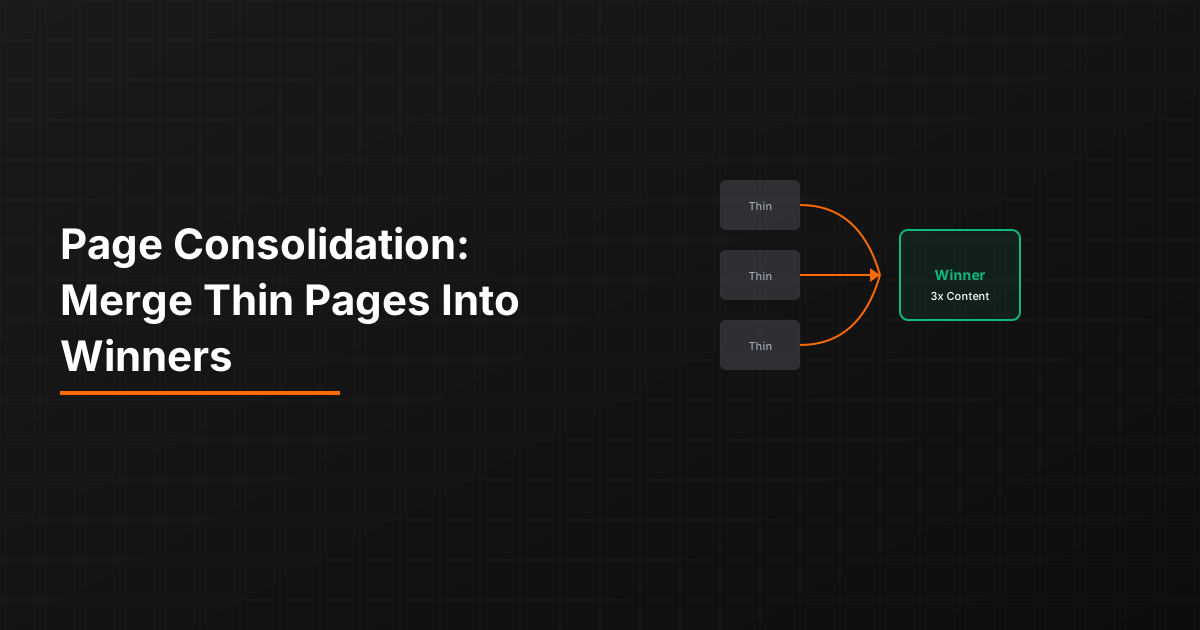
Those 130 pages aren't neutral—they're negative. They dilute topical authority, create potential cannibalization, waste crawl budget, and signal to Google that much of your content isn't worth indexing. Consolidation addresses this by merging weak content into strong content, creating fewer, better pages.
This guide provides a practical framework for comparison page consolidation—identifying candidates, choosing targets, executing mergers, and measuring results.
Why Consolidation Works
Understanding the mechanics behind consolidation benefits.
Consolidation Benefits
| Benefit | How It Works |
|---|---|
| Authority concentration | Link equity from multiple pages flows to one |
| Cannibalization elimination | One strong page instead of competing weak ones |
| Quality signal improvement | Higher average page quality across site |
| Crawl efficiency | Fewer pages to crawl, more budget for important pages |
| User experience | Users find comprehensive content, not scattered pieces |
When Consolidation Makes Sense
Good candidates for consolidation:
- Thin pages: Under 500 words, minimal unique content
- Zero-traffic pages: No organic visits for 6+ months
- Cannibalization: Multiple pages targeting same keyword
- Outdated pages: No longer relevant, not worth updating
- Overlapping content: High similarity between pages
When NOT to Consolidate
Don't consolidate when:
• Pages serve genuinely different intents
• Both pages rank well (they're not cannibalizing)
• Pages target different audience segments
• Natural expansion would solve the problem
• Pages have significant backlinks and traffic
Identifying Consolidation Candidates
Finding pages that should be merged.
Candidate Identification Criteria
| Criterion | Threshold | Data Source |
|---|---|---|
| Organic traffic | <10 sessions/month for 6 months | Google Analytics |
| Word count | <500 words unique content | Site crawl |
| Indexing status | Crawled but not indexed | GSC Coverage |
| Rankings | No keywords in top 50 | Rank tracker |
| Content overlap | >60% similarity with another page | Content comparison tool |
Finding Overlapping Content
Identify pages that should be one page:
- Keyword analysis: Pages targeting the same primary keyword
- GSC query overlap: Same queries driving impressions to multiple pages
- Content similarity: High text overlap between pages
- Topic coverage: Pages covering the same products/categories
- User journey: Pages users would reasonably expect to be one page
Prioritization Matrix
Consolidation priority:
Priority 1 (Immediate):
Thin pages cannibalizing high-traffic pages
Priority 2 (High):
Multiple thin pages that together would make a strong page
Priority 3 (Medium):
Thin pages with some backlinks (preserve equity)
Priority 4 (Low):
Zero-traffic pages with no backlinks (remove or consolidate)
Choosing Consolidation Targets
Deciding which page wins.
Target Selection Criteria
The “winner” page should have:
| Factor | Weight | Why It Matters |
|---|---|---|
| Current traffic | High | Preserve what's working |
| Backlink profile | High | Maintain link equity |
| Rankings | High | Build on existing positions |
| URL structure | Medium | Better URL often preferred |
| Content quality | Medium | Less rewriting needed |
| Age | Low | Older URLs may have more trust |
Common Consolidation Scenarios
- Strong + weak: Merge weak page content into strong page
- Multiple weak: Combine all into new comprehensive page
- Overlapping mid-tier: Choose best performer, merge others in
- Same product, different angles: Consolidate into comprehensive review
When to Create New vs. Merge Into Existing
- Merge into existing: When one page is clearly stronger
- Create new: When all candidates are equally weak and URL rebranding is needed
- Hybrid: Keep best URL, but substantially rewrite content
Build Comprehensive Comparison Pages
Generate thorough comparison content that doesn't need consolidation.
Try for Free
The Consolidation Process
Step-by-step execution guide.
Pre-Consolidation Checklist
| Step | Action | Document |
|---|---|---|
| 1 | List all URLs being consolidated | Source URL list |
| 2 | Identify target/winner URL | Target URL |
| 3 | Document current metrics (traffic, rankings, links) | Baseline metrics |
| 4 | Identify unique content to preserve | Content migration list |
| 5 | List internal links pointing to source pages | Internal link update list |
| 6 | Note backlinks to source pages | Backlink preservation list |
Content Integration Process
- Audit unique content: What does each source page have that the target doesn't?
- Plan integration: Where in the target page should new content go?
- Write, don't paste: Rewrite to integrate naturally, not append
- Enhance overall: Use consolidation as opportunity to improve
- Update metadata: Title/description should reflect expanded scope
Redirect Implementation
Redirect requirements:
• Use 301 redirects (permanent)
• Redirect each source URL to target
• Update internal links to point directly to target
• Remove source URLs from sitemap
• Document all redirects in redirect map
• Test redirects post-implementation
Post-Consolidation Actions
- Submit target URL: Request indexing in GSC
- Monitor redirects: Check they're working correctly
- Track de-indexing: Source URLs should drop from index
- Update internal links: Replace links to source with links to target
- Notify if needed: If significant backlinks, consider outreach
Measuring Consolidation Success
How to know if consolidation worked.
Success Metrics
| Metric | Measurement | Success Indicator |
|---|---|---|
| Target page traffic | Before vs. after (8 weeks) | Increase or maintain |
| Combined traffic | All source + target before vs. target after | Net positive or minimal loss |
| Rankings | Target page keyword positions | Improvement or maintenance |
| Redirect traffic | Traffic flowing through redirects | Confirms redirects working |
| Indexing | Source URLs de-indexed, target indexed | Clean transition |
Expected Timeline
- Week 1: Redirects processed, traffic should start flowing
- Weeks 2-4: Source URLs begin de-indexing, rankings may fluctuate
- Weeks 4-8: Rankings stabilize on target URL
- Week 8+: Full impact measurable
Troubleshooting Issues
If traffic drops significantly:
• Verify redirects are working (not 404s)
• Check target page is indexed
• Ensure target page quality is high
• Review if redirect target was appropriate
If rankings drop:
• Give more time (8 weeks minimum)
• Check for technical issues
• Verify content quality on target
• Consider if consolidation was premature
Common Consolidation Mistakes
Pitfalls to avoid.
Mistakes to Avoid
- Redirecting to homepage: Always redirect to relevant page, not generic
- Losing unique content: Preserve valuable information from source pages
- Mass consolidation: Do in batches of 10-20, not hundreds at once
- Ignoring backlinks: Ensure pages with links are redirected properly
- Not updating internal links: Creates unnecessary redirect chains
- Forgetting sitemap: Remove source URLs from sitemap
- No documentation: Losing track of what was consolidated
When to Reverse Consolidation
Consider reversing if:
- Traffic drops 50%+ after 8 weeks
- Rankings lost with no recovery
- User feedback indicates content loss
- Business needs require separate pages
Reversal requires recreating the source page (possibly with improvements) and implementing appropriate redirects.
Conclusion: Fewer, Better Pages
Consolidation is about quality concentration. By merging weak pages into strong ones, you create a library of comprehensive, authoritative content rather than a collection of scattered fragments. The result is better user experience, stronger rankings, and more efficient use of your domain's authority.
Identify candidates systematically. Choose targets based on performance data. Execute carefully with proper redirects. Monitor results and give time for impact to show. Document everything for future reference.
The goal isn't fewer pages for its own sake—it's better pages that serve users and search engines more effectively.
For identifying underperformers, see Underperforming Listicle Triage. For content decision frameworks, see Content Consolidation Decisions.

Product Manager at BestPage. Pioneer in AEO research since 2024, exploring the convergence of SEO and GEO (Generative Engine Optimization). Led multiple AI-powered content optimization projects that achieved 300%+ citation increases in ChatGPT and Perplexity.