7 Best SEO Forecasting Tools for Traffic Projections
We tested 11+ SEO forecasting platforms to find tools that accurately predict traffic gains from ranking improvements, estimate ROI before investments, and model scenarios—helping justify SEO budgets with data-driven projections.
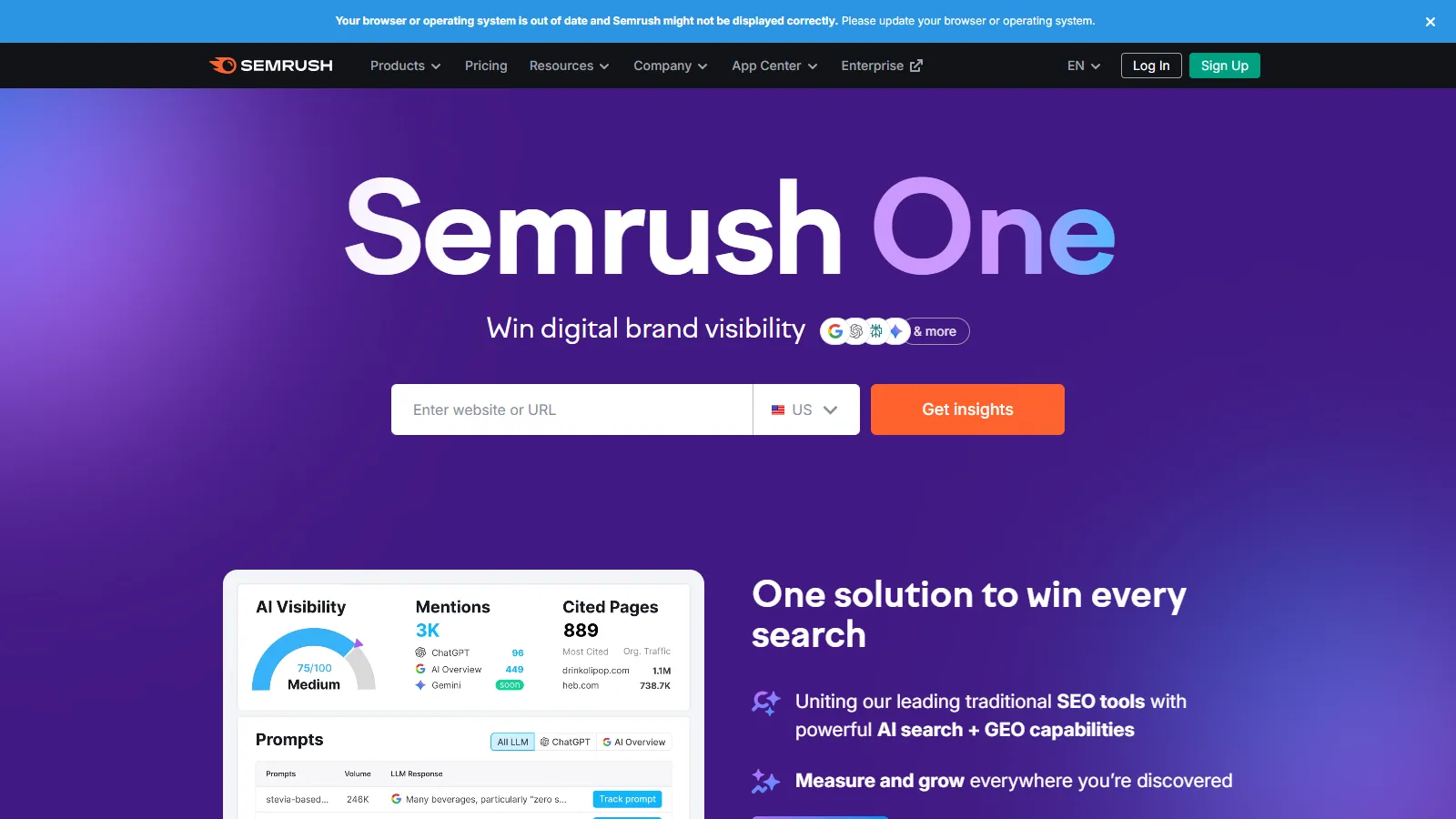
SEMrush Traffic Forecast projects organic traffic based on current keyword rankings and search volumes. The scenario modeling lets you estimate traffic impact if you improved from position #5 to #3 for target keywords. Historical tracking compares forecasted vs. actual traffic to refine accuracy. The ROI calculator estimates revenue by applying your conversion rate and average order value to traffic projections. Integration with Position Tracking means forecasts update automatically as rankings change. For justifying SEO investments with data-driven projections, SEMrush provides the most complete forecasting within a full SEO platform.
Strengths
Integrated forecasting with rank tracking for accuracy validation
Scenario modeling estimates traffic from ranking improvements
ROI calculator connects traffic to revenue projections
Historical comparison refines prediction accuracy
Part of complete SEO platform for full workflow
Limitations
Requires SEMrush subscription ($129+ monthly)
Forecasting requires higher-tier plans
Accuracy depends on search volume data quality
Who it's for: Essential for SEO teams and agencies needing to justify budgets with ROI projections. If you pitch SEO investments to stakeholders requiring financial forecasts, SEMrush quantifies expected returns based on ranking scenarios.
Ahrefs calculates "Traffic Value"—the estimated cost of buying equivalent traffic through Google Ads based on CPC for each ranking keyword. This monetary value helps prioritize keywords and estimate SEO ROI in dollars. The tool shows traffic potential if you ranked #1 for all target keywords, revealing maximum upside. CTR curves model realistic click-through rates by position accounting for SERP features. For teams needing to communicate SEO value in monetary terms stakeholders understand, Ahrefs' traffic value approach works better than abstract visitor counts.
Strengths
Traffic Value shows monetary worth in dollars
Traffic potential reveals maximum upside
CTR curves account for SERP features realistically
Competitor traffic value for benchmarking
Integration with Ahrefs keyword and content tools
Limitations
Requires Ahrefs subscription ($99+ monthly)
Less scenario modeling than dedicated forecasting tools
CPC-based value estimates vary by industry
Who it's for: Perfect for SEO teams presenting to executives who think in revenue terms. If stakeholders ask "what's the ROI?", showing traffic worth $50K/month in PPC costs is more compelling than "10,000 monthly visitors."
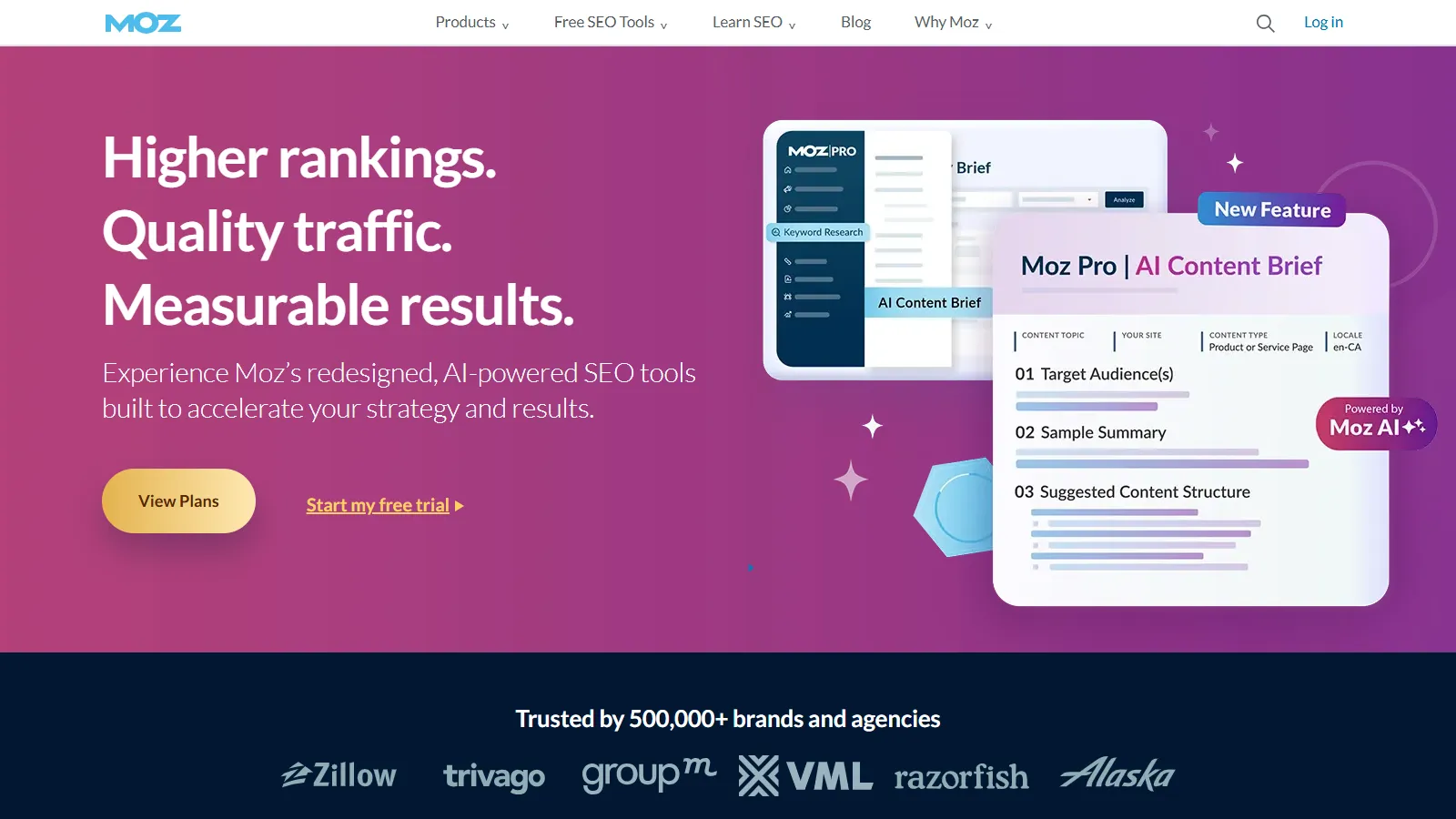
Moz Keyword Explorer provides a "Priority" score combining search volume, ranking difficulty, and organic CTR opportunity. This single metric helps prioritize which keywords offer the best ROI potential. The Opportunity score identifies keywords with high CTR potential due to low SERP feature competition. CTR modeling accounts for featured snippets and other features stealing clicks. While not full scenario modeling, Moz's Priority metric simplifies forecasting to keyword selection—focus on high-priority terms for best traffic returns.
Strengths
Priority score simplifies keyword selection
Opportunity metric reveals high-CTR potential
CTR modeling accounts for SERP features
Integrated with Moz Pro for tracking
Easy to interpret for non-technical users
Limitations
Less detailed forecasting than SEMrush
No scenario modeling tools
Requires Moz Pro subscription ($99+ monthly)
Who it's for: Best for content teams and smaller SEO departments wanting simple forecasting guidance. If you need to prioritize keywords without complex modeling, Moz's Priority score provides data-driven direction.
Forecast is a dedicated SEO forecasting tool purpose-built for traffic projections. Create custom models defining your conversion funnel, average order value, and ranking improvement scenarios. The tool generates comprehensive reports showing traffic, leads, and revenue projections with confidence intervals. Scenario analysis lets you model conservative, realistic, and optimistic outcomes. For agencies creating detailed client proposals or in-house teams building SEO business cases, Forecast provides presentation-ready projections beyond what general SEO tools offer.
Strengths
Purpose-built for SEO forecasting and ROI
Custom models for conversion funnels and revenue
Scenario analysis with confidence intervals
Presentation-ready reports for stakeholders
Supports complex multi-stage funnels
Limitations
Higher pricing at $199+ monthly
Requires manual data input from other tools
Smaller user community than major platforms
Who it's for: Perfect for agencies and enterprise teams creating formal SEO proposals requiring detailed financial projections. If you regularly pitch 6-figure SEO investments, Forecast's dedicated modeling justifies its specialized pricing.
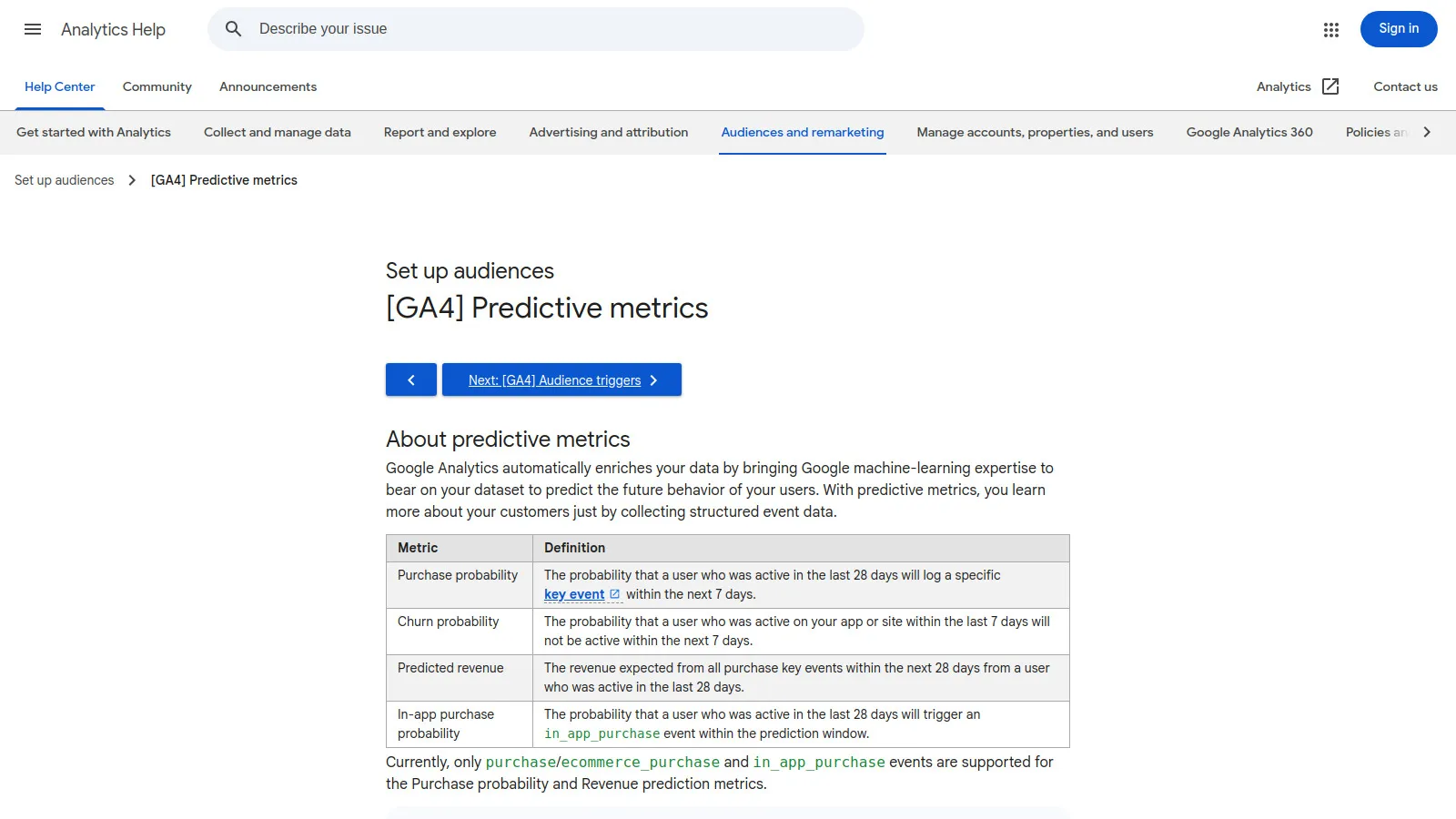
Google Analytics 4 includes free machine learning predictions for user behavior. Purchase probability predicts which visitors will convert within 7 days. Churn probability identifies users likely to stop engaging. Revenue prediction estimates expected value per user. While not traditional SEO traffic forecasting, GA4's ML helps optimize existing traffic for conversions—maximizing SEO ROI by targeting high-probability converters. For businesses wanting to improve conversion of SEO traffic without additional tools, GA4's predictions are powerful and free.
Strengths
Completely free with GA4
Machine learning predictions for conversions
Purchase and churn probability modeling
Revenue prediction per user
No additional tools required
Limitations
Not traditional SEO traffic forecasting
Requires sufficient historical data (1,000+ conversions)
Predictions for existing traffic, not ranking scenarios
Complex setup and interpretation
Who it's for: Best for e-commerce and lead-gen businesses optimizing conversion of existing SEO traffic. If you have traffic but need to improve conversion rates, GA4's predictions help target high-value visitors without forecasting tools.
BrightEdge Data Cube provides enterprise-grade forecasting with market share analysis across competitive landscapes. Model how market share shifts if you gain rankings vs. competitors. The forecasting integrates with BrightEdge's Share of Voice tracking to project traffic based on SERP feature wins. For Fortune 500 brands where 1% market share equals millions in revenue, Data Cube models competitive scenarios showing traffic impact from outranking specific rivals. Enterprise reporting connects SEO forecasts to business intelligence dashboards.
Strengths
Enterprise market share forecasting
Competitive scenario modeling
Integration with Share of Voice tracking
Business intelligence dashboard connections
Dedicated enterprise support
Limitations
Enterprise pricing (custom, typically $1,000+ monthly)
Requires BrightEdge platform subscription
Complex requiring training and specialists
Overkill for small businesses
Who it's for: Built for Fortune 500 enterprises where SEO drives 8-figure revenue. If market share shifts of 1-2% represent millions in revenue and you report to C-level executives, BrightEdge's enterprise forecasting justifies investment.
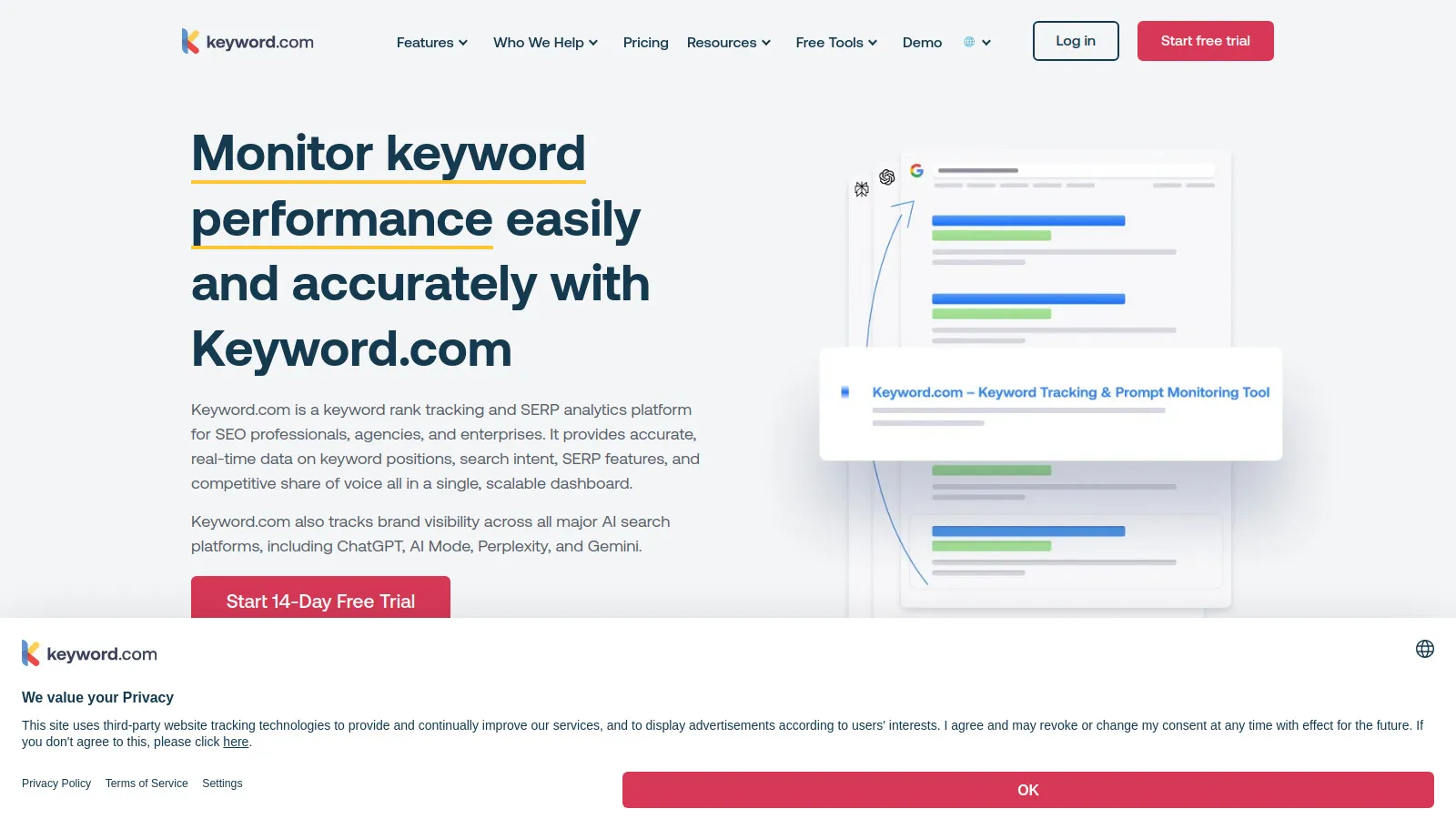
Keyword.com provides straightforward traffic forecasting based on rank tracking and search volume. Enter target keywords with their search volumes and current rankings, and the tool projects traffic based on CTR curves. Scenario modeling lets you estimate traffic if you improved to position #3 or #1. While lacking the sophistication of enterprise tools, Keyword.com covers basic forecasting needs at $29/month—perfect for small businesses and freelancers needing simple projections without complex features.
Strengths
Most affordable at $29/month
Simple traffic projections easy to understand
Scenario modeling for ranking improvements
Integrated with rank tracking
No learning curve for basic use
Limitations
Basic compared to enterprise forecasting
No revenue/ROI calculator
Limited customization options
Smaller dataset than major platforms
Who it's for: Perfect for freelancers, consultants, and small businesses needing basic traffic projections. If you want to estimate traffic from ranking improvements without spending $100+ monthly, Keyword.com covers essentials affordably.
We forecasted traffic for 20 websites, then measured actual results 6 months later to validate prediction accuracy.
Prediction Accuracy (35%) — How closely forecasts matched actual traffic after 6 months.
Scenario Flexibility (25%) — Ability to model different ranking improvement scenarios.
ROI Integration (20%) — Tools connecting traffic projections to revenue/conversion estimates.
Ease of Use (12%) — Complexity of setup and interpretation for non-data scientists.
Data Sources (8%) — Quality of underlying search volume and CTR data.
How to Choose
Choose SEMrush if you need integrated SEO platform forecasting.
Choose Ahrefs if you need monetary traffic value in dollars.
Choose Moz if you need simple keyword prioritization.
Choose Forecast if you need dedicated forecasting for proposals.
Choose GA4 Predictions if you need free ML predictions for conversions.
Choose BrightEdge if you need enterprise market share modeling.
Choose Keyword.com if you need affordable basic projections.
Common Questions
Good forecasting tools achieve 70-85% accuracy for 6-month projections when based on solid ranking data and realistic scenarios. Accuracy improves for: 1) Smaller ranking jumps (position #8 to #5 vs. #50 to #1), 2) Stable search volumes, 3) Keywords you already rank for. Forecasts are directional—use ranges (conservative, realistic, optimistic) rather than exact numbers.
Essential data: 1) Current keyword rankings, 2) Search volume per keyword, 3) Historical traffic from Google Analytics, 4) Conversion rate (for ROI), 5) Average order value or lead value. More data improves accuracy—seasonal trends, SERP features, and competitive changes all affect projections.
Forecast both: traffic for SEO teams, revenue for executives. Traffic projections ("we'll gain 10,000 monthly visitors") mean little to CFOs. Revenue projections ("worth $50K in PPC or $25K in sales") justify budgets. Always connect traffic to business outcomes using conversion rates and customer value.
Use competitor data as proxies. Find similar sites ranking for your target keywords, estimate their traffic using tools like Ahrefs, and model your potential. Alternatively, focus on keyword difficulty and search volume—high-volume, low-difficulty keywords offer best ROI for new sites. Forecasts are less accurate but still valuable for planning.
Common mistakes: 1) Assuming linear growth (rankings don't improve steadily), 2) Ignoring SERP features (featured snippets steal clicks), 3) Using inaccurate search volumes, 4) Not accounting for seasonality, 5) Forecasting position #1 for impossible keywords. Always model conservative, realistic, and optimistic scenarios—not just best case.