
You've probably noticed that some listicles seem to get cited by AI systems over and over, while others—even well-written ones—get completely ignored. The difference often comes down to how clearly your content communicates entity relationships. When AI systems can easily identify what you're talking about and how different items relate to each other, they're far more likely to pull your content into their answers.
In our comprehensive guide on how listicles get cited by AI, we covered the broader framework for AI citations. This article dives deeper into one critical aspect: the entity signals that make your rankings machine-readable. Think of it as the difference between writing for humans alone versus writing content that both humans and machines can parse with confidence.
These five signals aren't complicated to implement, but they do require intentional structure. Most best-of pages fail at entity recognition not because the information is missing, but because it's presented in ways that AI systems struggle to extract reliably.
What Are Entity Signals and Why Do They Matter?
In the context of AI and search, an entity is any clearly identifiable thing—a product, company, person, concept, or category. When Google's Knowledge Graph identifies “Notion” as a specific software product made by Notion Labs, that's entity recognition at work. AI systems rely on entity recognition to understand what your content is actually about.
Entity signals are the structural elements in your content that help AI systems identify and categorize these entities. Strong entity signals tell the AI: “This is definitely Salesforce the CRM, not just a generic mention of sales forces.” They also communicate relationships: “Salesforce is being compared to HubSpot in the context of CRM tools for small businesses.”
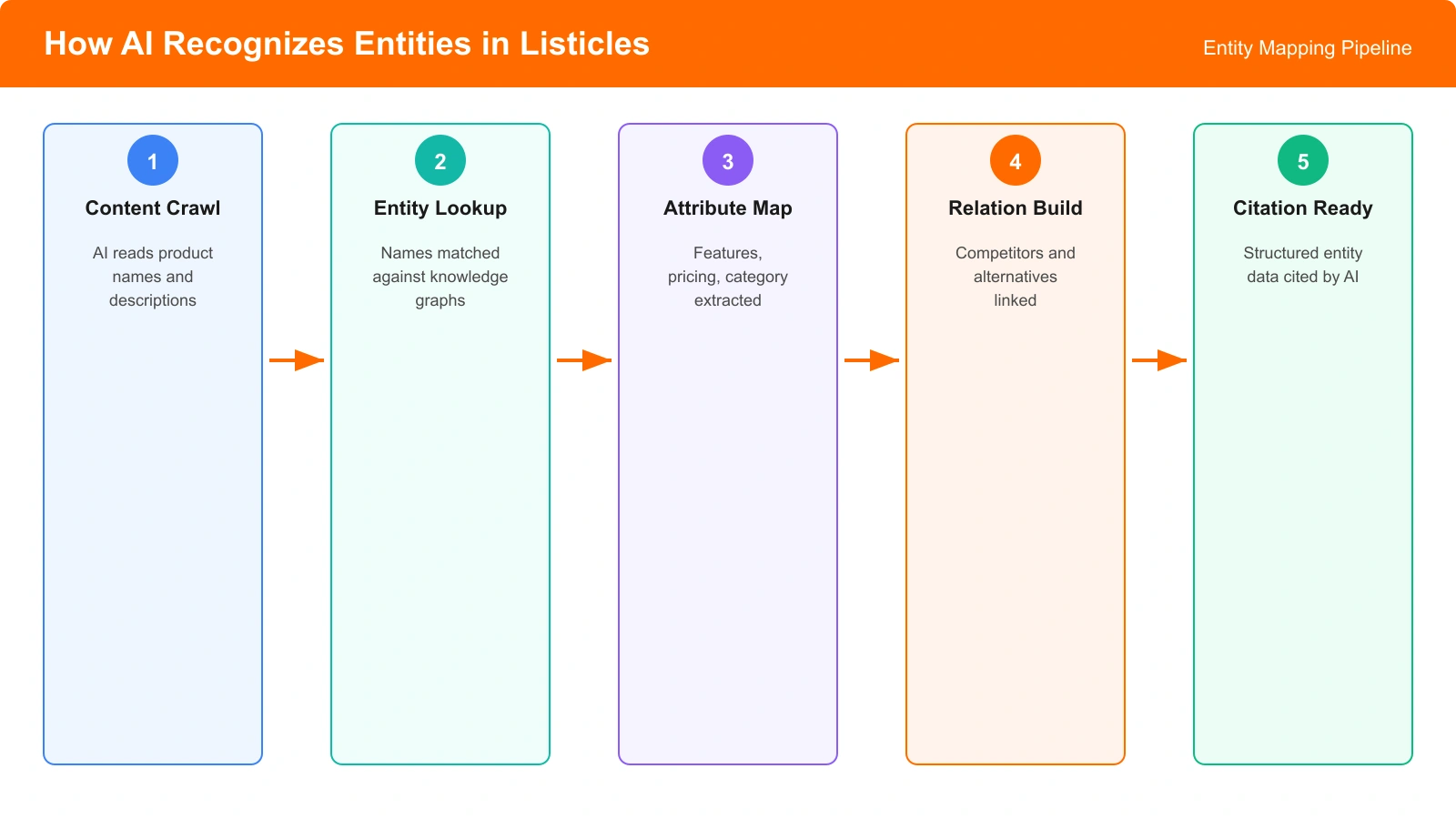
Why does this matter for citations? When an AI is generating an answer to “What's the best project management tool for remote teams?” it needs to find content that clearly identifies project management tools as entities and provides explicit recommendations for remote teams. If your listicle uses vague language or inconsistent naming, the AI can't reliably extract what it needs—so it moves on to a source that's easier to parse.
The 5 Entity Signals Framework
Based on analyzing hundreds of cited and non-cited listicles, we've identified five entity signals that consistently appear in pages that AI systems cite. Let's break down each one with practical implementation guidance.
Signal 1: Canonical Naming
The most fundamental signal is using the canonical (official) name for each entity in your listicle. This sounds obvious, but many pages get it wrong by using abbreviations, nicknames, or inconsistent variations.
| Weak Naming | Strong Canonical Naming |
|---|---|
| “SFDC” or “Salesforce platform” | “Salesforce” (consistent throughout) |
| “MS Project” or “Microsoft's project tool” | “Microsoft Project” |
| “The Monday tool” or “monday” | “Monday.com” |
The rule is simple: use the exact product name as it appears on the company's website, and use it consistently throughout your article. Don't switch between variations for stylistic reasons—consistency helps AI systems build confidence in entity identification.
Signal 2: Explicit Relationship Declarations
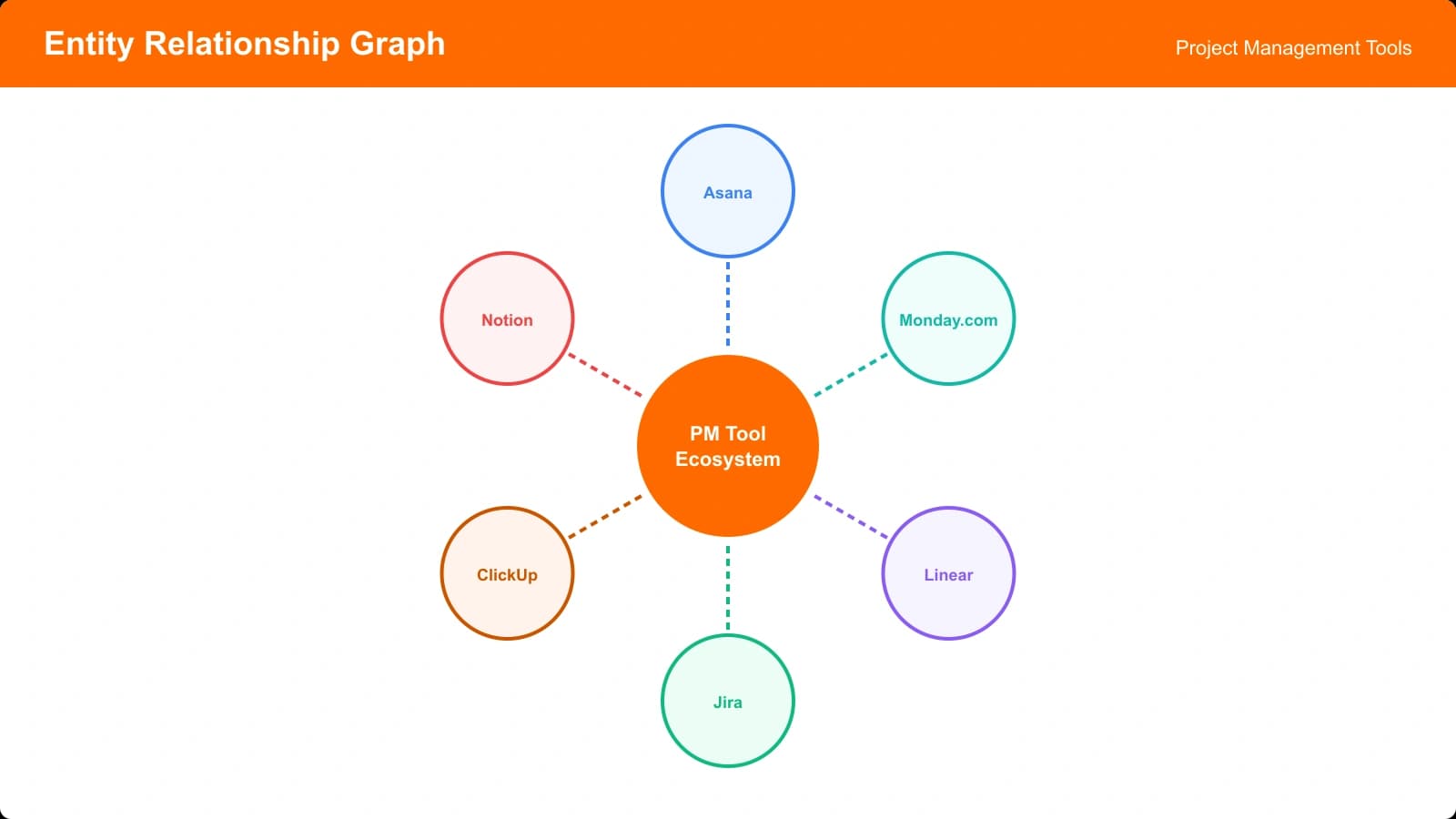
AI systems don't just need to know what entities you're discussing—they need to understand how those entities relate to each other and to the broader category. Explicit relationship language makes these connections clear.
Instead of just listing tools, explicitly state their relationships:
- “Notion is a direct competitor to Coda in the all-in-one workspace category”
- “Asana focuses on project management, while Monday.com expands into work OS functionality”
- “For teams already using Slack, Asana offers native integration that reduces context switching”
This comparative language creates a relationship graph that AI systems can use when synthesizing answers. When someone asks “Is Notion or Coda better for documentation?” your explicit comparison gives the AI exactly what it needs.
Signal 3: Categorical Positioning
Each entity in your listicle should be placed within a clear categorical hierarchy. This helps AI systems understand not just what the product is, but what type of product it is and who it's for.
Strong categorical positioning includes:
- Product category: “Notion is an all-in-one workspace tool”
- Market segment: “Best for startups and small teams”
- Use case: “Ideal for knowledge management and documentation”
- Price tier: “Falls in the mid-range pricing tier”
The key is being specific. “Best for small businesses” is less useful than “Best for marketing agencies with 5-20 employees.” The more precise your positioning, the more queries your content can match.
Signal 4: Attribute Consistency
When you describe multiple entities, use consistent attributes across all of them. This creates a structured comparison that AI systems can reliably parse.
Build Best-Of Pages in Minutes
Create professional listicles with built-in entity optimization. No templates needed.
Try for Free
If you mention pricing for one tool, mention it for all. If you describe the learning curve for Asana, describe it for Monday.com too. Inconsistent attributes make comparison extraction unreliable.
| Tool | Starting Price | Best For | Learning Curve |
|---|---|---|---|
| Notion | Free / $10/user/mo | All-in-one workspaces | Moderate |
| Asana | Free / $13.49/user/mo | Project management | Low |
| Monday.com | Free / $12/user/mo | Visual workflows | Low |
Notice how every row has the same columns filled in. This consistency allows AI systems to extract and compare attributes programmatically.
Signal 5: Schema Markup Reinforcement
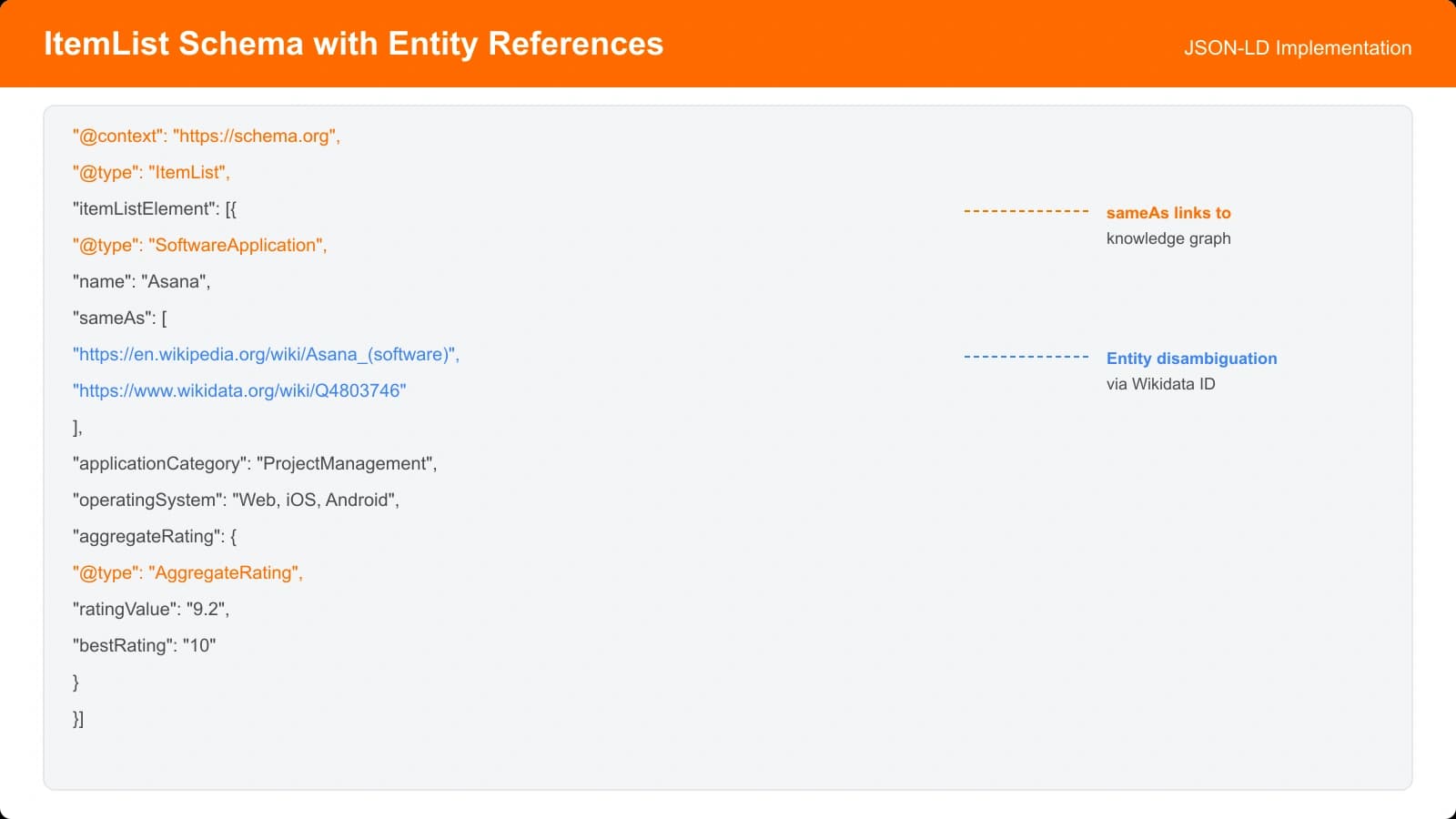
Finally, structured data markup provides an explicit, machine-readable layer that reinforces all your other entity signals. While schema markup for rankings deserves its own deep dive, the key for entity signals is ensuring your schema accurately reflects your content.
For entity-optimized listicles, implement:
- ItemList schema for your ranked items
- Product or SoftwareApplication schema for each tool
- sameAs properties linking to official websites and Wikipedia entries
- Aggregate ratings if you provide scores
Implementing Entity Signals: Step-by-Step
Now that you understand the five signals, let's walk through a practical implementation process you can apply to any best-of page.
Step 1: Audit Your Entity References
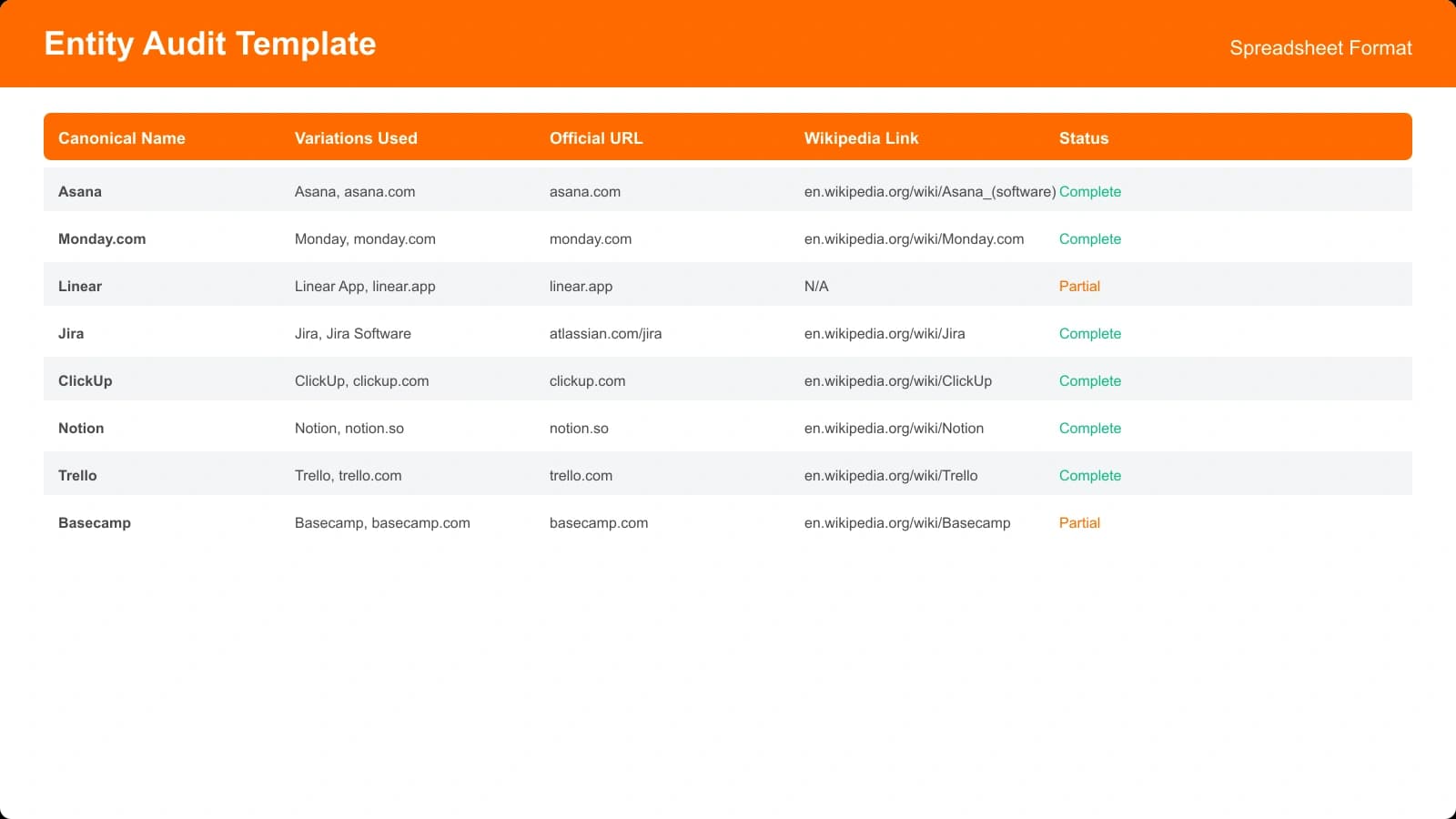
Start by creating a spreadsheet of every entity mentioned in your listicle. For each one, document:
- The canonical name (from the official website)
- Any variations you've used in the content
- The official website URL
- Wikipedia or Wikidata entry (if available)
Then normalize your content to use only the canonical names. This often reveals surprising inconsistencies—you might have called the same tool three different names without realizing it.
Step 2: Add Explicit Relationship Language
Review each listing in your article and add explicit relationship statements. Ask yourself:
- How does this tool compare to others in the list?
- What makes it different from similar options?
- What other tools does it integrate or compete with?
Add at least one comparative statement per listing. Use relationship verbs like “competes with,” “integrates with,” “is an alternative to,” “differs from,” or “builds on.”
Step 3: Standardize Your Listing Structure
Create a template for each listing that ensures consistent attributes. Every tool in your list should follow the same format:
- Name + positioning label: “Notion — Best for All-in-One Workspaces”
- One-sentence value proposition
- Key strengths (3-5 bullets)
- Limitations (2-3 bullets)
- Best for statement with specific audience
- Pricing summary
Step 4: Implement Supporting Schema
Add ItemList schema at minimum, with nested Product or SoftwareApplication schema for each entity. Include sameAs references to official sites. Test with Google's Rich Results Test to verify implementation.
Common Entity Mistakes to Avoid
Even well-intentioned optimization efforts can backfire. Here are the entity-related mistakes we see most often:
Mistake 1: Overloading with Entity Variations
Some content creators try to target multiple search variations by using different names for the same product. This actually hurts entity recognition—stick to one canonical name and let search engines handle the synonyms.
Mistake 2: Vague Category Language
Calling something “a great tool for teams” provides no categorical signal. Be specific: “a project management platform designed for software development teams.”
Mistake 3: Inconsistent Comparison Depth
Providing detailed analysis for some tools and cursory mentions for others creates uneven entity signals. AI systems may only be able to extract reliable information about the detailed tools, ignoring the rest.
Mistake 4: Missing Disambiguation Signals
For products with common names, you need explicit disambiguation. “Harvest” could be a time-tracking tool, a game, or a farming term. Adding context like “Harvest, the time tracking and invoicing software” prevents confusion.
How to Measure Entity Signal Success
Unlike traditional SEO metrics, entity signal success is harder to measure directly. But there are proxy indicators that suggest your entity optimization is working:
Featured Snippet Capture
Strong entity signals often lead to featured snippet placement for specific queries. Track whether your pages capture featured snippets for entity-specific queries like “[Product] vs [Competitor]” or “[Product] for [use case].”
Knowledge Panel Associations
Check whether Google's Knowledge Panel for products you review ever references or links to your content. This suggests Google has associated your page with those entities.
AI Citation Monitoring
Manually check AI Overviews for your target queries. When your page gets cited, note what information was extracted. Strong entity signals typically result in accurate extraction of your recommendations.
Schema Validation Reports
Use Google Search Console's enhancements report to monitor schema performance. Errors or warnings may indicate entity signal problems that need fixing.
Putting Entity Signals Into Practice
Entity signals are the foundation of AI-citable content. When you implement canonical naming, explicit relationships, categorical positioning, attribute consistency, and schema reinforcement, you're making your expertise machine-readable without sacrificing quality for human readers.
The investment is relatively small—an extra hour or two per article—but the impact compounds over time. As AI systems become the default interface for information discovery, pages with strong entity signals will capture an increasing share of visibility.
Start by auditing your highest-traffic listicles. Identify the entity signal gaps. Implement fixes methodically. Then watch your citation rates improve as AI systems learn they can rely on your content for accurate, extractable information.
Related Reading: For the complete framework on AI citations, see our pillar guide on how listicles get cited by AI. You might also find our guide on schema markup for best-of rankings helpful for implementing Signal 5 in detail.

Product Manager at BestPage. Pioneer in AEO research since 2024, exploring the convergence of SEO and GEO (Generative Engine Optimization). Led multiple AI-powered content optimization projects that achieved 300%+ citation increases in ChatGPT and Perplexity.