
Picture this: you've spent weeks crafting the perfect “Best CRM Tools for Agencies” listicle. Your rankings are solid, your descriptions are detailed, and you're pretty confident it's the most comprehensive resource out there. Then you check Google's AI Overview for that query—and someone else's list is being cited instead. Sound familiar?
Here's the thing about listicles and AI citations: the rules have fundamentally changed. It's no longer just about having good content or even ranking well in traditional search. AI systems like Google's SGE, Perplexity, and ChatGPT with browsing have their own criteria for what makes a source “citable”—and most best-of pages don't meet them.
We've spent the last six months analyzing which listicles actually get cited in AI-generated answers. The patterns we found were surprisingly consistent. And honestly? Most of them have nothing to do with traditional SEO metrics like backlinks or domain authority. They're about structure, clarity, and something we call “machine-readable expertise.”
Why Most Listicles Never Get Cited
Let's start with an uncomfortable truth: the vast majority of best-of pages are essentially invisible to AI systems. They might rank on page one for their target keywords, pull in decent organic traffic, and even convert visitors into customers. But when someone asks an AI assistant “What's the best project management tool for remote teams?”—these pages get passed over entirely.
Why does this happen? It comes down to how AI systems process and evaluate content. Unlike traditional search engines that rely heavily on link signals and keyword matching, AI models are trying to understand and synthesize information. They're looking for content that's easy to parse, clearly structured, and—this is the key part—explicitly states its reasoning.
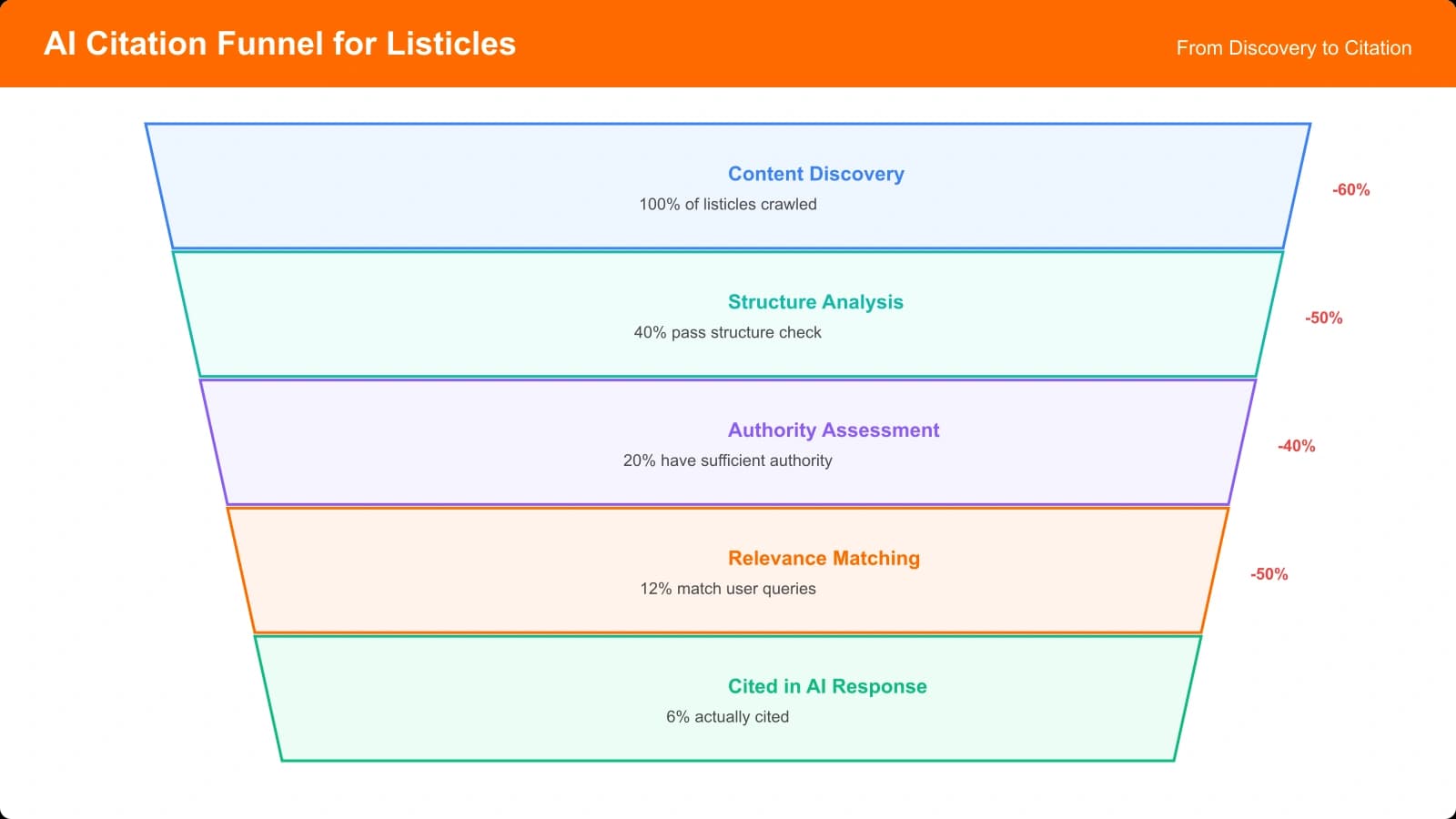
Think about it from the AI's perspective. When generating an answer about “best tools,” it needs to extract specific information: which tools are being recommended, why they're recommended, and for whom. If your listicle buries this information in flowery prose or vague descriptions, the AI simply can't reliably extract what it needs.
The listicles that do get cited tend to make this extraction trivially easy. They have clear headers, explicit criteria, and structured comparisons. It's not about dumbing down your content—it's about making your expertise machine-readable.
The Five Signals Framework for AI Citations
After dissecting hundreds of cited listicles, we've identified five structural signals that appear consistently in pages that AI systems choose to reference. Missing one or two of these might still get you occasional citations. Missing three or more? You're basically invisible to AI synthesis.
Now, let's break down each signal and look at what it actually means in practice.
Signal 1: Explicit Ranking Criteria
This is probably the most important signal, and it's the one most listicles completely miss. AI systems need to understand why you ranked things the way you did. If your methodology is implicit or unstated, the AI has no way to evaluate the credibility of your recommendations.
The pages that get cited almost always have a dedicated section—usually titled something like “How We Evaluated” or “Our Methodology”—that explicitly states the criteria used for ranking. And here's the kicker: they often include weights or priorities for each criterion.
| Weak Approach | Strong Approach |
|---|---|
| “We tested all the top tools” | “We evaluated each tool on 5 criteria: ease of use (25%), feature depth (25%), pricing value (20%), integration options (15%), support quality (15%)” |
| “Based on our experience...” | “We spent 40+ hours testing each platform with a team of 5 across real projects” |
| No methodology section | Dedicated “How We Tested” section with specific protocols |
Signal 2: Clear Entity Definitions
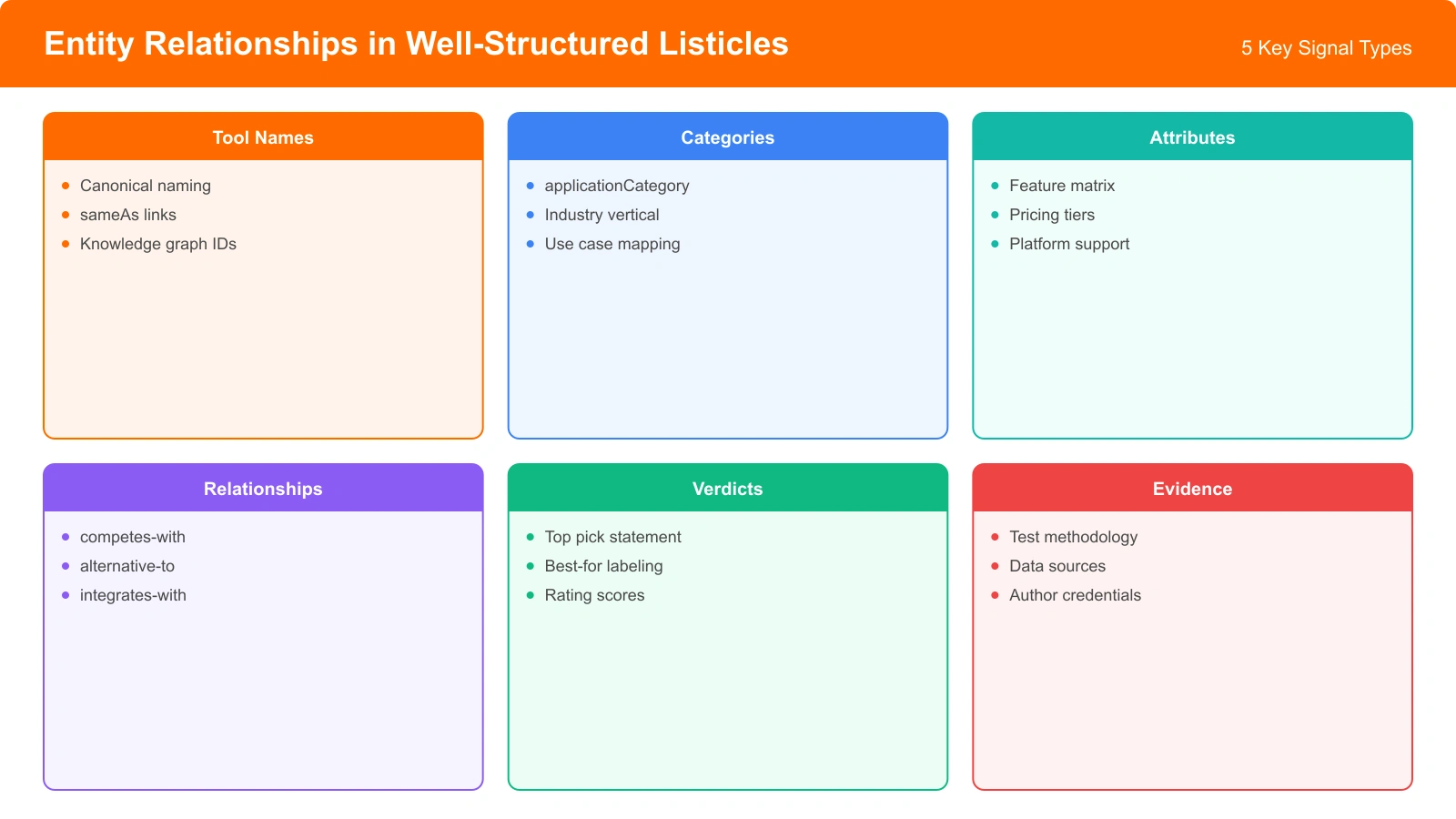
AI systems think in terms of entities—specific, identifiable things with defined attributes. When your listicle mentions “Notion,” the AI knows that's a specific product with certain characteristics. But when you use vague descriptors or inconsistent naming, you make entity extraction much harder.
What does this mean practically? Each item in your list should be introduced with its full, canonical name. Use consistent naming throughout—don't switch between “Salesforce,” “SFDC,” and “the Salesforce platform.” And include structured data that explicitly identifies these entities.
Signal 3: Comparative Context
Here's something we noticed in almost every cited listicle: they don't just describe tools in isolation. They provide comparative context that helps AI systems understand relative positioning. Phrases like “unlike Asana, Monday.com focuses on...” or “while HubSpot offers more features, Pipedrive is better for...” give the AI crucial context for synthesis.
This comparative language helps AI systems build a mental model of the competitive landscape. When someone asks “Which is better, X or Y?” the AI can pull from your comparisons rather than having to infer relationships itself.
Signal 4: Audience Segmentation
The best listicles don't just rank tools generically—they segment recommendations by audience. “Best for small teams,” “Best for enterprise,” “Best budget option”—these labels make your content infinitely more useful for AI synthesis.
Why? Because most AI queries include implicit audience context. When someone asks for the “best CRM for a startup,” an AI can directly match that to your “Best for startups” recommendation rather than trying to figure out which of your top picks might be appropriate.
Signal 5: Structured Data Markup
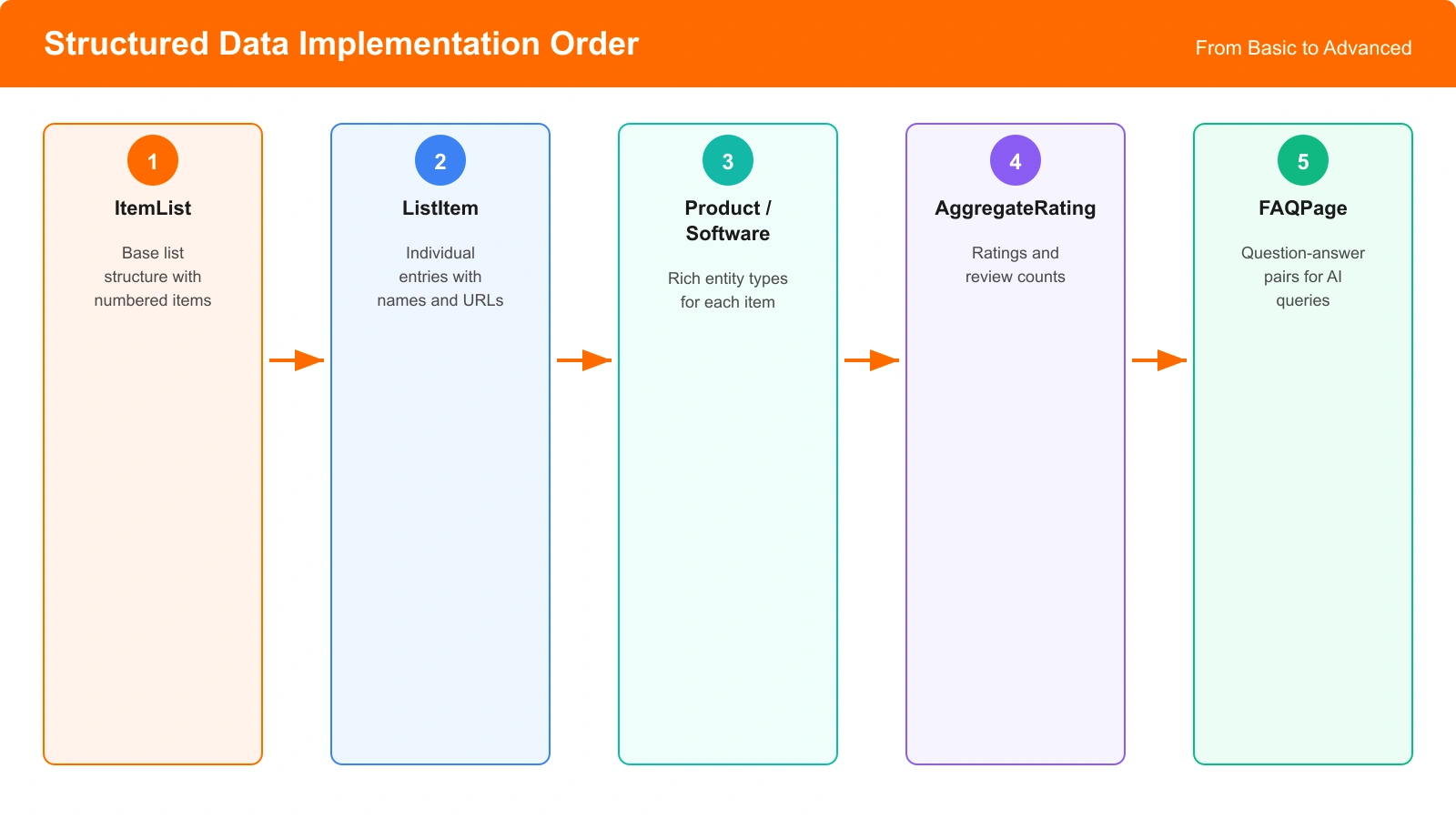
Finally, the technical signal that ties everything together: structured data. Pages with proper ItemList schema, FAQ markup, and product annotations get cited at significantly higher rates than pages without them.
And it's not just about having schema—it's about having the right schema. ItemList for your rankings, FAQPage for common questions, and Product or SoftwareApplication schema for individual tools. This structured data acts as a translation layer between your content and AI systems.
Generate Converting Listicles in Seconds
Create professional listicles with built-in AI citation optimization. No templates needed.
Try for Free
Implementing the Framework: A Practical Guide
Alright, so you understand the five signals. But how do you actually implement them without completely rebuilding your existing content? Let's walk through a practical approach that we've used to optimize dozens of listicles for AI citation.
Step 1: Audit Your Current Structure
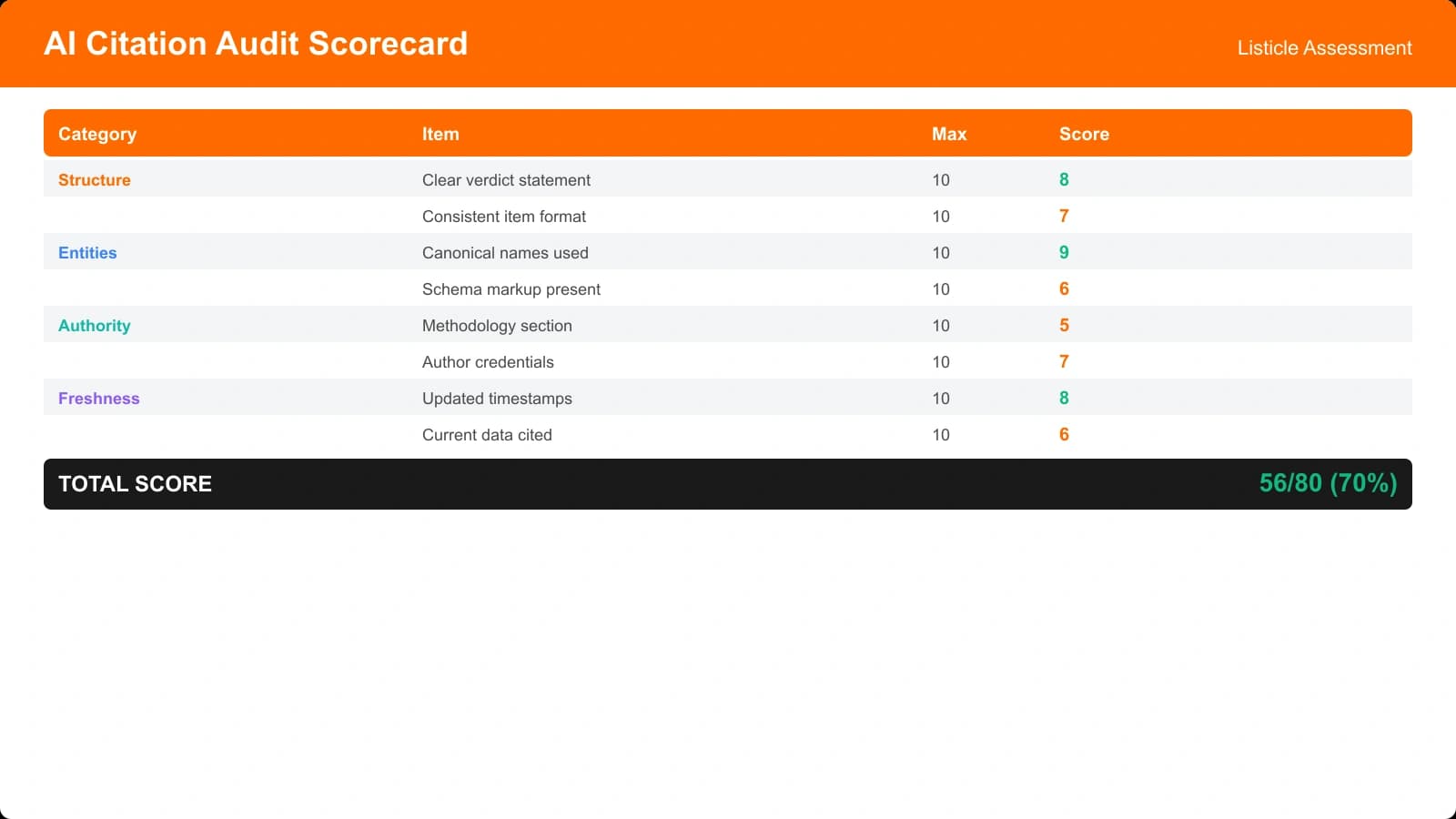
Start by evaluating your existing listicle against each of the five signals. Create a simple scorecard—does the page have explicit criteria? Clear entity naming? Comparative language? Audience segmentation? Structured data? Most pages we audit score 1-2 out of 5.
The goal isn't to hit all five perfectly on day one. It's to identify which signals are completely missing versus which ones need strengthening. Usually, there's low-hanging fruit—adding a methodology section or implementing ItemList schema can be done in an afternoon.
Step 2: Create a Methodology Section
If you're missing explicit ranking criteria, this is your highest-impact fix. Add a dedicated section near the top of your listicle (after the intro, before the rankings) that explains:
- What criteria you used to evaluate options
- How you weighted or prioritized each criterion
- Your testing methodology (how long, what scenarios, who tested)
- Any limitations or biases in your approach
Honestly, this section does double duty. It improves AI citability and builds trust with human readers. There's really no downside.
Step 3: Restructure Individual Listings
Each item in your listicle should follow a consistent structure that makes information extraction easy. We recommend this pattern:
- Name + positioning label (e.g., “Notion — Best for All-in-One Workspaces”)
- One-sentence summary of why it earned this ranking
- Key strengths as bullet points
- Limitations (yes, include them—it builds credibility)
- Best for statement with specific audience
- Pricing context
This structure gives AI systems exactly what they need: clear entity identification, comparative context, and audience segmentation all in a predictable format.
Step 4: Add Comparison Tables
If you don't have a comparison table, add one. If you do, make sure it's actually useful. The tables that get cited in AI overviews typically include:
| Element | Why It Matters for AI |
|---|---|
| Starting price | Enables price-filtered queries (“best free CRM”) |
| Key differentiator | Helps with “best for X” matching |
| Feature checkmarks | Answers feature-specific queries |
| Overall rating | Provides citation-ready ranking signal |
Step 5: Implement Structured Data
This is where things get a bit technical, but it's worth the effort. At minimum, you want ItemList schema that defines your ranked items. Ideally, you'll also add FAQPage schema for any questions you answer and Product or SoftwareApplication schema for individual tools.
The key is making sure your structured data matches your visible content exactly. If your schema says Tool A is #1 but your visible ranking shows Tool B first, you're sending mixed signals that hurt credibility with AI systems.
Common Mistakes That Kill Your Citation Chances
Before we wrap up, let's talk about what not to do. We've seen plenty of well-intentioned listicle optimization efforts that actually hurt citation rates. Here are the mistakes to avoid:
Mistake 1: Burying the Rankings
Some listicles put 2,000 words of context before revealing any actual recommendations. By the time you get to the list, you've forgotten what you were looking for. AI systems have the same problem—if your rankings aren't clearly identified and accessible, they won't be extracted.
The fix? Put a summary of your top picks near the top. You can still have detailed reviews later, but don't make readers (or AI systems) work to find your recommendations.
Mistake 2: Vague Positioning
Calling everything “great for most users” or “highly recommended” gives AI systems nothing to work with. These vague endorsements can't be matched to specific user queries.
Be specific. “Best for sales teams under 10 people” is infinitely more useful than “great for small businesses.” The more specific your positioning, the more queries you can match.
Mistake 3: Inconsistent Naming
We talked about this in the entity signals section, but it bears repeating. If you call a tool “HubSpot CRM” in one place, “HubSpot” in another, and “the HubSpot platform” elsewhere, you're fragmenting the entity signal. Pick one name and stick with it.
Mistake 4: Missing the “Why”
Many listicles say Tool X is “best for enterprises” without explaining why. What makes it enterprise-suitable? Security features? Compliance certifications? User seat pricing? Without the reasoning, AI systems can't synthesize meaningful answers.
Every positioning claim should have at least one supporting reason. “Best for enterprises because of SOC 2 compliance and unlimited user seats” is citable. “Best for enterprises” alone isn't.
How to Measure Your AI Citation Success
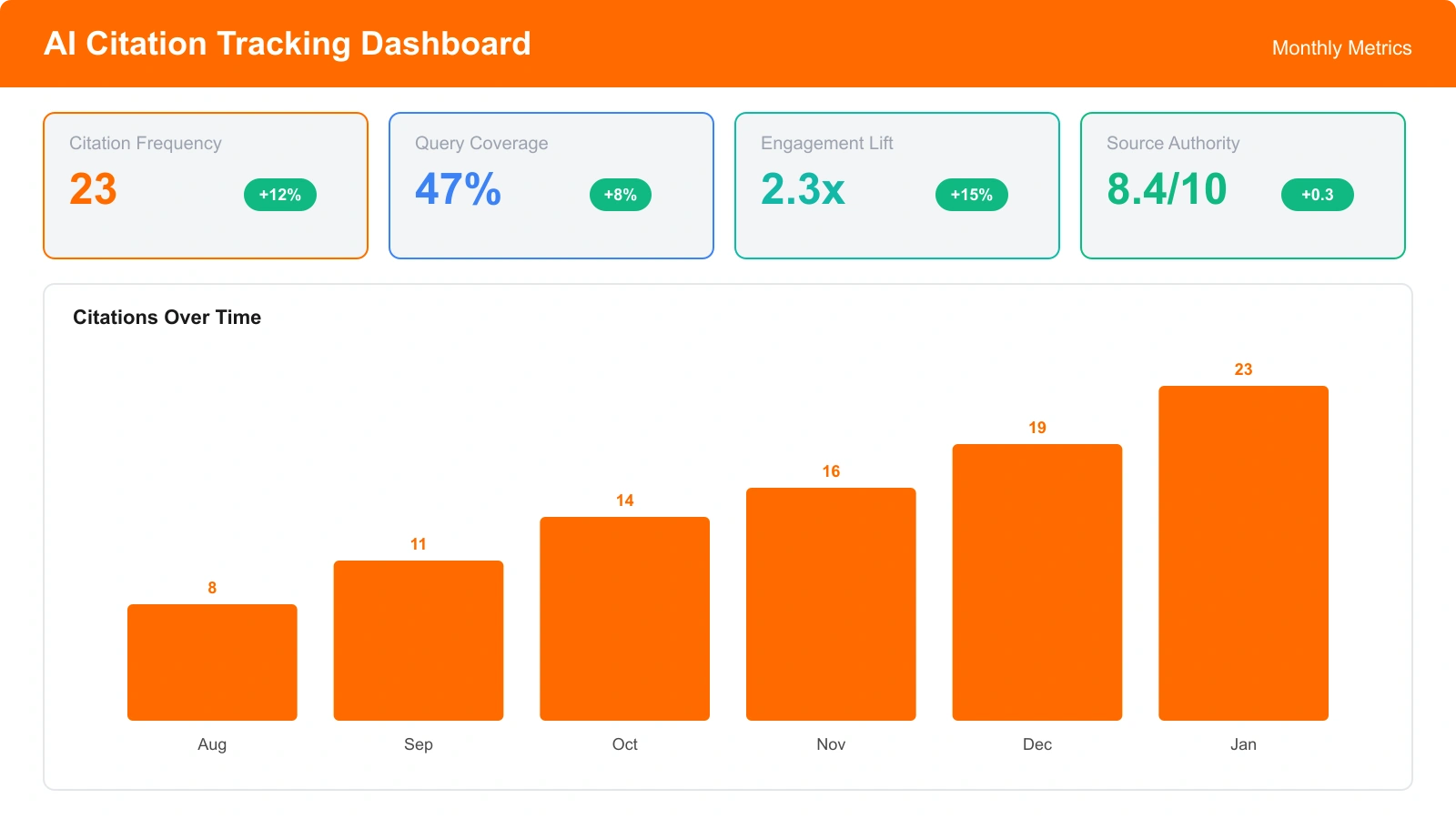
So you've implemented the framework. How do you know if it's working? Unfortunately, there's no “AI Citations” report in Google Search Console (yet). But there are several ways to track your progress.
Manual Monitoring
The most straightforward approach: regularly check AI Overviews for your target queries. Note which pages are being cited, whether yours is among them, and how the citations are being used. This is tedious but informative.
We recommend checking your top 10-20 target queries weekly and documenting what you find. Over time, you'll see patterns in what gets cited and what doesn't.
Traffic Pattern Analysis
AI citations often drive a specific type of traffic: users who click through from AI answers tend to have higher intent and spend more time on page. If you see improvements in these engagement metrics without a corresponding increase in traditional SERP clicks, AI citations might be the cause.
Brand Mention Tracking
Tools like Mention or Brandwatch can help you track when your content is referenced across the web. While they don't specifically track AI citations, they can catch instances where AI-generated content on other sites references your work.
The Future of AI Citations: What's Coming Next
We're still in the early days of AI-powered search. The patterns we've identified today will evolve as AI systems become more sophisticated. But a few trends seem pretty clear.
First, structured data is only going to become more important. As AI systems get better at understanding content, they'll rely more heavily on explicit signals rather than inference. Pages that make their structure machine-readable will have a lasting advantage.
Second, authenticity signals will matter more. AI systems are already getting better at detecting content that's been optimized purely for their consumption. The pages that will win long-term are those that combine machine-readability with genuine expertise and unique insights.
And third, we'll likely see more explicit citation mechanisms. Google is already experimenting with source attribution in AI Overviews. As these systems mature, there may be ways to track and optimize for citations more directly than we can today.
Putting It All Together
Getting your listicles cited by AI systems isn't magic—it's methodology. The pages that get cited consistently share five structural patterns: explicit ranking criteria, clear entity definitions, comparative context, audience segmentation, and proper structured data markup.
The good news? Most of your competitors aren't doing this yet. While everyone else is still optimizing for traditional SEO signals, you can get ahead by making your expertise machine-readable.
Start with an audit of your existing content. Identify which signals you're missing and prioritize the high-impact fixes first. Add a methodology section. Restructure your listings for clarity. Implement the schema. And then—here's the part most people skip—monitor your results and iterate.
The way I see it, AI citations are becoming the new featured snippets. They're not replacing organic search; they're adding a new layer of visibility that savvy publishers can capture. The question isn't whether to optimize for AI citations—it's how quickly you can get there before your competitors figure this out.
Related Reading: For more on optimizing content for AI search, check out our guide on Answer Engine Optimization (AEO) and learn about schema markup specifically for best-of pages.

Product Manager at BestPage. Pioneer in AEO research since 2024, exploring the convergence of SEO and GEO (Generative Engine Optimization). Led multiple AI-powered content optimization projects that achieved 300%+ citation increases in ChatGPT and Perplexity.