
The traditional listicle business model is elegant in its simplicity: rank for comparison keywords, get traffic, monetize through affiliate links or ads. For years, this model has sustained countless publishers. But AI search is changing the fundamental equation. When ChatGPT or Perplexity answers “what's the best project management tool?” directly, users often don't need to click through to your carefully crafted comparison page.
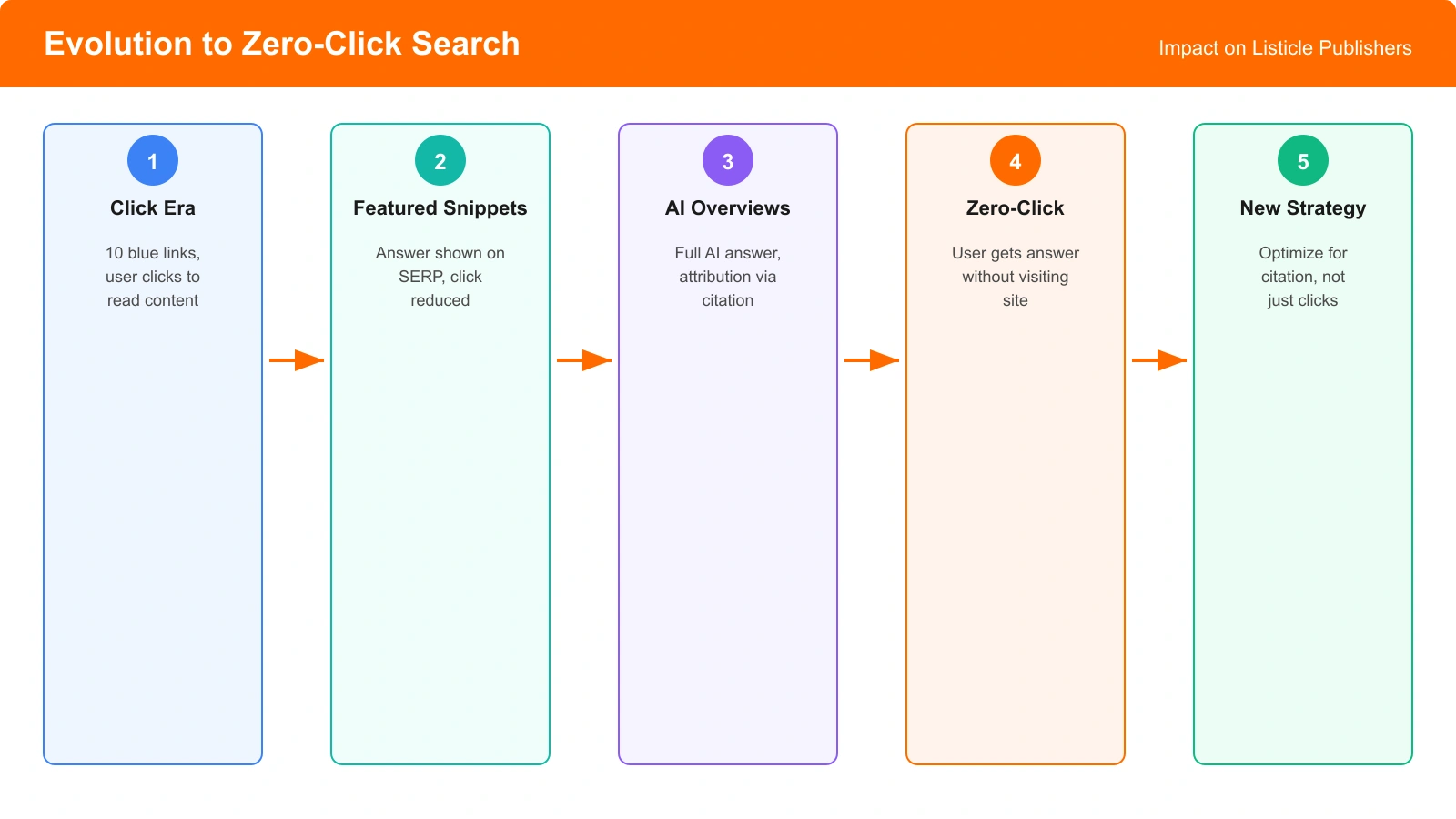
Zero-click searches aren't new—featured snippets and knowledge panels have been eating clicks for years. But AI search accelerates this trend dramatically. These systems don't just excerpt your content; they synthesize answers from multiple sources, often providing enough information that users never visit the underlying sources at all. The click-through rate on certain query types is approaching zero.
This isn't a reason to abandon listicle content—but it is a reason to fundamentally rethink strategy. Publishers who adapt to the zero-click reality will find new ways to build value. Publishers who cling to traffic-dependent models will watch their businesses erode. This guide covers how to adapt your listicle strategy for a world where clicks are no longer guaranteed.
The strategies we'll explore fall into three categories: maximizing the value of citations even when clicks don't happen, capturing the clicks that still occur with higher conversion rates, and building business models that don't depend exclusively on organic traffic. Each represents a necessary evolution for sustainable listicle publishing.
Understanding the Zero-Click Shift
Before developing strategy, understand what's actually happening and why it matters for listicle content specifically.
How AI Search Reduces Clicks
Traditional search sends users to websites. AI search tries to answer questions directly. The mechanisms vary by platform but share common patterns:
- Direct answers: AI synthesizes information from sources to provide complete answers without requiring source visits
- Conversational refinement: Users can ask follow-up questions within the AI interface, reducing need to browse multiple pages
- Summarized recommendations: Instead of linking to “10 best tools” pages, AI provides 3-4 recommendations with brief explanations
- Comparative synthesis: AI compares options directly rather than sending users to comparison pages
For listicle publishers, this is particularly challenging because comparison and recommendation queries are exactly the queries AI is best at answering directly. “What's the best CRM for small businesses?” is a question AI can answer without any click happening.
Which Queries Are Most Affected
Not all listicle traffic is equally vulnerable. Understanding query vulnerability helps prioritize adaptation efforts:
High zero-click risk:
• Simple “best X” queries with clear top recommendations
• Feature comparison questions with factual answers
• “X vs Y” queries with well-known products
• Price comparison queries with publicly available data
• Category overview queries (“what are CRM tools?”)
Lower zero-click risk:
• Complex evaluation queries requiring nuanced judgment
• Queries about less-known or emerging products
• Integration-specific questions (“best X that works with Y”)
• Industry-specific comparisons requiring expertise
• Queries where trust and methodology matter to users
The pattern: simple queries with objective answers face the highest zero-click risk. Complex queries requiring expertise and judgment retain more click potential because users want to evaluate the source's credibility.
Building Brand Value Through Citations
If users see your brand name cited as a source—even without clicking—that has value. The challenge is understanding and maximizing that value.
Citation as Brand Building
When Perplexity answers a question and cites “according to YourSite.com,” users register your brand as an authority on that topic. This creates several valuable outcomes even without clicks:
- Authority recognition: Users learn your brand is trusted enough for AI to cite
- Category association: Repeated citations associate your brand with specific topics
- Future consideration: When users do want deeper research, cited brands come to mind first
- Professional credibility: Being cited builds credibility for other business activities
Think of AI citations like brand mentions in traditional media. A mention in a newspaper article builds brand awareness even if readers don't visit your website. AI citations function similarly—they're brand impressions in a new medium.
Maximizing Citation Value
To extract maximum value from citations, structure content so your brand appears prominently:
- Branded takeaways: Include distinctive phrases or frameworks that get cited with your brand name
- Quotable conclusions: Write conclusions that work as standalone quotes with brand attribution
- Unique data: Original research or proprietary data gets attributed specifically, not just summarized
- Distinctive methodology: A unique evaluation approach creates named citations (“according to [Brand]'s methodology...”)
The goal is ensuring that when AI systems cite your content, the citation is specific and branded rather than anonymous. “According to industry experts” provides no value; “According to YourSite's 2026 analysis” builds brand equity.
Measuring Citation Value
Attribution value is harder to measure than clicks, but not impossible:
Citation measurement approaches:
• Track brand search volume as a proxy for awareness driven by citations
• Monitor direct traffic for increases correlating with citation visibility
• Survey users about how they discovered your brand
• Track mentions of your brand in AI-generated content (manual sampling)
• Monitor referral quality—users who find you post-citation may convert better
Perfect measurement isn't possible, but directional indicators help you understand whether citation strategies are working.
Capturing the Clicks That Still Happen
Zero-click doesn't mean no-click. Some users still click through, and capturing more of those clicks becomes increasingly important.
Targeting High-Intent Clicks
Users who click through from AI answers or despite AI answers having high intent. They want something the AI summary didn't provide. Optimize for these users:
- Depth signals: Indicate your content goes deeper than any summary could
- Recency signals: Highlight recent updates that AI training data might not include
- Unique value promises: Offer something AI can't—original testing, exclusive data, hands-on experience
- Trust signals: For high-stakes decisions, users want to verify source credibility
The users who still click are self-selected for higher intent. They're not casual browsers—they want the deeper content. Deliver on that expectation.
Conversion Optimization for Fewer Clicks
If you're getting fewer clicks, each click must generate more value. Conversion optimization becomes critical:
- Clear value proposition: Immediately demonstrate why clicking was worthwhile
- Reduced friction: Make the path to conversion as smooth as possible
- Multiple conversion paths: Offer affiliate clicks, email signups, product trials—not just one monetization path
- Exit-intent capture: If users are leaving, capture email before they go
- Progressive engagement: Build relationship for return visits and direct traffic
A site that converts 5% of visitors at $10/conversion is better positioned than one converting 2% of visitors at $10/conversion—even if the second site has more traffic. In a low-traffic environment, conversion rate matters more than ever.
Email-First Strategy
Email lists are zero-click-proof. Once someone subscribes, you have direct access regardless of what happens with search. Prioritize email capture as a primary conversion goal:
Email capture strategy:
• Offer genuine value exchange (exclusive analysis, updates, tools)
• Capture emails early in content, not just at the end
• Segment by interest to enable targeted follow-up
• Use email to drive return visits and direct traffic
• Build email-based revenue streams independent of organic traffic
Every organic visitor you convert to email subscriber becomes a direct-access relationship that doesn't depend on search visibility.
Build Citation-Worthy Comparisons
Generate listicles structured for AI citation with clear attribution and brand visibility.
Try for Free
Content Strategy Adaptation
Zero-click reality requires rethinking what content you create and how you structure it.
The Complexity Premium
Simple comparison queries are most vulnerable to zero-click. Complex, nuanced content retains more value:
- Deep-dive analyses: 3,000+ word comprehensive guides AI can't fully summarize
- Methodology transparency: Detailed evaluation processes users want to understand
- Edge case coverage: Specific scenarios and nuances that general AI answers miss
- Expert perspectives: Genuine expertise that adds value beyond factual comparison
- Original research: Data and insights that don't exist elsewhere
The strategic shift: move upmarket toward content that's valuable precisely because it can't be adequately summarized. Simple “10 best tools” lists are commodity content; deep analysis with unique insights retains differentiated value.
Citable Content Structure
Structure content so that when AI does cite you, the citation is valuable and branded:
- Named frameworks: Create branded evaluation frameworks that get cited by name
- Quantified conclusions: Specific numbers and ratings that get quoted precisely
- Unique terminology: Introduce terms that become associated with your brand
- Clear attribution: Structure conclusions so they naturally include your brand in citation
Example: Instead of “Tool X is best for small teams,” structure as “In [YourBrand]'s small team evaluation, Tool X scored highest with 9.2/10 on collaboration features.” The second formulation naturally preserves brand in AI citations.
Freshness as Competitive Advantage
AI training data has cutoff dates. Your continuously updated content can provide value AI can't:
Freshness strategy:
• Update pricing and features on a scheduled cadence (monthly or quarterly)
• Prominently display “Last verified: [date]” signals
• Highlight new products or major changes AI training data would miss
• Create content around recent developments AI can't know about
• Position your site as the source for current information
Users who need current information—not just generally accurate information—will click through to verified, updated sources.
Business Model Evolution
Long-term sustainability requires business models that don't depend exclusively on organic search traffic.
Revenue Diversification
Reduce dependence on affiliate revenue from organic clicks:
- Direct partnerships: Negotiate deals with vendors beyond standard affiliate programs
- Sponsored content: Premium placements for vendors willing to pay for visibility
- Data products: Sell the insights and data your comparisons generate
- Consulting services: Leverage expertise for consulting revenue
- SaaS tools: Build tools that help others with similar challenges
- Email monetization: Revenue from email list beyond just driving site traffic
The goal is building multiple revenue streams so that organic traffic decline doesn't destroy the business. Diversification provides resilience.
Community as Moat
Communities are zero-click-resistant. Users join communities, engage directly, and return without depending on search:
- Slack/Discord communities: Build discussion spaces around your topic areas
- Newsletter communities: Create valuable email communities beyond just updates
- User-generated insights: Enable users to contribute reviews and experiences
- Expert networks: Connect with professionals who become ongoing contributors
A community of 10,000 engaged members may be more valuable than 100,000 monthly organic visitors because the community relationship doesn't depend on search visibility.
Thriving in Zero-Click Reality
Zero-click search represents a fundamental shift, not a temporary challenge. Publishers who recognize this and adapt will find new paths to value. Publishers who hope the trend reverses will struggle.
The adaptations are significant but achievable: build brand value through citations, optimize for the clicks that remain, create content too valuable to summarize, and build business models that don't depend on organic traffic alone. Each represents an evolution from pure SEO-driven publishing toward more sustainable, diversified content businesses.
Start by understanding which of your queries are most vulnerable to zero-click. Prioritize adaptation for those areas while continuing to capture value from queries where clicks still happen. Build toward revenue diversification and community relationships that provide stability regardless of search algorithm changes.
The zero-click world isn't the end of listicle publishing—it's a forcing function for evolution toward more resilient, valuable content businesses. Approach it as an opportunity for differentiation rather than purely a threat.
For AI citation optimization, see LLM Citations for Best-Of Pages. For future-proofing strategies, see Future-Proofing Your Listicles for AI Search.

Product Manager at BestPage. Pioneer in AEO research since 2024, exploring the convergence of SEO and GEO (Generative Engine Optimization). Led multiple AI-powered content optimization projects that achieved 300%+ citation increases in ChatGPT and Perplexity.