
The AI search landscape is changing faster than anyone can reliably predict. Perplexity has grown from obscurity to major player in months. Google's SGE keeps evolving in unpredictable directions. New AI search products launch regularly. The specific platforms, their citation behaviors, and their optimization patterns will continue shifting.
This volatility creates a strategic challenge. Optimizing heavily for how Perplexity works today might not serve you if Perplexity changes—or if users shift to a different AI search platform entirely. Short-term tactical optimization makes sense, but it needs to be balanced with longer-term strategic thinking about what will remain valuable regardless of platform-specific changes.
This guide focuses on future-proofing: building listicle content and publishing practices that will remain valuable across different AI search futures. We'll examine the principles that appear fundamental to AI search success (versus platform-specific tactics), the content characteristics that should remain valuable regardless of technology evolution, and the business model adaptations that provide resilience against unpredictable change.
The goal isn't to predict the future—it's to prepare for multiple possible futures while continuing to capture value today. That requires distinguishing between fundamental principles worth heavy investment and tactical optimizations worth lighter, more adaptable investment.
Principles That Will Remain Fundamental
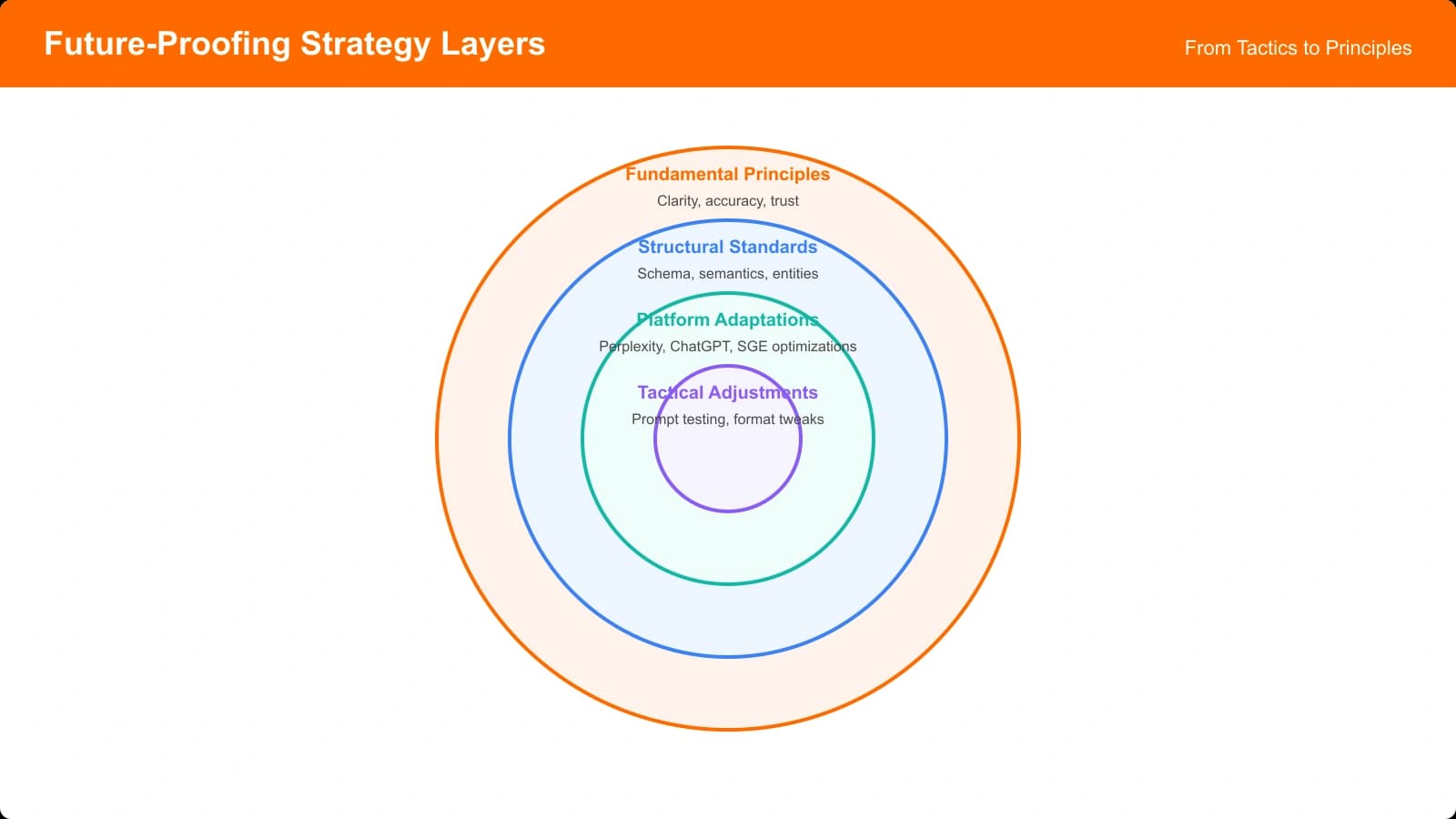
Certain principles appear fundamental to how AI systems process and value content. These are worth heavy, sustained investment because they're unlikely to become less important.
Genuine Expertise Over Gaming
AI systems are increasingly sophisticated at distinguishing genuine expertise from surface-level content. This trajectory will only accelerate as models improve. Future-proof investment means:
- Building real expertise in your comparison categories, not just researching for content
- Developing author credibility through genuine experience, not manufactured credentials
- Creating insights that demonstrate actual product use, not just documentation paraphrasing
- Establishing methodology that reflects real evaluation work, not template-filling
AI models will only get better at detecting authentic expertise versus content that mimics expertise without possessing it. Investment in genuine expertise compounds over time as detection improves.
Accuracy as Trust Foundation
AI systems rely on accurate sources to generate accurate answers. Inaccurate sources create liability for AI providers, who will increasingly filter them out. Future-proof accuracy means:
Accuracy investment areas:
• Rigorous fact-checking processes before publication
• Regular verification and update cycles for existing content
• Transparent correction processes when errors are found
• Primary source verification rather than aggregating other sources
• Clear dating so AI systems know information currency
As AI systems become more selective about sources, accuracy reputation will become a competitive advantage. Sites known for reliable information will be preferred over those with accuracy problems, regardless of how specific citation mechanics evolve.
Genuine User Value
AI search ultimately serves users. Systems that help users accomplish their goals will survive; systems that enable manipulation will be corrected. Content that genuinely helps users make decisions will remain valuable because that's what AI systems are trying to enable.
This means focusing on what users actually need from comparison content: honest assessments, clear recommendations, useful context, and trustworthy information. Content optimized purely for AI citation without genuine user value will face increasing friction as AI systems improve at distinguishing helpful from manipulative content.
Building Durable Content
Beyond principles, specific content characteristics create durability across AI search evolution.
Depth Over Breadth
Shallow content across many topics is more vulnerable than deep content in focused areas. As AI becomes better at synthesizing information, shallow aggregation becomes less valuable—AI can do that itself. What remains valuable is deep expertise that AI can't easily replicate:
- Proprietary testing: Original hands-on evaluation that creates unique data
- Expert insights: Perspectives from genuine practitioners, not just researchers
- Longitudinal knowledge: Understanding how products evolve over time
- Integration expertise: How products work together in real environments
- Edge case coverage: Knowledge of unusual scenarios and limitations
Deep expertise in specific categories creates moats that AI can't easily replicate. Broad but shallow content becomes increasingly commoditized.
Original Data and Research
AI systems can synthesize existing information, but they can't create new data. Original research creates durable value:
Original data investments:
• User surveys about product satisfaction and usage patterns
• Performance benchmarking across products in controlled conditions
• Pricing tracking over time to show trend data
• Feature testing with documented methodology
• User experience studies revealing insights not in documentation
Original data becomes more valuable as AI makes synthesizing existing data easier. When everyone can compile the same public information, original data differentiates.
Transparent Methodology
Methodology transparency serves multiple future-proofing purposes:
- Trust signaling: Demonstrates genuine evaluation rather than surface research
- Reproducibility: Allows others to verify your conclusions
- Authority building: Establishes your approach as the standard for the category
- AI confidence: Gives AI systems context for how to weight your conclusions
Transparent methodology becomes a form of brand that travels with citations. “According to [YourBrand]'s testing methodology...” carries more weight than unsourced claims.
Structural Adaptability
Beyond content, structure your publishing approach for adaptability.
Modular Content Architecture
Content structured modularly adapts more easily to changing requirements:
- Separable components: Product reviews, comparisons, and guides that can be recombined
- Structured data layers: Content with metadata that can feed multiple outputs
- API-friendly formats: Content that can serve web, apps, and AI interfaces
- Update independence: Components that can be updated without full page rewrites
Modular architecture means you can adapt to new requirements without rebuilding from scratch. If a new AI platform requires different content formats, modular content can be reformatted more easily than monolithic pages.
Platform Diversification
Don't bet entirely on any single platform or traffic source:
- Multiple AI platforms: Optimize for Perplexity, ChatGPT, Google SGE, and emerging players
- Traditional search: Maintain organic search optimization alongside AI
- Direct relationships: Build email lists and communities not dependent on search
- Social presence: Establish presence where users discover content directly
- Partnership channels: Develop distribution through partners and referrals
Diversification provides resilience against any single platform changing in ways that disadvantage you.
Build Future-Proof Comparisons
Generate listicles with the structure and depth that remain valuable across AI search evolution.
Try for Free
Investment Allocation Framework
Allocate effort across different time horizons to balance current capture with future resilience.
| Investment Type | Allocation | Focus Area | Time Horizon |
|---|---|---|---|
| Fundamental principles | 40-50% | Expertise, accuracy, user value | 3+ years |
| Durable content | 25-35% | Original research, depth, methodology | 1-3 years |
| Platform optimization | 15-25% | Current AI platform best practices | 6-12 months |
| Tactical experiments | 5-10% | Testing emerging platforms and techniques | 1-3 months |
This allocation ensures majority investment in long-term fundamentals while maintaining tactical adaptability. The specific percentages should flex based on your situation, but the principle of heavy long-term investment with lighter tactical allocation provides sustainable positioning.
Monitoring and Adaptation
Future-proofing requires ongoing monitoring to detect when adaptation is needed:
Monitoring signals:
• Citation pattern changes across AI platforms
• New AI search products gaining user adoption
• Changes in how AI systems display and attribute sources
• Shifts in user behavior between search modalities
• Competitor adaptations that signal market direction
Regular monitoring helps you identify when tactical adjustments are needed without overreacting to short-term fluctuations.
Building for Multiple Futures
No one can predict exactly how AI search will evolve. But we can identify principles and characteristics that appear fundamental across possible futures: genuine expertise, accuracy, user value, depth, original data, and adaptable structure. Heavy investment in these fundamentals provides resilience regardless of specific platform changes.
Future-proofing isn't about predicting the future—it's about building value that remains valuable across multiple possible futures. The publishers who invest in fundamentals while maintaining tactical flexibility will navigate AI search evolution successfully, whether that evolution looks like we expect or surprises everyone.
Start by auditing your current investment allocation. Are you over-indexed on tactical optimization that might become obsolete? Under-invested in fundamentals that will compound over time? Adjust your allocation to balance current capture with long-term sustainability.
The future of AI search is uncertain, but the opportunity to build durable value is clear. Focus on what will matter regardless of how specific technologies evolve.
For current tactical optimization, see Optimizing for Perplexity and SearchGPT. For zero-click adaptation, see Zero-Click Strategy for Listicles.

Product Manager at BestPage. Pioneer in AEO research since 2024, exploring the convergence of SEO and GEO (Generative Engine Optimization). Led multiple AI-powered content optimization projects that achieved 300%+ citation increases in ChatGPT and Perplexity.