
“Best dentists in Austin” and “top cardiologists near me” are high-intent, high-value searches. Users searching for healthcare providers are making decisions that directly impact their health and wellbeing. This places healthcare comparison content squarely in Google's YMYL category—content that could potentially impact a person's health, financial stability, or safety.
The stakes are real. Recommending an unqualified provider or publishing inaccurate credential information could genuinely harm users. Google recognizes this and applies significantly stricter quality standards to healthcare content. What works for “best project management tools” content will fail for “best orthopedic surgeons” content—not just from a ranking perspective, but from an ethical and potentially legal perspective.
This guide covers how to build healthcare comparison content that deserves to rank. The standards are high for good reason: people making healthcare decisions deserve accurate, trustworthy information. Publishers who meet these standards can capture valuable traffic while genuinely helping users. Publishers who cut corners should reconsider whether healthcare content is appropriate for their platform.
We'll cover the specific YMYL requirements for healthcare content, credential verification processes, medical review workflows, appropriate content scope, and disclaimer requirements. The goal isn't just ranking—it's building content that genuinely serves users making important healthcare decisions.
Understanding YMYL for Healthcare
Before building healthcare comparison content, understand what YMYL means and why healthcare content faces elevated scrutiny.
What YMYL Designation Means
YMYL (Your Money or Your Life) is Google's designation for content that could significantly impact a person's health, financial stability, safety, or happiness. Healthcare content is explicitly named as a core YMYL category. The implications are substantial:
- Higher E-E-A-T requirements: Experience, Expertise, Authoritativeness, and Trustworthiness standards are significantly elevated
- Manual review potential: YMYL content may receive manual quality review from human raters
- Stricter accuracy standards: Factual errors in YMYL content are weighted more heavily
- Source scrutiny: Google evaluates whether your site should be trusted for healthcare information
- Algorithm sensitivity: Core updates often hit YMYL content hardest when quality is marginal
The practical implication: tactics that work for non-YMYL content often fail for healthcare content. You can't keyword-stuff your way to ranking for healthcare queries; you need to genuinely demonstrate expertise and trustworthiness.
Healthcare-Specific Concerns
Healthcare content faces unique concerns beyond general YMYL standards:
Healthcare-specific YMYL considerations:
• Provider credentials must be verifiable through official licensing bodies
• Medical specialties have specific board certification requirements
• Healthcare regulations vary by state and specialty
• Malpractice and disciplinary history is publicly available and relevant
• Patient reviews have HIPAA and authenticity considerations
• Medical claims require evidence-based sourcing
These aren't just SEO considerations—they're ethical and potentially legal requirements. Publishing inaccurate credential information or undisclosed conflicts of interest in healthcare content creates real liability.
Credential Verification Requirements
Healthcare provider credentials must be verified through official sources, not self-reported information.
Primary Verification Sources
Use official licensing and certification bodies for verification:
- State medical boards: Verify physician licenses through state medical board databases
- Board certification: Verify specialty certifications through relevant boards (ABMS for physicians)
- NPI Registry: National Provider Identifier confirms healthcare provider status
- State dental boards: Separate from medical boards; verify dentist credentials specifically
- DEA registration: For providers who prescribe controlled substances
- Hospital privileges: Verify claimed hospital affiliations directly
Verification should be documented internally with dates and sources. “Last verified: [date] via [source]” creates an audit trail and demonstrates due diligence.
Disciplinary History Checks
Disciplinary actions are public record and materially relevant to healthcare provider comparisons:
Disciplinary check sources:
• State medical board disciplinary databases
• National Practitioner Data Bank (limited access)
• Federation of State Medical Boards physician profile
• Malpractice settlement records (availability varies by state)
• DEA actions for controlled substance violations
How to handle disciplinary history is a judgment call. Excluding providers with significant disciplinary actions protects users. Alternatively, disclosing disciplinary history with context allows users to make informed decisions. What's not acceptable: ignoring disciplinary history entirely and recommending providers with serious violations.
Ongoing Verification Processes
Credentials change—licenses expire, certifications lapse, disciplinary actions occur after initial verification. Build ongoing verification into your content maintenance:
- Annual re-verification of all listed providers
- Quarterly checks of high-traffic or featured providers
- Immediate verification when user reports suggest credential issues
- Systematic removal process for providers with verification failures
Healthcare credentials require more frequent verification than typical business listings because the consequences of credential lapses are more serious.
Content Structure for Healthcare
Healthcare comparison content requires specific structural elements beyond general listicle formats.
Appropriate Content Scope
Define what your healthcare content should and shouldn't do:
Appropriate scope:
• Provider information: credentials, specialties, locations, contact information
• Objective factors: years in practice, hospital affiliations, accepted insurance
• Aggregated reviews: platform ratings with appropriate caveats
• Accessibility information: telehealth options, new patient availability
Out of scope (avoid):
• Medical advice or treatment recommendations
• Outcome claims (“best success rates”) without verifiable data
• Definitive quality rankings without transparent methodology
• Guarantees about provider performance
The content helps users find and evaluate providers—it doesn't replace medical consultation or make medical recommendations. Clear scope definition protects users and reduces legal liability.
Required Disclaimers
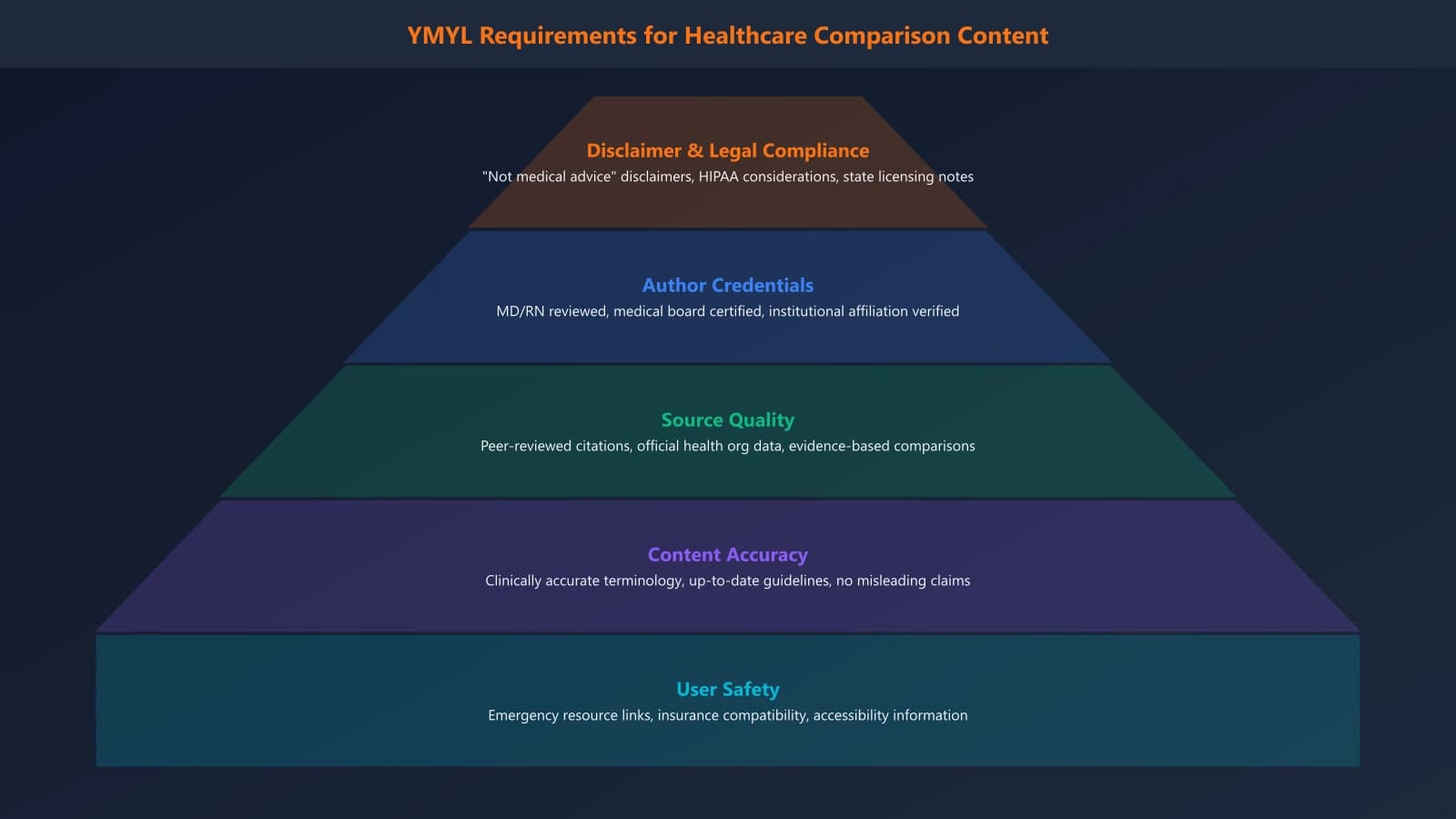
Healthcare comparison content needs clear disclaimers addressing its limitations:
- Not medical advice: Explicit statement that content is informational, not medical guidance
- Verification responsibility: Users should independently verify credentials and suitability
- No endorsement: Listing doesn't constitute endorsement or recommendation
- Data currency: Information may change; last verified dates provided
- Insurance caveat: Insurance acceptance should be verified directly with providers
Place disclaimers prominently—near the top of content where users see them before engaging with provider listings.
Author Expertise Requirements
Healthcare content ideally involves qualified professionals:
- Medical review: Content reviewed by a licensed healthcare professional
- Healthcare writer: Author with healthcare writing credentials or experience
- Transparent attribution: Reviewer credentials clearly displayed with verification links
- Regular review cycle: Medical review repeated when content is substantially updated
If your organization lacks healthcare expertise, consider whether healthcare content is appropriate for your platform—or partner with qualified reviewers who can lend credibility.
Build YMYL-Compliant Comparisons
Generate healthcare listicle frameworks with proper structure and verification workflows.
Try for Free
Patient Review Handling
Patient reviews are valuable but require careful handling in healthcare contexts.
Aggregating Reviews Appropriately
When aggregating reviews from platforms like Google, Healthgrades, or Zocdoc:
- Multiple sources: Aggregate from multiple platforms for balanced perspective
- Clear attribution: Show which platforms reviews come from
- Review count context: Display review volume alongside ratings
- Recency weighting: Recent reviews matter more; indicate review freshness
- Response patterns: Note if providers actively respond to reviews
Don't cherry-pick only positive reviews—present balanced aggregations that help users make informed decisions.
Authenticity Considerations
Healthcare reviews face specific authenticity concerns:
Review authenticity factors:
• Healthcare reviews may be incentivized (watch for patterns)
• HIPAA prevents providers from responding with patient details
• Review bombing can target healthcare providers unfairly
• Platform-specific review policies affect authenticity differently
• Verified patient reviews carry more weight than anonymous reviews
Where possible, rely on platforms with verified review mechanisms over open submission platforms.
Maintaining YMYL Compliance
Healthcare content requires ongoing maintenance beyond typical update cycles.
Update Requirements
Healthcare content becomes stale faster than general content:
- Credential verification: Annual minimum; quarterly for featured providers
- Practice information: Quarterly verification of locations, contact info, insurance acceptance
- Review aggregation: Monthly refresh of review data
- New provider additions: Full verification before any new provider is listed
- Provider removals: Prompt removal when credential verification fails
Healthcare content that becomes stale doesn't just rank poorly—it actively harms users who rely on outdated information.
Error and Incident Response
When errors are discovered or reported:
- Immediate investigation: Verify reported issues promptly
- Quick correction: Fix confirmed errors immediately
- Transparency: Acknowledge significant errors publicly if appropriate
- Process improvement: Update verification processes to prevent recurrence
- Documentation: Maintain records of corrections for due diligence
The speed and thoroughness of error response demonstrates commitment to accuracy that search engines and users can recognize.
Building Healthcare Content That Deserves to Rank
Healthcare comparison content carries real responsibility. Users making healthcare decisions based on your content deserve accurate, trustworthy information. Google's YMYL standards exist because the stakes are genuinely high.
Publishers who meet these standards—rigorous credential verification, appropriate medical review, clear scope boundaries, transparent methodology—can build healthcare content that both ranks well and genuinely serves users. The investment is substantial, but so is the value of healthcare search traffic.
If the requirements outlined here seem prohibitive for your operation, that's valuable signal. Healthcare content isn't appropriate for every publisher. But for those willing to meet the standards, the opportunity to help users find quality healthcare while building a sustainable content asset is significant.
For related local service content, see Local Business Trust Signals. For professional services more broadly, see Professional Services Listicles.

Product Manager at BestPage. Pioneer in AEO research since 2024, exploring the convergence of SEO and GEO (Generative Engine Optimization). Led multiple AI-powered content optimization projects that achieved 300%+ citation increases in ChatGPT and Perplexity.