
When someone searches for “best roofing contractors in Denver,” they need more than a generic list. They need confidence that you understand Denver's market, that the businesses you recommend actually serve their area, and that your information is accurate and current. Generic trust signals aren't enough—local comparisons require local credibility.
The difference between trusted local comparison content and throwaway directory scraping comes down to specificity. Local trust signals demonstrate that someone with actual knowledge of the area created this content for people in that area. Without these signals, you're competing against every automated directory on the internet.
This guide covers the trust elements specific to local service comparisons: what readers and search engines look for, how to demonstrate local expertise, and how to maintain accuracy that builds ongoing credibility.
Business Verification Signals
The most fundamental trust signal for local comparisons is that the businesses you list actually exist, operate in the stated location, and remain in business. This sounds obvious, but it's where most scraped local content fails.
Contact Information Accuracy
Every business in your comparison should have verified contact information. Phone numbers should connect to the business. Addresses should be current. Hours of operation should be accurate. When readers call a number from your list and reach a disconnected line, your credibility evaporates.
Verification checklist:
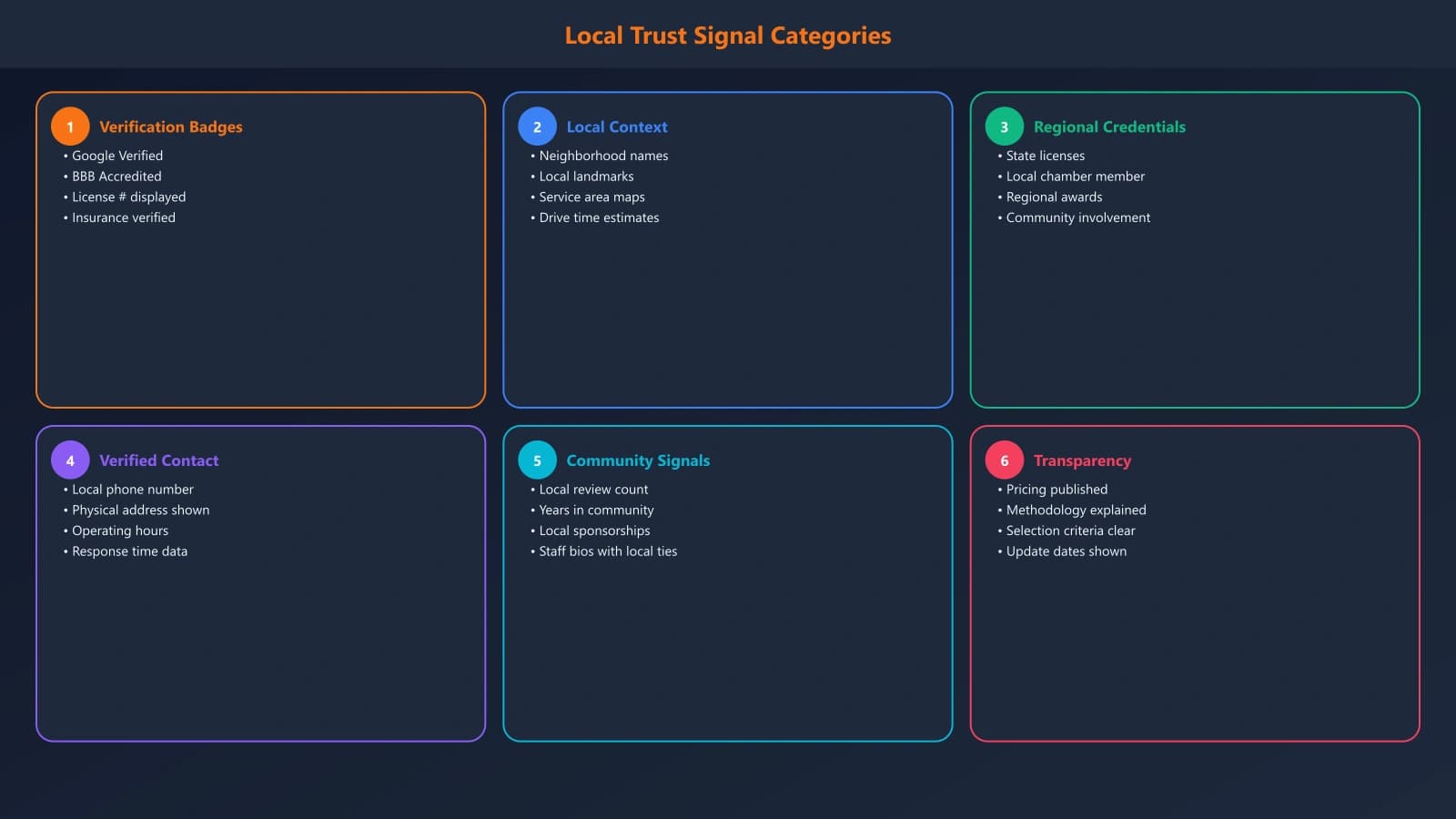
• Phone number connects to the business (test it)
• Address is current physical or mailing location
• Website URL leads to active, legitimate site
• Business hours match current operation
• Service area accurately represents where they work
Automate verification where possible, but some manual checking is unavoidable. A single incorrect phone number damages trust in your entire list.
Credential and License Verification
For licensed professions—contractors, plumbers, electricians, lawyers—verify credentials through official sources. Many states provide online license lookup tools. Mentioning verified license numbers or links to verification builds substantial trust.
Example credential display:
“ABC Plumbing - Colorado Contractor License #PC-12345 (verified via Colorado DORA). Licensed for residential and commercial plumbing. Insurance verified through Colorado coverage database.”
This level of verification distinguishes your content from directory sites that simply list names without validation.
Local Context and Expertise
Beyond verifying businesses exist, demonstrate you understand the local market they serve.
Regional Market Factors
Local context that only someone familiar with the area would include:
Denver roofing example:
“Denver's frequent hailstorms (averaging 7+ significant events annually) make contractor experience with insurance claims particularly important. The contractors below all have documented hail damage repair experience and familiarity with Colorado's specific insurance claim processes.”
This context shows you understand local conditions that affect which service providers are actually good choices—not just who exists.
Neighborhood-Level Detail
Where appropriate, go beyond city-level to neighborhood-level knowledge. Which contractors specialize in historic districts with specific building codes? Which plumbers are familiar with the aging infrastructure in certain neighborhoods? This granularity signals genuine local expertise.
Neighborhood context example:
“For homes in Capitol Hill's historic district, check whether contractors have experience with Denver Landmark Preservation requirements. XYZ Renovation has completed 15+ approved historic renovations in the area.”
Community Connection Indicators
Businesses with genuine community ties are often more trustworthy than chains. Mention factors like years in the local community, local business association memberships, community sponsorships or involvement, and local awards or recognition.
These indicators suggest stability and community investment—businesses that care about their local reputation.
Build Trust-Rich Local Comparisons
Generate local service listicles with built-in verification and local context.
Try for Free
Review and Reputation Integration
Reviews are central to local service decisions. How you present review information affects trust significantly.
Multi-Platform Review Aggregation
Don't rely on a single review source. Aggregate signals from Google Business Profile, Yelp, BBB, and industry-specific platforms. Multiple consistent signals are more trustworthy than a single high rating.
Multi-source review display:
“ABC Electric: 4.8★ on Google (127 reviews), 4.5★ on Yelp (43 reviews), A+ BBB rating. Consistent high ratings across platforms suggest reliable service quality.”
Review Recency and Velocity
Old reviews matter less than recent ones. A business with 200 reviews from 3 years ago and silence since raises red flags. Highlight review recency when available—recent positive reviews suggest current quality.
Maintaining Trust Over Time
Trust signals degrade if not maintained. Local business information changes frequently—businesses move, close, change ownership, or update contact information.
| Trust Element | Verification Frequency | Common Issues |
|---|---|---|
| Phone numbers | Quarterly | Disconnected, changed |
| Addresses | Bi-annually | Business moved |
| Business status | Quarterly | Closed, ownership change |
| Licenses | Annually | Expired, revoked |
| Reviews/ratings | Monthly | Significant changes, new issues |
| Website URLs | Quarterly | Broken, domain changes |
Build verification into your content maintenance workflow. Displaying “Last verified: [date]” shows readers your content is actively maintained, not abandoned.
Building Local Credibility
Local service comparisons live or die on trust. Readers are making high-stakes decisions—hiring contractors, choosing lawyers, selecting healthcare providers. They need confidence that your recommendations are based on real knowledge, not automated scraping.
Invest in the verification and local context that competitors skip. It takes more effort, but the credibility gap becomes a competitive moat. Readers learn to trust your local recommendations, return for other local searches, and share your content with neighbors facing similar decisions.
For the broader local comparison strategy, see Local Service Comparison Playbook. For city-specific optimization, see City Best-Of Pages Strategy.

Product Manager at BestPage. Pioneer in AEO research since 2024, exploring the convergence of SEO and GEO (Generative Engine Optimization). Led multiple AI-powered content optimization projects that achieved 300%+ citation increases in ChatGPT and Perplexity.