

When someone searches “best roofing companies in Denver,” they're not casually browsing—they need a roof fixed. Local service comparison queries combine high intent with geographic specificity, making them valuable for publishers and service providers alike.
But local comparison content plays by different rules than national product listicles. You're dealing with local pack results, service area dynamics, and the need for genuine local knowledge. Generic “best of” content scraped from directories won't cut it.
This pillar guide covers the complete strategy for local service comparison content—from identifying opportunities to scaling across multiple locations.
Identifying Local Comparison Opportunities
Not all local service categories are equally valuable for comparison content. Here's how to identify the best opportunities.
High-Value Service Categories
The best local comparison opportunities share certain characteristics: high transaction value, multiple providers to compare, and genuine differentiation between options.
Strong categories include home services (roofing, HVAC, plumbing, electricians), professional services (lawyers, accountants, financial advisors), healthcare providers (dentists, doctors, specialists), and lifestyle services (gyms, salons, restaurants).
Weaker categories are those where providers are essentially interchangeable (gas stations, basic retail) or where a single dominant player exists (utilities, government services).
Query Research Checklist
Before building local comparison content, verify the opportunity:
- Search volume exists for “best [service] in [city]” pattern
- Current results are dominated by directories or low-quality content
- Multiple legitimate providers exist to compare
- Service involves meaningful selection criteria (not just proximity)
- Transaction value justifies content investment
Local Modifier Patterns
Local searches use various geographic modifiers. Capture the full range:
- “Best [service] in [city]” — Most common explicit pattern
- “Top [service] [city]” — Alternative phrasing
- “[service] near me” — Implicit local intent (harder to target)
- “[neighborhood/area] [service]” — Hyper-local variations
- “Best [service] [metro area]” — Broader geographic scope
Content Structure for Local Services
Local comparison pages need different structural elements than national content.
Local Context Section
Demonstrate genuine local knowledge upfront. This isn't just an SEO signal—it builds trust with readers who live in the area.
Include local context like regional factors affecting service selection (climate considerations for HVAC, soil types for landscaping), local regulations or licensing requirements, typical price ranges for the local market, and community factors (locally-owned vs. chain preferences).
This section also helps differentiate your content from generic directory listings that don't understand local nuances.
Provider Profile Elements
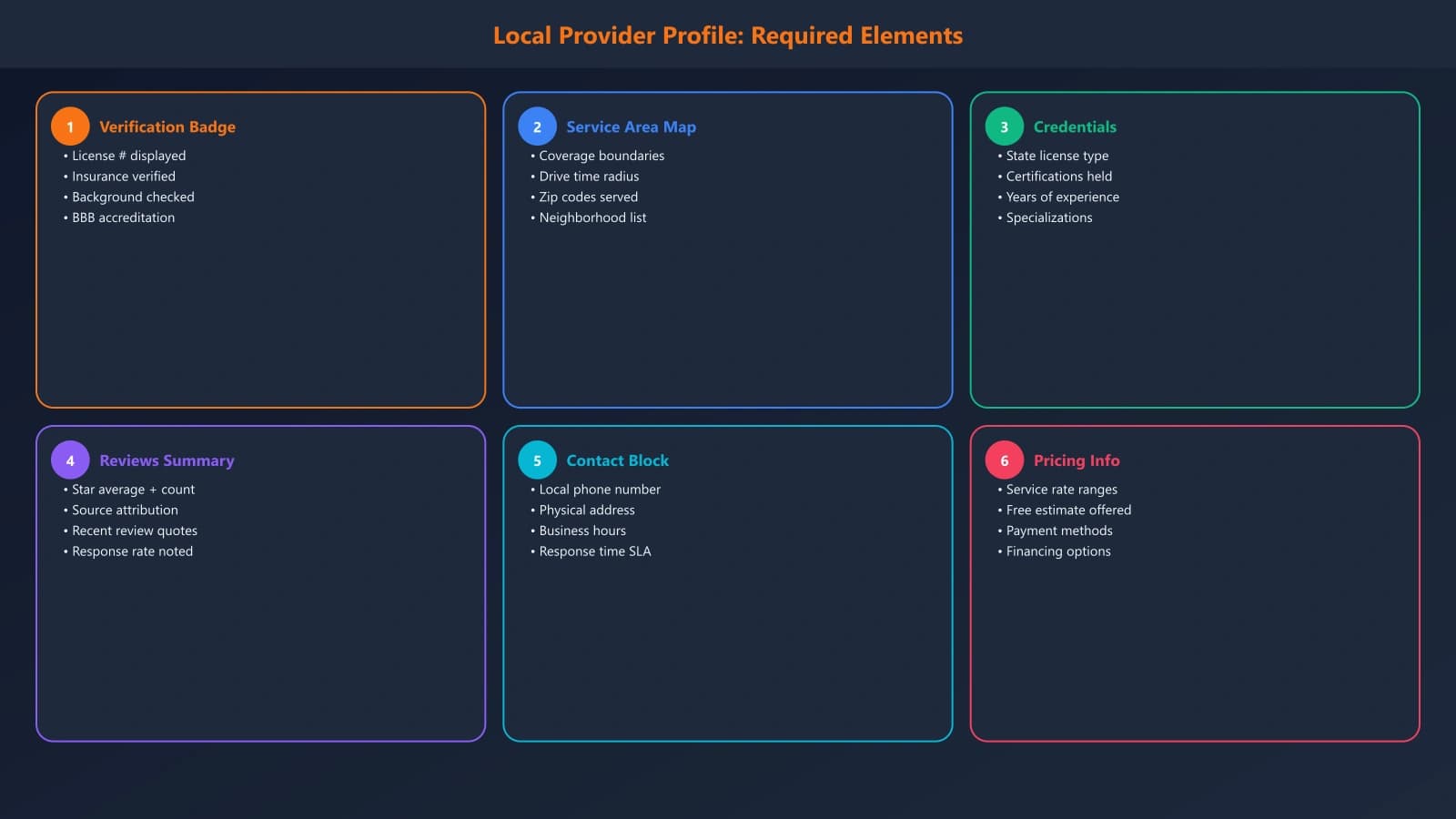
Each service provider profile should include:
- Business name and verification of current operation
- Service area within the region
- Years serving the local community
- Licensing and certification status
- Specializations relevant to local needs
- Price range (if publicly available)
- Contact information and hours
- Recent customer feedback summary
Selection Guidance
Beyond listing providers, help readers choose. What questions should they ask when calling? What red flags indicate low-quality providers? What credentials matter for this service type in this area?
This guidance positions your content as genuinely helpful rather than just a directory listing—and it's content that generic aggregators can't easily replicate.
Generate Local Service Comparison Pages
Create location-specific listicles with proper local SEO structure and provider profiles.
Try for Free
Local SEO Integration
Local comparison content intersects with local SEO in specific ways.
Organic vs. Local Pack Targeting
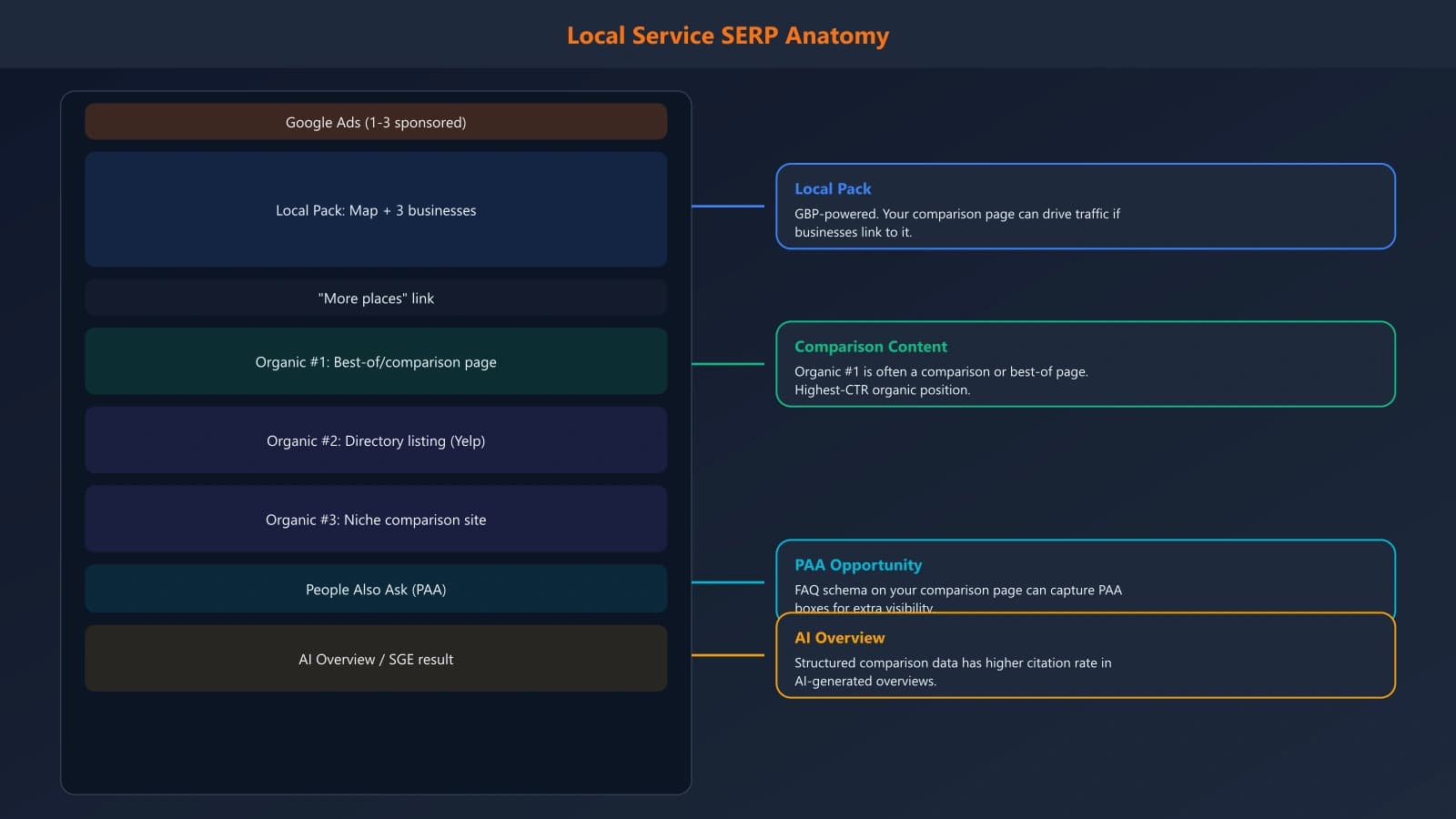
Understand which results your comparison content can realistically capture. The Local Pack (map results) typically shows actual service providers, not comparison content. Your comparison pages target the organic results below the Local Pack.
This means your page competes with other comparison sites, directories, and media publications—not with the businesses themselves. Different competitive set, different optimization priorities.
Schema Implementation Checklist
Proper schema helps search engines understand your local comparison content:
- Article schema for the page itself
- ItemList for the ranked providers
- LocalBusiness schema for each provider profiled
- AggregateRating if you provide ratings
- Geographic targeting through content (city/region mentioned)
Building Local Authority
Comparison content benefits from local authority signals beyond on-page optimization. Consider local link building opportunities—local news mentions, community organization links, local business associations. These help both the specific comparison page and your overall local topical authority.
Scaling Across Locations
Once you have a successful local comparison format, scaling to multiple cities becomes attractive—and dangerous if done poorly.
Quality Thresholds
Scaling local content creates thin content risks. Each city page needs genuine local research—not just find-and-replace city names. Establish minimum quality requirements before expansion:
- At least 5-7 legitimate, verified local providers per page
- Genuine local context that differs between cities
- Accurate, verified business information
- City-specific pricing or market context
- Different featured providers based on local strengths
Prioritizing Cities
Don't try to cover every city simultaneously. Prioritize based on search volume, competition, and your ability to source accurate local information. Start with major metros where search volume justifies investment, then expand methodically.
Maintenance Requirements
Local business information changes frequently. Businesses close, move, change ownership, or update contact information. A scaling strategy must include maintenance resources:
- Scheduled verification of business listings (quarterly minimum)
- Process for handling “business closed” reports
- Monitoring local news for provider changes
- System for providers to request corrections
Monetization Strategies
Local comparison content can monetize through several channels.
Lead generation. The most direct path: capture inquiries and sell leads to service providers. This works best for high-value services where providers pay for qualified leads (legal, home improvement, healthcare).
Advertising. Local display advertising or featured placement for providers who want premium visibility. This requires traffic at scale to be worthwhile.
Affiliate relationships. Some service categories (insurance, financial services) have affiliate programs. Others require direct partnerships with local providers.
Directory upgrades. If you build significant coverage, you can offer premium profiles with enhanced features, photos, or priority placement.
Implementation Roadmap
Here's the step-by-step approach to launching local service comparison content:
- Select your first city and service category — Start where you have local knowledge or research access
- Research and verify 7-10 providers — Ensure accurate, current information
- Build the template with local context — Create structure that can scale
- Implement proper schema — LocalBusiness, ItemList, Article
- Publish and monitor performance — Track rankings and traffic
- Iterate based on results — Refine template before scaling
- Expand methodically — Additional cities only after proving the model
For related local strategies, see our guides on City Best-Of Pages and Service Area PSEO.

Product Manager at BestPage. Pioneer in AEO research since 2024, exploring the convergence of SEO and GEO (Generative Engine Optimization). Led multiple AI-powered content optimization projects that achieved 300%+ citation increases in ChatGPT and Perplexity.