
Multi-location businesses and publishers want local SEO coverage across many cities. Manually creating best-of pages for 50, 100, or 500 locations isn't practical. Programmatic generation offers a path to scale—but local PSEO has unique challenges.
The fundamental tension: local content needs local specificity, but PSEO by nature uses templates. Resolution requires location-specific data layers that meaningfully differentiate each page, not just placeholder text with city names swapped in.
This guide covers how to build service area PSEO that actually works—the data requirements, template architecture, quality thresholds, and indexation strategy that separate successful local PSEO from thin content penalties.
PSEO Approaches for Local Content
Different local PSEO strategies suit different situations. Choose based on your data assets and content goals.
| Approach | Data Required | Best For | Risk Level |
|---|---|---|---|
| Provider-based | Verified local providers per location | Lead gen, service directories | Low if data is accurate |
| Market data-based | Location-specific market information | Real estate, financial services | Low if data is fresh |
| Template-heavy | Minimal; mostly city-name swaps | Nothing (avoid this) | High—thin content |
| Hybrid | Provider data + editorial enrichment | Quality local comparisons | Low with proper QA |
The template-heavy approach—generating pages with identical content except for city names—is the most common failure mode. Search engines easily detect this pattern and suppress or penalize such pages.
Data Requirements for Quality Local PSEO
The data layer determines whether your local PSEO creates value or creates problems.
Location-Specific Data
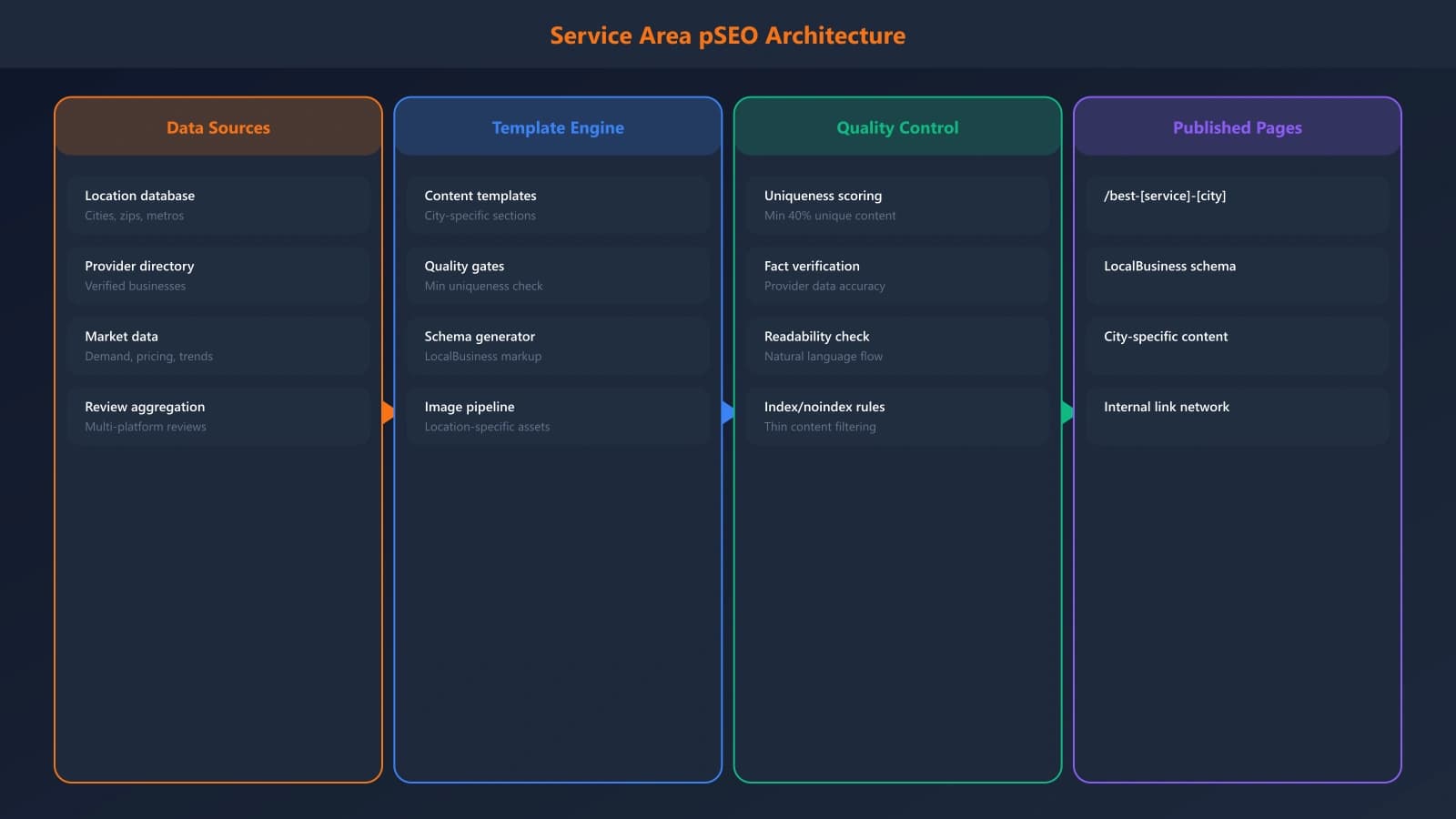
Each location page needs data unique to that location. This typically includes local providers actually serving that area (verified, with accurate contact information), market context specific to the location (pricing, demand patterns, seasonal factors), and relevant local regulations or requirements if they vary by area.
Without this location-specific layer, you don't have local content—you have generic content with local keywords inserted.
Provider Data Quality
For service comparison PSEO, provider accuracy is critical. Verify that each provider actually serves the target location, contact information is current, the business is still operating, and licensing and credentials are accurate.
Inaccurate provider data destroys credibility faster than in national content. Someone searching “best plumbers in [their city]” will immediately know if you're listing businesses that don't exist or don't serve their area.
Minimum Data Thresholds
Set minimum thresholds before generating a page. If a location doesn't have enough verified providers (typically 5+ for a useful comparison) or lacks location-specific market data, don't generate the page. A sparse page hurts more than no page.
Template Architecture
Service area PSEO templates need different structure than national templates.
Variable Content Sections
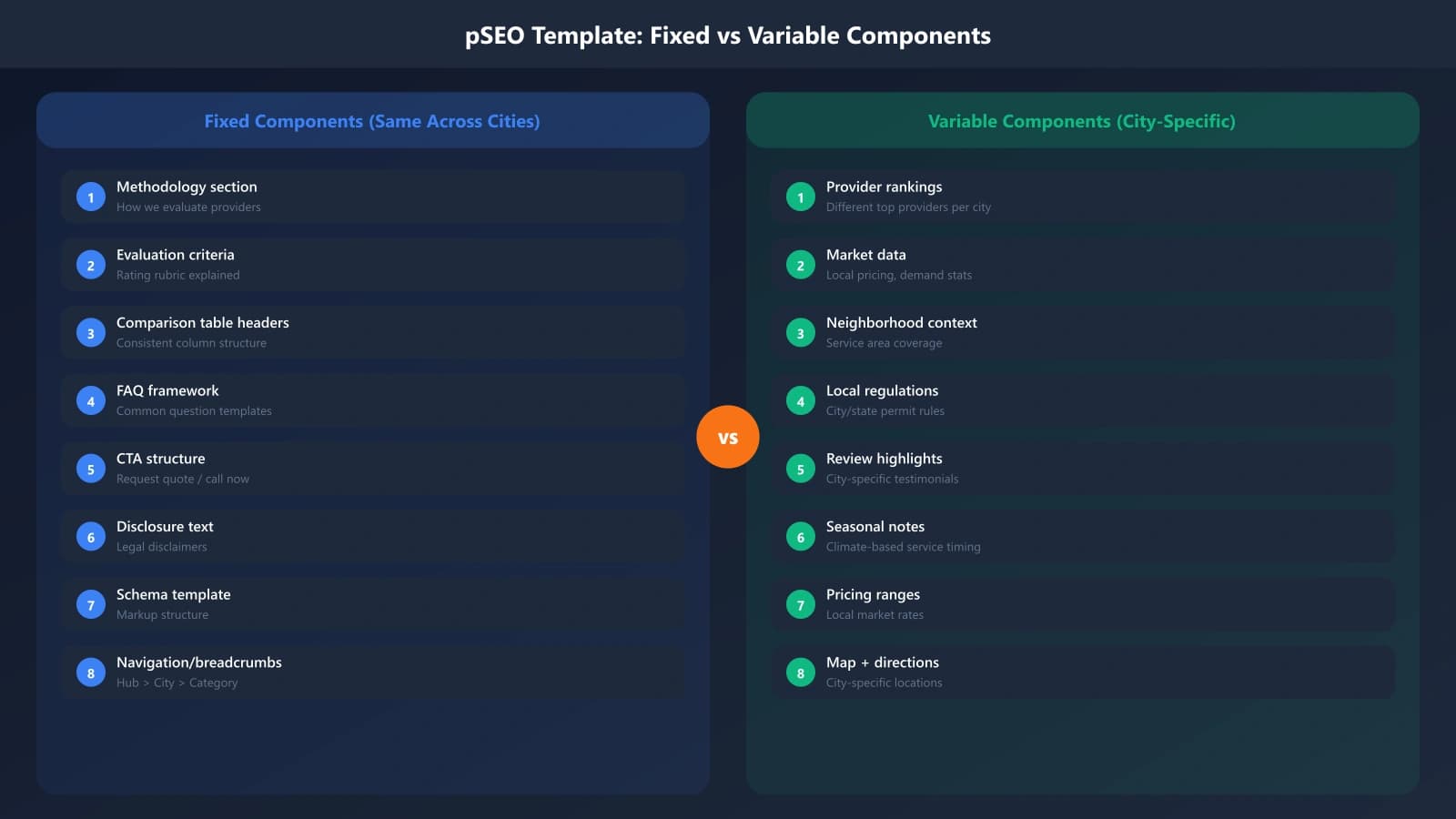
Identify which sections vary by location and which remain constant. Constant sections might include methodology explanation, general category education, and evaluation criteria. Variable sections include provider listings and details, local market context, location-specific recommendations, and relevant local information.
Design templates so variable sections dominate. If 80% of your page is template text and 20% is location-specific, you're likely creating thin content.
Conditional Content Blocks
Build templates with conditional logic. If local market data exists for this location, include the market context section. If not, omit it gracefully rather than showing placeholder text. If provider count is high, show expanded listings. If low, focus on detailed profiles rather than sparse lists.
Smart conditionals prevent the empty-placeholder problem that signals template-generated content.
Local Enrichment Layers
Add enrichment that varies meaningfully by location. Regional factors affecting service needs (climate considerations for HVAC, soil types for landscaping), local regulatory context if relevant, and community-specific considerations all add genuine differentiation.
Scale Local Comparison Pages
Generate service area content with built-in quality gates and location-specific data integration.
Try for Free
Indexation Strategy
Not every generated page should be indexed. Smart indexation protects overall domain quality.
Quality-Based Indexation
Establish indexation criteria. Pages meeting quality thresholds (sufficient providers, complete data, meaningful differentiation) get indexed. Pages below threshold either get noindexed or not generated at all.
Quality criteria might include minimum 5 verified providers, at least 70% of template variables populated with real data, location-specific content comprising at least 40% of page, and all provider contact information verified within 90 days.
Crawl Budget Management
Large local PSEO sites can have thousands of pages. Help search engines prioritize by using XML sitemaps that prioritize high-value locations, implementing clear internal linking from hub pages to spokes, and ensuring fast page speed even with dynamic data.
Ongoing Monitoring
Monitor indexation health in Search Console. Watch for pages showing “Crawled - currently not indexed” status (signals quality concerns), soft 404 patterns (empty or near-empty pages), and mobile usability issues at scale.
Problems appearing across many location pages often indicate template issues worth addressing at the source.
Scaling Local PSEO Successfully
Service area PSEO works when you have the data to support it. The constraint isn't technical—template generation at scale is straightforward. The constraint is data quality: verified providers, accurate information, and genuine location-specific content.
Invest in data first, then build templates around that data. Set quality thresholds that prioritize page quality over page quantity. Monitor rigorously and be willing to noindex or remove pages that don't meet standards.
Done right, service area PSEO captures local search traffic across your entire service geography. Done wrong, it creates thin content at scale—a much bigger problem than having no local content at all.
For the foundational local strategy, see Local Service Comparison Playbook. For individual city page optimization, see City Best-Of Pages Strategy.

Product Manager at BestPage. Pioneer in AEO research since 2024, exploring the convergence of SEO and GEO (Generative Engine Optimization). Led multiple AI-powered content optimization projects that achieved 300%+ citation increases in ChatGPT and Perplexity.