

SaaS comparison pages often want to include review data from established platforms like G2, Capterra, TrustRadius, and Gartner Peer Insights. It makes sense—these platforms have thousands of verified reviews that add credibility to your comparison.
But pulling in third-party review data creates both legal and SEO risks. Legally, you're dealing with copyright, terms of service, and potentially trademark issues. For SEO, Google has explicit guidelines about review schema that many aggregation approaches violate.
This framework covers how to aggregate reviews properly—benefiting from the credibility of established review platforms while avoiding the pitfalls that get sites penalized or sued.
Legal Considerations
Before diving into SEO best practices, let's address the legal foundation. Most comparison sites aren't run by lawyers, but these issues can result in DMCA takedowns or worse.
Copyright and Content Ownership
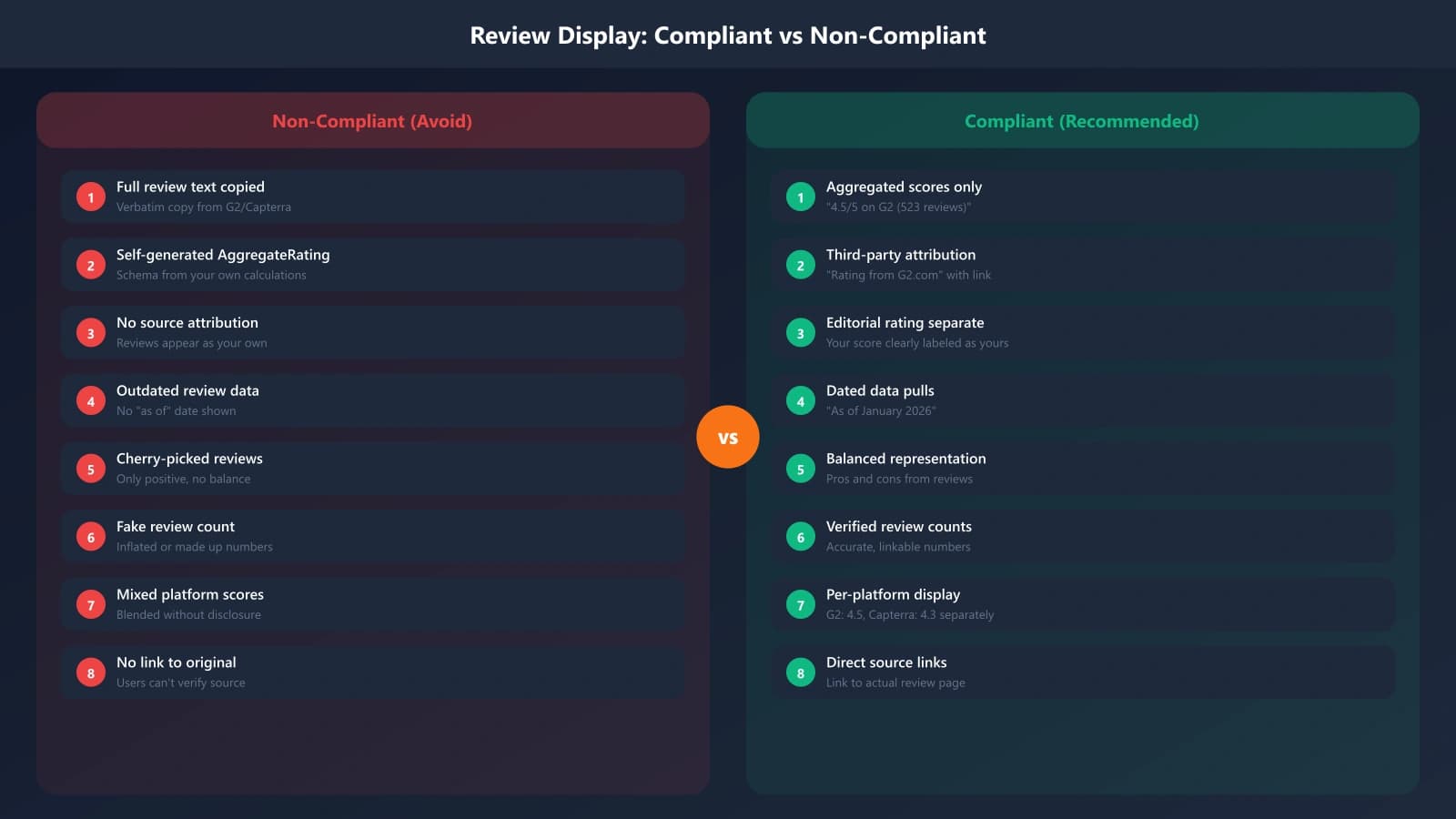
Individual reviews are copyrighted by their authors. Platforms like G2 have terms of service that grant them certain rights but don't transfer ownership to them—or to you. Copying full review text to your site without permission is copyright infringement.
What you can typically do safely:
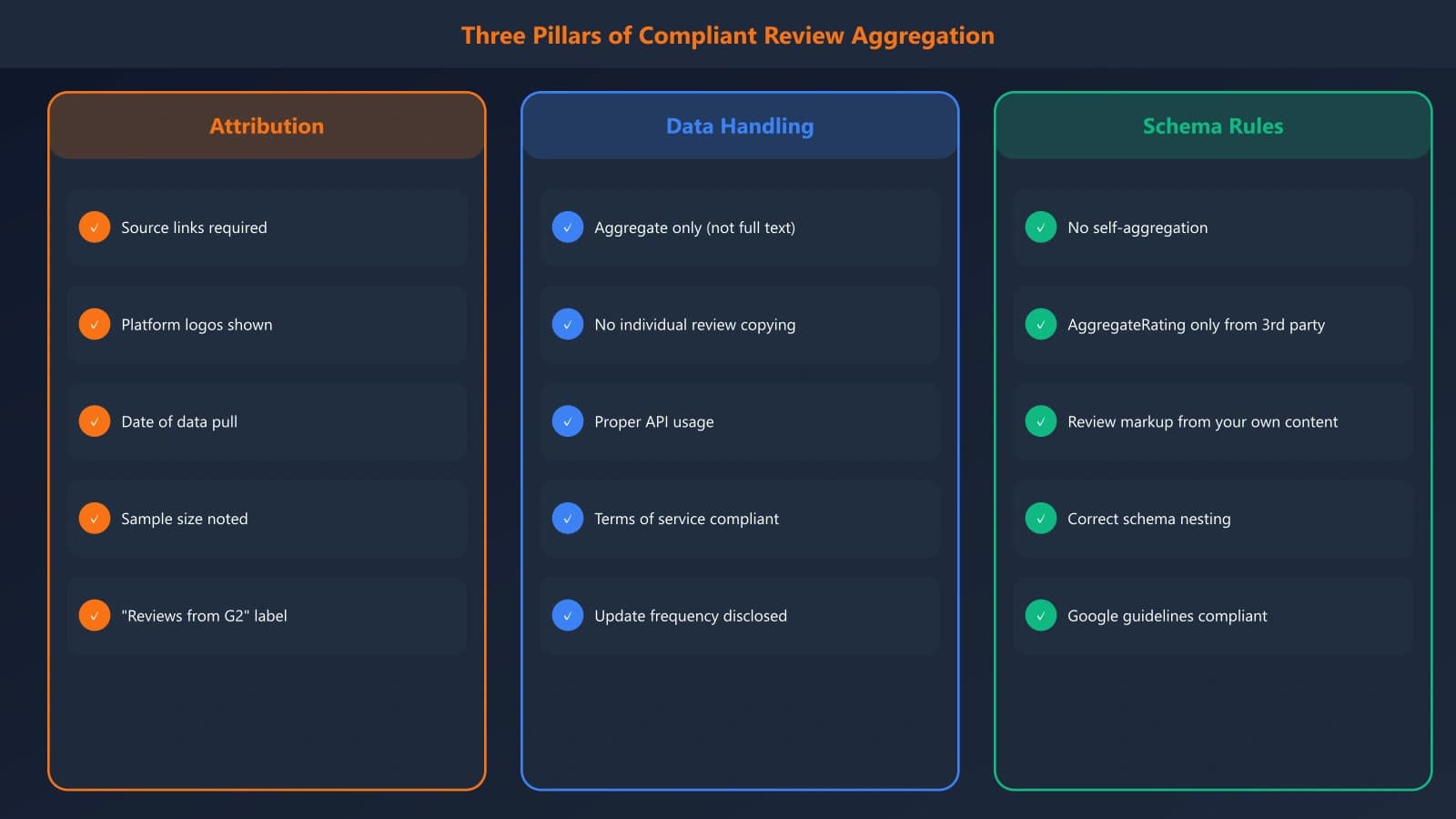
- Reference aggregate statistics (e.g., “4.5 average rating based on 500+ G2 reviews”)
- Short, attributed quotes with clear sourcing
- Links to the source platform for the full reviews
- Your own summary of review themes (not copies of specific reviews)
What typically creates risk:
- Copying multiple full reviews to your page
- Presenting reviews as if they're on your site without clear attribution
- Scraping review content in ways that violate platform terms of service
Platform Terms of Service
Each review platform has its own terms. G2, for example, explicitly prohibits scraping and has specific requirements for partners who want to display review data. Violating platform TOS can result in legal action and loss of any legitimate API access.
If you want to display review data at scale, the safest path is using official APIs or partner programs where available. These typically provide aggregate data with clear usage guidelines.
SEO Compliance
Beyond legal issues, Google has specific guidelines for review schema that directly impact how you should handle aggregated reviews.
Review Schema Rules
Google's documentation explicitly states that aggregateRating should represent ratings from your site's users, not imported from other sites. This means you cannot:
- Apply aggregateRating schema to third-party review data
- Combine your ratings with third-party ratings in one aggregateRating
- Use schema to claim rich results for reviews you didn't collect
You can still display third-party ratings on your page—you just can't mark them up with schema as if they were your own.
Proper Implementation Approach
The compliant approach separates your editorial ratings from third-party data:
Your ratings: If you have your own rating methodology, apply aggregateRating schema to that. Your “4.5 out of 5 editor rating” can have schema—with ratingCount of 1 if it's purely editorial.
Third-party ratings: Display as text without schema markup. “G2 Rating: 4.7/5 (500+ reviews)” with a link to G2. No schema on this element.
| Rating Type | Schema Allowed? | Display Method |
|---|---|---|
| Your editorial rating | Yes | Visual stars + aggregateRating schema |
| Third-party aggregate (G2, Capterra) | No | Text with source link, no schema |
| Individual third-party reviews | No | Short quotes with attribution |
| User reviews on your site | Yes | Full schema implementation |
Build Compliant Comparison Pages
Generate listicles with proper rating attribution and schema implementation that won't trigger manual actions.
Try for Free
Practical Implementation Patterns
Here are patterns that work for different levels of review integration.
Light Integration: Stats and Links
The simplest approach: reference aggregate statistics and link out. No legal risk, no schema issues.
Example format: “HubSpot CRM maintains a 4.4/5 rating on G2 based on 10,000+ reviews. See reviews →”
This provides credibility without copying content or misusing schema. Users who want detail click through to the source.
Moderate Integration: Curated Quotes
Select a small number of representative quotes with clear attribution:
“The workflow automation saved our team 10 hours per week.” — Verified G2 Review, Marketing Manager
Keep quotes short (under 50 words). Always attribute with platform and role. Link to the full review if possible. This falls under fair use for commentary purposes, though be conservative with quantity.
Heavy Integration: Partner APIs
If you need extensive review data, pursue official partnerships. G2 and similar platforms offer content syndication programs with clear licensing terms.
Partner programs typically provide:
- Sanctioned data feeds with usage rights
- Official widgets you can embed
- Clear guidelines on attribution and display
- Sometimes, permission to use specific schema markup
This route requires business relationships but eliminates legal ambiguity.
Red Flags to Avoid
These patterns consistently cause problems:
Scraping at scale. Automated extraction of review content violates virtually every platform's terms and creates massive copyright exposure.
Fake aggregation. Marking up third-party ratings as if they were your aggregateRating is explicitly against Google guidelines. Manual actions for this are common.
Unclear attribution. Displaying reviews or ratings without clear source attribution confuses users about where the data came from and can be seen as misrepresentation.
Cherry-picking without disclosure. Only showing 5-star quotes without mentioning the overall rating or range is misleading. If a product has 3.2 stars overall but you only quote the glowing reviews, that's a credibility problem.
Building a Sustainable Approach
Third-party reviews add genuine value to comparison content—readers want to know what real users think. The key is integrating this data in ways that are legally sound, SEO-compliant, and genuinely helpful.
Start with the light integration pattern for most use cases. Reference aggregate data, link to sources, and let the review platforms handle the detailed content. If you need deeper integration, pursue official partnerships rather than scraping.
For your own editorial ratings, implement proper schema as covered in Rating Schema for Listicles. Keep your ratings and third-party ratings visually and technically separate.
This approach builds sustainable credibility—the kind that doesn't disappear when a platform sends a cease-and-desist or Google issues a manual action.

Product Manager at BestPage. Pioneer in AEO research since 2024, exploring the convergence of SEO and GEO (Generative Engine Optimization). Led multiple AI-powered content optimization projects that achieved 300%+ citation increases in ChatGPT and Perplexity.