
Ratings make listicles actionable. A “4.5 out of 5” score gives readers a quick summary of your assessment. But beyond user experience, ratings create an opportunity for rich results in search and help AI systems understand your evaluations.
The challenge is implementing rating schema correctly. Google has become increasingly strict about review and rating markup. Sites that use arbitrary or self-serving ratings risk manual actions. Sites that implement ratings without proper methodology undermine their own credibility.
This guide covers how to build a legitimate rating system for listicles and implement the corresponding schema correctly. You'll learn what properties are required, what triggers spam signals, and how to make ratings that both users and search engines trust.
Building a Legitimate Rating Methodology
Before implementing schema, you need a rating system worth marking up. Arbitrary 4.7-star ratings across all products aren't just unhelpful—they're a spam signal.
Defining Rating Criteria
Effective ratings break down into measurable components. For software listicles, common criteria include:
- Features — Does the product offer capabilities relevant to this category?
- Usability — How easy is it to learn and use day-to-day?
- Value — Is the pricing appropriate for what you get?
- Support — What's the quality and availability of help?
- Reliability — Does it work consistently without issues?
Define your criteria explicitly, weight them appropriately for your audience, and document the methodology. This documentation serves double duty: it makes your ratings defensible and provides content for a methodology section that builds E-E-A-T.
Designing the Scoring System
Choose a rating scale and stick with it. The most common options:
| Scale | Pros | Cons |
|---|---|---|
| 5-star | Familiar, rich result compatible | Can feel arbitrary at decimal level |
| 10-point | More granular differentiation | Harder to interpret quickly |
| 100-point | Maximum granularity | False precision; convert to 5-star for schema |
| Letter grade | Clear communication | Needs numerical mapping for schema |
Whatever scale you use internally, schema expects a numerical rating. Map your system to bestRating/worstRating appropriately. For 5-star systems, bestRating is 5 and worstRating is 1.
Schema Types for Listicle Ratings
Two schema types are relevant for listicle ratings: AggregateRating and Review. Understanding when to use each is critical.
AggregateRating Schema
Use AggregateRating when your rating represents a synthesis of multiple factors or sources. This is the most common type for listicles where you assign a single overall score to each product.
AggregateRating requires these properties:
- ratingValue — The actual rating number
- bestRating — Maximum possible value (usually 5)
- ratingCount or reviewCount — How many ratings/reviews contributed
The ratingCount requirement is where many listicles go wrong. If your rating is based solely on your editorial assessment (one review), ratingCount should be 1. Don't inflate this number.
Review Schema
Use Review schema when you're providing a full review with prose assessment, not just a numerical score. Review includes an author, reviewBody (the actual review text), and can include a rating.
For listicles, you might nest Review inside Product schema for each item, with your editorial review as the content. This is more accurate than standalone AggregateRating if you're providing substantive analysis.
Combining With Product/ItemList
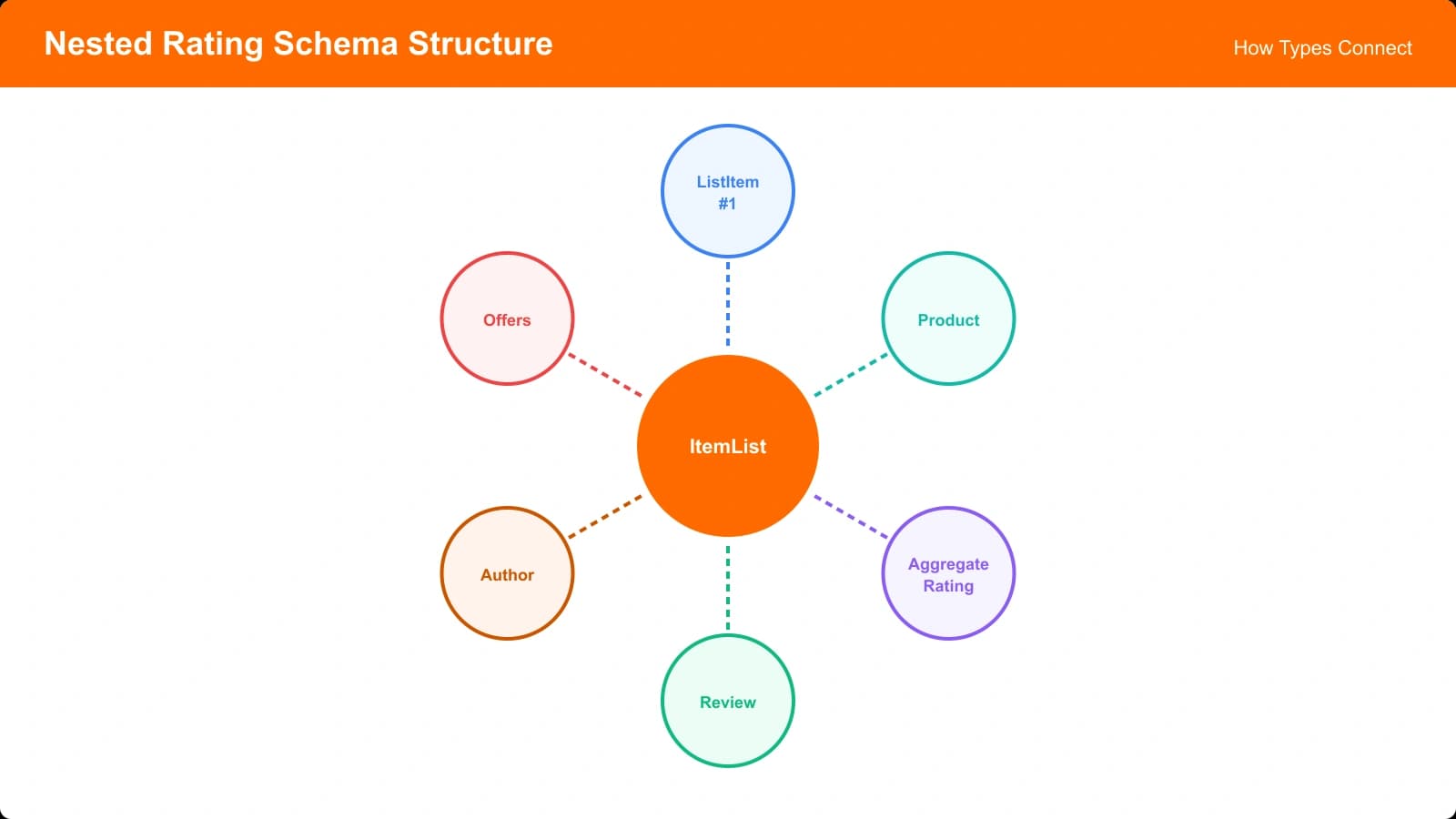
Ratings don't exist in isolation—they attach to Product or SoftwareApplication entities within your ItemList. The structure looks like:
Page level: ItemList containing multiple ListItem entries. Each ListItem contains a Product/SoftwareApplication with an aggregateRating or review property.
For complete JSON-LD templates showing this structure, see our guide on JSON-LD Templates for Best-Of Pages.
Generate Listicles With Proper Rating Schema
Create best-of pages with legitimate rating systems and correctly implemented structured data.
Try for Free
Implementation Checklist
Before publishing rating schema, verify each of these requirements.
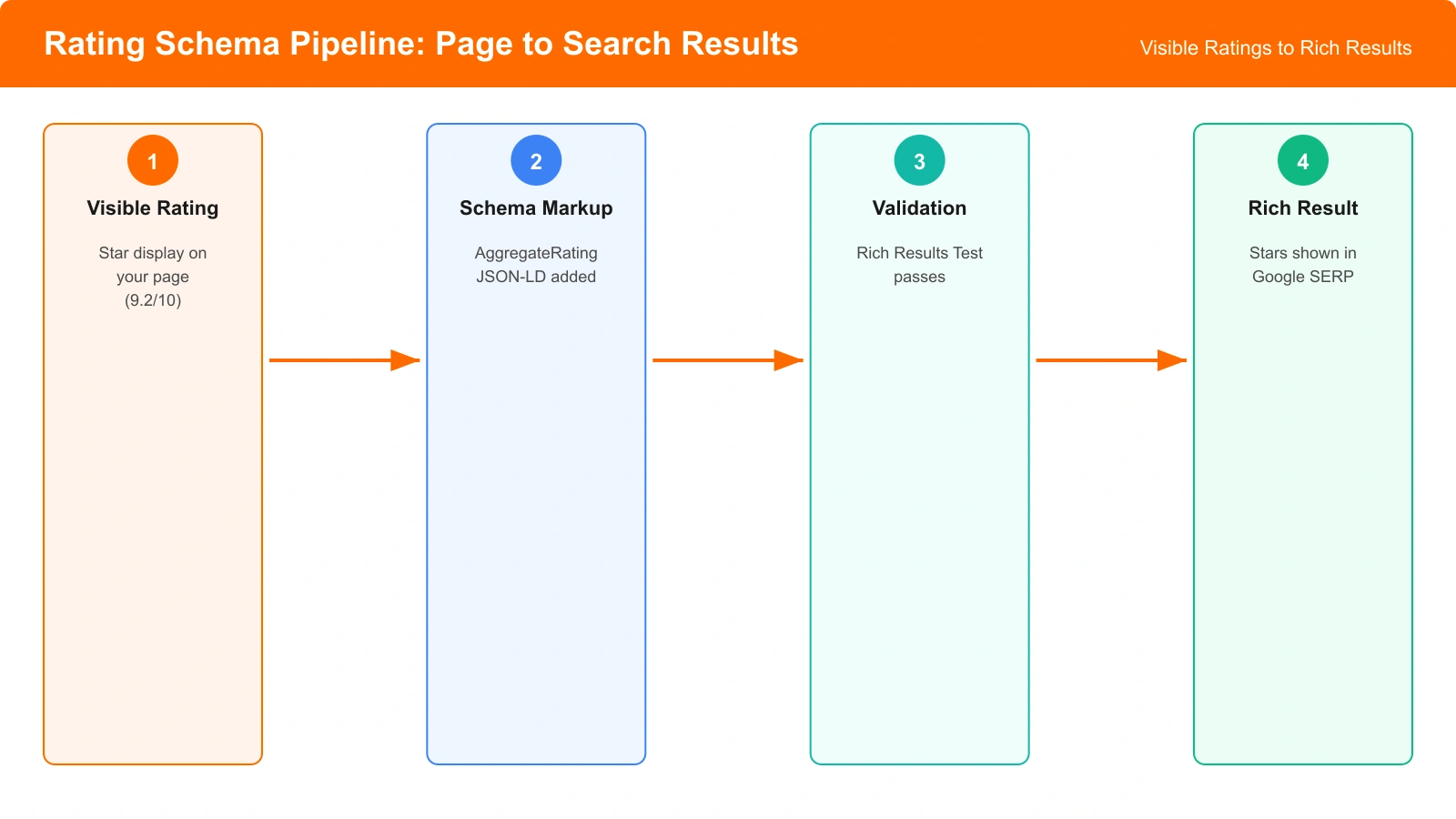
Visible ratings match schema. The star rating users see must match what's in your schema. Any discrepancy is a spam signal. If your page shows 4.2 stars, your ratingValue must be 4.2.
Required properties are present. Missing ratingValue, bestRating, or ratingCount causes validation errors. Use Google's Rich Results Test to check.
Ratings are specific to individual items. Each product in your listicle should have its own rating, not a page-level aggregate. A “Best CRM Software” page doesn't have a 4.5-star rating—individual CRM products do.
Methodology is documented. Even if not required by schema, having a visible methodology section improves credibility and helps with E-E-A-T evaluation.
Ratings vary appropriately. If all 10 products score between 4.3-4.7, you're not providing meaningful differentiation. Review whether your criteria actually distinguish products.
Common Mistakes That Trigger Spam Signals
Google's review and rating documentation explicitly warns against these patterns.
Self-serving reviews. Rating your own product 5 stars while rating competitors lower is an obvious conflict of interest. If you're a vendor comparing yourself to competitors, be especially careful about bias signals.
Fabricated rating counts. Claiming “based on 50 reviews” when your rating is actually one editor's opinion is deceptive. If it's editorial, own that. Set ratingCount to 1.
Rating non-ratable items. AggregateRating is for products, services, recipes, and similar entities. Don't add rating schema to content that isn't meaningfully ratable.
Ratings without corresponding content. If you show 4.5 stars but your page doesn't actually review the product, the rating lacks context. Ensure each rating is supported by visible assessment.
Ignoring negative aspects. Reviews that are 100% positive for everything look fake. Legitimate ratings acknowledge weaknesses alongside strengths.
Building Trust Through Ratings
Ratings are powerful precisely because they summarize complex assessments into simple signals. But that power comes with responsibility. Arbitrary or manipulated ratings undermine trust with both users and search engines.
The approach that works: build a legitimate methodology first, then implement schema that accurately represents it. Don't start with “I want star ratings in search results” and work backward—that approach almost always produces problematic markup.
When done right, rating schema helps users quickly understand your assessments and helps AI systems extract accurate information about how products compare. That's a win for everyone.
For the complete picture of structured data options for listicles, see our guides on Structured Data for Listicles and JSON-LD Templates for Best-Of Pages.

Product Manager at BestPage. Pioneer in AEO research since 2024, exploring the convergence of SEO and GEO (Generative Engine Optimization). Led multiple AI-powered content optimization projects that achieved 300%+ citation increases in ChatGPT and Perplexity.