
Search “best [almost anything]” and Wirecutter is probably in the top three results. Best mattresses, best headphones, best blenders, best carry-on luggage—they rank for thousands of high-value product comparison queries.
For anyone building comparison content, Wirecutter is both inspiration and intimidation. They seem to have cracked the code on product listicles. But what exactly makes their pages work so well?
This teardown analyzes a representative Wirecutter guide—their “Best Wireless Earbuds” page—to identify the specific patterns that drive their success. We'll examine page structure, content depth, E-E-A-T signals, and what you can actually learn and apply.
The Authority Foundation
Before examining page-level tactics, acknowledge the elephant in the room: Wirecutter is part of The New York Times. This gives them a domain authority advantage most sites can't replicate.
But Wirecutter built their authority before the NYT acquisition. The patterns that built that authority—and that still drive their success—are learnable.
Genuine Testing Credibility
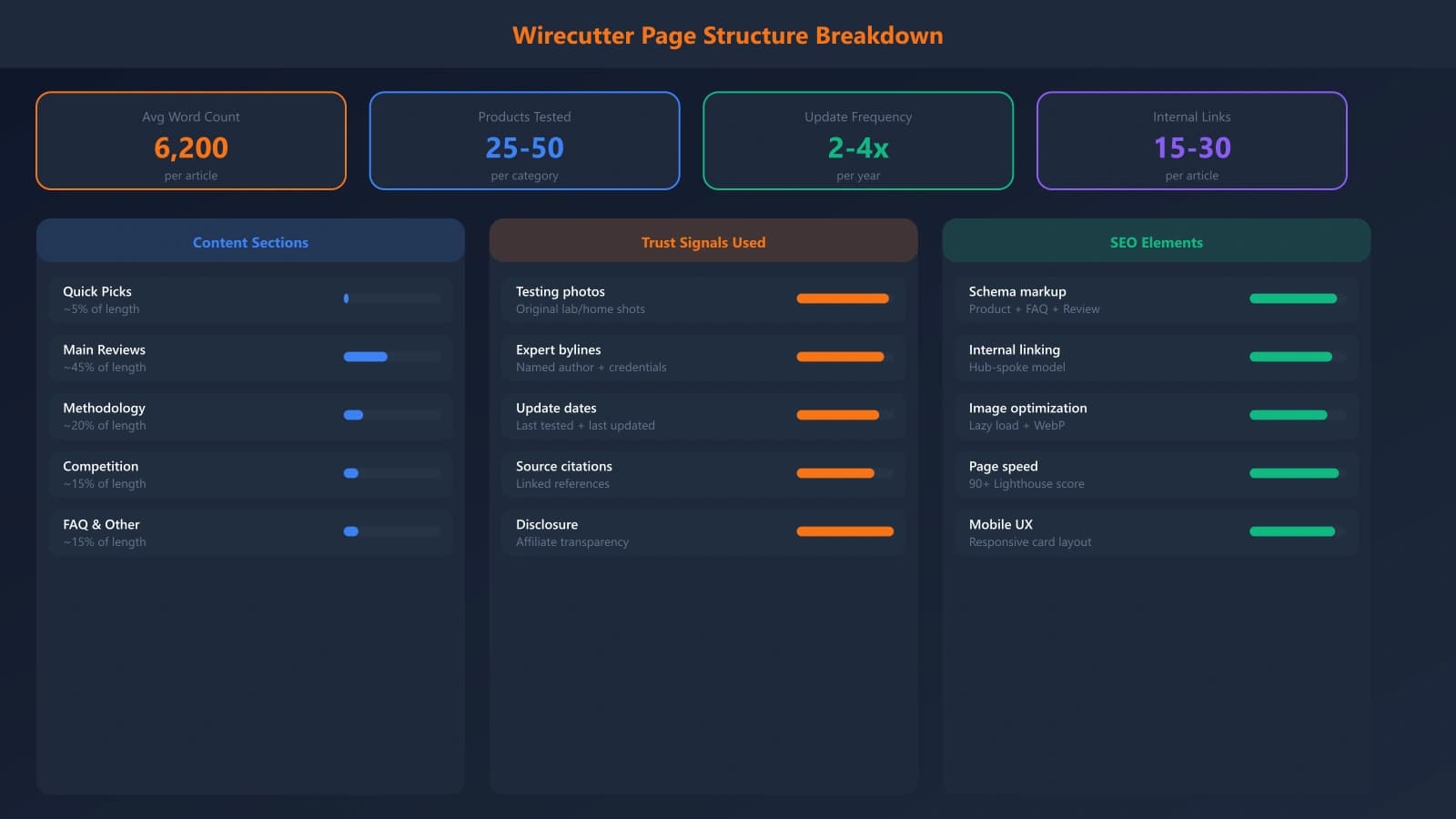
Wirecutter actually tests products. Their wireless earbuds guide mentions testing “over 200 pairs of true wireless earbuds.” They describe methodology: how they evaluate sound quality, measure battery life, assess fit across testers with different ear shapes.
This isn't claimed expertise—it's demonstrated expertise. Photos show testing setups. Staff bylines link to author pages with credentials. The process is documented, not just claimed.
What to learn: If you recommend products, have a real process. Document it. Show your work. “We reviewed the specs” is not testing. “We used each pair for a week of commutes, workouts, and video calls” is.
Transparent Methodology
Every Wirecutter guide includes a “Why you should trust us” or “How we picked and tested” section. This isn't boilerplate—it's specific to the category, explaining what matters for this product type and how they evaluated it.
This section serves multiple purposes:
- Builds reader trust through transparency
- Satisfies Google's E-E-A-T requirements
- Adds unique content that competitors don't have
- Creates internal linking opportunities to related guides
Page Structure Analysis
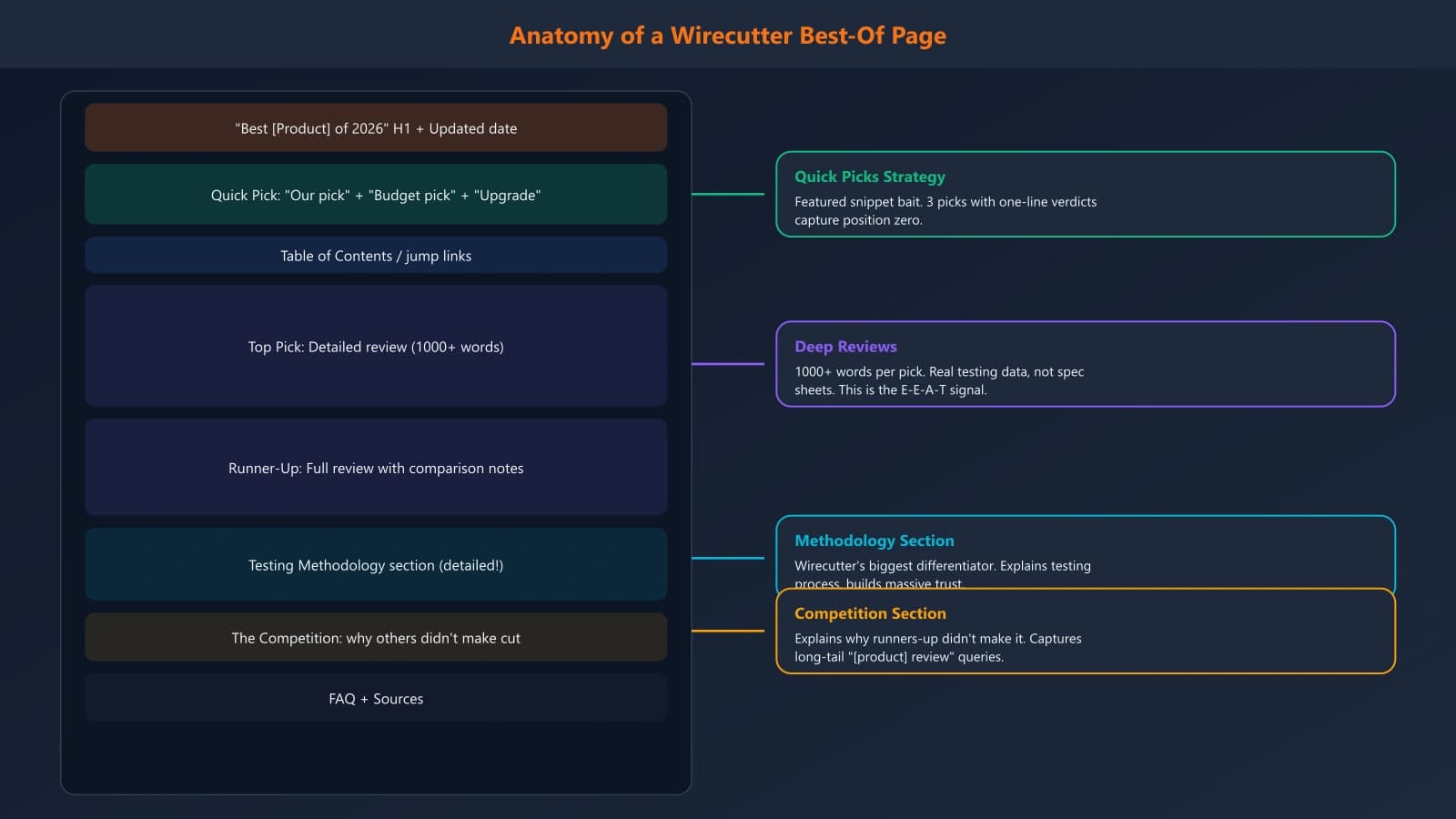
Wirecutter pages follow a consistent structure that serves both user experience and SEO.
Immediate Value: Quick Picks
The page opens with a table of “Our picks”—the top recommendations with one-line summaries. Someone who just wants “the answer” gets it immediately. This reduces pogo-sticking and satisfies the search intent within seconds.
Each pick links to the detailed section below. Users who want justification can jump there; users who trust Wirecutter can click straight to Amazon.
Structured Deep Dives
After quick picks, each recommended product gets a dedicated section following a consistent template:
- Product name as H2 with verdict summary
- Why it's great — Specific features and benefits
- Flaws but not dealbreakers — Honest downsides
- Key specs — Technical details that matter
- Who it's for — Use case guidance
This template creates consistency across thousands of product reviews while allowing category-specific customization.
The Competition Section
After the main picks, Wirecutter includes a “Competition” section covering products they tested but didn't recommend. This is brilliant for several reasons:
- Captures search queries for products they don't feature
- Demonstrates comprehensive testing
- Provides contrast that makes their picks look better
- Adds substantial unique content
| Section | Purpose | SEO Benefit |
|---|---|---|
| Quick Picks | Immediate answer | Reduces bounce, satisfies intent |
| Detailed Reviews | Justification and detail | Depth, dwell time |
| How We Tested | Credibility | E-E-A-T signals |
| Competition | Comprehensiveness | Long-tail capture |
| FAQ | Category education | Featured snippet potential |
Create Wirecutter-Style Listicles
Generate professionally structured comparison pages with quick picks, deep dives, and methodology sections.
Try for Free
Content Approach
Beyond structure, Wirecutter's content style sets them apart from commodity comparison content.
Opinionated, Not Comprehensive
Wirecutter doesn't try to list every option. Their “Best Wireless Earbuds” guide features 6-8 picks—not 50. Each pick has a clear use case: best overall, best budget, best for workouts.
This constraint creates value. Readers trust that Wirecutter has filtered options to the ones worth considering. Compare to generic listicles that list 25 options with no real differentiation.
Honest Negatives
Every Wirecutter review includes “Flaws but not dealbreakers.” Even their top pick has documented downsides. This honesty paradoxically increases trust—readers know they're getting complete information.
Compare to affiliate content that pretends every product is perfect. Users know that's not true, so they don't trust the positive claims either.
Specific, Not Generic
Wirecutter content is notably specific. Not “great sound quality” but “a warm, bass-forward sound signature with crisp highs that suits most genres well, though audiophiles who prefer neutral reproduction might find them colored.”
This specificity signals expertise. Anyone can say “good.” Describing exactly how something is good—and for whom—requires actually understanding the product.
Technical SEO Elements
Wirecutter's technical SEO is solid but not exotic. What's notable is consistent execution rather than innovative tactics.
Schema implementation: Product schema with ratings, Article schema with author details, FAQ schema for the FAQ section. Nothing unusual, but correctly implemented.
Internal linking: Extensive cross-linking between related guides. The wireless earbuds guide links to their headphone guide, their budget earbuds guide, and individual brand pages.
URL structure: Clean, keyword-focused URLs like /reviews/best-wireless-earbuds/. Category organization supports topical authority.
Update signals: Visible “Last updated” dates that are genuinely recent. Wirecutter maintains pages, adding new products and removing discontinued ones.
What You Can Actually Replicate
Not everything about Wirecutter is replicable. NYT domain authority isn't something you can build overnight. But many patterns are actionable:
Structure your pages for skimmers AND readers. Quick picks at top, detailed content below. Serve both user types.
Be opinionated. Pick winners. Don't hedge with “it depends.” The value of comparison content is the comparison—making clear recommendations.
Include honest negatives. Every product has downsides. Documenting them builds trust and demonstrates genuine evaluation.
Document methodology. Explain how you evaluate products. This adds unique content and builds E-E-A-T signals.
Cover the competition. Products you didn't recommend are still content opportunities. Explain why they didn't make the cut.
Maintain and update. Comparison content isn't publish-and-forget. Regular updates with new products and removed old ones signal ongoing value.
Applying These Lessons
Wirecutter's dominance isn't magic—it's the result of doing comparison content exceptionally well over many years. The compound effect of quality content, maintained over time, with the resources to test genuinely, adds up.
You probably can't out-Wirecutter Wirecutter in their core categories. But you can apply their patterns to niches they don't cover deeply. Find categories where you can be the testing authority, document your methodology, and execute the structural and content patterns that make their pages work.
The gap between commodity listicles and Wirecutter-quality content is effort and expertise, not secrets. Put in the work, and the patterns work for you too.
For related implementation guidance, see our articles on Affiliate Listicle Compliance and Building a Listicle Testing Methodology.

Product Manager at BestPage. Pioneer in AEO research since 2024, exploring the convergence of SEO and GEO (Generative Engine Optimization). Led multiple AI-powered content optimization projects that achieved 300%+ citation increases in ChatGPT and Perplexity.