
Programmatic SEO creates a dangerous temptation: if generating one page is easy, why not generate thousands? The answer is thin content penalties. Google specifically targets “automatically generated content” that adds no value beyond what a simple database query provides.
The line between valuable programmatic content and thin spam is real. Crossing it doesn't just affect individual pages—it can tank your entire domain. This guide covers how to identify thin content risks in PSEO, prevent them during development, and fix them if they already exist.
Identifying Thin Content
Before you can fix thin content, you need to recognize it. Here are the patterns that signal problems.
The Template-Only Problem
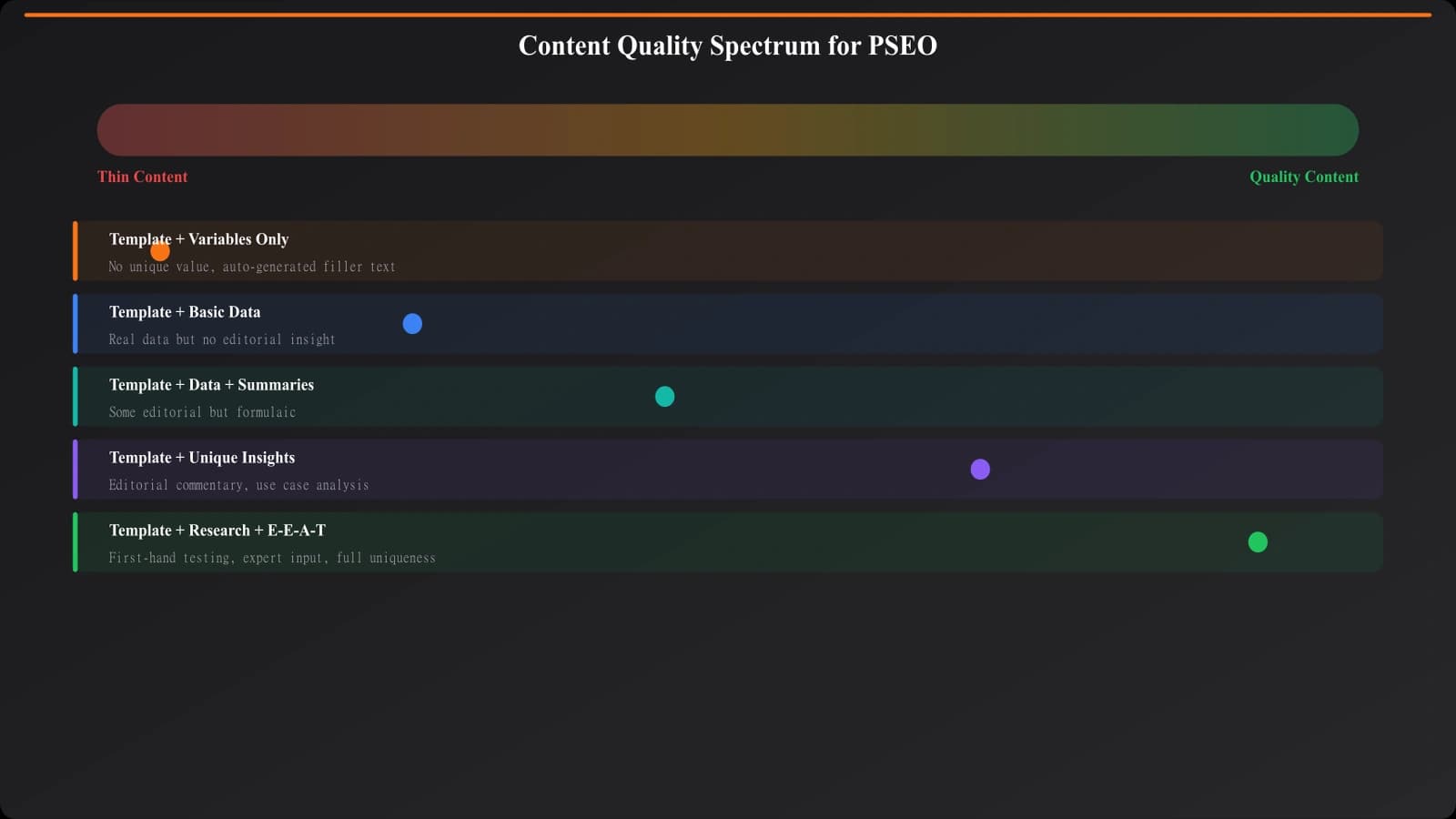
The most obvious thin content: pages where template text dominates and variables are the only difference. If your “Best [Product] for [Industry]” pages have identical sentences except for [Product] and [Industry], that's thin content.
Signs to look for:
- Same paragraphs appearing on hundreds of pages
- Only product names and specs varying between pages
- No commentary, analysis, or unique insight per page
- Page content could be generated by find-and-replace
Incomplete Data Pages
Pages generated despite missing critical data. Empty comparison tables, product cards with “N/A” in every field, sections that say “[No description available]”—these expose that your template ran but lacked substance.
A comparison page without actual comparison data isn't a comparison page—it's a placeholder. Placeholders shouldn't be indexed.
No Meaningful Differentiation
Pages that technically differ but don't provide distinct value. “Best CRM for Accountants” and “Best CRM for Bookkeepers” might sound like different pages, but if the content is 95% identical because you're recommending the same products with the same reasons, that's effectively duplicate content.
Prevention Techniques
The best approach to thin content is not generating it in the first place.
Minimum Value Thresholds
Before generating a page, check if the inputs meet minimum quality standards:
- Does the keyword have sufficient search volume to justify a page?
- Is there enough data to populate critical page sections?
- Can you provide unique insight for this specific combination?
- Does this page meaningfully differ from existing pages?
Build these checks into your generation pipeline. If thresholds aren't met, skip the page or flag it for manual review.
Data Completeness Requirements
Define which data fields are required versus optional. Required fields must be populated—if they're missing, don't generate the page.
| Field | Required? | Fallback if Missing |
|---|---|---|
| Product name | Yes | Skip page |
| Product description | Yes | Skip page |
| Pricing | No | “Contact for pricing” |
| Rating | Yes | Skip page if no evaluation |
| Pros/Cons | Yes | Skip page |
| Screenshots | No | Hide image section |
Unique Content Layers
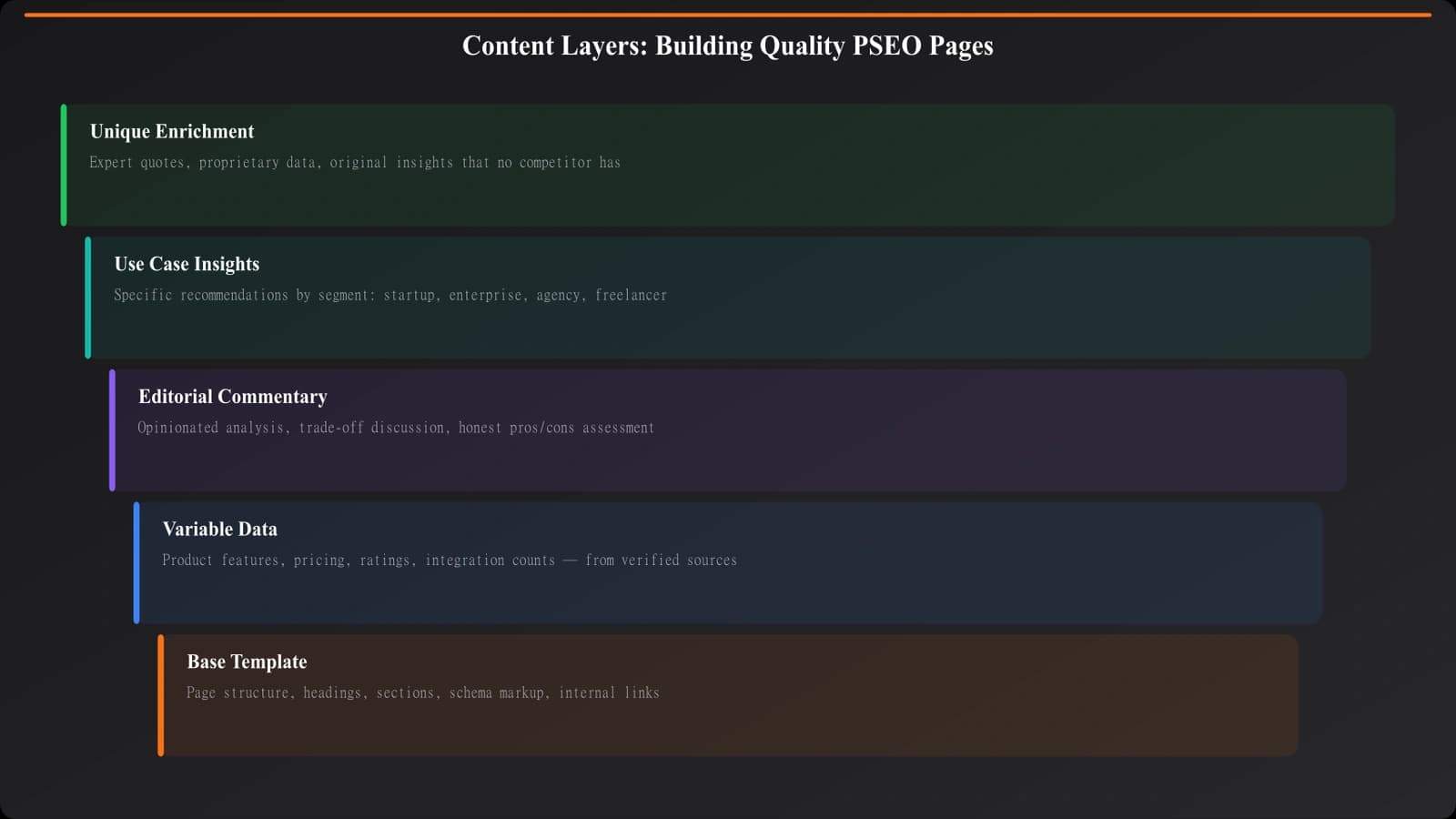
Add content layers that vary per page beyond simple variable substitution:
- Editorial commentary — Human or AI-written insight specific to this combination
- Use case matching — Content that explains why this specific product fits this specific context
- Comparison context — How this option differs from alternatives in this segment
- Data enrichment — Information specific to the page that isn't template-driven
Each layer adds uniqueness. The more layers, the less thin the content.
Generate Quality PSEO Pages Automatically
Built-in quality thresholds ensure every generated page provides genuine value.
Try for Free
Fixing Existing Thin Content
If you've already generated thin content, here's how to remediate.
Audit the Damage
Start by identifying which pages are thin. Run content similarity analysis across your PSEO pages. Pages with very high similarity scores are candidates for consolidation or improvement.
Check Search Console for pages not being indexed or showing “Crawled - currently not indexed” status. Google may have already identified them as low-quality.
Remediation Options
For each thin page, choose one of these paths:
1. Enhance. Add unique content, better data, editorial insight. Make the page genuinely valuable. This is appropriate for high-priority keywords where you have the resources to improve quality.
2. Consolidate. Merge similar pages into one comprehensive page. If you have ten near-identical pages, one strong page targeting all those keywords is better than ten weak pages.
3. Noindex. For pages not worth the effort to improve or consolidate, add noindex. They can still exist for user navigation but won't consume crawl budget or risk penalties.
4. Remove. Delete pages that have no user value. Redirect or 404 as appropriate. Sometimes less is more.
Prevention Going Forward
After remediation, update your generation pipeline to prevent recurrence. Add the quality thresholds, data requirements, and uniqueness checks that would have caught these issues before publishing.
For systematic uniqueness measurement, see PSEO Uniqueness Scoring.
Building Quality at Scale
Thin content is the primary risk of programmatic SEO. It's also entirely preventable. The techniques in this guide—value thresholds, data requirements, uniqueness layers, and systematic auditing—form a quality control system that scales with your content.
The goal isn't generating the most pages. It's generating pages that deserve to exist—pages that help users, satisfy search intent, and earn their place in the index. Every page that meets that bar strengthens your domain. Every page that doesn't weakens it.
Build quality into your pipeline, not as an afterthought. The pages you don't generate might be more valuable than the ones you do.

Product Manager at BestPage. Pioneer in AEO research since 2024, exploring the convergence of SEO and GEO (Generative Engine Optimization). Led multiple AI-powered content optimization projects that achieved 300%+ citation increases in ChatGPT and Perplexity.