
For years, featured snippets were the coveted “position zero”—a prominent answer box at the top of search results pulling content directly from your page. Win the featured snippet, get prominent visibility and strong click-through. The optimization playbook was well-established: answer questions concisely, use clear structure, target snippet-friendly query patterns.
AI answer boxes—whether Google's SGE, Bing's Copilot integration, or other implementations—operate fundamentally differently. Instead of excerpting one source, they synthesize answers from multiple sources. Instead of pulling your exact text, they generate new text influenced by your content. The value proposition changes: you're not getting your words displayed, but rather influencing the AI's answer.
For comparison content publishers, this distinction matters enormously. Featured snippets for “best CRM tools” might pull your top 3 picks directly. AI answers for the same query might synthesize recommendations from multiple sources, citing you alongside competitors. The optimization approaches, expected outcomes, and strategic value differ substantially.
This guide compares the two SERP features in depth, helping you understand which to prioritize for different queries and how to optimize for each. The reality is that search results increasingly show both—but understanding their differences helps you allocate optimization effort effectively.
Understanding the Fundamental Differences
Before developing strategy, understand how these SERP features differ in mechanism and value.
Featured Snippets: The Traditional Model
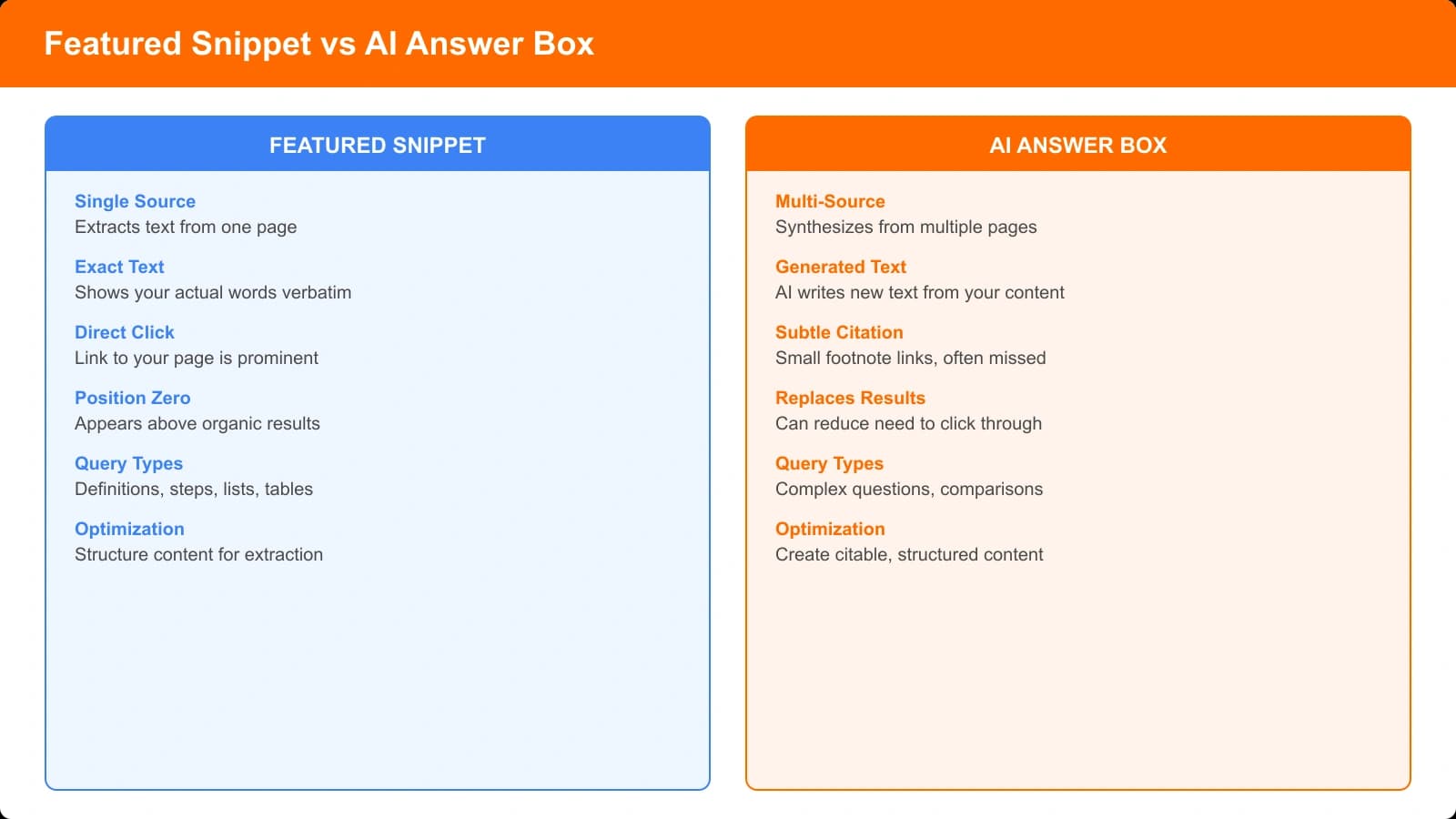
Featured snippets work by extraction. Google identifies a page that answers the query well, then extracts and displays relevant content directly. Key characteristics:
- Single source: One page wins the snippet position for a given query
- Direct extraction: Your exact words appear in search results
- Clear attribution: Your page URL and title are prominently displayed
- Click path: Users can click through to your full content
- Predictable selection: Well-established optimization patterns work
The value proposition is straightforward: get excerpted, get visibility, get clicks. The winner-take-all dynamic means effort focuses on beating competing pages for that single snippet position.
AI Answer Boxes: The New Model
AI answer boxes work by synthesis. The AI reads multiple sources, understands the collective information, and generates a new answer. Key characteristics:
- Multiple sources: Several pages contribute to the answer
- Generated text: AI writes new text, not excerpting yours
- Variable attribution: Citations may appear as footnotes, inline links, or not at all
- Reduced clicks: Comprehensive answers reduce click-through need
- Emerging patterns: Optimization best practices still evolving
The value proposition is murkier: influence the answer, maybe get cited, maybe get clicks. Multiple sources can “win” simultaneously by contributing to the synthesized answer.
Key distinction:
Featured snippets: “Your content is THE answer”
AI answer boxes: “Your content contributes to AN answer”
Query-Level Targeting Decisions
Not all queries warrant the same approach. Different query types favor different SERP features.
Queries Where Featured Snippets Dominate
Featured snippets remain strong for certain query patterns:
Featured snippet-favorable patterns:
• Definition queries: “What is [term]?”
• How-to queries with step sequences: “How to [action]”
• Quick factual answers: “How many [things]?”
• Simple comparisons: “X vs Y” with clear differences
• Lists with definitive items: “Types of [category]”
These queries have relatively objective, stable answers that Google can confidently excerpt from a single authoritative source. The featured snippet model works well when one source genuinely has the best answer.
Queries Where AI Answers Dominate
AI synthesis shines for queries requiring nuance or aggregation:
AI answer-favorable patterns:
• Complex recommendations: “Best X for [specific situation]”
• Multi-factor comparisons: Queries needing synthesis across dimensions
• Subjective evaluations: “Should I [action]?”
• Personalized guidance: Queries implying specific user context
• Emerging topics: Areas where no single authoritative source exists
For comparison content, this means many of your target queries—“best CRM for sales teams,” “which project management tool for agencies”—increasingly trigger AI answers rather than traditional snippets.
Strategic Prioritization
For comparison publishers, consider this prioritization framework:
- Definition/educational queries: Prioritize featured snippet optimization with clear, concise definitions
- “X vs Y” queries: Optimize for both—structured for snippets, comprehensive for AI
- “Best X” queries: Prioritize AI optimization—these increasingly trigger SGE
- Complex evaluation queries: Focus on AI optimization and citation capture
The shift is clear: as queries become more complex and subjective, AI answers become more prevalent. Simple factual queries retain snippet potential.
Optimization Tactics for Each
Specific tactics differ between snippet and AI optimization.
Featured Snippet Optimization Tactics
Traditional snippet optimization focuses on format and structure:
- Direct answer format: Answer the question in the first 40-60 words of a section
- Question-matching headers: Use headers that match query phrasing
- Structured lists: For list queries, use clear numbered or bulleted formats
- Definition patterns: “[Term] is [definition]” structure for definition queries
- Table formatting: For comparison queries, structured tables often win snippets
- Concise completeness: Complete answers in extractable chunks
The goal is making your content easy to extract while ensuring it's comprehensive enough to be the best answer. Format matters as much as content quality.
AI Answer Box Optimization Tactics
AI optimization focuses on comprehensiveness and citability:
- Comprehensive coverage: Cover topics thoroughly so AI doesn't need other sources
- Clear conclusions: State recommendations explicitly in extractable form
- Supporting evidence: Include data and reasoning that AI can reference
- Unique insights: Provide perspectives that AI can't get elsewhere
- Structured data: Schema markup helps AI understand content relationships
- Source authority: Build topical authority signals AI systems recognize
The goal is being a source AI systems trust and reference throughout their answer generation. Being partially cited across the answer may be more valuable than being fully excerpted once.
Generate Snippet and AI-Optimized Comparisons
Build listicles structured for both featured snippets and AI citation.
Try for Free
Measuring Success Differently
Success metrics differ between the two SERP feature types.
Featured Snippet Success Metrics
Snippet success is relatively measurable:
- Snippet capture rate: Percentage of target queries where you hold the snippet
- Ranking positions: Page ranking when snippet is present vs absent
- CTR from snippet: Click-through rate from snippet position
- Traffic attribution: Organic traffic from snippet-captured queries
Tools like SEMrush and Ahrefs track snippet ownership, making measurement relatively straightforward.
AI Answer Box Success Metrics
AI success is harder to measure directly:
- Citation frequency: How often your source appears in AI answers (requires manual sampling)
- Citation position: Where in the AI answer your content is cited
- Brand mention: Whether your brand name appears in generated text
- Referral quality: Engagement metrics for traffic from AI features
- Brand search correlation: Brand searches as proxy for AI visibility
Perfect measurement isn't possible yet—the AI search ecosystem lacks mature tracking tools. Directional indicators combined with manual testing provide best current visibility.
Building a Unified Strategy
Rather than choosing between snippet and AI optimization, build content that works for both.
Content That Works for Both
Certain content characteristics serve both optimization goals:
Universal optimization elements:
• Clear, hierarchical structure with descriptive headers
• Authoritative, well-sourced information
• Direct answers near the top of relevant sections
• Comprehensive coverage of the topic
• Structured data markup for key content types
• Regular updates with freshness signals
• Strong topical authority signals
Build your foundation with these universal elements, then add specific optimizations for each feature type where relevant.
Query-Level Optimization Decisions
For each target query, assess which features are likely to appear and prioritize accordingly:
- Search the query: See what currently appears (snippet, AI answer, both, neither)
- Assess query type: Simple/factual (snippet-likely) or complex/subjective (AI-likely)
- Check competition: Who currently wins snippets; who gets AI citations
- Allocate effort: Focus optimization on the most likely and valuable feature
- Monitor changes: SERP features evolve—reassess periodically
This query-level analysis ensures optimization effort aligns with actual opportunity rather than assuming one approach fits all.
Navigating the Hybrid SERP Landscape
The search results page is increasingly a hybrid environment where traditional and AI-powered features coexist. For comparison content publishers, this means developing fluency in both optimization approaches rather than specializing in one.
Featured snippets remain valuable for queries with clear, extractable answers. AI answer boxes are becoming dominant for complex recommendation queries—exactly the queries comparison content targets. Smart publishers optimize for both, understanding that different queries warrant different primary strategies.
Start by auditing your target queries to understand current SERP feature distribution. Identify which of your existing content performs well for each feature type. Build new content with universal optimization elements that serve both, then add query-specific optimizations based on the primary opportunity.
The publishers who thrive will be those who adapt fluidly as the balance between traditional and AI features continues to evolve.
For AI-specific optimization, see Optimizing for Perplexity and SearchGPT. For multi-turn query strategy, see Multi-Turn Query Optimization.

Product Manager at BestPage. Pioneer in AEO research since 2024, exploring the convergence of SEO and GEO (Generative Engine Optimization). Led multiple AI-powered content optimization projects that achieved 300%+ citation increases in ChatGPT and Perplexity.