
Traditional search optimization focuses on single queries. You research a keyword, optimize a page for that keyword, and hope to rank. But AI search doesn't work that way. ChatGPT, Perplexity, and similar systems support ongoing conversations where users refine their questions based on initial answers. The search isn't a single query—it's a dialogue.
This conversational dynamic creates both challenges and opportunities for comparison content. If your page only answers the initial question but lacks the depth for follow-ups, AI systems will pull in other sources for the continuation. But if your content anticipates and answers the likely follow-up questions, you can maintain source position throughout the conversation.
This guide covers multi-turn query optimization for comparison pages: understanding how conversational search works, identifying common follow-up patterns, and structuring content to serve entire search journeys rather than isolated queries. The publishers who master this will capture more value from AI-driven discovery.
Multi-turn optimization represents a fundamental shift in content strategy. Instead of thinking about individual keywords, we need to think about question sequences and information journeys. Your content needs to answer not just what users initially ask but what they're likely to ask next.
Understanding Multi-Turn Search Behavior
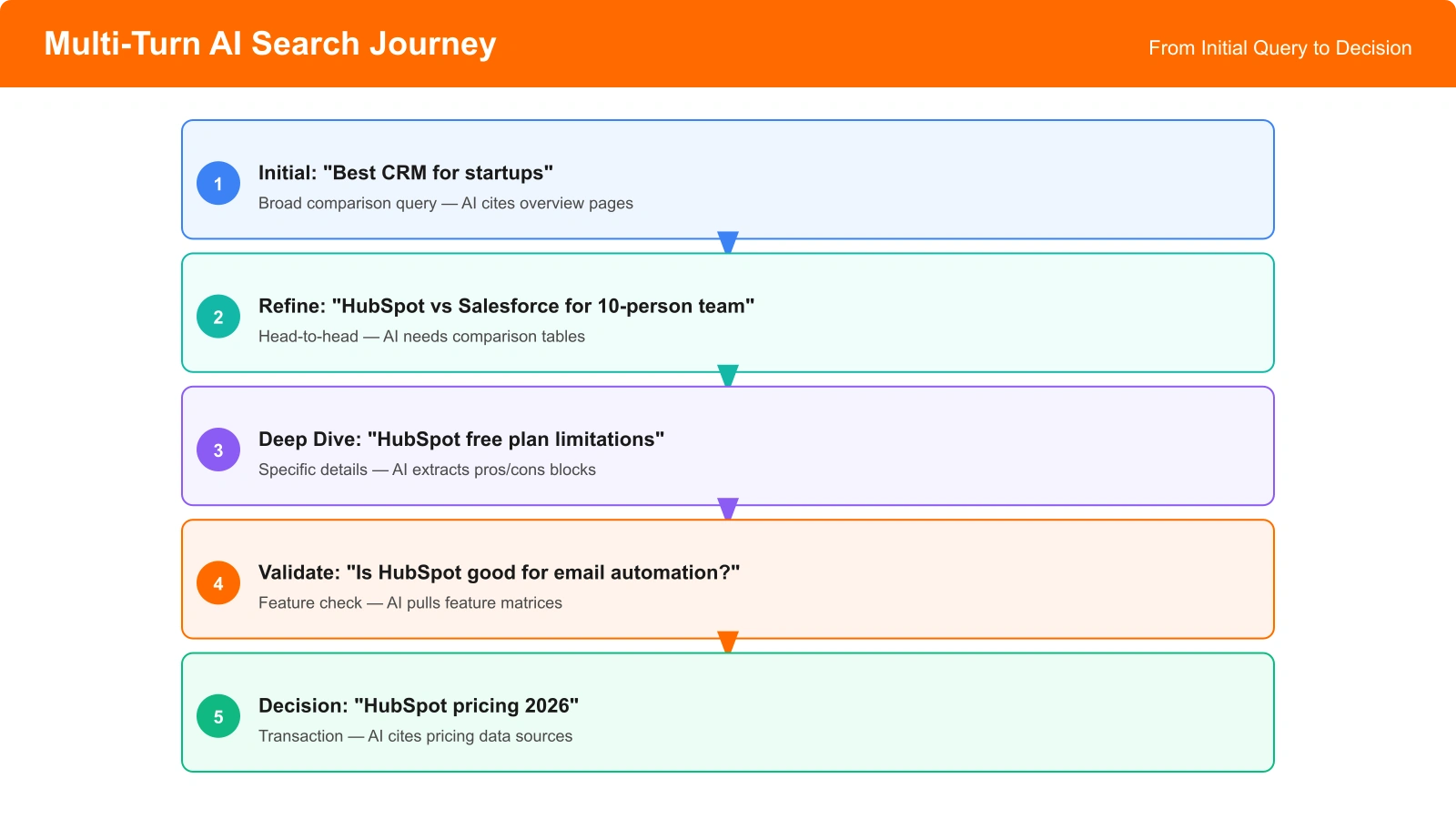
Before optimizing for multi-turn queries, understand how users actually interact with conversational AI for comparison research.
| Turn | User Intent | Example Query | Content Need |
|---|---|---|---|
| Initial | Broad discovery | “What are the best CRM tools?” | Overview with top picks |
| Refinement | Narrow by criteria | “Which is best for sales teams under 10 people?” | Segment-specific recommendations |
| Comparison | Head-to-head evaluation | “How does Pipedrive compare to Freshsales?” | Direct comparison data |
| Deep dive | Specific feature questions | “Does Pipedrive integrate with Slack?” | Detailed feature information |
| Decision | Final validation | “Any concerns about Pipedrive I should know?” | Honest cons and limitations |
This progression from broad to specific, from discovery to decision, is the typical pattern. Users rarely make decisions based on one question—they iterate toward confidence through multiple exchanges.
Common Follow-Up Patterns
While specific questions vary, follow-up patterns are predictable:
Typical follow-up question categories:
• Segment refinement: “Which is best for [specific use case]?”
• Budget constraints: “Which of those are under $50/month?”
• Feature specifics: “Which has the best [specific feature]?”
• Head-to-head: “Compare X and Y specifically”
• Concerns: “What are the downsides of X?”
• Alternatives: “What about Z instead?”
• Integration: “Does X work with [other tool]?”
Content that anticipates and answers these follow-up categories has a better chance of remaining the cited source throughout the conversation.
Content Structure for Multi-Turn Optimization
Structure your comparison content to serve entire search journeys, not just initial queries.
Comprehensive Information Architecture
Build content that covers the full decision journey:
- Overview section: Answer the broad initial query with clear top recommendations
- Segment sections: Break down recommendations by user type, team size, use case
- Individual profiles: Detailed information on each recommended product
- Comparison matrices: Head-to-head data for common comparison pairs
- Integration information: Connectivity with popular tools and platforms
- Honest limitations: Clear cons and concerns for each option
- Decision guidance: How to choose based on specific criteria
This structure means your page has relevant content for multiple turns of conversation. When the user asks a follow-up, the AI can often pull the answer from your same source rather than seeking new sources.
Anticipatory Content Blocks
Explicitly answer questions users are likely to ask next:
Anticipatory content patterns:
“If you're specifically looking for a solution under $30/month, consider...”
“For teams that prioritize Slack integration, the best option is...”
“Comparing HubSpot and Pipedrive directly: HubSpot excels at X while Pipedrive...”
“The main concern about Tool X is... however, this matters most if...”
These anticipatory blocks serve double duty: they help human readers with likely questions, and they provide extractable answers for AI systems responding to follow-up queries.
Strategic FAQ Sections
FAQ sections are particularly valuable for multi-turn optimization because they mirror conversational question-answer structure:
- Frame questions as users actually ask them conversationally
- Cover the common follow-up patterns identified earlier
- Provide specific, extractable answers (not vague redirects)
- Include questions about limitations and concerns (decision-phase queries)
A well-designed FAQ section can capture citation for multiple follow-up turns because each Q&A pair matches a potential conversation continuation.
Context Preservation Strategies
Help AI systems understand that follow-up information relates to your initial recommendations.
Internal Context References
Structure content so sections explicitly reference each other:
Context linking examples:
“Among the top 5 recommendations above, Pipedrive stands out for budget-conscious teams...”
“Comparing our top pick HubSpot against runner-up Pipedrive...”
“For the integration concerns mentioned in Tool X's profile, here's detailed coverage...”
These internal references help AI systems understand that your content is a cohesive source covering multiple aspects of the comparison, not disconnected information fragments.
Semantic Coherence
Maintain consistent terminology and framework throughout your content:
- Consistent product naming: Use the same product names throughout (not alternating between “HubSpot,” “HubSpot CRM,” and “the HubSpot platform”)
- Consistent criteria: Evaluate all products against the same factors
- Consistent scoring: If you use ratings, apply them consistently
- Cross-referencing: Explicitly connect different sections covering the same product
Semantic coherence helps AI systems treat your content as a unified source rather than fragmented information that might need supplementation from other sources.
Build Conversation-Ready Comparisons
Generate comparison pages structured for multi-turn AI search journeys.
Try for Free
Practical Implementation
Translate multi-turn strategy into specific content practices.
Comprehensive Segment Coverage
For each major user segment, provide specific recommendations:
- By team size: Solo users, small teams (2-10), mid-size (11-50), enterprise (50+)
- By budget: Free/freemium, budget ($0-30/mo), mid-range ($30-100), premium ($100+)
- By primary use case: Sales, marketing, support, general business
- By technical sophistication: Non-technical, technical, developer-focused
Each segment section should include a clear top recommendation and brief explanation. When users refine their initial query by segment, your content has the specific answer ready.
Pre-Built Comparison Pairs
Head-to-head comparison queries are extremely common follow-ups. Pre-build comparison content for likely pairs:
Comparison pair structure:
• Identify products commonly compared in your category
• Create brief comparison summaries for top 5-10 pairs
• Cover key differentiators: price, features, ideal user
• Include clear recommendation: “Choose X if... Choose Y if...”
• Link to detailed comparison content if available
Including these comparison pairs means your page can answer “How does X compare to Y?” without AI needing to pull from additional sources.
Proactive Objection Handling
Decision-phase queries often focus on concerns and limitations. Address these proactively:
- Honest cons: Every product should have clearly stated limitations
- Context for concerns: Explain when limitations matter and when they don't
- Mitigation options: How users can work around limitations
- Alternative suggestions: When to choose differently based on specific concerns
Content that handles objections maintains citation into the decision phase rather than losing users to sources that address their concerns.
Measuring Multi-Turn Success
Traditional SEO metrics don't fully capture multi-turn optimization success.
Relevant Metrics
Consider tracking:
- Citation depth: How often your source appears in extended AI conversations (requires manual testing)
- Content comprehensiveness scores: Coverage of common follow-up topics
- FAQ engagement: Which FAQ questions drive engagement (proxy for follow-up relevance)
- Time on page: Longer engagement may indicate users finding answers to multiple questions
- Section-level engagement: Which content sections users actually consume
Direct measurement of multi-turn citation remains challenging, but proxy metrics help assess whether content structure supports conversational discovery.
Optimizing for Conversations, Not Keywords
Multi-turn query optimization represents a fundamental shift in how we think about comparison content. The goal isn't ranking for a single keyword—it's being the comprehensive source that serves users throughout their entire decision journey.
Content that anticipates follow-up questions, provides segment-specific recommendations, includes pre-built comparisons, and honestly addresses limitations has the best chance of maintaining source position through conversational AI interactions. This requires more comprehensive content than traditional listicle formats, but it creates more durable value.
Start by mapping the common follow-up patterns for your specific comparison topics. Audit your existing content against these patterns. Identify gaps where users would need to go elsewhere for follow-up information, then fill those gaps systematically.
The publishers who successfully adapt to multi-turn search will capture more value from each piece of content—serving entire journeys rather than isolated queries.
For related optimization, see AI Answer Box vs Featured Snippet. For zero-click strategies, see Zero-Click Strategy for Listicles.

Product Manager at BestPage. Pioneer in AEO research since 2024, exploring the convergence of SEO and GEO (Generative Engine Optimization). Led multiple AI-powered content optimization projects that achieved 300%+ citation increases in ChatGPT and Perplexity.