
Here's something that kept bugging me: why do some comparison queries generate AI Overviews while others just show traditional results? I'd search “Notion vs Coda” and get a full AI summary. Then I'd search “best note-taking apps” and... nothing. Just regular blue links. What gives?
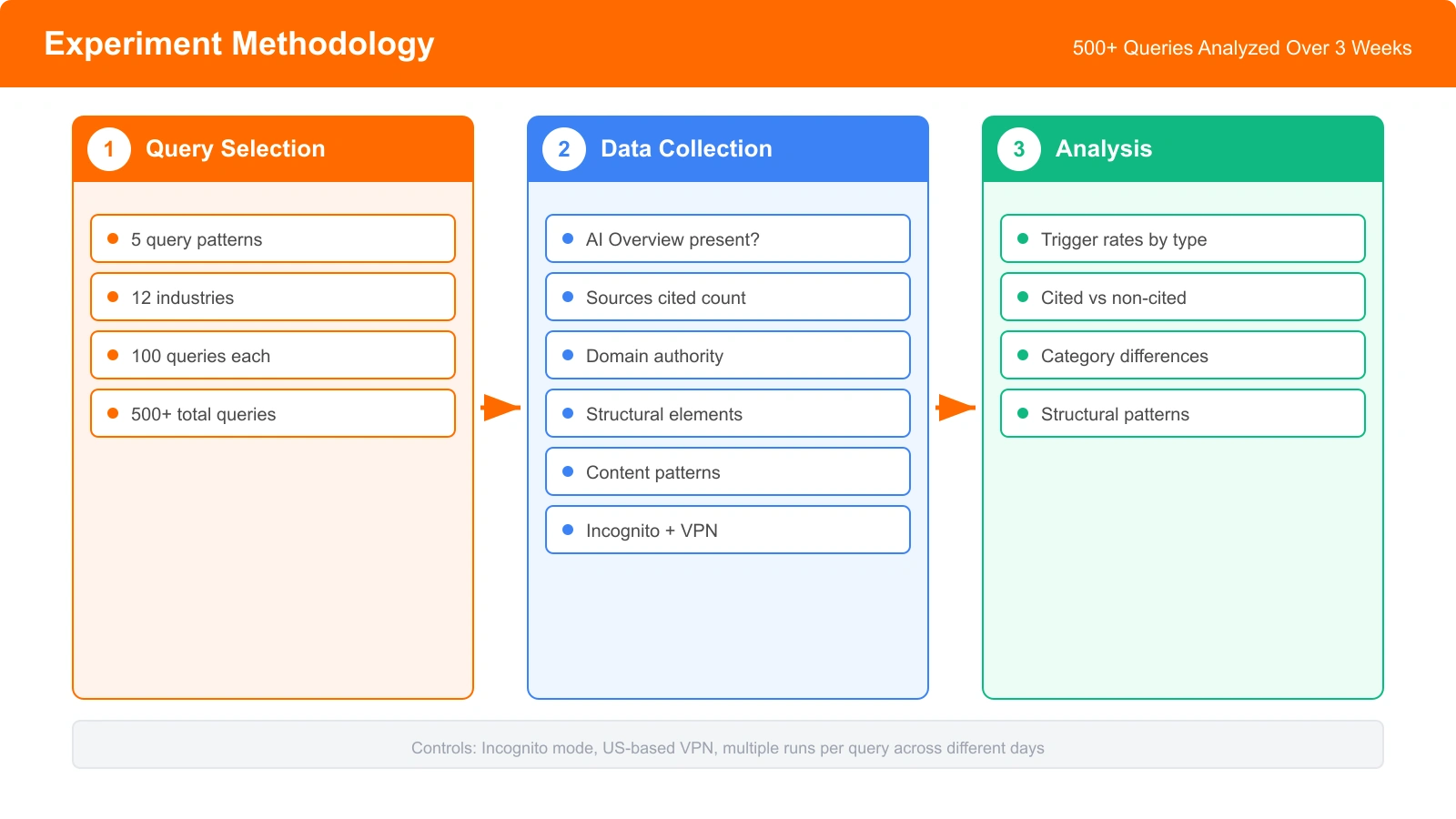
So we decided to actually figure this out. Over three weeks, my team and I analyzed 500+ comparison-related queries across SaaS tools, consumer electronics, financial products, and more. We tracked which queries triggered AI Overviews, which sources got cited, and what structural elements those sources shared.
The findings challenged some assumptions I had about how listicles get cited by AI. Turns out, the query pattern matters almost as much as the content itself. And some query types are basically goldmines for AI visibility while others are nearly impossible to crack.
How We Ran This Experiment
Before we get into the juicy findings, let me walk you through how we actually conducted this research. I want to be transparent here because methodology matters—especially when you're making optimization decisions based on the data.
The Query Categories
We selected queries from five distinct patterns. Each pattern represents a different way people search when they're comparing or evaluating options:
- Direct comparison: “X vs Y” (e.g., “Notion vs Coda,” “HubSpot vs Salesforce”)
- Best for context: “Best X for Y” (e.g., “Best CRM for startups,” “Best laptop for video editing”)
- Generic best: “Best X” (e.g., “Best project management tools,” “Best headphones”)
- Alternative seeking: “X alternatives” (e.g., “Slack alternatives,” “Zoom alternatives”)
- Difference queries: “Difference between X and Y”
We ran about 100 queries in each category, spread across 12 different industries. This wasn't just tech—we included everything from consumer electronics to financial services to see if patterns held across verticals.
What We Recorded
For each query, we documented:
- Whether an AI Overview appeared (yes/no)
- How many sources were cited in the AI Overview
- Domain authority of cited sources (via Ahrefs)
- Structural elements present in cited pages
- Content patterns used—specifically looking at the citable content blocks we'd identified previously
The Data: AI Overview Trigger Rates by Query Type
Alright, let's get to what you came here for. These are the core findings from our 500+ query analysis.
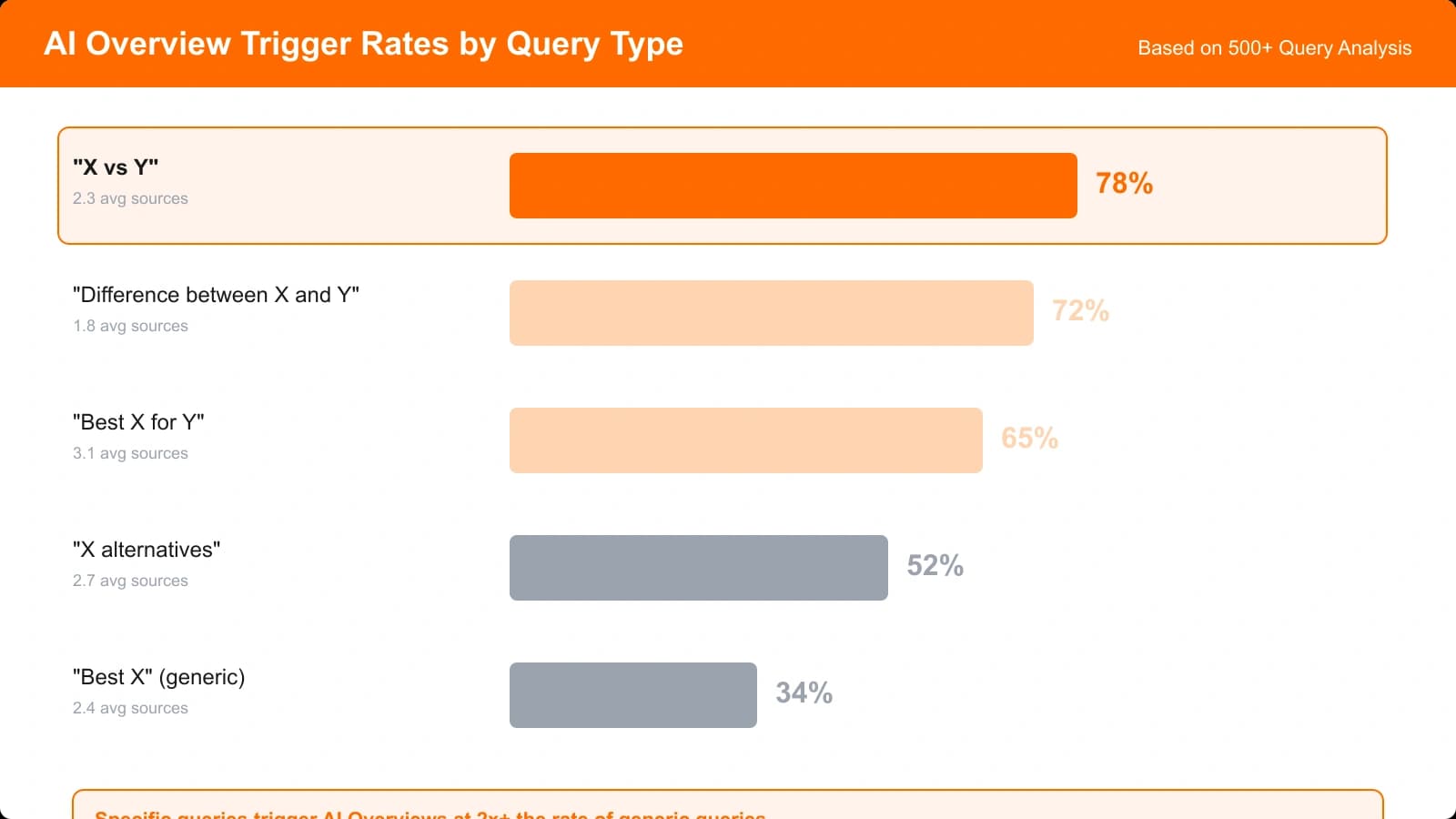
Trigger Rates by Query Pattern
| Query Pattern | AI Overview Rate | Avg. Sources Cited |
|---|---|---|
| “X vs Y” | 78% | 2.3 |
| “Difference between X and Y” | 72% | 1.8 |
| “Best X for Y” | 65% | 3.1 |
| “X alternatives” | 52% | 2.7 |
| “Best X” (generic) | 34% | 2.4 |
The pattern is striking. Specific comparison queries trigger AI Overviews at more than double the rate of generic queries. “Notion vs Coda” (78% chance) is far more likely to generate an AI answer than “best note-taking apps” (34% chance). That's not a subtle difference.
Why Specificity Matters So Much
According to Google's AI Overview documentation, the system is designed to provide helpful answers when it has high confidence in accuracy. Specific comparison queries have clearer “right answers” that AI can synthesize from existing content.
Think about it from the AI's perspective. When someone asks “Notion vs Coda,” there's a relatively bounded set of information needed: feature comparison, pricing, use cases, strengths, weaknesses. The AI can find multiple sources that cover these points, triangulate the information, and synthesize a confident answer.
But “best project management tools”? That's massively subjective. Best for whom? For what purpose? At what budget? There are dozens of legitimate answers depending on context. The AI has lower confidence it can synthesize something genuinely helpful—so it often doesn't try.
What the Cited Sources Have in Common
Knowing which queries trigger AI Overviews is only half the battle. You also need to know what makes a source get *cited* in those overviews. So we analyzed the structural elements of every cited source in our sample.
The Structural Elements That Matter
| Element | Present in Cited Sources | Present in Non-Cited Pages |
|---|---|---|
| Comparison table | 89% | 34% |
| Explicit verdict statement | 82% | 28% |
| Pros/cons sections | 76% | 45% |
| Pricing comparison | 71% | 52% |
| Use case segmentation | 68% | 31% |
| Schema markup | 64% | 23% |
The gap between cited and non-cited sources is stark. Pages with comparison tables are 2.6x more likely to be cited than pages without them. Verdict statements show a 2.9x difference. These aren't marginal improvements—they're structural requirements.
Build Comparison Pages That Get Cited
Generate comparison content with built-in tables, verdicts, and schema markup—automatically structured for AI visibility.
Try for Free
Content Depth Metrics
We also measured content depth. Here's how cited sources compared to non-cited ones:
- Word count: Cited sources averaged 2,847 words vs 1,523 for non-cited
- H2 sections: Cited sources had 7.2 average vs 4.1 for non-cited
- Internal links: Cited sources had 5.8 average vs 2.3 for non-cited
- External citations: Cited sources had 4.2 average vs 1.7 for non-cited
But here's the nuance that matters: depth without structure doesn't help. A well-structured 2,000-word article with proper comparison tables actually outperformed poorly-structured 4,000-word articles in our analysis. Structure first, depth second.
How Different Industries Behave
Not all niches behave the same way. We noticed significant differences in AI Overview rates across categories—which makes sense when you think about the type of information involved.
Categories with High AI Overview Rates
- SaaS/Software tools: 71% average trigger rate
- Consumer electronics: 68% average trigger rate
- Financial products: 62% average trigger rate
These categories have something in common: objective, comparable attributes. Features, pricing, specifications. Things you can put in a table and compare directly. AI loves this stuff because it can synthesize answers with confidence.
Categories with Lower AI Overview Rates
- Local services: 28% average trigger rate
- Fashion/apparel: 31% average trigger rate
- Food/restaurants: 24% average trigger rate
These are more subjective or location-dependent. What's the “best Italian restaurant”? Depends on where you are, what you like, your budget. AI has lower confidence here, so it generates fewer overviews.
If you're in a low-trigger category, don't despair. Focus on the queries within your space that *are* more specific and comparable. “Best budget running shoes for marathon training” will trigger more often than “best running shoes.”
What This Means for Your Content Strategy
Alright, enough data. Let's talk about what you should actually *do* with this information.
1. Target Specific Comparison Queries
Instead of only targeting broad keywords like “best CRM software,” create dedicated pages for:
- “HubSpot vs Salesforce”
- “Best CRM for small sales teams”
- “HubSpot alternatives for startups”
Each specific query has a higher AI Overview trigger rate *and* typically less competition. It's a double win. Yes, the search volume per query is lower—but the citation potential is much higher.
2. Always Include Comparison Tables
Comparison tables appeared in 89% of cited sources. That's not optional—it's basically required. Your tables should compare:
- Key features (yes/no or checkmarks work great)
- Pricing tiers with actual numbers
- Best-for use cases
- Notable limitations
Tables make information scannable for humans *and* extractable for AI. They're one of the rare elements that serve both audiences equally well.
3. Add Clear, Explicit Verdicts
Don't make readers—or AI—guess your recommendation. Include explicit verdict statements like:
“Our verdict: HubSpot wins for small marketing teams who need free CRM with built-in automation. Salesforce wins for enterprise sales teams requiring advanced customization and integrations.”
This directness might feel uncomfortable if you're used to hedging. But AI systems need clear signals to cite your content confidently.
4. Segment by Use Case
Create clear sections for different audiences:
- “Best for small businesses (under 50 employees)”
- “Best for enterprise”
- “Best budget option”
- “Best for [specific use case]”
This matches how “best X for Y” queries are structured—and those queries trigger AI Overviews 65% of the time.
Limitations and What We're Watching
I want to be honest about what this research doesn't tell us:
- Time-bound: This data is from January 2026. AI Overview behavior evolves constantly—what works today might shift in six months.
- US-focused: We used US-based searches. Results may differ in other markets, particularly where AI features have different rollout stages.
- Sample size: 500 queries is substantial but not exhaustive. Edge cases exist.
We plan to repeat this experiment quarterly and update our recommendations as the landscape shifts. AI search is moving fast, and staying current matters.
The Opportunity Is in Specificity
Here's the bottom line: AI Overviews favor specific comparison queries over generic “best of” searches. The 78% trigger rate for “X vs Y” queries represents a massive opportunity that most content strategies completely ignore.
If you're creating comparison content, stop optimizing for just the broad head terms. Build dedicated pages for specific head-to-head matchups and contextual “best for X” queries. Structure your content with the elements that actually get cited—comparison tables, explicit verdicts, use case segmentation.
Most competitors are still optimizing for traditional SEO signals while ignoring these AI-specific patterns. That gap won't last forever. The window to get ahead is now.
Want the full framework? For the complete picture on AI citations, dive into our guide on how listicles get cited by AI. And if you need help implementing the structural elements we found in cited sources, check out our citable content blocks templates.

Product Manager at BestPage. Pioneer in AEO research since 2024, exploring the convergence of SEO and GEO (Generative Engine Optimization). Led multiple AI-powered content optimization projects that achieved 300%+ citation increases in ChatGPT and Perplexity.