
Picture this: you've written what you think is the most comprehensive “Best Email Marketing Tools” listicle on the internet. It's got everything—detailed reviews, pros and cons, pricing breakdowns. But when someone asks ChatGPT or Perplexity about email marketing tools, your page doesn't show up. Meanwhile, a competitor's thinner article gets quoted word-for-word. Sound familiar?
Here's the thing: it's not about having *more* information. It's about how you structure that information. AI systems like Google's AI Overviews, ChatGPT, and Perplexity are essentially pattern-matching machines. They look for specific content formats that they can extract cleanly and cite with confidence. And if your content doesn't fit those patterns? It basically doesn't exist to them.
I've spent months analyzing which listicles actually get cited in AI-generated answers. The patterns are surprisingly consistent—and honestly, most of them have nothing to do with traditional SEO wisdom. For a deeper dive into the overall framework, check out our comprehensive guide to how listicles get cited by AI. But right now, let's get tactical with the specific content blocks you need.
Why Content Patterns Actually Matter for AI Citations
Let me be real with you: AI systems don't read content the way humans do. At all. They're not sitting there appreciating your witty prose or nodding along to your nuanced arguments. They're scanning for discrete, extractable chunks of information that directly answer specific queries.
Think about what happens when someone asks “What's the best CRM for small businesses?” The AI needs to find content that explicitly, clearly, unambiguously answers that exact question. Not content that *discusses* CRMs generally. Not content that *might* answer the question if you read between the lines. Content that says: “HubSpot is best for small businesses because X, Y, Z.”
This is where citable content blocks come in. These are predictable structural patterns that AI systems have learned to recognize, trust, and cite. When your content follows these patterns, you're basically speaking the AI's language.
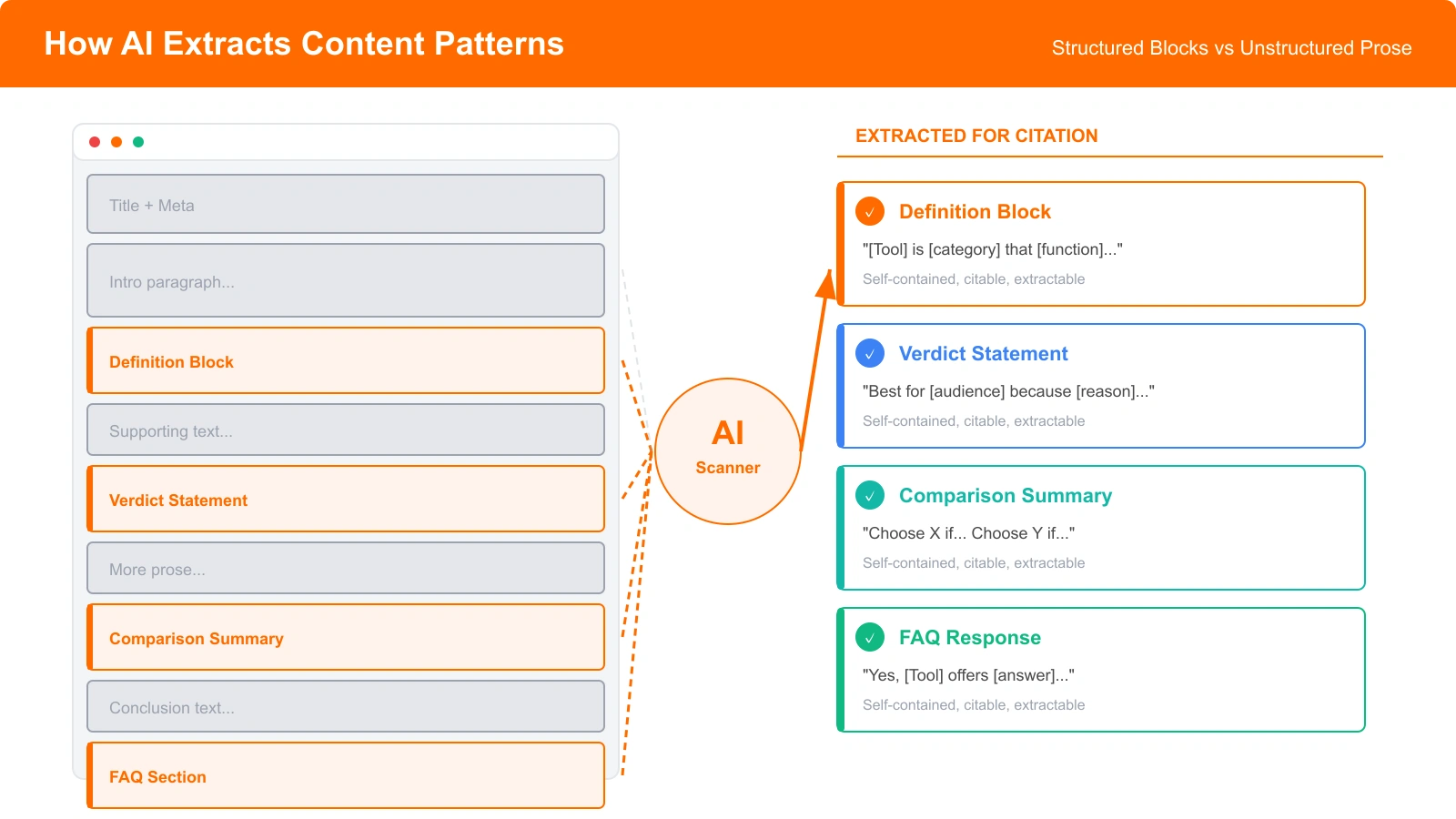
The 6 Citable Content Block Templates
Alright, let's get into the actual templates. I've broken down the six patterns that consistently appear in AI-cited content. For each one, I'll give you the template structure and a real example so you can see exactly how to implement it.
Pattern 1: Definition Blocks
Definition blocks answer “What is X?” questions. They're probably the most commonly cited pattern because they provide clear, authoritative explanations that AI systems can quote directly. The key? Your definition needs to be self-contained—it should make complete sense even if someone pulls it out of context.
[Term] is [category] that [primary function]. Unlike [alternative], [Term] [key differentiator]. [One sentence about who uses it or why it matters].Here's what that looks like in practice:
Notion is an all-in-one workspace tool that combines notes, databases, wikis, and project management in a single platform. Unlike traditional project management tools like Asana or Monday.com, Notion offers unlimited flexibility in how you structure information. It's particularly popular among startups and remote teams who need customizable workflows without rigid structures.
See how that works? It's a complete, citable definition. An AI can grab that entire block and use it to answer “What is Notion?” without any additional context.
Pattern 2: Verdict Statements
Now we're getting into the real money. Verdict statements answer the question everyone's actually asking: “Which one is best for me?” These are explicit recommendations with clear reasoning—exactly what AI systems need to synthesize answers for comparison queries.
[Tool] is best for [specific audience/use case] because [primary reason]. [Supporting evidence or context]. [Limitation or caveat if relevant].In action:
HubSpot CRM is best for small marketing teams because it offers free core CRM features with built-in marketing automation. Most competitors charge separately for email marketing and CRM functionality, but HubSpot bundles them together at no cost. That said, advanced features like custom reporting require paid plans starting at $50/month.
Notice the caveat at the end? That's actually important. It makes your recommendation more credible. If you only say positive things, you sound like a shill. AI systems—and users—appreciate balanced verdicts.
Pattern 3: Comparison Summaries
Comparison summaries answer “X vs Y” questions. These are absolutely *prime* real estate for AI citations because comparison queries are incredibly common. When someone asks “Notion vs Coda,” AI needs direct head-to-head analysis it can quote.
| Element | What to Include |
|---|---|
| Opening verdict | Clear winner declaration for specific context |
| Primary difference | The main factor that separates them |
| Use case guidance | When to choose each option |
| Price context | Comparative pricing information |
Example comparison summary:
Asana vs Monday.com: Choose Asana if you need robust project management with clear task hierarchies and dependencies. Choose Monday.com if you want visual, flexible workflows that can adapt to different team processes quickly. Asana starts at $10.99/user/month while Monday.com starts at $8/user/month, but Monday requires a minimum of 3 users—so for very small teams, Asana often works out cheaper.
Generate Citable Listicles Automatically
Create best-of pages with built-in citation patterns. No templates needed—the structure is baked in.
Try for Free
Pattern 4: Numbered Rankings
This one seems obvious, but you'd be surprised how many listicles mess it up. Numbered rankings answer “Top X” and “Best X” queries. The explicit numbering makes it easy for AI to extract your recommendations in order. But here's what most people miss: each entry needs a consistent structure.
#[Rank]. [Tool Name] — [Positioning Label][One-sentence value proposition]Best for: [Specific audience]Price: [Starting price]Applied:
#1. Notion — Best All-in-One Workspace
Combines notes, databases, and project management in a single flexible platform that adapts to how your team actually works.
Best for: Remote teams and startups needing customizable workflows
Price: Free for individuals, $10/user/month for teams
The consistency is key here. If your first three entries follow this format and then you switch to something else? AI systems get confused. They might only cite the structured ones.
Pattern 5: Statistic Callouts
Want to know what AI systems absolutely love? Specific numbers. Statistic callouts answer “How much/many X?” questions and add credibility to everything around them. The trick is making them self-contained and clearly sourced.
[Specific number/percentage] of [population] [action/state], according to [source]. This [means/suggests] [implication for reader].Like this:
73% of project managers report using multiple tools to manage their workflows, according to a 2025 PMI survey. This fragmentation costs an average of 5 hours per week in context-switching and data reconciliation—time that unified platforms like Monday.com or ClickUp aim to eliminate.
Notice how the statistic isn't just thrown in there? It's contextualized. That makes it more useful for AI citation and more valuable for readers.
Pattern 6: FAQ Responses
FAQ sections are gold mines for AI citations because they match exactly how users phrase questions. When you structure them with proper entity signals and clear answers, you're basically pre-formatting content for AI extraction.
Q: [Exact question users ask]A: [Direct answer in first sentence]. [Supporting detail]. [Practical recommendation or next step].In practice:
Q: Is Notion free to use?
A: Yes, Notion offers a free plan for individuals with unlimited pages and blocks. The free plan includes core features like notes, databases, and basic collaboration. For team features and advanced permissions, paid plans start at $10/user/month.
The first sentence directly answers the question. That's crucial. AI systems often pull just the first sentence for quick answers, so front-load the most important information.
How to Actually Implement These Blocks
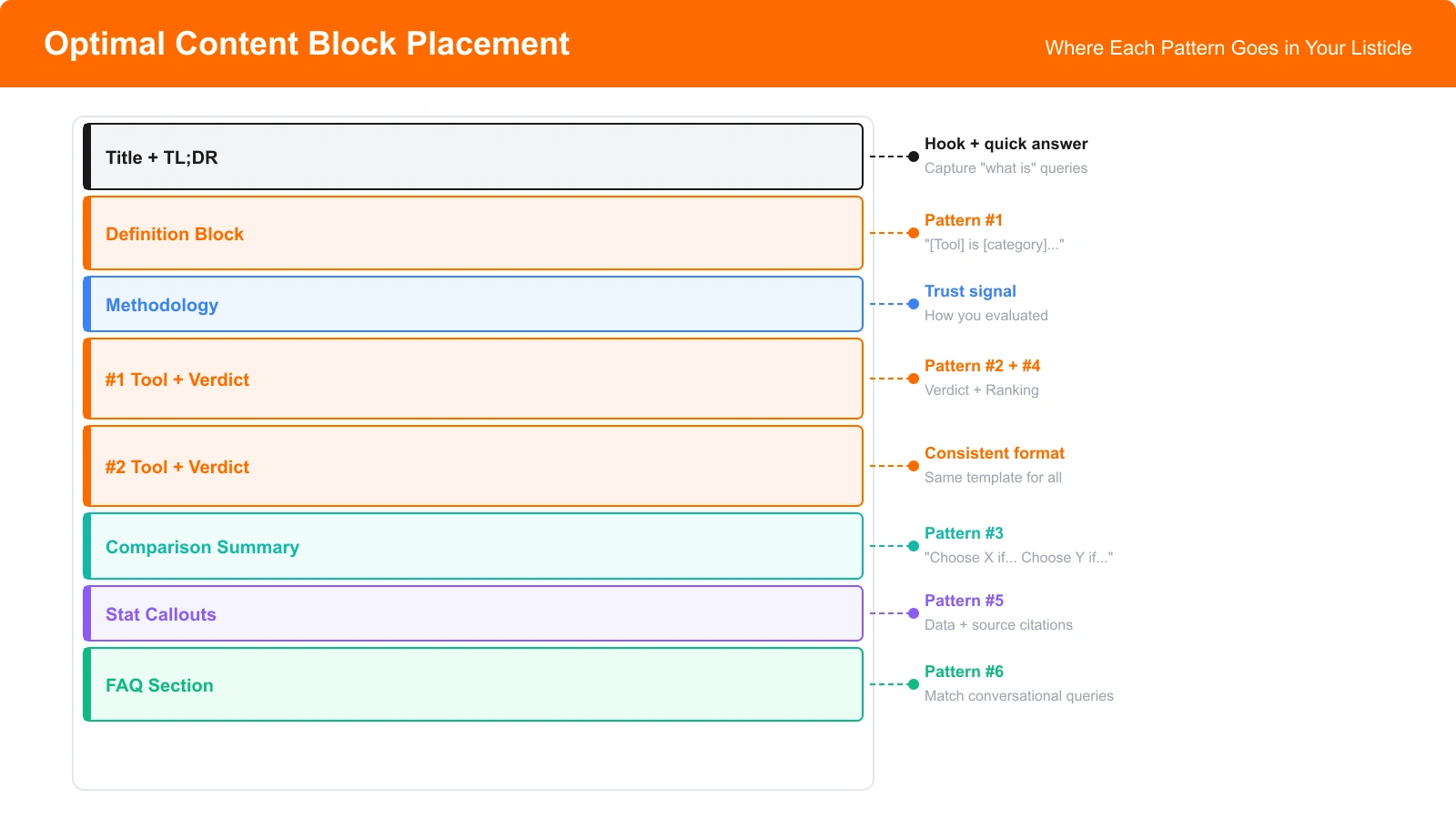
Knowing the patterns is one thing. Implementing them effectively is another. Here's how to strategically place these blocks throughout your listicle for maximum citation potential.
Block Placement Strategy
- Definition block: Place near the top, after your introduction. This captures “What is X?” queries and establishes context for everything that follows.
- Numbered rankings: Use consistently for all tool listings in your main content. Maintain the exact same format for every single entry—no exceptions.
- Verdict statements: Include in each tool's “Best for” section. Be genuinely specific about audiences. “Great for everyone” is useless.
- Comparison summaries: Add after your rankings for major head-to-head matchups users frequently search. Think “Notion vs Coda” or “HubSpot vs Salesforce.”
- Statistic callouts: Sprinkle throughout to add credibility. One every 400-600 words is a good rhythm. Always cite your sources.
- FAQ section: Add at the end with 5-8 common questions. These are perfect for capturing long-tail queries.
Formatting Tips That Actually Matter
The way you format these blocks is just as important as the content itself. AI systems look for consistent, predictable structures. Here's what to do—and what to avoid.
| Do This | Not This |
|---|---|
| Use consistent heading hierarchy (H2 → H3 → H4) | Mix heading levels randomly |
| Bold key terms and product names on first use | Bold entire sentences for emphasis |
| Start blocks with the entity name (“HubSpot is...”) | Bury entity names mid-paragraph |
| Include specific numbers and prices ($49/month) | Use vague terms like “affordable” or “reasonably priced” |
| Cite sources for all statistics | Present data without attribution |
Mistakes That Kill Your Citability
Even with the right patterns, certain mistakes can prevent AI systems from citing your content. I see these constantly—sometimes in otherwise excellent listicles. Let's fix them.
Mistake 1: Burying the Answer
If your verdict statement is surrounded by three paragraphs of context, AI systems might not extract it. The answer should come first, not last. Lead with the verdict, then provide supporting context. Not the other way around.
Mistake 2: Vague Positioning
“Great for most users” tells AI nothing useful. It can't match that to any specific query. “Best for marketing teams under 20 people with limited budget” is specific enough to match actual user questions. Be ruthlessly specific, even if it feels limiting.
Mistake 3: Inconsistent Formatting
This is the silent killer. If your first three tools follow the ranking template perfectly but tools 4-10 switch to a different format? AI systems might only confidently cite the well-formatted ones. Consistency isn't optional—it's the whole game.
Mistake 4: Missing Entity Signals
Your content blocks need strong entity signals to work properly. Use canonical product names (it's “HubSpot,” not “Hubspot” or “hubspot”). Maintain consistency throughout. Never switch between variations mid-article. For more on this, see our guide to entity signals for best-of pages.
How to Test If Your Blocks Are Working
So you've implemented all the patterns. How do you know if they're actually working? Here are practical testing methods I use regularly.
The Extraction Test
Copy a single content block and paste it somewhere completely out of context. Does it still make sense? Does it still provide value? If the block requires surrounding paragraphs to be understood, it's not self-contained enough for citation. Revise until it stands alone.
The Query Match Test
For each content block, identify the specific query it should answer. Then search that exact query in Google and AI tools like Perplexity. Is similar structured content being cited? If yes, your format is on track. If no, you might need to adjust your structure to match what's actually getting cited.
The Schema Check
Run your page through Google's Rich Results Test. Verify your FAQ and other structured data is properly implemented. Schema errors can prevent otherwise perfectly citable content from being extracted. It's an easy thing to overlook, but it matters.
Start Using These Templates Today
Here's the bottom line: citable content isn't about writing for robots—it's about structuring your expertise in formats that AI systems can reliably extract and cite. The six patterns we covered (definitions, verdicts, comparisons, rankings, statistics, and FAQs) are the building blocks of AI-friendly listicles.
Start by auditing your existing content. Open up your top-performing listicles and look for these patterns. Are they there? Are they consistent? Where can you add structured blocks? Pick one article and retrofit it with these templates. Then watch what happens.
The organizations getting cited by AI right now aren't necessarily the ones with the most content or the highest domain authority. They're the ones who've figured out how to structure information in ways AI can use. Now you know how to do the same.
What's next? For the complete framework on AI citations, dive into our pillar guide on how listicles get cited by AI. And if you're building a new listicle from scratch, make sure you're also implementing proper entity signals so AI systems can confidently identify what you're talking about.

Product Manager at BestPage. Pioneer in AEO research since 2024, exploring the convergence of SEO and GEO (Generative Engine Optimization). Led multiple AI-powered content optimization projects that achieved 300%+ citation increases in ChatGPT and Perplexity.