
Traditional SEO optimizes for Google's ranking algorithm: backlinks, keyword relevance, domain authority, Core Web Vitals. AI search systems work differently. They're not ranking pages to show in a list of results—they're selecting sources to cite in generated answers.
This fundamental difference means many traditional SEO factors matter less, while new factors become critical. A page with a strong backlink profile but poorly structured content may rank well in Google but rarely get cited by ChatGPT. Meanwhile, a page with modest traditional SEO but excellent extractable content may be cited frequently by AI systems.
This guide examines what we currently understand about AI ranking factors for comparison and listicle content. We'll distinguish between high-confidence observations (consistently observed across multiple platforms) and emerging hypotheses (observed patterns that may indicate ranking factors).
High-Confidence Ranking Factors
These factors are consistently observed across AI search platforms and have strong correlation with citation frequency.
Content Extractability
AI systems cite content they can easily parse and extract. Key elements:
| Factor | What It Means | Impact on AI Citation |
|---|---|---|
| Clear structure | Headings, lists, tables organized logically | High: enables extraction of specific sections |
| Semantic HTML | Proper use of H1-H6, lists, table elements | High: helps AI understand content hierarchy |
| Direct answers | Clear statements that answer questions | High: provides citable content snippets |
| Minimal boilerplate | Less repetitive navigation, ad content | Medium: cleaner extraction |
Source Authority
AI systems evaluate whether sources are trustworthy:
- Domain reputation: Established sites with history are preferred
- Author credibility: Named, credentialed authors increase trust
- Citation quality: Content that cites authoritative sources is more trusted
- Publishing history: Sites with consistent, quality publishing track records
Query Relevance Match
AI systems match content to user queries:
- Question-answer alignment: Content that directly answers the likely query
- Topic coverage: Comprehensive treatment of the subject
- Intent matching: Content format matches query intent (comparison → comparison page)
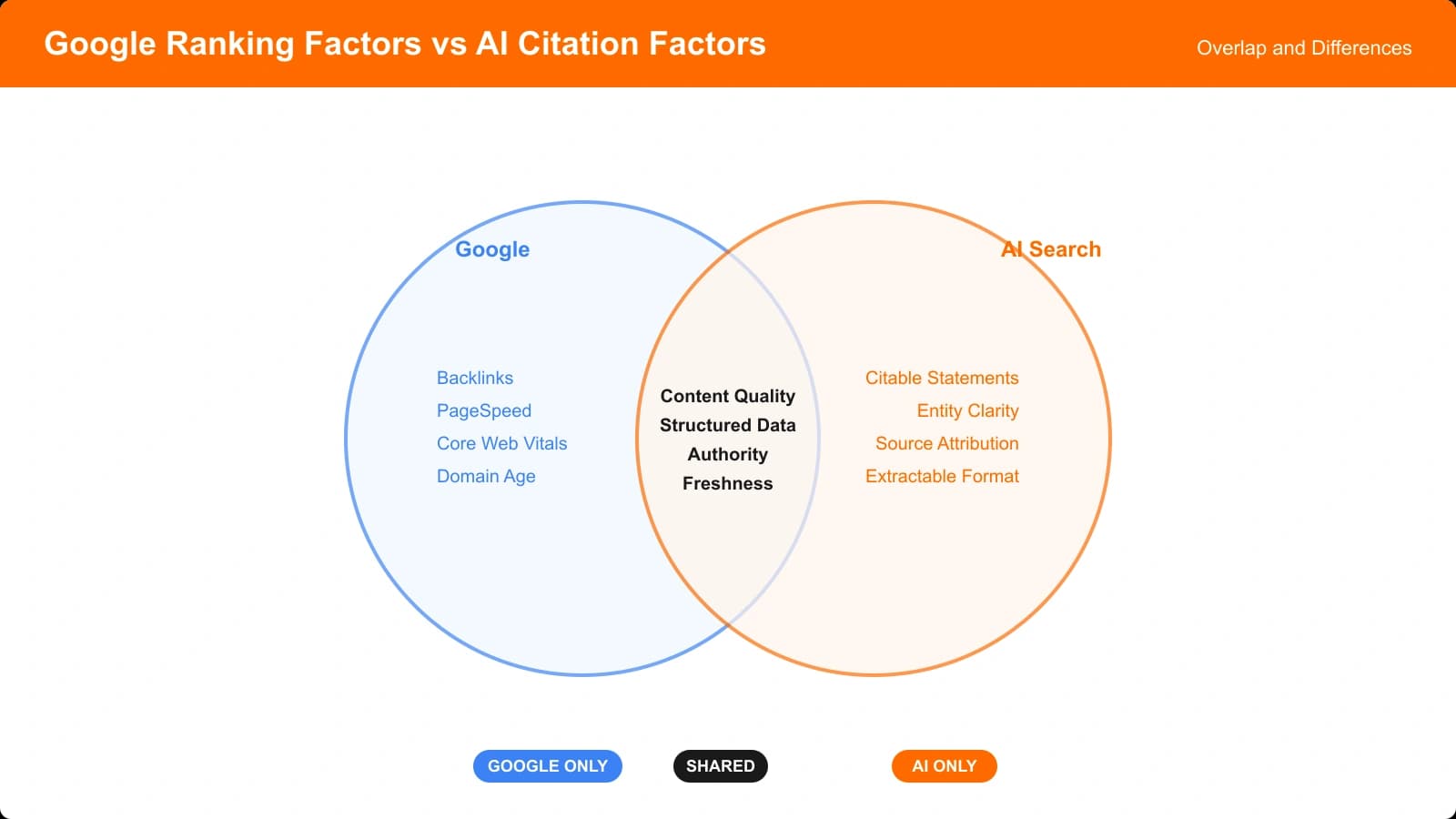
Factors That Differ from Google
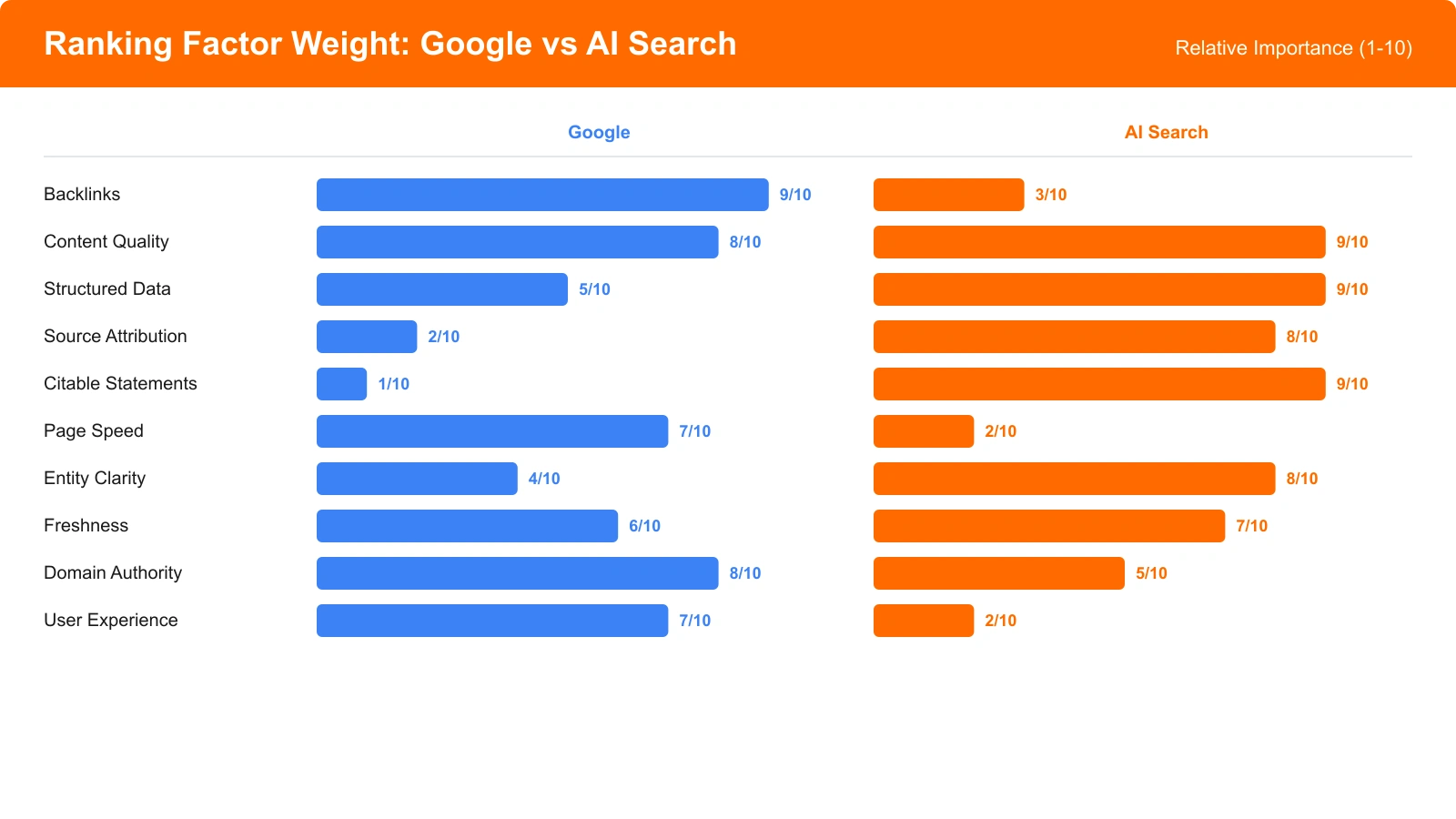
Some traditional SEO factors matter less for AI citation, while others matter more.
Factors That Matter Less
| Factor | Importance for Google | Importance for AI | Why the Difference |
|---|---|---|---|
| Backlink quantity | Very high | Low-Medium | AI evaluates content quality directly |
| Keyword density | Medium | Low | AI understands semantics, not keywords |
| Exact match anchors | Medium | Very low | AI doesn't use anchor text signals |
| Page speed scores | Medium | Low | AI accesses content, not page experience |
| CTR from SERPs | Medium | None | No SERP in AI responses |
Factors That Matter More
| Factor | Importance for Google | Importance for AI | Why the Difference |
|---|---|---|---|
| Content structure | Medium | Very high | AI needs to parse and extract |
| Direct answer patterns | Medium | Very high | AI pulls citable statements |
| Factual specificity | Medium | High | AI cites specific facts, not general content |
| Freshness signals | Medium | High | AI trained to value recent information |
| Schema markup | Medium | High | Helps AI understand entity relationships |
Optimize for AI Citation
Build comparison content structured for AI extraction and citation.
Try for Free
Platform-Specific Factors
Different AI platforms have different citation patterns.
ChatGPT (with Browse)
- Relies on real-time search: Indexes content at query time
- Favors recent content: Strong freshness preference
- Cites liberally: Often includes multiple sources
- Respects robots.txt: Won't cite blocked content
Perplexity
- Strong source attribution: Always shows sources for claims
- Prefers authoritative domains: Known sites cited more frequently
- Values structured content: Tables and lists extracted often
- Real-time indexing: Can cite very recent content
Google AI (SGE)
- Integrates with traditional search: Google rankings influence visibility
- Favors indexed content: Must be in Google's index first
- E-E-A-T signals matter: Experience, expertise, authority, trust
- Shopping integration: Product pages have special treatment
Emerging and Hypothetical Factors
These factors are observed but not yet confirmed with high confidence.
Entity Recognition and Relationships
AI systems may give preference to content that clearly defines entities and relationships:
- Clear product/brand identification
- Explicit category membership (“Salesforce is a CRM”)
- Relationship statements (“better than,” “alternative to”)
Consensus Signals
AI may prefer sources that align with broader consensus:
- Claims that match information from multiple sources
- Rankings that align with other authoritative rankings
- Ratings that correspond to aggregated review data
Training Data Influence
Content that appeared in training data may have advantages:
- Established sites with long publishing history
- Content that has been widely cited or referenced
- Formats that match patterns the model learned
Optimization Priorities
Based on current understanding, prioritize these areas for AI search optimization:
- Structure for extraction: Clear headings, semantic HTML, organized tables
- Write direct answers: Statements that can be quoted as facts
- Build authority signals: Author bios, source citations, methodology
- Implement schema markup: Product, ItemList, Review, Person schemas
- Maintain freshness: Regular updates with visible timestamps
- Ensure accessibility: Don't block AI crawlers in robots.txt
- Focus on specificity: Concrete facts over vague statements
- Match query intent: Format content for how users ask questions
AI search optimization is still evolving. The factors that matter today may change as AI systems improve. Focus on fundamental quality—clear, accurate, well-sourced content—and adapt as the landscape develops.
For specific optimization by platform, see our guides on How to Get Your Listicle Cited by Perplexity and ChatGPT Browse: How to Get Found and Cited.

Product Manager at BestPage. Pioneer in AEO research since 2024, exploring the convergence of SEO and GEO (Generative Engine Optimization). Led multiple AI-powered content optimization projects that achieved 300%+ citation increases in ChatGPT and Perplexity.