
Perplexity AI has emerged as a leading AI search engine specifically designed for research and fact-finding. Unlike ChatGPT, which can browse but doesn't always cite, Perplexity builds its identity around source citation—every answer includes numbered references users can click to verify claims and explore further.
This citation-forward design makes Perplexity particularly valuable for content publishers. When your listicle gets cited, users see your domain name directly in the answer interface. They can click through to read more. The citation becomes a visible link, not hidden behind an AI-generated summary.
This guide covers how Perplexity sources and cites comparison content, what patterns emerge in which sources get cited, and specific tactics to increase your citation rate for listicle and comparison pages.
How Perplexity Cites Sources
Understanding Perplexity's citation mechanics helps you optimize for visibility.
Citation Mechanics
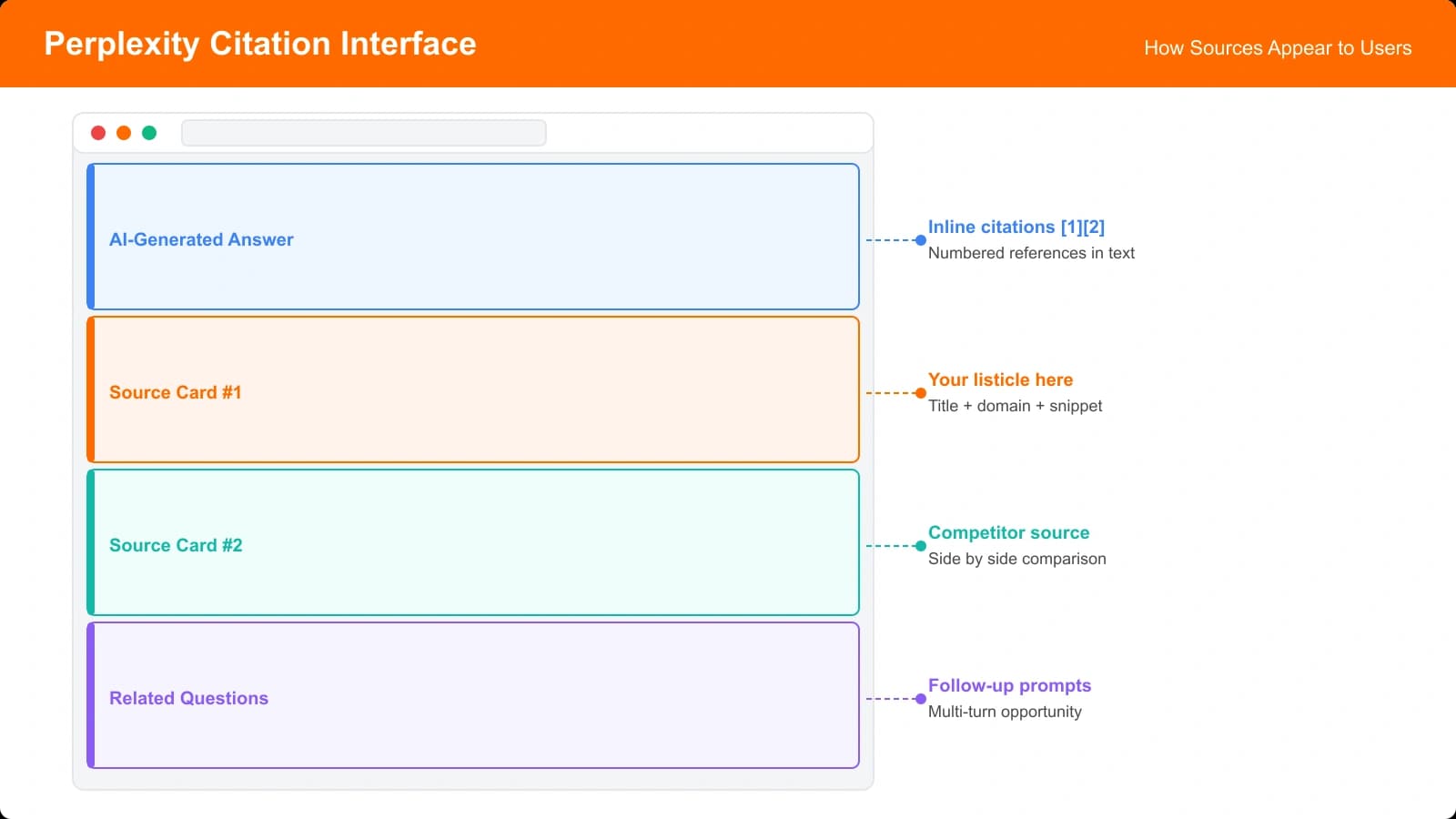
Perplexity searches the web (or its index) for each query, retrieves relevant pages, and synthesizes an answer with inline citations. Citations appear as numbered superscripts linking to source cards. A single answer typically cites 3-8 sources, depending on query complexity.
For comparison queries like “best project management tools,” Perplexity typically cites several comparison articles/listicles, possibly product pages for specific recommendations, and occasionally supporting sources for specific claims.
| Citation Position | What Perplexity Cites | What Gets That Position |
|---|---|---|
| Primary source (1-2) | Main answer foundation | Authoritative, comprehensive comparison pages |
| Supporting sources (3-5) | Additional perspectives, specific claims | Complementary listicles, expert reviews |
| Detail sources (6+) | Specific facts, pricing, features | Product pages, documentation, news |
Source Selection Factors
Perplexity appears to favor sources based on several factors:
- Relevance match: How directly the content answers the query
- Source authority: Domain reputation, author expertise
- Content freshness: Recent content preferred for time-sensitive topics
- Answer clarity: Content with extractable statements over vague commentary
- Comprehensiveness: Thorough coverage of the query topic
Optimization Tactics for Perplexity
Specific tactics increase your likelihood of being cited in Perplexity answers.
Optimizing for Answer Extraction
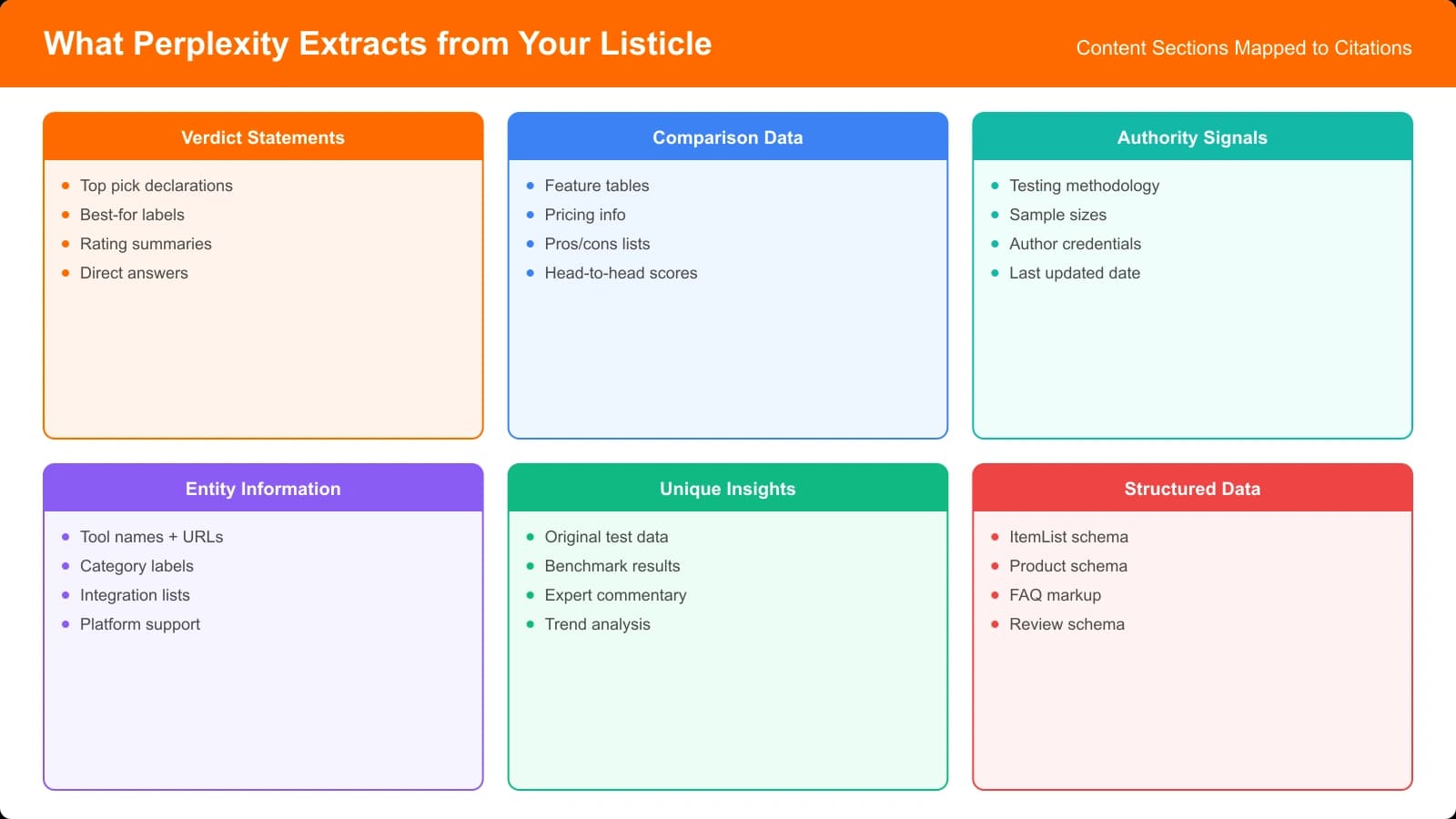
Perplexity extracts and synthesizes content from cited sources. Make your key points easy to extract:
How Perplexity might cite this:
“According to [Source], the best project management tool for remote teams is Monday.com due to its visual collaboration features and timezone-friendly scheduling tools.”
Your content needs a clear, extractable statement that can be paraphrased this way.
Structure content with clear topic sentences that summarize each section. Lead paragraphs with your conclusions. Use specific, factual language rather than vague assessments.
Freshness and Currency
Perplexity values recent content, especially for comparison queries where products change frequently. Include clear date indicators (publish date, last updated date, “current as of January 2026”), reference current pricing and features, remove or update outdated product information, and add year to titles where appropriate (“Best Tools (2026)”).
Authority Signals
Like traditional search, Perplexity considers source authority:
- Author expertise: Named experts with credentials visible
- Site authority: Established domains with quality backlink profiles
- Content depth: Comprehensive coverage signals expertise
- Citation by others: Content cited elsewhere may rank higher
- Clear methodology: Explained evaluation criteria builds trust
Perplexity citation example:
“[YourSite] tested 15 email marketing platforms over 6 weeks, evaluating deliverability, automation features, and ease of use. They found Mailchimp best for beginners and Klaviyo best for e-commerce.” [1]
The testing methodology becomes part of why you're cited—it signals authority and credibility to include in the answer.
Get Cited in AI Search Results
Generate listicles structured for Perplexity and AI assistant citations.
Try for Free
Structuring Content for Perplexity
Specific structural patterns make your content more citeable.
Quick Answer Sections
Include a quick-answer section near the top of your listicle that provides extractable recommendations. This might be your TL;DR, executive summary, or “Our Top Picks” section. Make recommendations explicit and immediately available.
Structured Comparisons
Well-structured comparison tables and lists are easier for AI to parse and cite. Include clear comparison dimensions, explicit winners per dimension, and scannable formats.
| Optimization | Implementation | Why It Helps |
|---|---|---|
| Clear recommendations | “Best for X: [Product]” format | Easy to extract and cite |
| Explicit criteria | Named evaluation factors with scores/ratings | Adds credibility to citation |
| Comparison tables | Feature/price matrices with clear data | Structured data easier to reference |
| Pros/cons lists | Bulleted pros and cons per product | Balanced view supports citing |
| Use-case matching | “Best for small teams,” “Best for enterprise” | Matches context-rich queries |
| Price transparency | Current pricing clearly stated | Factual claims get cited |
Unique Value Content
Perplexity is more likely to cite content that provides unique value—insights, data, or perspectives not available elsewhere. Original testing data, unique survey results, expert interviews, or proprietary analysis gives Perplexity reason to cite you specifically rather than any alternative source.
Monitoring Perplexity Citations
Track whether your optimization efforts are working.
Testing Your Citation Presence
Regularly test comparison queries in Perplexity to see if you're being cited. Search for your target keywords and variations. Check whether you appear in sources. Note which competitors are cited when you're not.
Keep a log of which queries cite you and which don't. Patterns emerge: maybe you're cited for “best X for small business” but not for “best X for enterprise.” These gaps become optimization opportunities.
Referral Traffic Tracking
Perplexity citations drive traffic when users click sources. Monitor your analytics for perplexity.ai referrals to see which pages receive citation traffic, which queries drive clicks (check landing page patterns), and whether citation traffic converts differently than search traffic.
Citation traffic often indicates high-intent users actively researching purchases—valuable traffic worth optimizing for.
Building Perplexity Citation Success
Perplexity's citation-forward model makes it uniquely valuable for content publishers. Unlike platforms where AI-generated answers might replace clicks, Perplexity's visible citations create genuine traffic opportunities. Optimizing for Perplexity means ensuring your content is authoritative, current, clearly structured, and provides explicit, extractable answers.
The investment pays off not just in Perplexity traffic but in content quality that also performs well in traditional search and other AI platforms. Citation-optimized content is fundamentally high-quality content.
For ChatGPT-specific optimization, see ChatGPT Browse Optimization. For Google's AI features, see Google SGE Strategy.

Product Manager at BestPage. Pioneer in AEO research since 2024, exploring the convergence of SEO and GEO (Generative Engine Optimization). Led multiple AI-powered content optimization projects that achieved 300%+ citation increases in ChatGPT and Perplexity.