
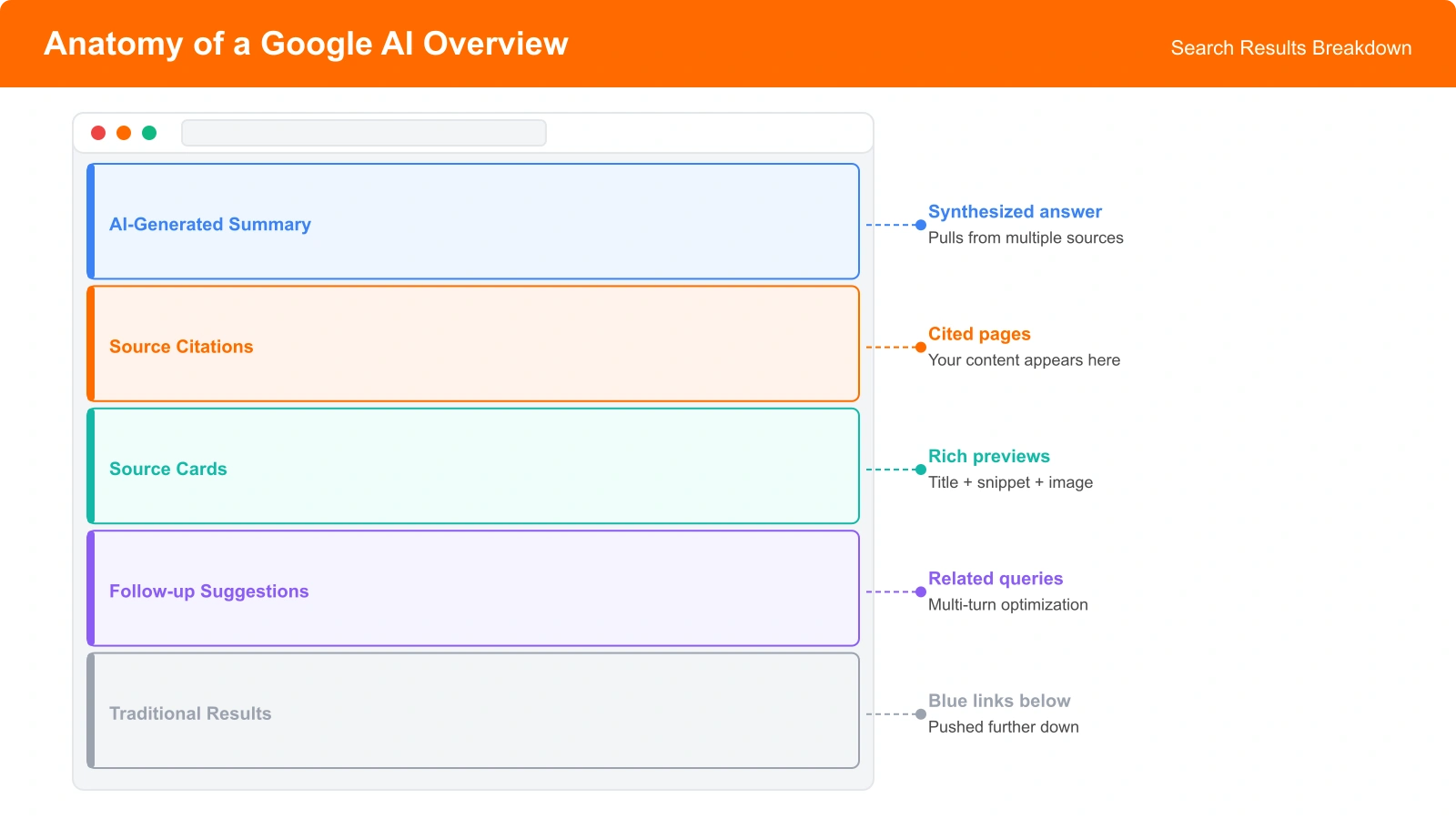
Google's Search Generative Experience (SGE), now called AI Overviews, represents the most significant change to search since featured snippets. For comparison and listicle content, the implications are substantial: AI Overviews can summarize your recommendations directly in search results, potentially reducing clicks while also providing new citation visibility.
The strategic response isn't to fight AI Overviews—they're here to stay. Instead, it's adapting your content strategy to thrive in both traditional organic results and AI-generated summaries. This guide covers what we know about how AI Overviews treat comparison content and actionable strategies for listicle publishers navigating this evolution.
How AI Overviews Affect Listicle Traffic
Understanding the traffic dynamics helps you prioritize your response.
Observed Traffic Patterns
AI Overviews affect different query types differently:
| Query Type | AI Overview Presence | Traffic Impact | Strategic Response |
|---|---|---|---|
| Simple “best X” | Often appears | May reduce clicks as summary satisfies | Optimize for citation within overview |
| Complex comparison | Sometimes appears | Users often click for detail | Provide depth overview can't capture |
| “Best X for Y” (specific) | Variable | Context-specific queries still drive clicks | Target contextual long-tail queries |
| “A vs B” | Often appears | Summary may satisfy or prompt deeper research | Provide unique comparison data |
| Transactional comparison | Less common | Purchase intent usually preserves clicks | Emphasize conversion-ready content |
The Citation Opportunity
AI Overviews cite sources—your content can appear in those citations. When users see your domain cited in an AI Overview, even if they don't click immediately, you've gained brand visibility. Some users do click cited sources for verification or deeper reading.
Appearing in AI Overview citations may also signal relevance for traditional organic rankings, though Google hasn't confirmed this relationship explicitly.
Optimization Strategies for AI Overviews
Specific tactics increase your chances of appearing in AI Overview citations.
Structured, Direct Answers
AI Overviews extract and synthesize content. Clear, structured answers are easier to extract and cite:
AI Overview-friendly structure:
H2: Best Project Management Tool for Small Teams
Direct answer: Monday.com is the best project management tool for small teams (under 25 people) because of its intuitive visual interface and affordable team pricing starting at $9/user.
Supporting context: [2-3 sentences expanding on why]
This pattern—clear heading, direct answer, supporting context—aligns with how AI Overviews extract and present information.
Strong E-E-A-T Signals
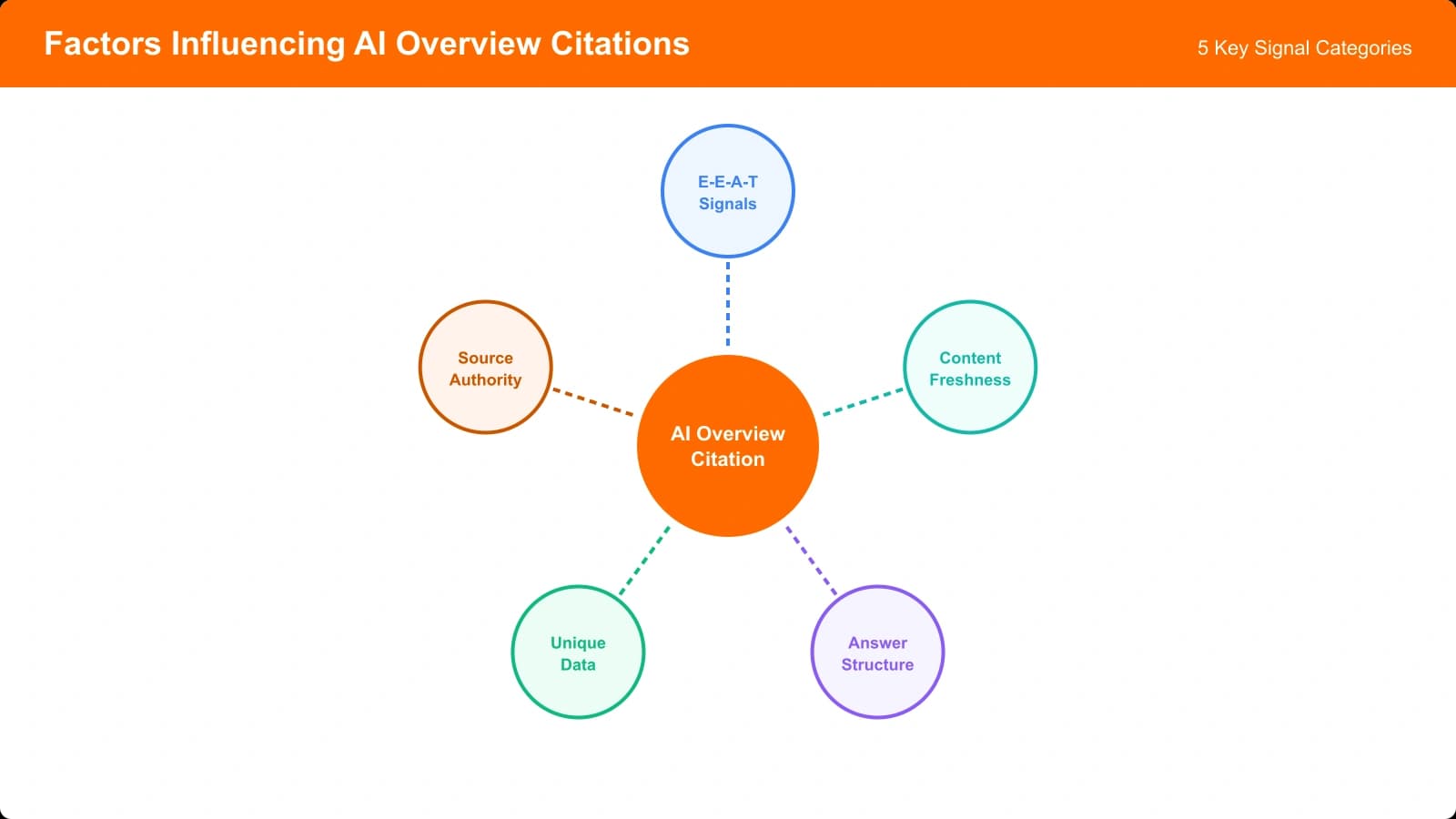
Google emphasizes E-E-A-T (Experience, Expertise, Authoritativeness, Trustworthiness) for AI Overview source selection. Strengthen these signals:
- Experience: Show evidence of product testing, hands-on use, real implementation
- Expertise: Author credentials, industry-specific knowledge, detailed technical analysis
- Authoritativeness: Citations from other sources, industry recognition, comprehensive coverage
- Trustworthiness: Clear methodology, balanced perspective, transparent affiliations
Content demonstrating genuine experience and expertise is more likely to be cited than generic aggregation.
Provide Value AI Can't Generate
AI Overviews synthesize existing information—they don't create new insights. Content with unique value remains essential:
- Original testing data: Benchmark results AI can't fabricate
- Expert opinions: Named expert perspectives AI can't simulate
- Proprietary research: Survey data, user interviews, case studies
- Current pricing: Verified, updated pricing AI may not have
- Implementation guidance: Practical how-to AI can't personalize
The unique value test: If an AI could generate the same content without your page, you're not providing unique value. What does your content offer that requires human experience, original research, or real-world testing?
Generate SGE-Optimized Listicles
Create comparison content structured for AI Overview citation and traditional rankings.
Try for Free
Content Strategy Adaptations
Beyond tactical optimization, consider strategic shifts in your content approach.
Depth Over Breadth
Generic “best 10 tools” listicles are most vulnerable to AI Overview summarization—an AI can list 10 tools as easily as your article. Deep, analytical content is harder to summarize completely:
- Detailed product teardowns with extensive testing
- Multi-page comparison guides with decision frameworks
- Industry-specific recommendations with contextual nuance
- Long-form buying guides that address the full decision journey
Users seeking depth will click through; users satisfied by summaries weren't your best converters anyway.
Contextual Query Targeting
AI Overviews appear less consistently for highly specific queries. Target context-rich long-tail terms:
- “Best CRM for real estate agents under $50/month”
- “Project management tools for remote marketing teams”
- “Email marketing platforms with Shopify Plus integration”
These contextual queries often retain more click-through because the specificity requires detailed, personalized responses.
Conversion-Focused Content
If AI Overviews reduce informational traffic, focus on traffic that converts. Optimize for users at the decision stage, include strong calls-to-action, and ensure your content serves purchase-ready visitors, not just researchers.
Monitoring and Adapting
AI Overviews continue evolving. Monitor your position and adapt.
Tracking AI Overview Presence
Currently, no perfect tool tracks AI Overview citations comprehensively. Manual monitoring approaches:
- Search your target queries regularly and note AI Overview appearance
- Check whether you appear in cited sources
- Compare traffic trends for queries with vs. without AI Overviews
- Monitor Search Console for impression/click ratio changes
Experimentation Mindset
AI Overview behavior changes as Google iterates. What works today may shift. Maintain an experimental approach—test different content structures, monitor results, and adapt. Publishers who treat this as a one-time optimization will fall behind those who continuously adapt.
Thriving in the AI Overview Era
AI Overviews represent an evolution, not an extinction event, for listicle publishers. The key is adapting rather than resisting. Optimize your content for citation in AI-generated summaries. Provide depth and unique value that summaries can't replace. Target queries where human-created, expert content remains essential.
The publishers who will thrive are those who view AI Overviews as a new channel for visibility, not just a threat to clicks. Get cited in overviews, convert the clicks you do receive, and build the kind of authoritative content that both AI and users recognize as valuable.
For optimization on other AI platforms, see Perplexity Optimization and ChatGPT Browse Optimization.

Product Manager at BestPage. Pioneer in AEO research since 2024, exploring the convergence of SEO and GEO (Generative Engine Optimization). Led multiple AI-powered content optimization projects that achieved 300%+ citation increases in ChatGPT and Perplexity.