
ChatGPT's browse feature transforms it from a knowledge-cutoff-limited model to a real-time information retrieval system. When users ask questions requiring current information—like “what are the best project management tools in 2026?”—ChatGPT searches the web, retrieves relevant pages, and synthesizes an answer.
This browsing behavior creates opportunities for content publishers, but the dynamics differ from traditional search and even from other AI assistants like Perplexity. ChatGPT's citation behavior is less predictable, its browsing patterns less transparent, and its content extraction more varied.
This guide explores what we know about ChatGPT's browse behavior and how to optimize comparison content for both findability and citation.
Understanding ChatGPT Browse Behavior
ChatGPT's browsing works differently from traditional search engines and other AI assistants.
When Browsing Triggers
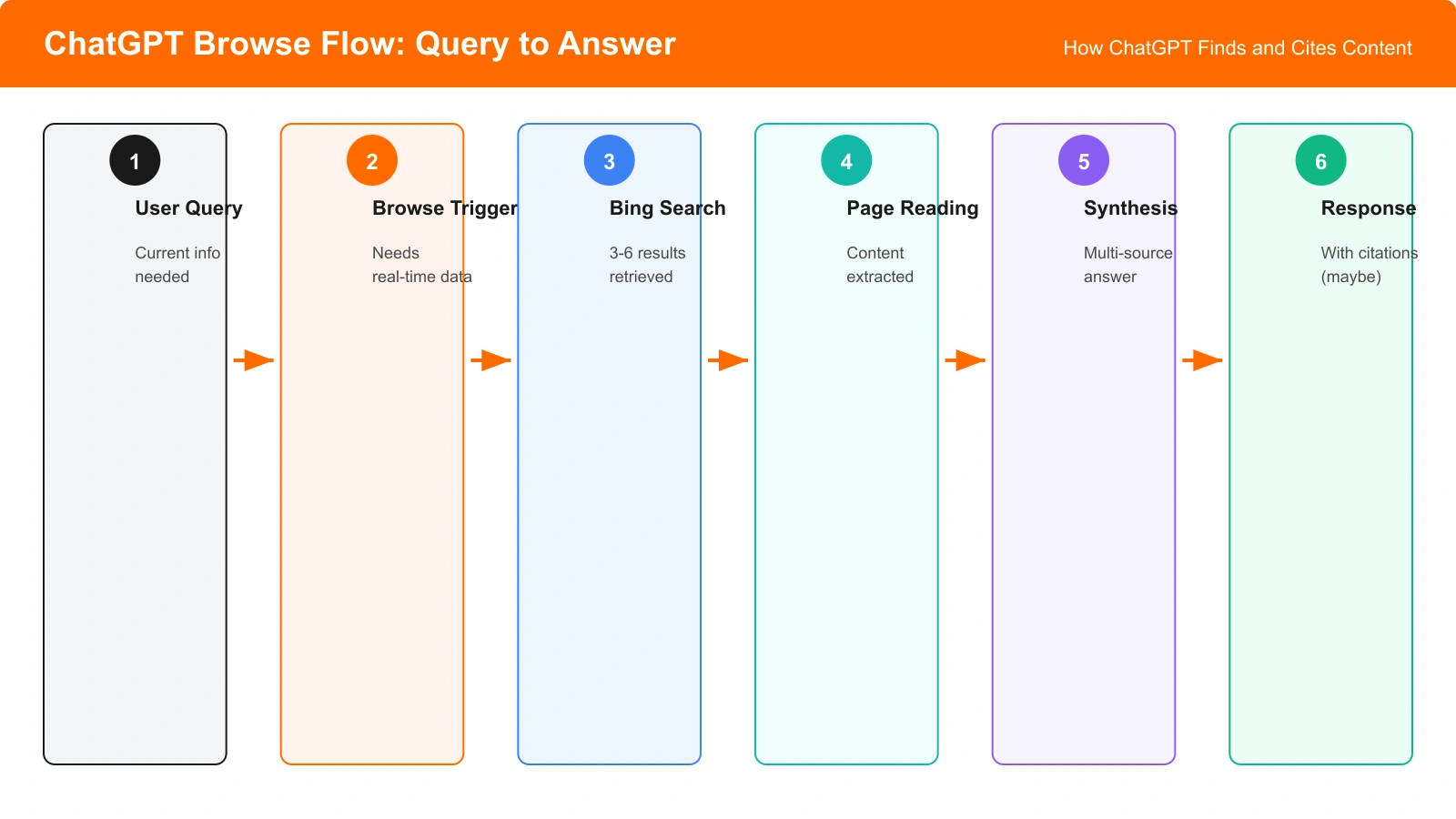
ChatGPT doesn't browse for every query. It browses when questions require current information (dates, prices, recent events), when the query explicitly requests current data (“what are the best tools in 2026”), when users ask it to search (“can you look up...”), and for fact-checking or verification requests.
For comparison and listicle content, queries that mention years, request current recommendations, or ask for updated information are most likely to trigger browsing—and therefore most likely to find your content.
Retrieval Patterns
When ChatGPT browses, it appears to use Bing as its search backend. This means Bing ranking factors influence which pages ChatGPT finds. Content that ranks well in Bing is more likely to be retrieved and potentially cited.
Observed pattern: ChatGPT typically retrieves 3-6 sources for a browse query. It may visit pages directly from search results, follow links within those pages, or perform multiple searches to gather comprehensive information.
Citation Dynamics in ChatGPT
ChatGPT's citation behavior is less consistent than Perplexity's, but patterns emerge.
How ChatGPT Cites
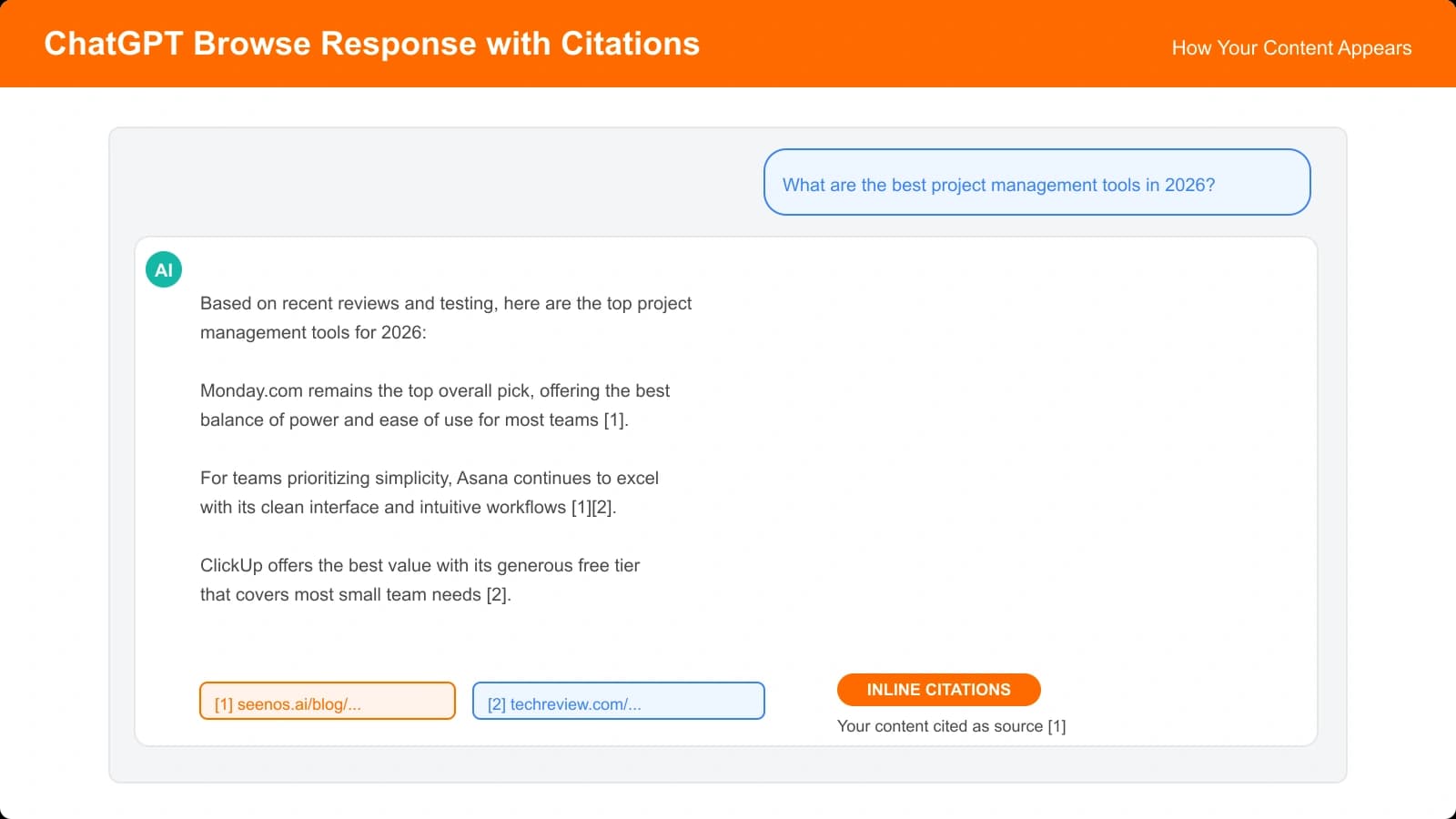
ChatGPT uses several citation styles depending on context:
| Citation Style | When Used | Visibility to User |
|---|---|---|
| Inline linked citations | Direct quotes, specific claims | High—clickable links in text |
| “According to [Source]” | Attributed information | Medium—named but not always linked |
| End-of-response sources | General references | Medium—listed but separated from content |
| Uncited synthesis | Combined information from multiple sources | None—sources used but not shown |
The frustrating reality: ChatGPT often synthesizes information without citation, especially when combining insights from multiple sources. Your content might inform the answer without receiving visible attribution.
What Triggers Citations
ChatGPT is more likely to cite when content provides unique, specific information (data, prices, features), when making claims that benefit from source backing, when the user's query implies they want sources, and when information is controversial or needs verification.
Citation-worthy content pattern:
“According to [YourSite]'s testing, Notion outperformed competitors in collaborative editing speed, handling 50+ simultaneous editors without lag—compared to Coda's limit of around 25.”
Specific data points and comparative testing results are more likely to be cited than general recommendations.
Optimization Strategies
Increase your findability and citation likelihood with targeted optimizations.
Structure for Content Extraction
ChatGPT reads and extracts content from your pages. Make key information easily extractable:
Extractable structure pattern:
Heading: Best Project Management Tool for Remote Teams
Direct answer: Monday.com is the best project management tool for remote teams in 2026.
Key reasons: Timezone-aware scheduling, async communication features, visual dashboards accessible from any device.
Pricing: Plans start at $9/user/month for small teams.
This pattern—clear heading, direct answer, supporting reasons, factual details—gives ChatGPT structured content to extract and potentially cite.
Provide Unique, Citable Data
Generic recommendations are easily synthesized without citation. Unique data demands attribution:
- Original testing results: “We tested load times across 10 platforms...”
- Proprietary surveys: “In our survey of 500 users...”
- Expert analysis: “[Named expert] evaluated integration capabilities...”
- Current pricing research: Specific, verified prices with dates
- Exclusive interviews: Quotes from product teams or users
When ChatGPT needs to cite a specific number or finding, it's more likely to attribute to your source.
Currency and Freshness Signals
ChatGPT prioritizes current information for time-sensitive queries:
- Include the current year in titles and content
- Show clear “Last Updated” dates
- Reference current pricing and features
- Update content regularly to maintain freshness
- Remove or flag outdated information
Generate ChatGPT-Optimized Comparisons
Create listicles structured for AI browse discovery and citation.
Try for Free
Bing-Specific Optimization
Since ChatGPT uses Bing, Bing ranking factors affect your browse visibility.
Key Bing Differences from Google
Bing values some factors differently than Google:
- Exact match keywords: Bing weights exact keyword matches more heavily
- Social signals: Bing considers social engagement more than Google
- Page age: Established pages sometimes get preference
- Meta descriptions: Bing uses meta descriptions more directly
- Clear, simple structure: Bing favors easily parsed content
Ensure your comparison content is indexed in Bing, check Bing Webmaster Tools for issues, and consider Bing-specific keyword optimization alongside Google SEO.
Verify Bing Indexing
Use Bing Webmaster Tools to verify your comparison pages are indexed and ranking. Pages not indexed in Bing won't be found by ChatGPT browse. Submit sitemaps to Bing, fix any crawl errors, and monitor Bing-specific rankings for your key comparison terms.
Preparing for ChatGPT Visibility
ChatGPT browse optimization combines traditional SEO fundamentals (particularly Bing optimization) with AI-specific content structuring. Make your content findable through strong Bing rankings, extractable through clear structure, and citable through unique data and explicit recommendations.
The browse feature continues evolving, with citation behavior likely to become more consistent over time. Content optimized for current browse patterns will be well-positioned as the feature matures.
For Perplexity-specific tactics, see Optimizing for Perplexity. For Google's AI features, see Google SGE Strategy.

Product Manager at BestPage. Pioneer in AEO research since 2024, exploring the convergence of SEO and GEO (Generative Engine Optimization). Led multiple AI-powered content optimization projects that achieved 300%+ citation increases in ChatGPT and Perplexity.