

When ChatGPT or Perplexity decides which sources to cite for a comparison query, they're not just evaluating content quality—they're evaluating source credibility. A well-structured comparison from a clearly credentialed author carries more weight than identical content from an anonymous source.
This matters especially for YMYL (Your Money, Your Life) topics and technical comparisons. AI systems have been trained to prioritize authoritative sources, and author signals are a key component of how they assess authority.
This guide explains how AI systems evaluate author expertise, what signals they look for, and how to structure author information on your listicles to maximize credibility and citation likelihood.
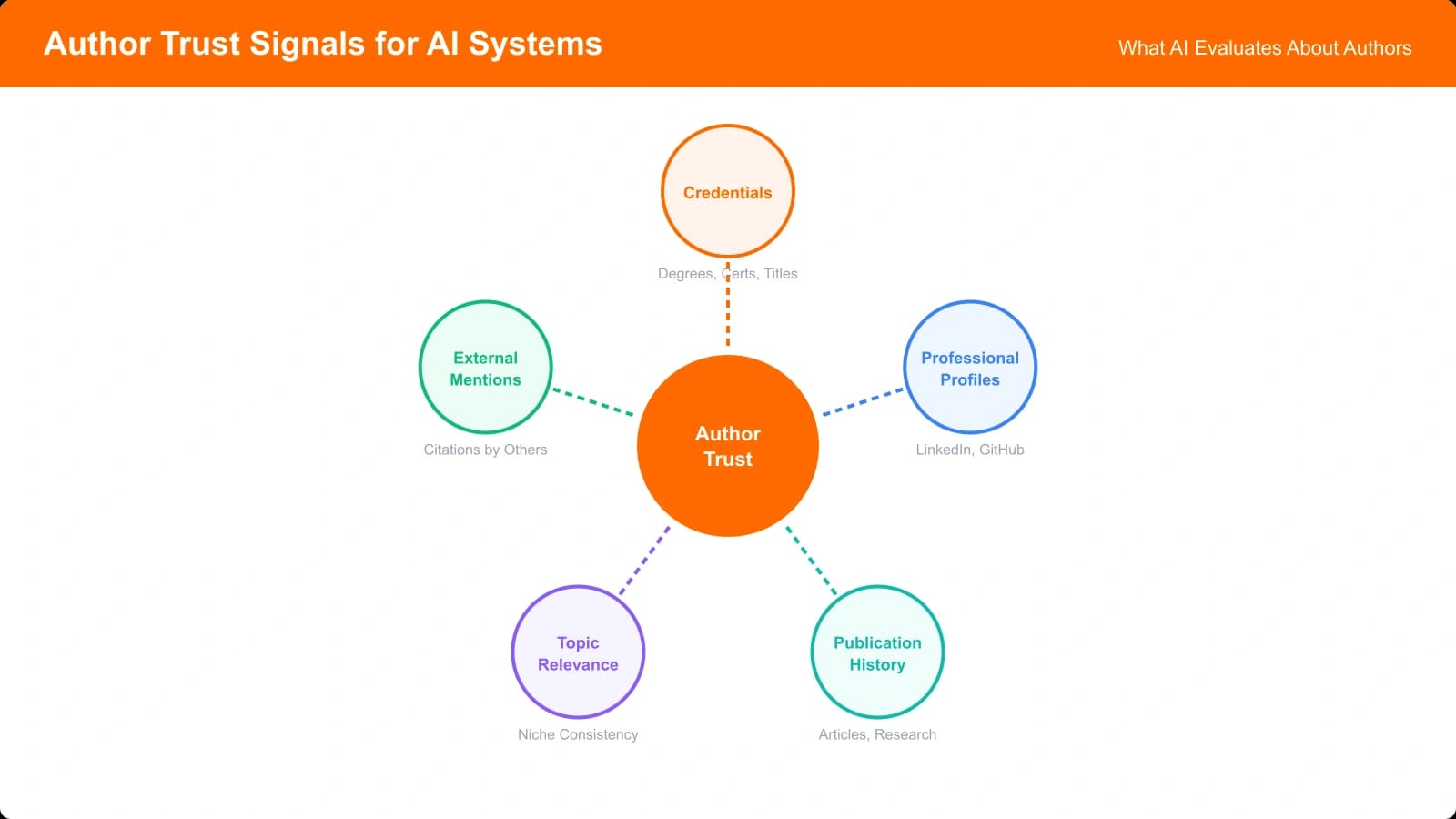
How AI Evaluates Authors
AI systems have been trained on patterns that correlate with credible authorship. Understanding these patterns helps you signal expertise effectively.
What AI Systems Look For
| Signal Type | What AI Detects | Why It Matters |
|---|---|---|
| Named authorship | Real name vs “Staff” or “Admin” | Named authors are more accountable |
| Professional credentials | Titles, certifications, degrees | Formal qualifications establish baseline expertise |
| Topic relevance | Author's stated experience in the topic area | Generic authors for specific topics reduce trust |
| External verification | Links to LinkedIn, professional profiles | Verifiable identity increases credibility |
| Publication history | Other articles by the same author | Consistent expertise across content signals depth |
The Anonymous Author Penalty
Content without clear authorship faces an implicit credibility penalty:
- No author byline: AI may treat content as less authoritative
- Generic bylines: “By Staff” or “By [Company Name]” provide no expertise signal
- Pseudonyms without profiles: Names without verifiable identities carry less weight
- Missing author pages: No place for AI to verify expertise claims
This doesn't mean anonymous content can't be cited. But when AI systems have multiple sources to choose from, author credibility becomes a differentiator.
Building Credible Author Profiles
Strong author profiles require intentional construction. Here's what to include.
Essential Profile Elements
| Element | What to Include | Example |
|---|---|---|
| Full name | Real name (not “J. Smith”) | Jennifer Smith |
| Title/role | Current professional position | Senior Product Manager at TechCorp |
| Expertise statement | Specific topic expertise | “Specializes in SaaS product management and B2B software evaluation” |
| Experience | Years in field or specific background | “10+ years in enterprise software” |
| Professional links | LinkedIn, Twitter, personal site | Links to verifiable profiles |
Establishing Topic Relevance
The expertise claim needs to match the content topic:
- Direct experience: “Has evaluated 50+ CRM platforms for enterprise clients”
- Industry background: “Former marketing operations lead at Fortune 500 company”
- Research focus: “Researches B2B software adoption trends”
- Practical use: “Has implemented 12 different PM tools across agencies”
Generic expertise (“writer with 10 years experience”) is less valuable than specific expertise (“SaaS analyst covering the marketing technology space since 2018”).
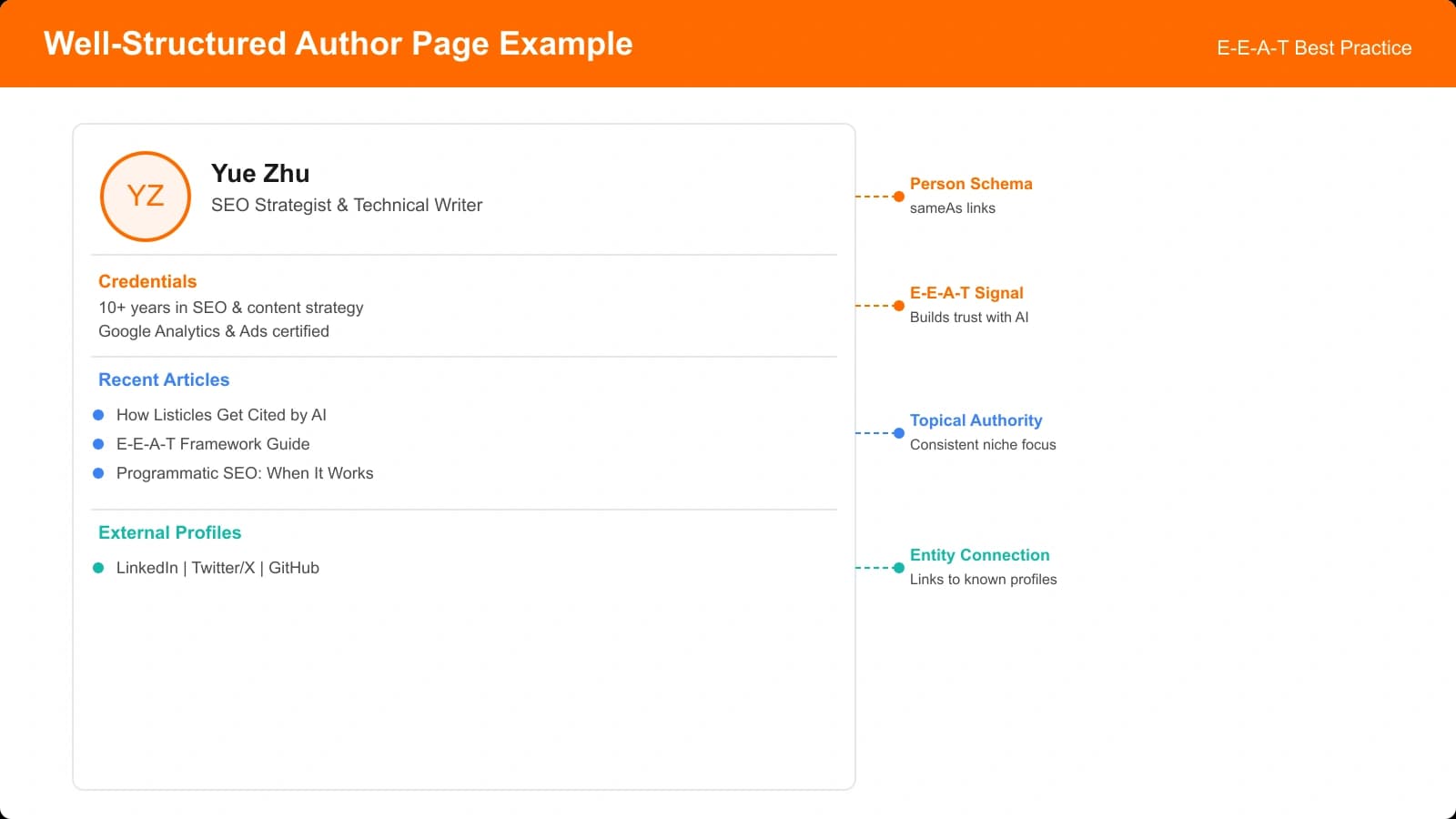
The Author Page
Each author should have a dedicated page that:
- Lists all articles by that author
- Contains a detailed bio (100-200 words)
- Links to external professional profiles
- Includes a professional headshot
- Provides contact or social information
Build Author-Credible Content
Create comparison pages with proper author attribution that AI systems trust.
Try for Free
Schema Markup for Authors
Structured data makes author information explicit for AI parsing.
Person Schema Properties
| Property | Purpose | Example Value |
|---|---|---|
| @type | Declares this is a person | “Person” |
| name | Full name | “Jennifer Smith” |
| jobTitle | Current role | “Senior Product Manager” |
| worksFor | Employer | Organization with name property |
| sameAs | Links to other profiles | Array of LinkedIn, Twitter URLs |
| url | Author page on your site | “/authors/jennifer-smith” |
| description | Brief expertise summary | “SaaS analyst specializing in...” |
Connecting Article to Author
Your Article schema should reference the author properly:
- author property: Should be a Person object, not just a string
- Full author details: Include credentials in the Person object
- Same as author page: Match the information on your author page
Knowledge Graph Connections
For authors with established online presence, leverage Knowledge Graph connections:
- sameAs links: Link to established profiles (LinkedIn, Wikipedia if applicable)
- Consistent naming: Use the same name format across all platforms
- Cross-reference: External profiles should link back to your site
On-Page Byline Best Practices
The visible author byline on each article matters for both humans and AI.
Byline Placement
- Near the title: Author should be visible immediately, not buried at bottom
- Consistent location: Same position across all articles
- Linked to author page: Author name should link to full profile
What to Show in Byline
| Element | Visibility | Purpose |
|---|---|---|
| Author name | Always visible | Establishes accountability |
| Author photo | Recommended | Adds human element, increases trust |
| Title/role | Recommended | Quick expertise signal |
| Publish date | Always visible | Freshness signal |
| Updated date | If different from publish | Shows maintenance |
Handling Multiple Authors
For content with multiple contributors:
- Primary author: List the main expert first
- Contributors: Note additional contributors separately
- Reviewers: For YMYL topics, list expert reviewers distinctly
- Editors: Editorial oversight can add credibility layer
Implementation Checklist
Use this checklist to ensure your author signals are properly implemented:
- Create author pages: Dedicated page for each regular contributor
- Write detailed bios: 100-200 words with specific expertise claims
- Add professional links: LinkedIn minimum, additional profiles if available
- Include credentials: Titles, certifications, relevant experience
- Implement Person schema: Full structured data for each author
- Connect Article to Author: Proper author property in Article schema
- Design visible bylines: Author info near title on every article
- Link bylines to author pages: Clickable author names
- Match topic to expertise: Assign authors to topics matching their background
- Maintain consistency: Same information across page, schema, and external profiles
Author credibility is a fundamental component of E-E-A-T (Experience, Expertise, Authoritativeness, Trustworthiness). As AI systems become more sophisticated in evaluating sources, strong author signals will increasingly differentiate content that gets cited from content that gets ignored.
For broader credibility signals beyond authorship, see our guide on Source Attribution: How to Signal Credibility to AI. For methodology transparency that builds trust, check out Methodology Sections: The AI Trust Signal You Need.

Product Manager at BestPage. Pioneer in AEO research since 2024, exploring the convergence of SEO and GEO (Generative Engine Optimization). Led multiple AI-powered content optimization projects that achieved 300%+ citation increases in ChatGPT and Perplexity.