
When you make a claim in a listicle—“Salesforce has a 4.3/5 rating” or “HubSpot starts at $45/month”—where does that information come from? For human readers, the answer might be obvious. For AI systems evaluating your credibility, clear source attribution is essential.
AI systems have been trained to prefer content that cites sources. They've learned that academic papers cite other papers, authoritative news articles quote sources, and credible comparisons reference where they got their data. Content that makes claims without attribution looks less trustworthy by comparison.
This guide covers how to attribute sources in listicles so AI systems recognize your content as well-researched and credible. We'll look at citation placement, link quality, evidence formatting, and the balance between readability and verifiability.
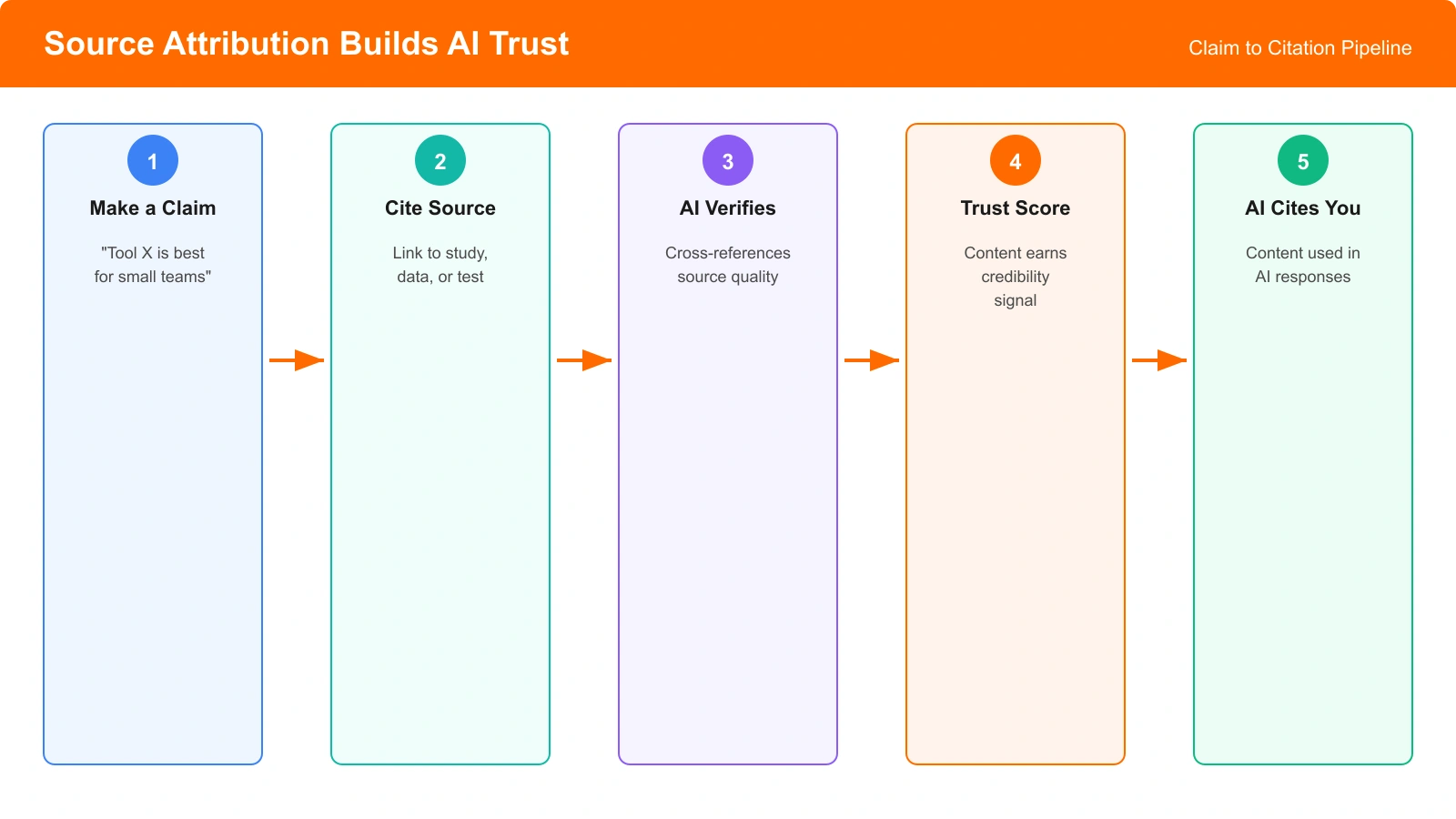
Why Source Attribution Matters for AI
Understanding why AI values sources helps you implement attribution effectively.
Patterns AI Has Learned
AI systems trained on web content have learned these patterns:
| Content Pattern | AI Association |
|---|---|
| Links to authoritative sources | Research-backed, trustworthy |
| Cited statistics with sources | Factual, verifiable |
| References to official documentation | Accurate, up-to-date |
| Quoted expert opinions | Expert-informed, credible |
| Unsourced claims | Potentially unverified, less reliable |
Types of Claims That Need Sources
Not every statement needs a citation. Focus source attribution on:
- Statistical claims: “85% of users prefer...” needs a source
- Pricing information: Link to official pricing pages
- Feature claims: Reference product documentation or announcements
- Ratings and reviews: Cite where the rating comes from (G2, Capterra, etc.)
- Market data: Link to research reports or data providers
- Expert quotes: Attribute to named individuals with credentials
General knowledge (“CRMs help manage customer relationships”) typically doesn't need citation. Specific claims (“CRM adoption increased 40% in 2025”) do.
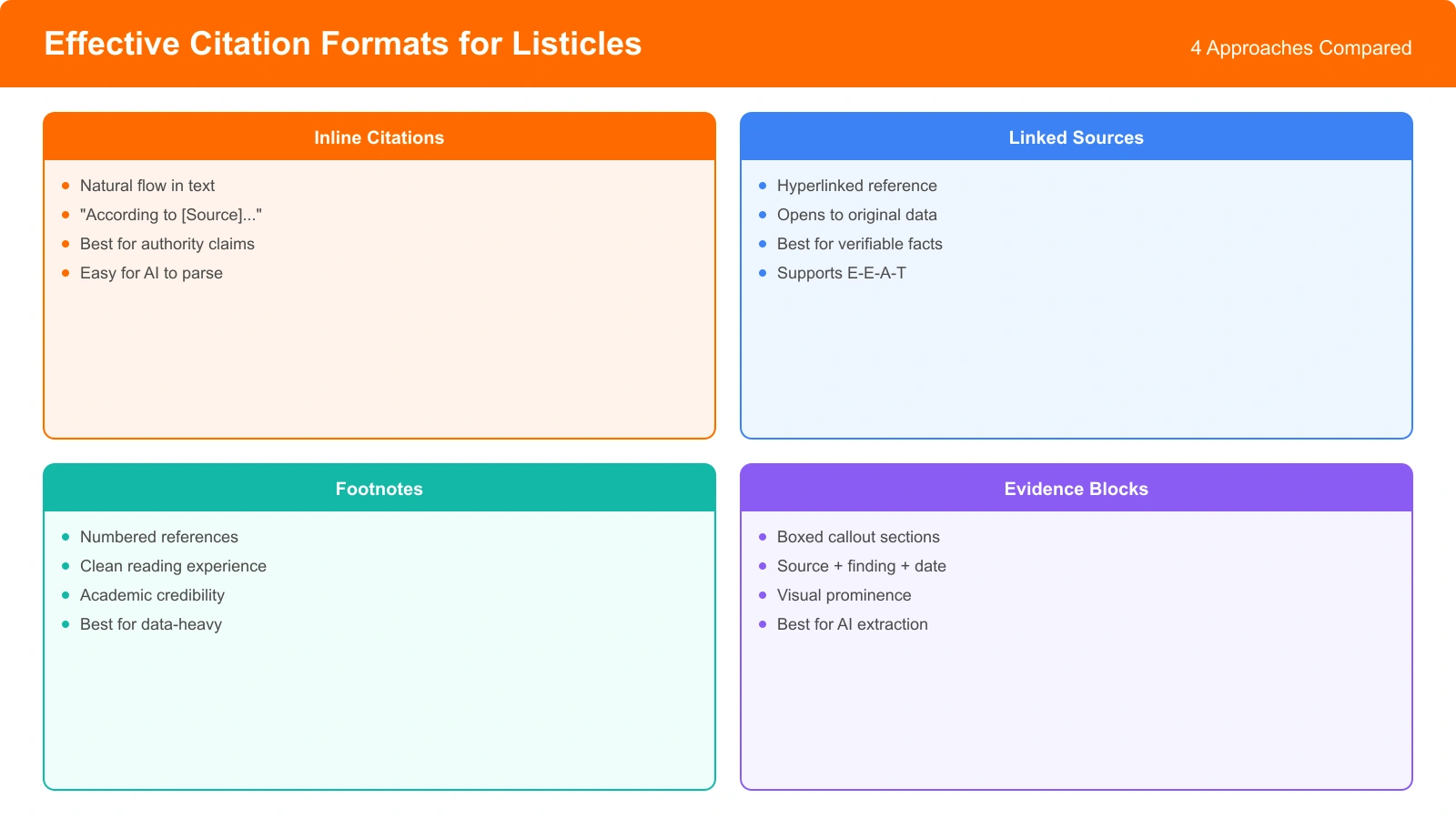
Effective Citation Formats
How you present citations affects both readability and AI comprehension.
Inline Citations
Citations placed within the text, near the claim:
- Good: “According to G2, Salesforce has a 4.3/5 average rating from 12,000+ reviews.”
- Good: “HubSpot's pricing starts at $45/month (source: HubSpot pricing page).”
- Less ideal: “The software has great ratings.” (no source specified)
Linked Source Names
Making source names clickable links:
| Format | Example | Effectiveness |
|---|---|---|
| Named + linked | “per <a href=...>Gartner's 2026 Report</a>” | Best: clear source, verifiable |
| Named only | “per Gartner's 2026 Report” | Good: clear source, not linked |
| Generic link | “per this report” (linked) | Acceptable: less clear source type |
| No attribution | “studies show...” | Weak: vague, unverifiable |
Dedicated Evidence Blocks
For important claims, consider dedicated evidence sections:
- Data sources section: List where pricing, ratings, feature data comes from
- Research sources: Studies or reports that inform your rankings
- Methodology note: Explain how you gathered and verified information
Create Well-Sourced Comparisons
Build comparison content with built-in source attribution that AI systems trust.
Try for Free
Source Link Quality
Not all source links carry equal weight. AI systems can distinguish between source types.
Source Authority Hierarchy
| Source Type | Authority Level | Examples |
|---|---|---|
| Official/primary sources | Highest | Product websites, pricing pages, documentation |
| Industry research | High | Gartner, Forrester, industry reports |
| Trusted review platforms | High | G2, Capterra, TrustRadius |
| Major publications | Medium-High | TechCrunch, major news outlets |
| Blog posts/articles | Medium | Industry blogs, thought leaders |
| User forums/social | Lower | Reddit, Twitter, community posts |
Prioritizing Primary Sources
When possible, link directly to primary sources:
- Pricing: Link to the product's official pricing page
- Features: Link to official documentation or feature pages
- Announcements: Link to press releases or official blog posts
- Integrations: Link to integration directories or documentation
Avoiding Weak Sources
- Don't cite your own site as the sole source: External validation matters
- Avoid “studies show” without naming the study: Be specific
- Don't link to content farms: Low-authority sites hurt credibility
- Verify links work: Broken links suggest unmaintained content
Balancing Citations and Readability
Over-citation makes content hard to read. Under-citation hurts credibility. Here's how to balance.
Citation Density Guidelines
- Product overviews: 1-2 citations per product (pricing, rating)
- Statistical claims: Always cite, no exceptions
- Feature lists: Link to documentation for verification, not every feature
- Comparisons: Cite sources for factual claims, not opinions
Grouped Attribution
Instead of citing every data point individually, group sources:
- Section-level attribution: “Pricing data sourced from official websites as of January 2026”
- Data sources section: List all sources used at the end
- Methodology note: Explain your research process once
Visual Citation Formatting
Make citations present but not intrusive:
- Subtle link styling: Don't make every citation visually overwhelming
- Tooltip citations: Hover-to-reveal source details
- Footnote style: Numbers linking to source list at bottom
- Expandable sections: “View sources” that expands
Implementation Checklist
Use this checklist to improve source attribution in your listicles:
- Audit existing claims: Identify statements that need source support
- Prioritize primary sources: Link to official product pages where possible
- Name your sources: Say “according to G2” not just “according to reviews”
- Link source names: Make source references clickable when practical
- Add data source section: List where pricing, ratings, features come from
- Include methodology note: Explain how information was gathered
- Verify link quality: Ensure sources are authoritative and working
- Update regularly: Keep sources and data current
- Balance readability: Don't over-cite to the point of confusion
- Test with AI: Ask AI systems to summarize your content and note what they cite
Source attribution is a foundational trust signal. Content that demonstrates where information comes from is more likely to be treated as authoritative by AI systems making citation decisions. The investment in proper attribution pays dividends in credibility.
For author-level credibility signals, see our guide on Author Signals That Make AI Trust Your Listicle. For evidence block formatting, check out Evidence Blocks: How to Look Authoritative to AI.

Product Manager at BestPage. Pioneer in AEO research since 2024, exploring the convergence of SEO and GEO (Generative Engine Optimization). Led multiple AI-powered content optimization projects that achieved 300%+ citation increases in ChatGPT and Perplexity.