

Here's a question I hear constantly: why does ChatGPT cite some listicles and ignore others that seem just as good?
Part of the answer is structural—clear headings, extractable verdicts, proper schema. But there's another piece that's less discussed: credibility signals. AI systems—especially the retrieval-augmented kind used by Perplexity and similar tools—aren't just looking for relevant information. They're evaluating whether sources are trustworthy.
Think about it from the AI's perspective. It's being asked to recommend project management software. It finds two articles with similar content. One makes unsupported claims: “This is the best tool.” The other backs up claims with specific evidence: “In our 6-week test, this tool reduced task completion time by 23%.”
Which would you cite? The one with evidence. AI systems are increasingly making the same choice.
This guide shows you how to build what I call “evidence blocks”—structured credibility signals that make AI systems treat your content as authoritative. For the broader framework, see our guide on how listicles get cited by AI.
What Are Evidence Blocks?
An evidence block is a distinct section of content that provides verifiable support for your claims. It's not just mentioning that something is true—it's showing why it's true.
Types of Evidence Blocks
- Statistics with sources: Data points attributed to research or testing
- Methodology sections: Descriptions of how you evaluated products
- Expert quotes: Statements from recognized authorities
- First-party data: Results from your own testing or surveys
- External citations: Links to authoritative third-party sources
- Case examples: Specific instances that demonstrate claims
Why Evidence Works for AI
AI systems are trained on patterns of credible content. Academic papers, quality journalism, authoritative reports—they all share common patterns: claims are supported, sources are cited, methodology is explained.
When your listicle includes these same patterns, AI systems recognize it as similar to other credible content. According to research from Search Engine Journal, content with explicit sourcing is more likely to appear in AI-generated summaries.
Building Methodology Blocks
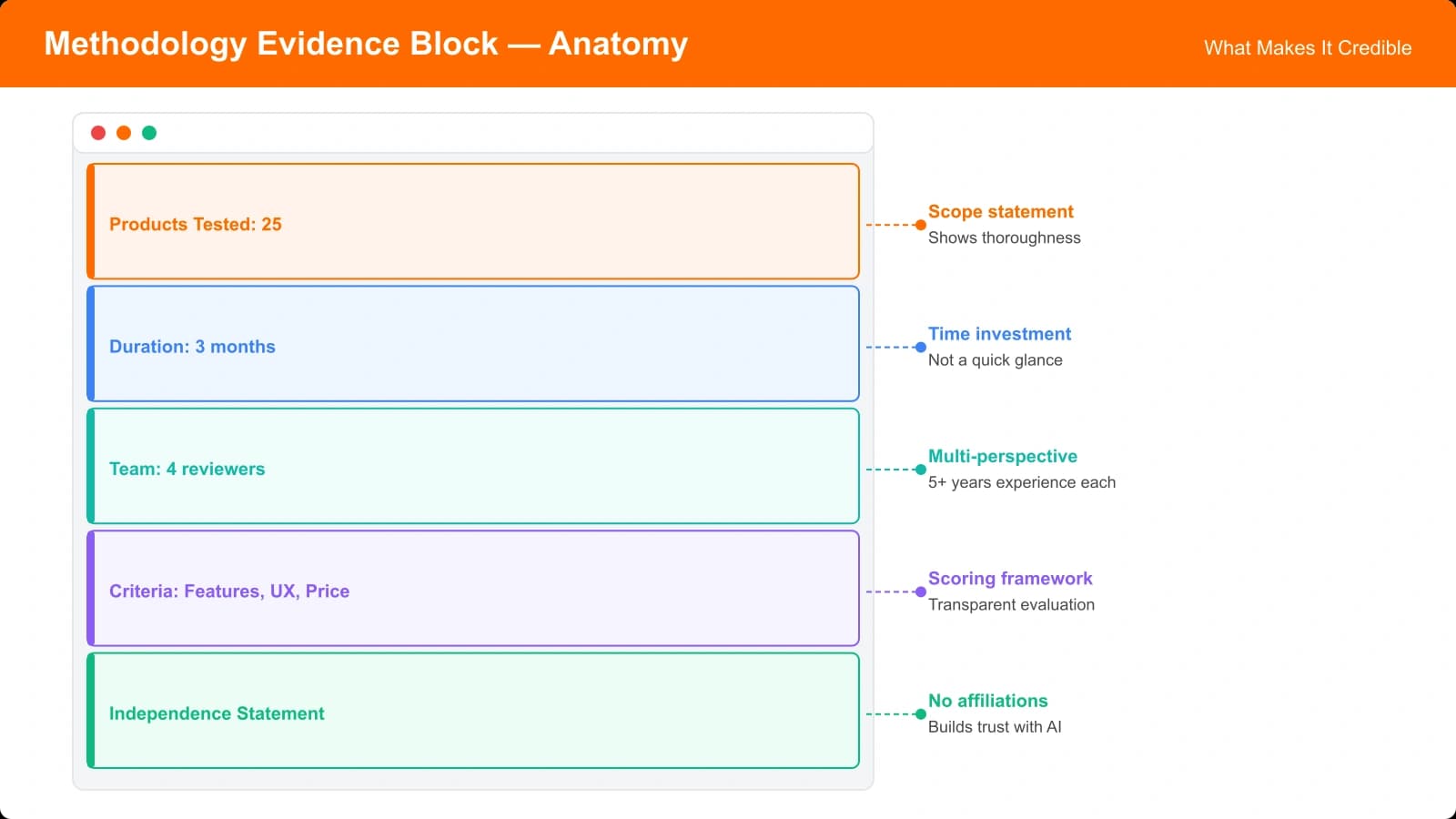
A methodology block explains how you arrived at your recommendations. It's one of the strongest credibility signals you can include.
What to Include
- Testing scope: How many products did you evaluate?
- Time investment: How long did you spend testing?
- Evaluation criteria: What factors did you assess?
- Testing approach: Hands-on use? Standardized tasks? Real projects?
- Team composition: Who conducted the evaluation?
Template
<section class="methodology-block">
  <h3>How We Tested</h3>
  <p>
    Our team evaluated <strong>23 project management tools</strong> over
    <strong>8 weeks</strong>. Each tool was tested by 4 team members
    using standardized project templates based on real client work.
  </p>
  <p>We assessed each tool on:</p>
  <ul>
    <li>Ease of setup and onboarding (timed)</li>
    <li>Task management features and workflow automation</li>
    <li>Collaboration capabilities across remote teams</li>
    <li>Reporting and analytics depth</li>
    <li>Value for price at each tier</li>
  </ul>
  <p>
    Our rankings reflect hands-on performance, not sponsored placement.
    See our <a href="/methodology">full methodology</a> for details.
  </p>
</section>
Notice how this methodology block is specific (23 tools, 8 weeks, 4 team members), explains the approach (standardized templates, real work), and lists concrete criteria. AI systems can extract any of these details as evidence of thorough evaluation.
Statistics with Attribution
Numbers are compelling—but only when sourced. Unsourced statistics actually hurt credibility.
Attribution Patterns That Work
First-party data:
“In our testing, Asana reduced average task completion time by 23% compared to spreadsheet tracking.”
Third-party research:
“According to Gartner's 2026 Collaboration Tools Report, 67% of organizations now use dedicated project management software.”
Platform data:
“HubSpot reports that free CRM users convert to paid plans at a 12% rate within the first year.”
Formatting Statistics for Extraction
When including statistics, make them easy to extract:
- Use specific numbers, not rounded approximations (“67%” not “about two-thirds”)
- Include the source inline, not just as a footnote
- Provide context for what the number means
- Link to the original source when possible
Build Authoritative Listicles AI Trusts
Generate listicles with built-in evidence blocks, proper citations, and credibility signals that make AI systems treat you as an authority.
Try for Free
Incorporating Expert Quotes
Expert quotes add authority that goes beyond your own credibility. When a recognized figure endorses a claim, AI systems treat that claim as more reliable.
Structuring Quotes for Impact
<blockquote class="expert-quote">
  <p>
    "Small businesses consistently underestimate the ROI of proper
    project management tooling. In our research, teams using dedicated
    PM software complete projects 28% faster on average."
  </p>
  <cite>
    — Dr. Sarah Chen, Project Management Institute Fellow
  </cite>
</blockquote>
Key elements:
- Use the
<blockquote>element for semantic clarity - Include full attribution with title or credentials
- Choose quotes that include specific claims or data
- Link to the expert's profile or the source when possible
Finding Legitimate Expert Sources
Where to find quotable experts:
- Industry analysts (Gartner, Forrester, IDC)
- Academic researchers with published work
- Professional association leaders
- Recognized practitioners with public profiles
- Authors of authoritative books in the field
Avoid quoting your own team as “experts” unless they have genuine external credentials. AI systems can detect self-serving attribution.
Leveraging First-Party Data
First-party data—evidence from your own research, testing, or surveys—is increasingly valuable. It's unique, it can't be easily replicated, and it demonstrates genuine expertise.
Sources of First-Party Data
- Product testing results: Performance metrics, time trials, feature comparisons
- User surveys: Preferences, satisfaction scores, usage patterns
- Usage analytics: How your readers engage with different tools
- Customer interviews: Qualitative insights from actual users
- Price tracking: Historical pricing data you've collected
Presenting First-Party Data
<div class="data-callout">
  <h4>Our Testing Results</h4>
  <p>We measured task completion time across 5 project management tools
  using identical project templates:</p>
  <ul>
    <li><strong>Asana:</strong> 4.2 days average</li>
    <li><strong>Monday.com:</strong> 4.5 days average</li>
    <li><strong>ClickUp:</strong> 4.1 days average</li>
    <li><strong>Notion:</strong> 5.0 days average</li>
    <li><strong>Trello:</strong> 4.8 days average</li>
  </ul>
  <p><small>Based on 20 standardized projects per tool,
  January 2026. <a href="/methodology">Full methodology</a></small></p>
</div>
This format is highly citable: specific numbers, clear methodology reference, and dated data.
Using External Citations Effectively
Links to authoritative external sources signal that you've done your homework. But not all links are equal.
High-Authority Sources to Cite
- Official product documentation
- Industry research from recognized analysts
- Academic papers and studies
- Government data and official statistics
- Major news outlets' original reporting
- Recognized industry publications (not SEO-focused blogs)
Citation Formatting
Make citations contextual, not just linked:
Weak: “CRM adoption is growing (source).”
Strong: “CRM adoption grew 14% year-over-year, according to Salesforce's 2026 State of Sales Report.”
The strong version includes the specific claim, the source name, and the specific publication. AI systems can extract all of this.
Link Distribution
Aim for a natural distribution:
- 2-4 external citations per major section
- Mix source types (industry, academic, official)
- Link to primary sources, not other aggregators
- Avoid linking only to sites that might link back (reciprocal linking patterns)
Putting It All Together
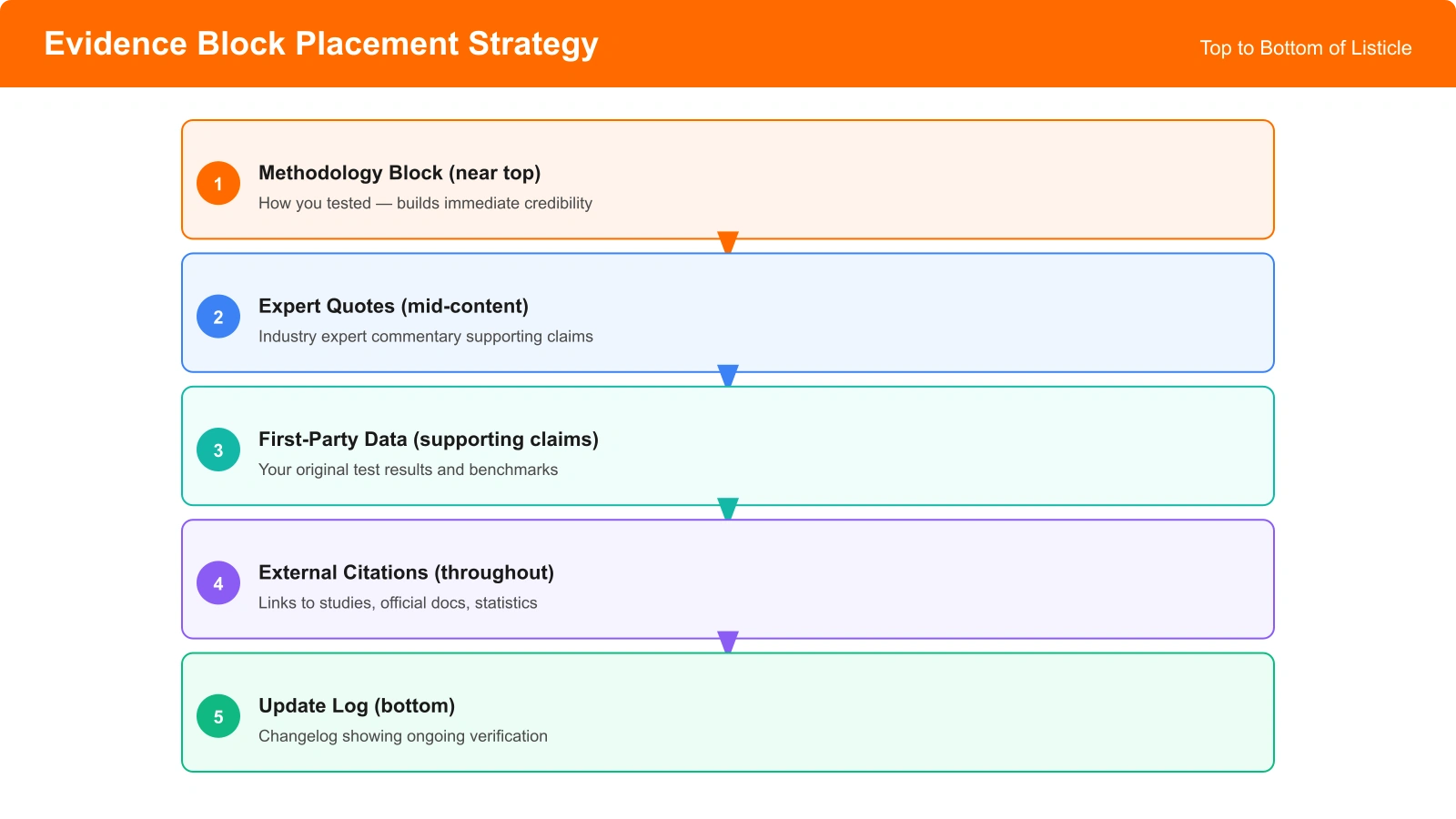
Here's how evidence blocks should flow throughout a typical listicle:
- Intro: Reference a compelling statistic that sets up the problem
- After quick picks: Methodology block explaining your approach
- Within product sections: First-party testing data supporting your verdicts
- Throughout: External citations backing up claims
- In key sections: 1-2 expert quotes adding third-party authority
- Conclusion: Summary that references your evidence foundation
You don't need every type of evidence in every article. But you should have at least:
- A methodology section (even brief)
- 3-5 attributed statistics
- 5-10 external citations to authoritative sources
Authority That AI Recognizes
Evidence blocks aren't just about looking authoritative to humans—they're about signaling credibility in ways that AI systems can parse and evaluate.
The principles are straightforward:
- Show your work with methodology sections
- Back up claims with attributed statistics
- Include expert voices when relevant
- Leverage first-party data that only you have
- Cite authoritative external sources
- Make evidence explicit and easy to extract
The sites that get cited most consistently aren't just well-organized—they're demonstrably credible. Evidence blocks are how you demonstrate that credibility in a format AI systems understand.
Start with your methodology section. Add attribution to your existing statistics. Include 2-3 more external citations. These small additions compound into significant credibility signals.
For the complete AI citation framework, see our guide on how listicles get cited by AI. And for the technical foundation, explore our structured data for listicles guide.

Product Manager at BestPage. Pioneer in AEO research since 2024, exploring the convergence of SEO and GEO (Generative Engine Optimization). Led multiple AI-powered content optimization projects that achieved 300%+ citation increases in ChatGPT and Perplexity.