
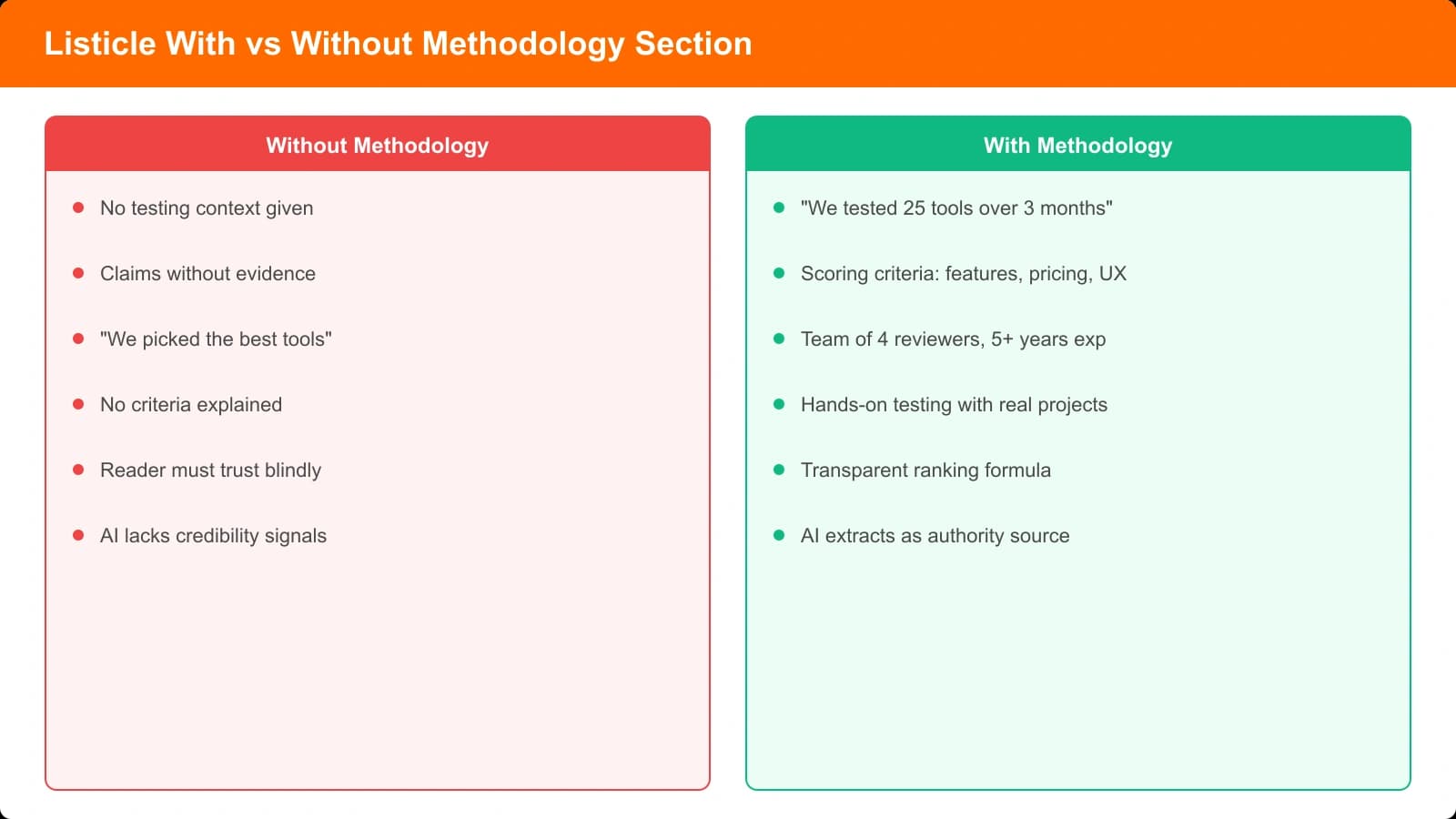
Why should anyone trust your listicle? It's a fair question. The internet is flooded with “best of” articles written by people who've never used the products they recommend, based on criteria they never reveal. AI systems have learned to distinguish between these thin affiliate plays and genuinely helpful content—and methodology transparency is one of their key signals.
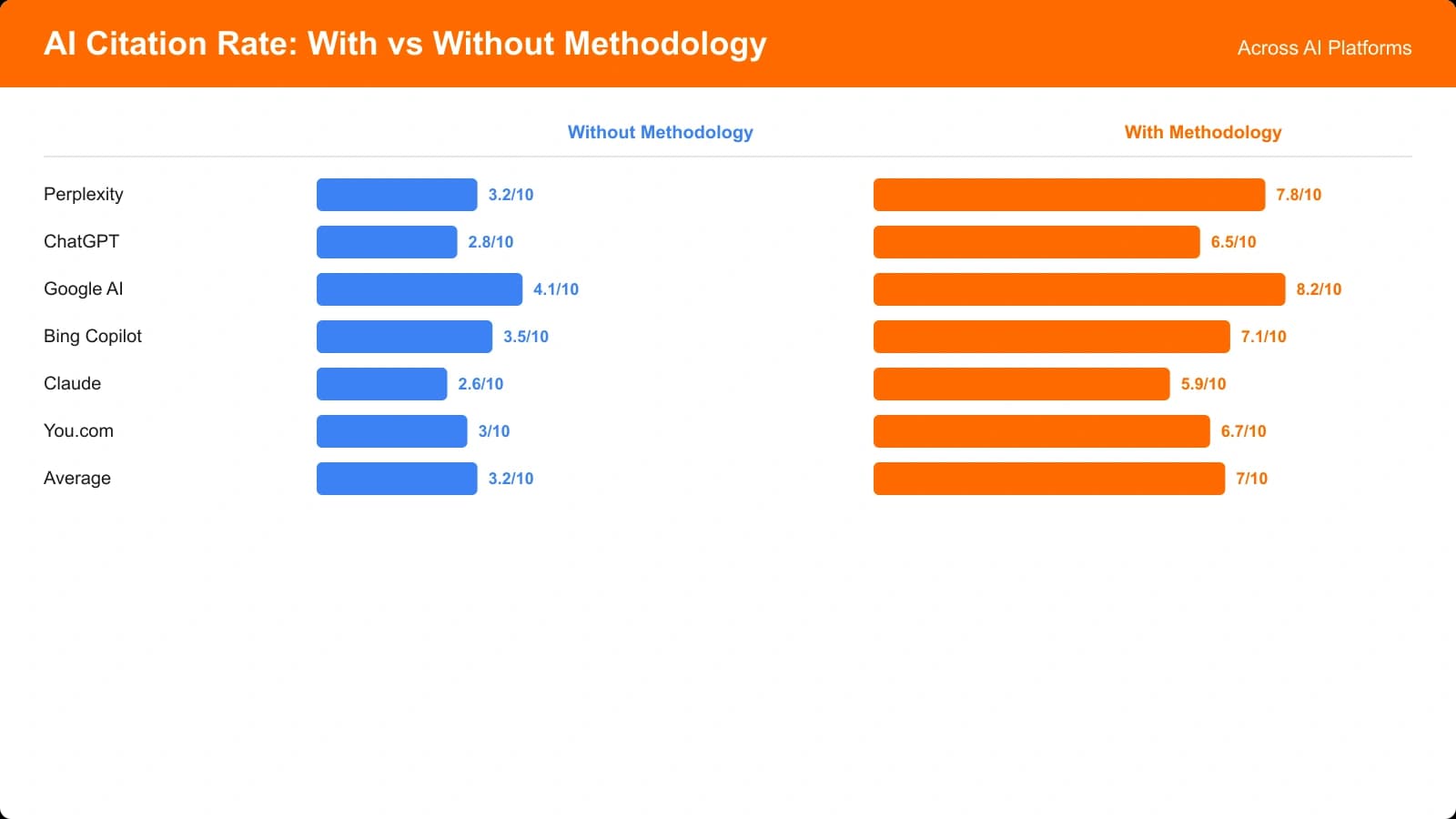
When you explain how you evaluated products, you're doing more than helping skeptical readers. You're telling AI systems: “This content is based on actual process, not arbitrary opinions.” That signal affects whether your recommendations get cited when someone asks ChatGPT or Perplexity for advice.
This guide gives you ready-to-use templates for writing methodology sections that build trust with both humans and AI. You'll learn what elements to include, where to place them, and how to write with the transparency that modern discovery systems reward.
Why Methodology Matters for AI Trust
Let's start with the “why” before we get to the “how.” Understanding the signals AI systems look for helps you write methodology sections that actually work, not just sections that exist for the sake of existing.
How AI Systems Evaluate Content Quality
AI systems don't just index content—they evaluate it. Modern language models have been trained on millions of documents, learning patterns that correlate with reliability, expertise, and trustworthiness. These patterns include:
- Evidence of process: Did the author follow a systematic approach?
- Specificity: Are claims backed by specific details, not vague generalities?
- Transparency: Does the author acknowledge limitations and potential biases?
- Consistency: Does the stated methodology match the actual content?
Methodology sections directly address all four of these signals. When you explain your evaluation process, you're providing the evidence, specificity, transparency, and consistency that AI systems associate with reliable sources.
The E-E-A-T Connection
For those familiar with Google's quality guidelines, methodology sections are pure E-E-A-T fuel. They demonstrate:
- Experience: You actually used or tested the products
- Expertise: You understand what criteria matter in this category
- Authoritativeness: You followed a structured evaluation process
- Trustworthiness: You're transparent about your methods and limitations
The overlap between what Google rewards and what AI systems trust isn't coincidental. Both are trying to identify content that genuinely helps users, and methodology transparency is a reliable indicator.
The Template Overview
Not every listicle needs the same methodology treatment. We've developed three templates for different content types and depth requirements. Choose based on your category complexity and audience expectations.
| Template | Best For | Word Count | Key Elements |
|---|---|---|---|
| Quick Methodology | Simple product roundups | 75-100 words | Scope, key criteria, transparency note |
| Standard Methodology | Software/service comparisons | 150-200 words | Process, weighted criteria, limitations |
| Detailed Methodology | Complex or YMYL categories | 250-350 words | Full process, data sources, expert input |
Let's look at each template in detail with filled examples.
Template 1: Quick Methodology
Use the Quick Methodology template for straightforward product categories where readers trust your judgment without needing extensive justification. This works well for physical product roundups, simple tool lists, and categories where hands-on testing isn't practical.
Structure
The Quick Methodology includes three components:
- Scope statement: What you considered and what you didn't
- Criteria summary: The 2-3 factors that mattered most
- Transparency note: Any potential biases or limitations
Copy-Paste Template
Filled Example
This example is 64 words and covers all three required components. It's brief enough not to slow readers down, but substantive enough to signal process.
When to Use Quick Methodology
- Product categories where quality differences are obvious (appliances, furniture)
- Lists based on research rather than hands-on testing
- Categories where your audience trusts expert curation
- Content where extensive methodology would feel excessive
Template 2: Standard Methodology
The Standard Methodology template is your go-to for most software comparisons, service evaluations, and any category where decision criteria meaningfully vary by user needs. This template provides enough depth to establish credibility without becoming an article within an article.
Structure
The Standard Methodology includes five components:
- Scope statement: Products considered and evaluation period
- Testing process: How you actually evaluated products
- Weighted criteria: Your evaluation factors with relative importance
- Limitations acknowledgment: What you couldn't test or might have missed
- Disclosure statement: Affiliate relationships, sponsorships, or conflicts
Copy-Paste Template
We evaluated [X] [products/services] over [time period]. Our testing process involved [brief description of actual testing methodology].
Our criteria (weighted by importance):
- [Criterion 1] ([X]%)
- [Criterion 2] ([X]%)
- [Criterion 3] ([X]%)
- [Criterion 4] ([X]%)
Limitations: [Honest statement about what you couldn't test or evaluate]
Disclosure: [Statement about affiliate relationships or other potential conflicts]
Filled Example
Our Evaluation Process:
We evaluated 14 project management tools over a 3-month period. Each tool was set up with a real 8-person team that ran identical project workflows—a marketing campaign with multiple stakeholders, dependencies, and deadline pressures.
Our criteria (weighted by importance):
- Ease of use and learning curve (30%)
- Collaboration and communication features (25%)
- Integration with common tools (20%)
- Value for the price (15%)
- Mobile app quality (10%)
Limitations: We focused on small to mid-size team use cases. Enterprise deployments with 500+ users may have different requirements we didn't evaluate. We also couldn't test every integration—we prioritized the most common ones (Slack, Google Workspace, GitHub).
Disclosure: We have affiliate partnerships with some products on this list. However, our rankings are based solely on our testing. We've declined affiliate relationships with products that didn't meet our quality standards.
This example is approximately 185 words and provides substantial credibility signals without becoming exhaustive.
Generate Credible Listicles
Create comparison pages with built-in methodology sections that AI systems trust.
Try for Free
Template 3: Detailed Methodology
For YMYL (Your Money or Your Life) categories, highly technical comparisons, or audiences with high expertise expectations, the Detailed Methodology template provides comprehensive coverage. This template is appropriate for financial product comparisons, healthcare-related content, legal services, or any category where trust is paramount.
Structure
The Detailed Methodology includes seven components:
- Research scope: Comprehensive description of what you evaluated
- Data sources: Where your information comes from
- Testing methodology: Detailed description of your evaluation process
- Evaluation criteria: Weighted factors with explanations for each
- Expert input: Any subject matter experts consulted
- Limitations and caveats: Thorough acknowledgment of constraints
- Update policy: How you keep the content current
Filled Example
Our Methodology
Research Scope: We analyzed 22 high-yield savings accounts from national banks, online banks, and credit unions. Our analysis covers accounts available to U.S. residents as of January 2026. We excluded accounts with geographic restrictions or minimum deposits above $10,000.
Data Sources: APY rates and account terms were verified directly from bank websites and updated weekly. We cross-referenced with FDIC/NCUA databases to confirm insurance coverage. Historical rate data comes from DepositAccounts.com's public dataset.
Evaluation Process: Each account was evaluated by opening an actual account and testing the deposit/withdrawal process. We assessed mobile app quality through real usage over a 30-day period. Customer service was tested through at least three interactions per institution across phone, chat, and email channels.
Evaluation Criteria:
- APY competitiveness (35%): Current rate compared to market average, plus historical rate stability
- Account accessibility (25%): Minimum deposits, withdrawal limits, and transaction flexibility
- Digital experience (20%): Mobile app quality, website usability, and feature set
- Customer service (15%): Response time and quality across channels
- Trust factors (5%): Institution history, insurance coverage, and complaint records
Expert Input: Our methodology was reviewed by James Chen, CFA, a personal finance expert with 15 years of experience in consumer banking. His feedback shaped our weighting of APY stability versus promotional rates.
Limitations: Rates change frequently—the APY you see may differ from what's listed. We couldn't test every edge case for account access. Our customer service testing represents a sample, not comprehensive coverage. Individual experiences may vary.
Update Policy: This article is reviewed weekly for rate accuracy and updated monthly for comprehensive re-evaluation. Last full update: January 28, 2026.
This example is approximately 340 words. For YMYL content, this level of detail is appropriate and expected.
Placement and Formatting
Where you put your methodology section and how you format it affects both reader experience and AI extraction. Here's our guidance.
Placement Options
Option 1: After the introduction, before product reviews. This is the default recommendation. Readers get context about how you evaluated before diving into specific products. AI systems encounter the methodology early, establishing credibility before extraction of product recommendations.
Option 2: In a collapsed/expandable section. For longer methodologies that might slow down readers who don't need them, consider a collapsible section with a clear heading like “How We Evaluated (Click to Expand).” Important: ensure the content is in the HTML for AI crawlers, even if hidden by default.
Option 3: As a linked page. For extremely detailed methodologies, consider a dedicated methodology page linked from your listicle. This works for publisher sites with multiple comparison pages that share a methodology.
| Placement | Best For | AI Impact |
|---|---|---|
| Inline (recommended) | Most listicles | Highest extraction |
| Collapsible section | Long methodologies | Good (if in HTML) |
| Linked page | Multi-article methodologies | Moderate |
Formatting Best Practices
These formatting choices improve both readability and AI parsing:
- Use a clear heading: “Our Methodology” or “How We Evaluated” works better than creative alternatives
- Use bold subheadings: “Testing Process:” helps AI identify distinct components
- Include specific numbers: “14 products over 3 months” beats “many products over time”
- Format criteria as lists: Bulleted or numbered criteria are easier to parse than prose descriptions
- Separate disclosure clearly: Make affiliate disclosures visually distinct
Common Mistakes to Avoid
Methodology sections can backfire if done poorly. Here are the mistakes we see most often and how to avoid them.
Mistake 1: Being Too Vague
“We carefully evaluated all the options and picked the best ones.” This tells readers nothing and provides no trust signal to AI systems. Vague methodologies are often worse than no methodology because they signal that you're trying to appear credible without actually being transparent.
The fix: Include specific numbers, time frames, and criteria. “We evaluated 14 products over 3 months, scoring each on ease of use, integrations, and value” is infinitely better.
Mistake 2: Methodology Doesn't Match Content
If your methodology says you weighted “ease of use” at 30%, but your product reviews barely mention ease of use, you have a consistency problem. AI systems and careful readers will notice this disconnect.
The fix: Write your methodology after completing your product reviews, or update your reviews to explicitly address each stated criterion. The methodology and content should clearly connect.
Mistake 3: Overclaiming Your Process
Claiming you “extensively tested every feature of all 50 products over 6 months with a dedicated team of experts” when you actually spent a weekend researching online will hurt your credibility if discovered—and AI systems are increasingly sophisticated at detecting implausible claims.
The fix: Be honest about your actual process. “Based on our research and limited hands-on testing” is more credible than fake claims of extensive evaluation.
Mistake 4: Hiding Relevant Disclosures
Omitting affiliate disclosures or conflicts of interest doesn't just create legal risk—it undermines the trust signal you're trying to build. Sophisticated readers and AI systems both look for transparency about incentives.
The fix: Include a clear disclosure statement every time. Being upfront about affiliate relationships actually increases trust because it signals honesty.
Putting It Into Practice
Methodology sections are one of the highest-impact additions you can make to listicle content. They serve multiple purposes simultaneously: building reader trust, satisfying E-E-A-T requirements, and signaling credibility to AI systems that increasingly determine content visibility.
Here's your implementation checklist:
- Choose the right template based on your content category and audience expectations (Quick, Standard, or Detailed)
- Include specific numbers—products evaluated, time invested, criteria weights
- Describe your actual process—don't overclaim what you didn't do
- List weighted criteria that match how you actually evaluated products
- Acknowledge limitations honestly—this builds rather than undermines trust
- Include disclosure statements for affiliate relationships or other conflicts
- Place methodology prominently—after your intro, before product reviews
- Format for scannability—bold subheadings, bulleted criteria, clear sections
The investment is minimal—150-300 words for most content—but the payoff is substantial. You'll build more trust with readers, satisfy quality guideline requirements, and send the credibility signals that AI systems use to determine citation worthiness.
For more on building AI-optimized listicle content, see our comprehensive guide to The AI-Optimized Listicle Template. For related trust-building techniques, explore Evidence Blocks for Listicle Credibility and Definition Blocks That Build Topical Authority.

Product Manager at BestPage. Pioneer in AEO research since 2024, exploring the convergence of SEO and GEO (Generative Engine Optimization). Led multiple AI-powered content optimization projects that achieved 300%+ citation increases in ChatGPT and Perplexity.