

When someone asks ChatGPT “What's the best CRM for small businesses?”, the AI is looking for a quotable answer. It wants something it can cite directly—a clear recommendation it can present as the answer rather than needing to synthesize one from your prose.
The difference between content that gets cited and content that gets passed over often comes down to writing patterns. Same information, different presentation, dramatically different AI visibility.
This guide provides the direct answer patterns that consistently win citations. For each pattern, you'll see the structure, examples, and when to use it.
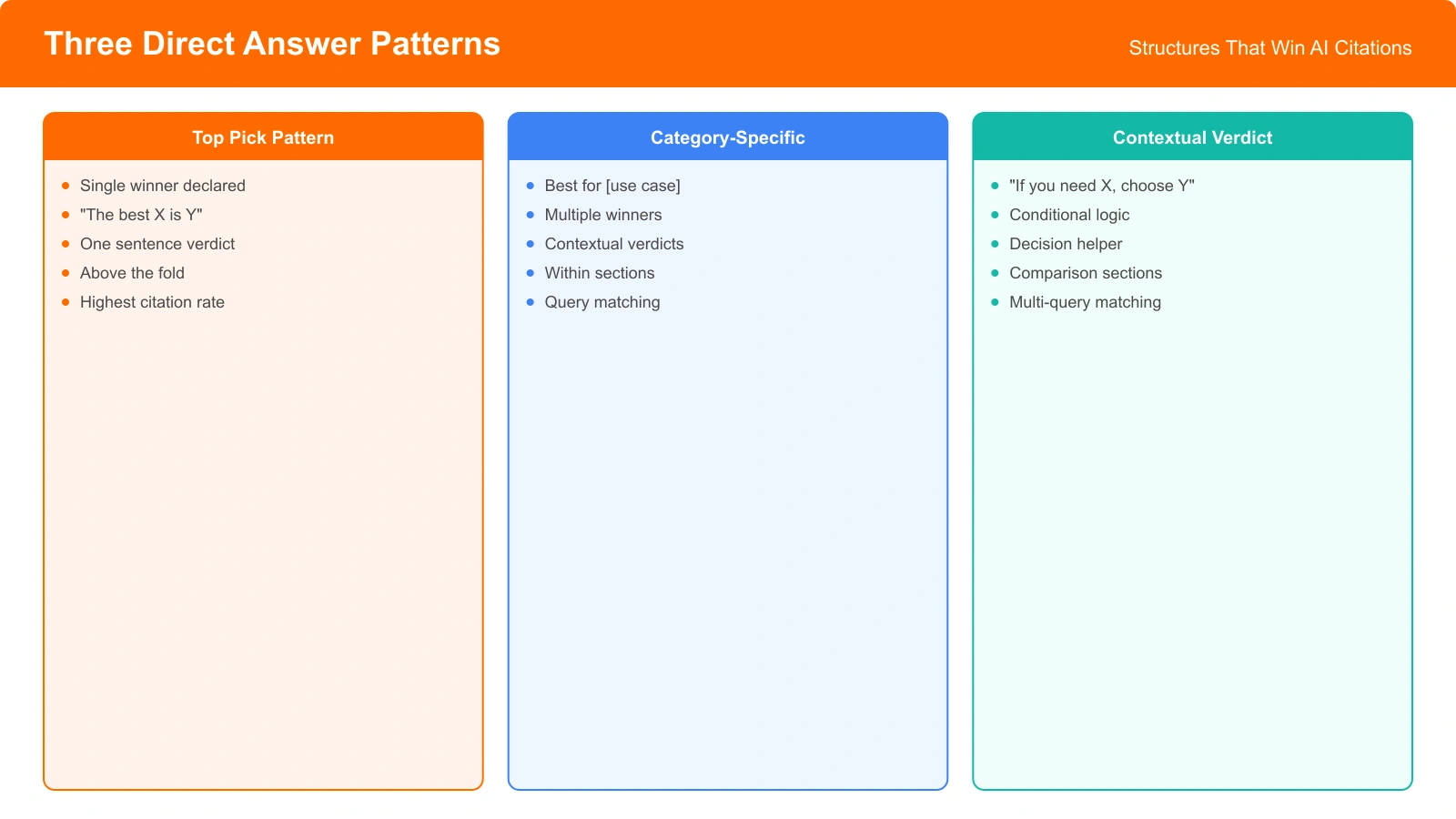
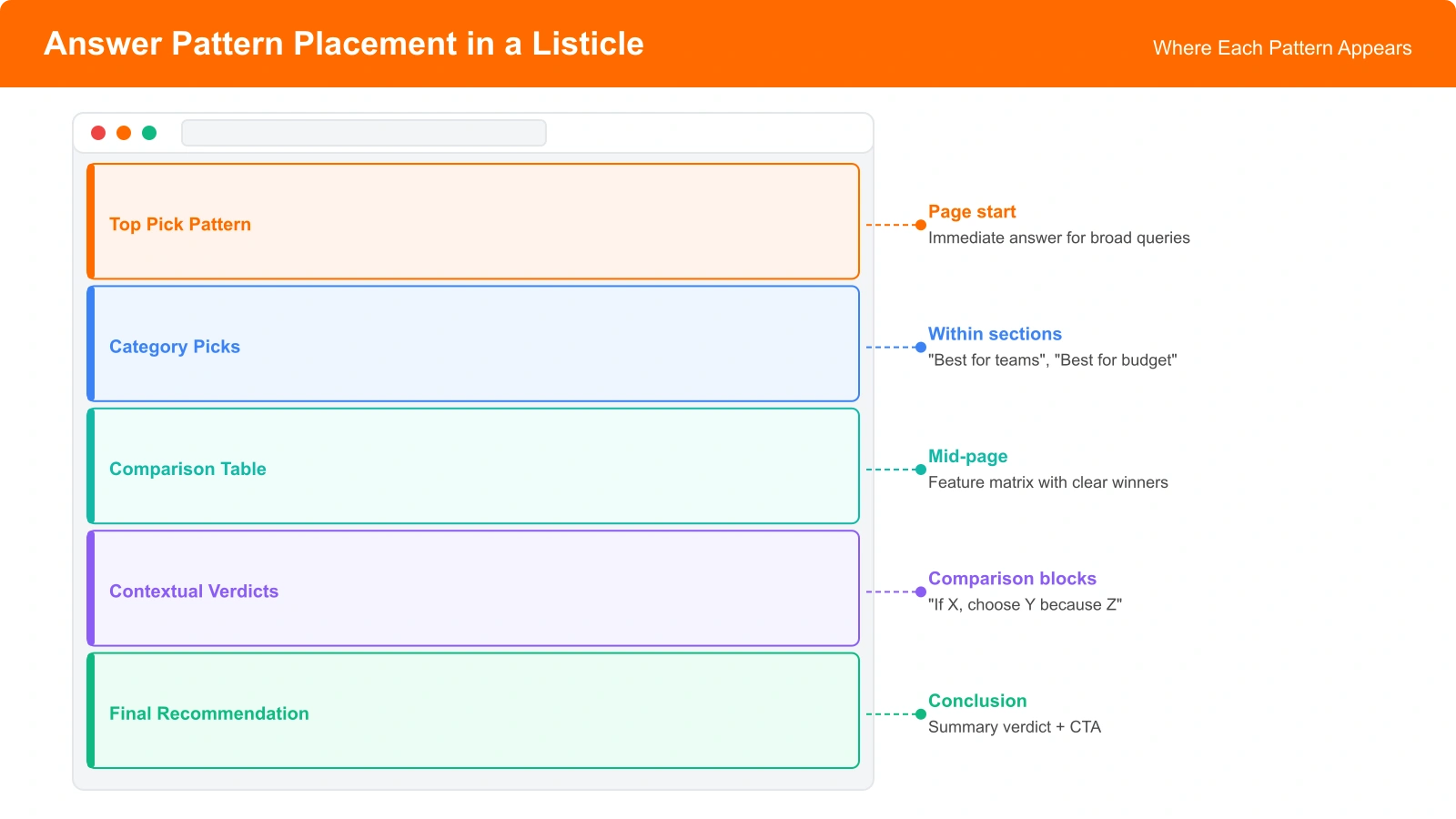
Pattern 1: The Top Pick Declaration
Use this for your overall, no-qualifiers recommendation. It answers “What's the best [category]?” directly.
Structure
[Product] is the best [category] for [primary audience] because [primary reason]. [One supporting detail or secondary benefit].
Every component serves a purpose:
- Product name first — The answer before the explanation
- Category explicitly stated — Reinforces relevance to the query
- Primary audience — Qualifies the recommendation appropriately
- Primary reason — Single most important differentiator
- Supporting detail — Adds credibility without bloating
Examples
“Monday.com is the best project management tool for marketing teams because it combines campaign tracking with flexible workflows that adapt to creative processes. The visual timeline view makes cross-team coordination intuitive.”
“Notion is the best documentation tool for remote startups because it unifies wiki, project management, and collaboration in a single workspace. The template gallery accelerates team onboarding significantly.”
“ClickUp is the best all-in-one productivity platform for agencies because it eliminates the need for multiple tools across departments. Custom fields and views allow each team to work their way within one system.”
Pattern 2: Category-Specific Recommendation
Use this for segmented picks—best budget option, best for enterprises, best free alternative. These answer more specific queries and appear throughout your listicle.
Structure
For [specific need/segment], choose [Product]—it [addresses the specific need] [better than alternatives/without tradeoff]. [Optional: One sentence on key limitation for honesty.]
This pattern leads with the use case, making it highly relevant for qualified searches like “best CRM for solo entrepreneurs” or “best free project management tool.”
Examples
“For budget-conscious startups, choose Pipedrive—it delivers enterprise-caliber sales pipeline management at less than half the cost of Salesforce. The tradeoff: fewer marketing automation features.”
“For enterprise teams requiring advanced security, choose Microsoft Dynamics 365—it integrates natively with Azure Active Directory and meets compliance requirements out of the box.”
“For freelancers who need simple invoicing, choose Wave—it's completely free for unlimited invoicing and receipts, with optional paid upgrades for payroll.”
Notice how each example names a specific segment, names the product, and explains the fit. These patterns are ready-to-quote for AI systems matching the specific query.
Pattern 3: Contextual Verdict
Use this for head-to-head comparisons and alternatives pages where you're declaring a winner between specific options.
Structure
Between [Product A] and [Product B], [winner] is the better choice for [most users/specific context] because [primary differentiator]. Choose [loser] instead if [specific exception scenario].
This pattern serves VS queries (“Notion vs Coda”) and gives both a clear winner and an honest exception—increasing trustworthiness.
Examples
“Between Slack and Microsoft Teams, Teams is the better choice for most enterprises because it eliminates additional costs for organizations already using Microsoft 365. Choose Slack instead if your team relies heavily on third-party app integrations or prefers a cleaner, less feature-dense interface.”
“Between HubSpot and Salesforce, HubSpot is the better choice for growing SMBs because its unified platform reduces complexity and admin overhead. Choose Salesforce instead if you need deep customization, complex enterprise workflows, or already have Salesforce expertise in-house.”
“Between Figma and Adobe XD, Figma is the better choice for collaborative design teams because real-time multiplayer editing transforms design reviews. Choose Adobe XD if deep Creative Cloud integration matters more than collaboration features.”
Generate Citation-Ready Listicles
Create comparison pages with direct answer patterns built into every section.
Try for Free
Anti-Patterns: What Doesn't Get Cited
Some writing patterns actively hurt citation potential. Avoid these:
The Hedge
Anti-pattern: “The best CRM really depends on your specific needs. There are many good options, and what works for one company might not work for another.”
This says nothing quotable. AI will skip it because there's no concrete answer to extract.
The Buried Answer
Anti-pattern: “After examining pricing structures, integration capabilities, user interface design, customer support quality, and scalability options across all 15 platforms in our analysis, considering factors like implementation complexity and total cost of ownership, we concluded that HubSpot offers a compelling value proposition.”
The answer (“HubSpot”) is buried after 40 words of preamble. AI may not even reach it. Flip the structure: lead with HubSpot, follow with reasoning.
The Everything-Is-Good
Anti-pattern: “All five of these CRM platforms are excellent choices. You really can't go wrong with any of them.”
This fails the basic task of comparison content: making a recommendation. AI needs you to commit to an answer.
Applying These Patterns
Start by auditing your existing listicles. Find your recommendation statements—are they direct or buried? Do they follow the patterns that get cited, or do they hedge and ramble?
For new content, draft your direct answer statements first. Before writing the supporting analysis, write the top pick declaration, the category-specific recommendations, and any VS verdicts. Then build the supporting content around these quotable anchors.
This inversion—starting with the extractable answers rather than building up to them—ensures your content is citation-ready from the ground up.
For the comprehensive AEO framework, see our pillar guide on Answer Engine Optimization for Comparisons. For technical implementation, see Verdict Summaries AI Love to Extract.

Product Manager at BestPage. Pioneer in AEO research since 2024, exploring the convergence of SEO and GEO (Generative Engine Optimization). Led multiple AI-powered content optimization projects that achieved 300%+ citation increases in ChatGPT and Perplexity.