
Search is fragmenting. Users increasingly ask comparison questions directly to AI assistants instead of searching Google. “What's the best CRM for small businesses?” goes to ChatGPT. “Compare Notion and Coda” goes to Perplexity. Google's own AI Overview often answers before users reach traditional results.
For comparison content creators, this shift demands new optimization strategies. Traditional SEO remains important, but Answer Engine Optimization—positioning your content to be cited by AI systems—is now equally critical.
This pillar guide covers the complete AEO framework for comparison content: understanding how answer engines work, optimizing content structure, implementing technical requirements, and measuring success.
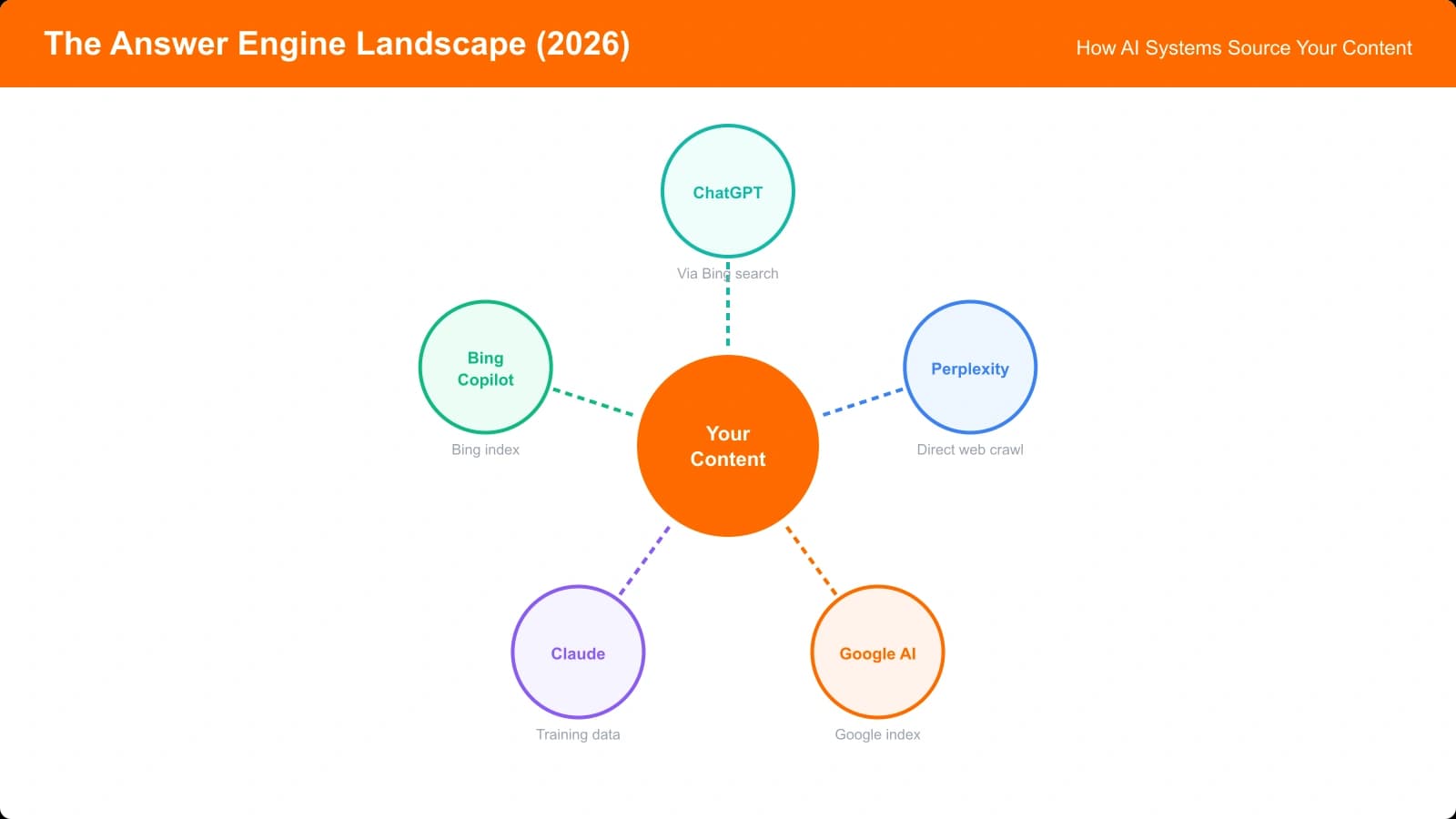
How Answer Engines Process Comparison Queries
Before optimizing, understand the mechanics. Answer engines handle comparison queries through a multi-step process.
Query Understanding
When a user asks “What's the best project management tool for remote teams?”, the AI identifies this as a comparison/recommendation query. It extracts the category (project management tools) and the qualifier (remote teams).
The system then searches its knowledge base and, for real-time systems like Perplexity, retrieves fresh web content that matches the query intent.
Source Selection and Extraction
Not all content is equally citable. Answer engines prioritize sources based on:
- Authority signals — Domain reputation, author expertise, publication credibility
- Relevance — How closely the content addresses the specific query
- Extractability — How easily the AI can identify and pull clear answers
- Freshness — Recent content is preferred for rapidly changing categories
- Specificity — Content that names names and makes clear recommendations
Your optimization targets all five factors, with particular emphasis on extractability—the dimension most under your control.
Answer Synthesis
Once sources are selected, the AI synthesizes an answer. This might quote directly, paraphrase, or combine information from multiple sources. The better structured your content, the more likely direct quotation over paraphrase—and direct quotes include citations.
Content Structure for AEO
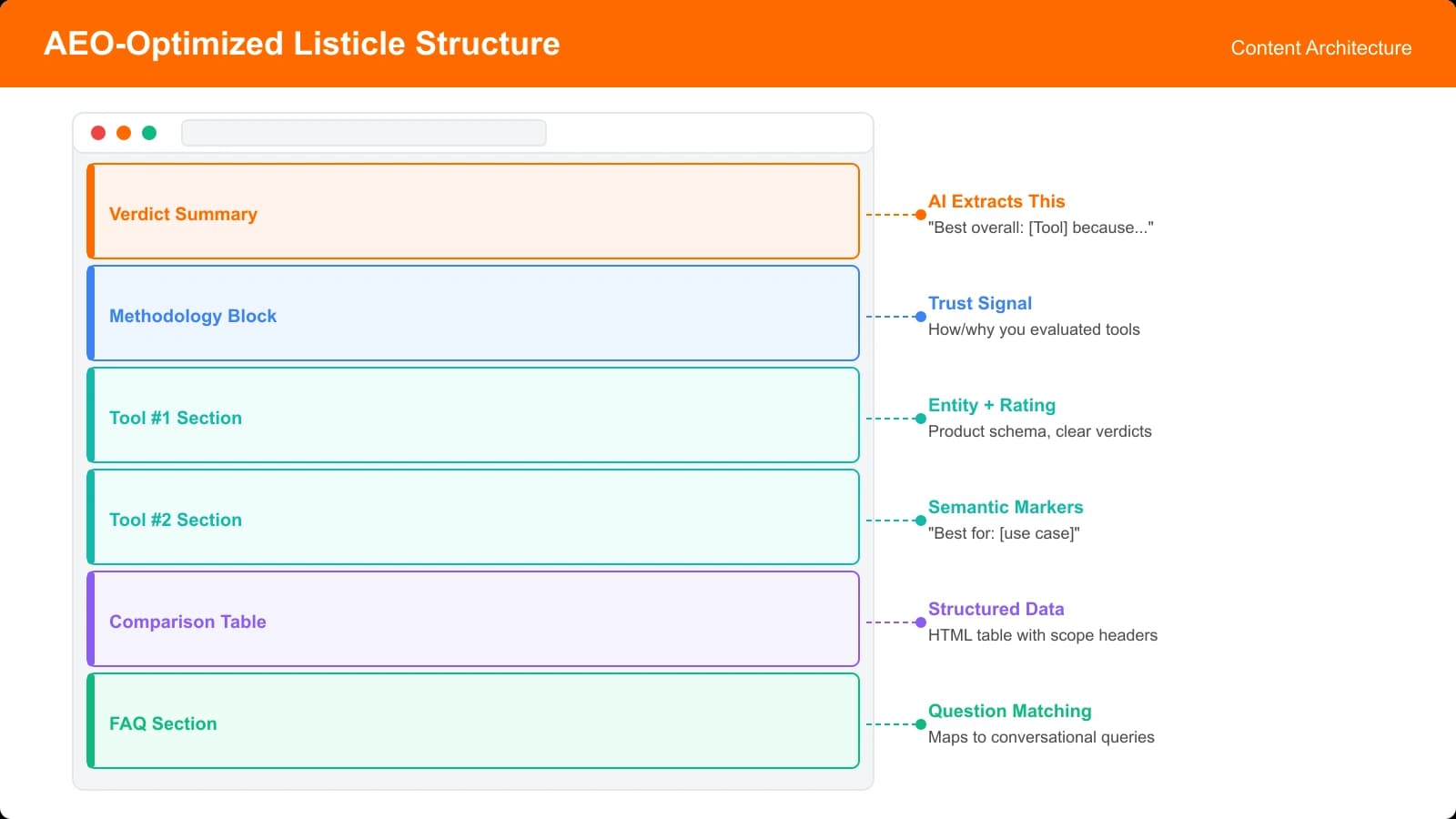
Structure determines extractability. Here's the checklist for comparison content that answer engines can parse.
Verdict-First Architecture
Place your primary recommendation early and explicitly. Don't make AI hunt through paragraphs to find “so which one is best?”
Optimal pattern:
- Brief context (1-2 sentences)
- Clear verdict (“Our top pick is X because Y”)
- Supporting picks for different use cases
- Detailed analysis following
This mirrors how answer engines want to respond: lead with the answer, support with context. Your content structure should match their output structure.
Extractable Verdict Statements
Write verdicts that can be quoted directly. Good verdicts are:
- Self-contained — Make sense without surrounding context
- Specific — Name the product and the reason
- Qualified — Specify who this recommendation is for
- Concise — 1-2 sentences maximum
Extractable: “HubSpot is the best CRM for growing sales teams because it combines powerful automation with an intuitive interface that doesn't require dedicated admin staff.”
Not extractable: “After considering all the factors we discussed above, and taking into account the various needs that different organizations might have, we think HubSpot offers a compelling value proposition for certain use cases.”
Semantic Markers
Use clear textual signals that help AI identify key statements:
- “Our recommendation:”
- “The verdict:”
- “Best for [use case]:”
- “Top pick:”
- “We recommend:”
These phrases act as extraction triggers—AI systems recognize them as signaling quotable conclusions.
Generate AEO-Optimized Comparisons
Create listicles built for answer engine visibility from the ground up.
Try for Free
Technical Implementation Checklist
Beyond content, technical factors influence AI extraction. Here's the complete checklist.
HTML Semantics Checklist
- Proper heading hierarchy (H1 → H2 → H3, no skipping)
- Article element wrapping main content
- Section elements for logical content groupings
- Lists using ul/ol, not styled divs
- Tables using semantic markup (thead, th, tbody, td)
- Aside for supplementary content
For detailed HTML guidance, see HTML Semantics for AI Crawlers.
Structured Data Checklist
- Article schema with author and publisher
- ItemList for product rankings
- Product/SoftwareApplication for individual items
- AggregateRating for your ratings (not third-party)
- FAQPage for genuine FAQ sections
- Speakable for voice-optimized summaries
For JSON-LD templates, see JSON-LD Templates for Best-Of Pages.
Accessibility as AEO
Accessibility best practices also improve AI parsing:
- Alt text for all images (AI uses this)
- Descriptive link text (not “click here”)
- Proper heading structure (screen readers and AI use the same cues)
- Table captions and header associations
Platform-Specific Optimization
Different answer engines have different behaviors. Here's what we've observed for the major platforms.
Perplexity
Perplexity retrieves fresh web content and cites sources prominently. Optimization priorities:
- Freshness — Recently updated content ranks higher
- Clear verdicts — Perplexity loves quotable recommendations
- Authoritative domains — Established sites get preference
ChatGPT
ChatGPT's behavior depends on mode. With browsing enabled:
- Training data matters — Well-known sites get cited more
- Comprehensive content — Detailed analyses get preference
- Citation is inconsistent — Optimize for being synthesized, not just quoted
Google AI Overview
Google's AI integrates with traditional search signals:
- Traditional SEO still matters — Rankings influence AI inclusion
- Featured snippet patterns — Content structured for snippets often appears in AI Overview
- E-E-A-T signals — Authority and expertise heavily weighted
Measuring AEO Success
Traditional analytics don't capture AI traffic well. Here's how to measure AEO performance.
Manual Monitoring
Regularly query answer engines with your target comparison queries. Track:
- Are you cited at all?
- Is your verdict accurately represented?
- Which competitors are cited instead?
- How prominent is your citation?
This manual process is tedious but currently necessary—no robust automated tools exist yet.
Proxy Metrics
Some traditional metrics correlate with AEO success:
- Featured snippet wins — Content structured for snippets often performs well in AI
- Direct traffic patterns — AI-driven visits may appear as direct traffic
- Brand search increases — Users who see your recommendation in AI may later search your brand
Implementation Roadmap
Here's the priority order for implementing AEO on your comparison content:
- Audit verdict placement — Are your recommendations clear and early?
- Add semantic markers — “Our pick”, “Best for”, “We recommend”
- Fix HTML semantics — Proper headings, lists, tables
- Implement structured data — Article, ItemList, Product schema
- Write extractable verdicts — Self-contained, quotable statements
- Monitor AI citations — Regular manual checks on target queries
AEO isn't a replacement for traditional SEO—it's a complementary layer. The same content can (and should) perform well in both traditional search and answer engines. Structure your content for humans first, then verify it works for AI extraction.
For deeper dives into specific AEO topics, explore our supporting guides: Direct Answer Patterns, Verdict Summaries AI Love, and Speakable Schema for Listicles.

Product Manager at BestPage. Pioneer in AEO research since 2024, exploring the convergence of SEO and GEO (Generative Engine Optimization). Led multiple AI-powered content optimization projects that achieved 300%+ citation increases in ChatGPT and Perplexity.