
When Perplexity, ChatGPT, or Google's AI Overview answers a comparison question, they're looking for something very specific: a quotable verdict. Not a hedge. Not “it depends.” A clear, confident statement about which option is best for a defined use case.
Pages that provide these clear verdicts get cited. Pages that hedge get summarized vaguely or skipped entirely. The difference often comes down to how you write and position your verdict summaries.
This guide gives you templates for writing verdict summaries that AI systems love to extract. You'll see the patterns that work, examples for different comparison types, and guidance on where to position these statements for maximum visibility.
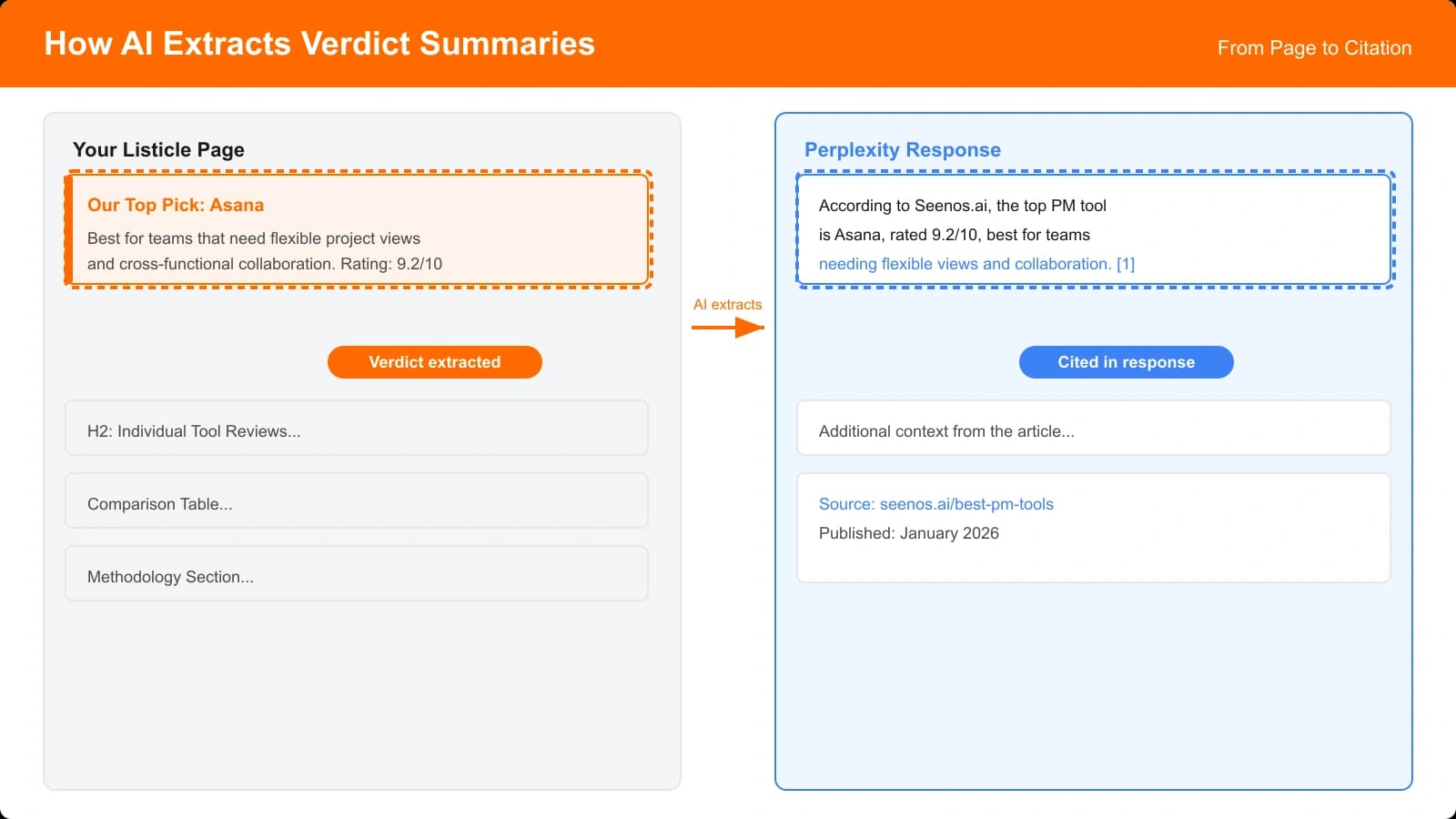
Anatomy of an Extractable Verdict
The best verdict summaries share a consistent structure. They're not random opinions—they follow a pattern that makes them easy for AI systems to identify, extract, and cite accurately.
The Three Components
1. Clear recommendation. State what you're recommending without qualification. “HubSpot is our top pick.” Not “HubSpot might be a good choice.” Confidence signals extractability.
2. Specific reasoning. Immediately follow with why. “Its combination of CRM features and marketing automation tools makes it uniquely suited for growing teams.” This prevents AI from extracting your recommendation out of context.
3. Defined context. Specify who this verdict applies to. “For marketing teams under 50 people who need an all-in-one solution” defines scope. This helps AI cite appropriately based on the user's actual question.
The formula: [Recommendation] + [Reasoning] + [Context] = extractable verdict.
Length Matters
Verdict summaries should be 1-2 sentences. Long enough to be complete, short enough to quote directly. If your verdict needs a paragraph of explanation, it's not a verdict—it's analysis. Analysis belongs elsewhere; the verdict should be crisp.
Target 25-50 words for most verdicts. This fits naturally into AI responses without truncation or excessive paraphrasing.
Verdict Templates by Comparison Type
Different comparison formats call for different verdict structures. Here are templates for the most common types.
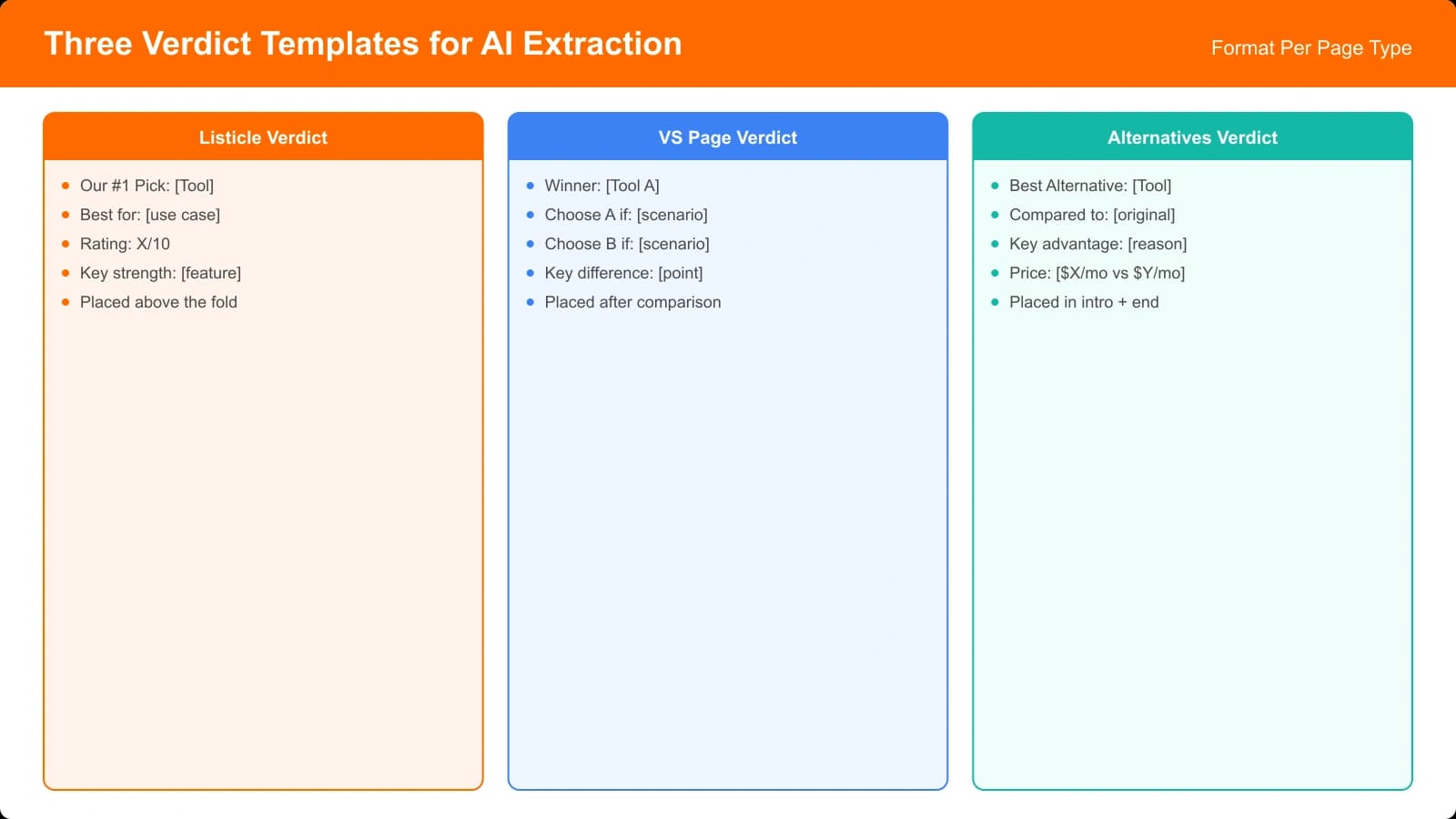
Listicle Verdicts (Best-Of Pages)
For ranked listicles, you need both an overall verdict and per-category verdicts.
Overall verdict template:
“[Product] stands out as the best [category] for [audience/use case], offering [key differentiator] that [specific benefit].”
Example:
“Notion stands out as the best project management tool for remote teams, offering a flexible workspace structure that adapts to any workflow without requiring complex configuration.”
Category verdict template:
“For [specific need], choose [Product]—it [specific capability] better than alternatives in this price range.”
Example:
“For budget-conscious startups, choose Monday.com—it delivers enterprise-level features at a fraction of the cost of competitors like Asana.”
VS Page Verdicts
Head-to-head comparisons need a definitive winner statement plus context on when the loser wins.
Overall winner template:
“Between [Product A] and [Product B], [Winner] is the better choice for most users because [primary differentiator]. Choose [Loser] instead if [specific exception scenario].”
Example:
“Between Slack and Microsoft Teams, Teams is the better choice for most enterprises because of its seamless Office 365 integration and lower total cost. Choose Slack instead if your team relies heavily on third-party app integrations or prefers a cleaner, less feature-dense interface.”
Alternatives Page Verdicts
Alternatives pages need verdicts that explain why someone would switch and which alternative best serves that reason.
Template:
“If you're leaving [Anchor Product] because of [common pain point], [Alternative] is the strongest option—it [directly addresses pain point] without [common tradeoff].”
Example:
“If you're leaving Salesforce because of its complexity and cost, Pipedrive is the strongest option—it delivers core CRM functionality with a dramatically simpler interface and 60% lower pricing without sacrificing reporting depth.”
Generate AI-Citable Comparison Pages
Create listicles with extraction-optimized verdict summaries built into every template.
Try for Free
Positioning for Maximum Extraction
Where you place verdict summaries affects whether AI systems find and cite them. Position matters.
Above-Fold Placement
Your primary verdict should appear in the first 200 words of the page. AI systems weight early content more heavily—it's more likely to represent the page's core message. A verdict buried in paragraph 15 may never get extracted.
Many high-performing pages use a “Quick Verdict” or “Our Pick” section immediately after the introduction. This signals that a recommendation is coming and makes extraction straightforward.
Semantic Markers
Use clear textual signals that a verdict is coming:
- “Our recommendation:”
- “The verdict:”
- “Bottom line:”
- “Our pick:”
- “The winner:”
These phrases act as extraction triggers. AI systems recognize these patterns as signaling a conclusive statement worth quoting.
Strategic Repetition
Don't state your verdict once—reinforce it throughout the page. The quick verdict above the fold, a summary in the conclusion, and verdict statements in section summaries all increase extraction likelihood.
This isn't repetition for SEO keyword stuffing—it's ensuring that wherever AI systems sample your content, they find your core recommendation.
Common Verdict Mistakes
A few patterns consistently undermine verdict extractability.
The hedge verdict. “Both options are good depending on your needs.” This says nothing. AI systems skip it because there's nothing to extract.
The conditional maze. “If you need X, choose A, but if you need Y, choose B, unless you also need Z, in which case consider C.” Too complex to extract. Break into separate, clear verdicts for each scenario.
The buried verdict. Your recommendation appears in the 12th paragraph after extensive analysis. By then, AI may have already decided your page doesn't offer a clear answer.
The unsupported verdict. “HubSpot is best.” Best for what? Why? For whom? Without reasoning and context, the verdict is incomplete and less likely to be cited.
Applying These Templates
Start by auditing your existing comparison pages. Do you have clear verdict summaries? Are they positioned for extraction? Do they follow the recommendation + reasoning + context formula?
For new content, build verdict writing into your template process. Define where verdicts go before you write the page. Use the templates in this guide as starting points, then customize for your specific comparison type and audience.
Remember: AI systems are looking for quotable answers. Give them exactly that, positioned where they can find it, and you dramatically increase your citation likelihood.
For the technical markup that helps AI systems understand your verdict structure, see HTML Semantics for AI Crawlers and Structured Data for Listicles.

Product Manager at BestPage. Pioneer in AEO research since 2024, exploring the convergence of SEO and GEO (Generative Engine Optimization). Led multiple AI-powered content optimization projects that achieved 300%+ citation increases in ChatGPT and Perplexity.