
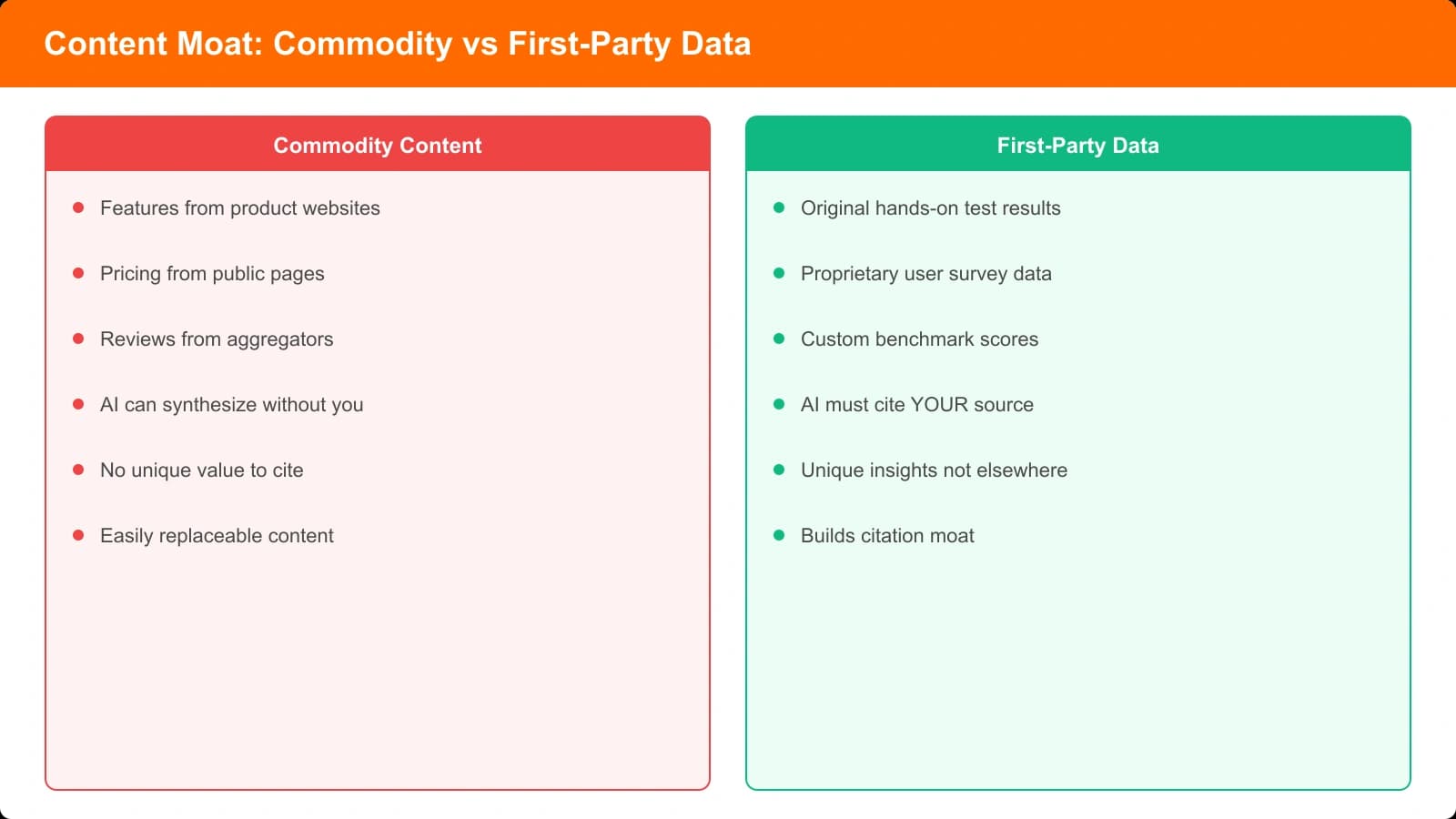
Most listicles are basically commodity content. They aggregate publicly available information—features from product pages, pricing from sales decks, reviews from G2—and repackage it with a ranking. There's nothing in them that AI systems couldn't synthesize from a hundred other sources.
And that's exactly why those listicles are getting decimated by AI search. When ChatGPT or Perplexity can assemble the same information from multiple sources, why would they cite yours specifically? They don't need to.
First-party data changes this equation entirely. When you have information that exists nowhere else on the internet—your own testing results, your own user surveys, your own benchmarks—AI systems can't replicate it. They can only cite it.
This guide covers how to build first-party data into your listicle strategy, from lightweight approaches anyone can implement to comprehensive research programs that create lasting competitive moats. For the complete AI visibility framework, see How Listicles Get Cited by AI Overviews.
Why First-Party Data Matters for AI Citation
Let's get specific about why original data is so powerful for AI visibility. It comes down to how AI systems are designed to behave.
The Attribution Requirement
Modern AI systems—particularly those optimized for search like Perplexity and Google AI Overviews—are built to cite sources for factual claims. This isn't just nice behavior; it's a core design principle for reducing hallucination and maintaining trust.
When an AI makes a factual claim, it's supposed to have a source. For generic information available everywhere, it might cite any of a dozen sources (or none, if it's considered common knowledge). But for unique data? There's only one source to cite.
The Scarcity Principle
Information scarcity drives citation behavior. Consider two scenarios:
Scenario A: Common information
“HubSpot offers a free tier for up to 1,000,000 contacts.”
This fact appears on HubSpot's website, hundreds of review sites, thousands of blog posts. AI doesn't need to cite anyone specific—the information is everywhere.
Scenario B: Unique information
“In our 3-month test with 50 small businesses, HubSpot users closed deals 23% faster than Salesforce users.”
This fact exists only in your content. If an AI wants to use this statistic, it must cite you. There's no alternative source.
First-Party Data as Trust Signal
Beyond citation mechanics, first-party data signals expertise and authority. It tells AI systems (and users) that you're not just aggregating—you're generating knowledge.
This aligns with Google's EEAT framework (Experience, Expertise, Authoritativeness, Trust). Original research is perhaps the strongest signal of expertise possible. You didn't just read about the topic—you studied it directly.
Types of First-Party Data for Listicles
First-party data isn't one thing—it's a category that includes many approaches, from quick-win tactics to comprehensive research programs.
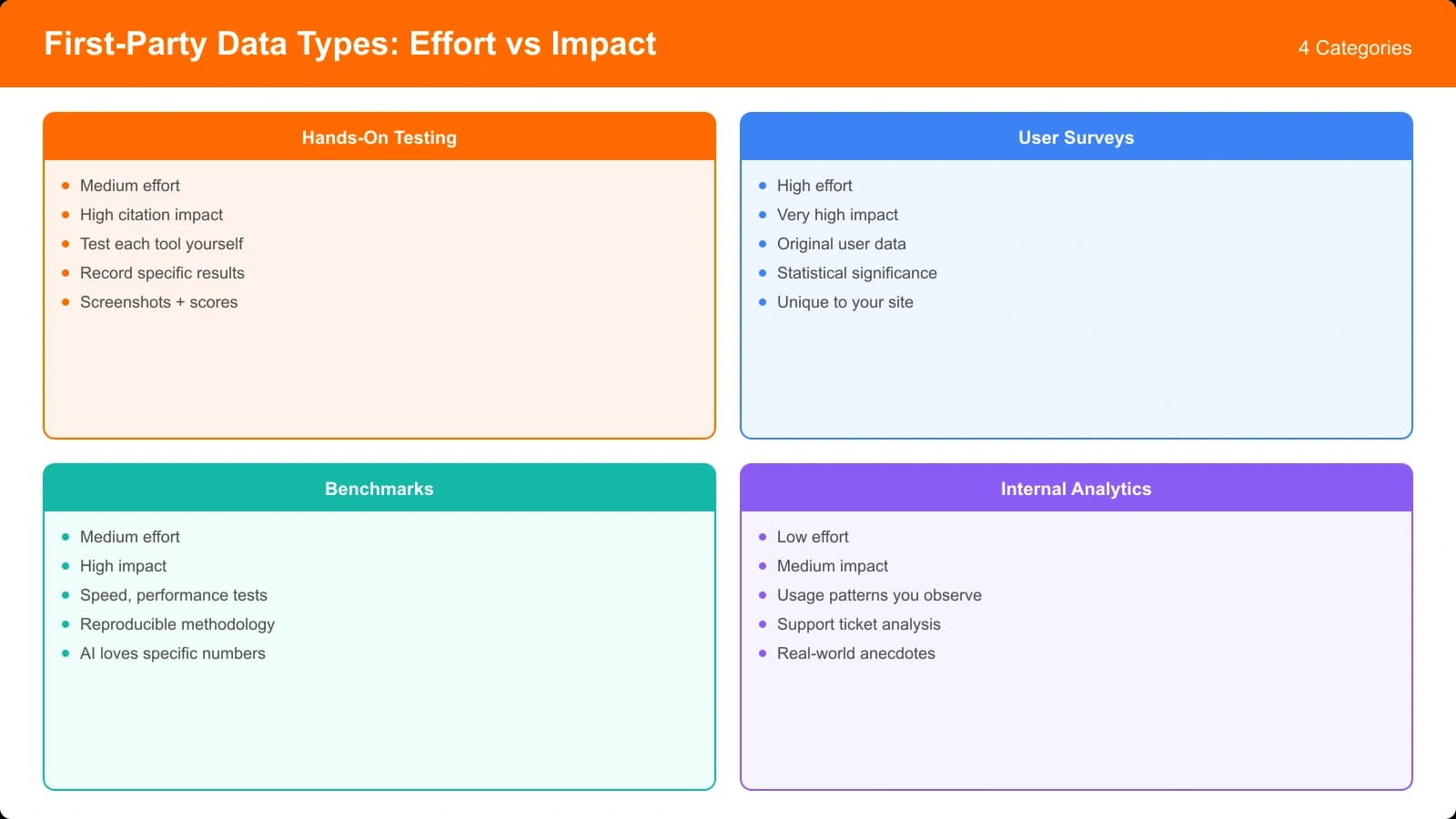
Hands-On Product Testing
The most straightforward approach: actually use the products you're reviewing.
What to measure:
- Setup time (minutes/hours to get started)
- Learning curve (time to basic proficiency)
- Performance metrics (speed, reliability, accuracy)
- Support responsiveness (time to first reply)
- Real-world workflow integration
How to present it:
“We tested each CRM by setting up a demo account and running our standard 5-step evaluation: initial setup, contact import, deal creation, email integration, and reporting. Average setup time ranged from 12 minutes (Pipedrive) to 47 minutes (Salesforce).”
User Surveys and Research
Survey your audience or a representative sample about their experiences with the products you're comparing.
What to ask:
- Satisfaction ratings (NPS, 1-10 scales)
- Feature importance rankings
- Pain points and complaints
- Switching behavior and reasons
- Willingness to recommend
Sample size considerations:
- n=100+ for directionally useful data
- n=500+ for statistically robust claims
- n=1,000+ for segmentation analysis
Performance Benchmarks
Create standardized tests that measure objective performance across products.
Examples by category:
- Web hosting: Load time tests, uptime monitoring, stress testing
- Email tools: Deliverability rates, send speed, inbox placement
- CRM software: API response times, data import speed, search performance
- Design tools: Export quality, render time, file size efficiency
Internal Usage Data
If you actually use the products you review (or have users who do), aggregate anonymized insights.
- Most-used features
- Common integration patterns
- Adoption curves
- Support ticket patterns
Implementing First-Party Data at Different Scales
Not everyone has resources for comprehensive research programs. Here's how to add first-party data at different investment levels.
Lightweight: Add Data to Existing Content
Time investment: 2-4 hours per listicle
What to do:
- Actually test each product yourself (free trials)
- Document specific observations during testing
- Time key workflows with a stopwatch
- Take screenshots of your actual testing process
- Add “In our testing...” observations throughout
Example addition:
“In our hands-on testing, Notion's learning curve surprised us. We achieved basic proficiency in 45 minutes, compared to 2+ hours for Coda and 3+ hours for Airtable.”
Moderate: Structured Testing Programs
Time investment: 1-2 weeks per category
What to do:
- Create standardized evaluation criteria
- Test each product using identical workflows
- Document methodology publicly
- Collect quantitative metrics (times, scores, percentages)
- Update regularly with versioned testing
Example framework:
“Our CRM Evaluation Framework tests 7 criteria across 3 user scenarios. Each product receives a composite score (0-100) based on weighted performance. Methodology and raw data available in our testing appendix.”
Comprehensive: Research Programs
Time investment: Ongoing, quarterly or annual
What to do:
- Conduct regular user surveys (n=500+)
- Build automated benchmark testing infrastructure
- Maintain longitudinal data across time periods
- Publish standalone research reports
- Create embeddable data visualizations
The payoff: Comprehensive research programs create citation moats that are nearly impossible for competitors to replicate. Your “2026 State of CRM Report” becomes the authoritative source that AI systems must cite.
Generate Listicles With Data Frameworks
Create comparison pages with built-in structures for showcasing first-party data.
Try for Free
Presenting Data for Maximum Citation Potential
Having first-party data isn't enough—you need to present it in ways AI systems can easily parse and cite.
Structure for Extraction
AI systems extract information more reliably from structured formats:
- Tables →Data points with clear column/row structure
- Lists →Numbered findings, ranked results
- Callout boxes →Key statistics highlighted visually
- Inline citations →“According to our 2026 survey (n=1,247)...”
Use Attribution Language
Make it clear that data comes from your research:
- “In our testing...”
- “Based on our survey of 500 users...”
- “Our benchmark results show...”
- “According to [Your Brand]'s 2026 research...”
Methodology Transparency
Disclose how you collected data. This builds trust with both AI systems and human readers:
- Sample sizes and selection criteria
- Testing timeframes and conditions
- Evaluation criteria and weighting
- Limitations and caveats
Maintaining Your Data Advantage
First-party data isn't a one-time investment. Here's how to maintain the advantage over time.
Update Cadence
- Testing data: Re-test major products quarterly or after significant updates
- Survey data: Annual survey with consistent methodology for trend tracking
- Benchmark data: Continuous monitoring where possible, quarterly snapshots otherwise
Version Tracking
Maintain historical data to show trends:
- “In Q1 2026, average setup time was 23 minutes (down from 31 minutes in Q1 2025)”
- “User satisfaction increased from 7.2 to 8.1 following the October 2025 update”
Historical trends are uniquely citable—no one else has your longitudinal data.
Building Defensive Moats
Make your data advantage sustainable:
- Proprietary methodology: Named frameworks that become associated with your brand
- Exclusive access: Partnerships that give you data others can't get
- Scale advantages: Large user bases for survey research
- Infrastructure investment: Automated testing systems that continuously generate data
Making First-Party Data Your Strategy
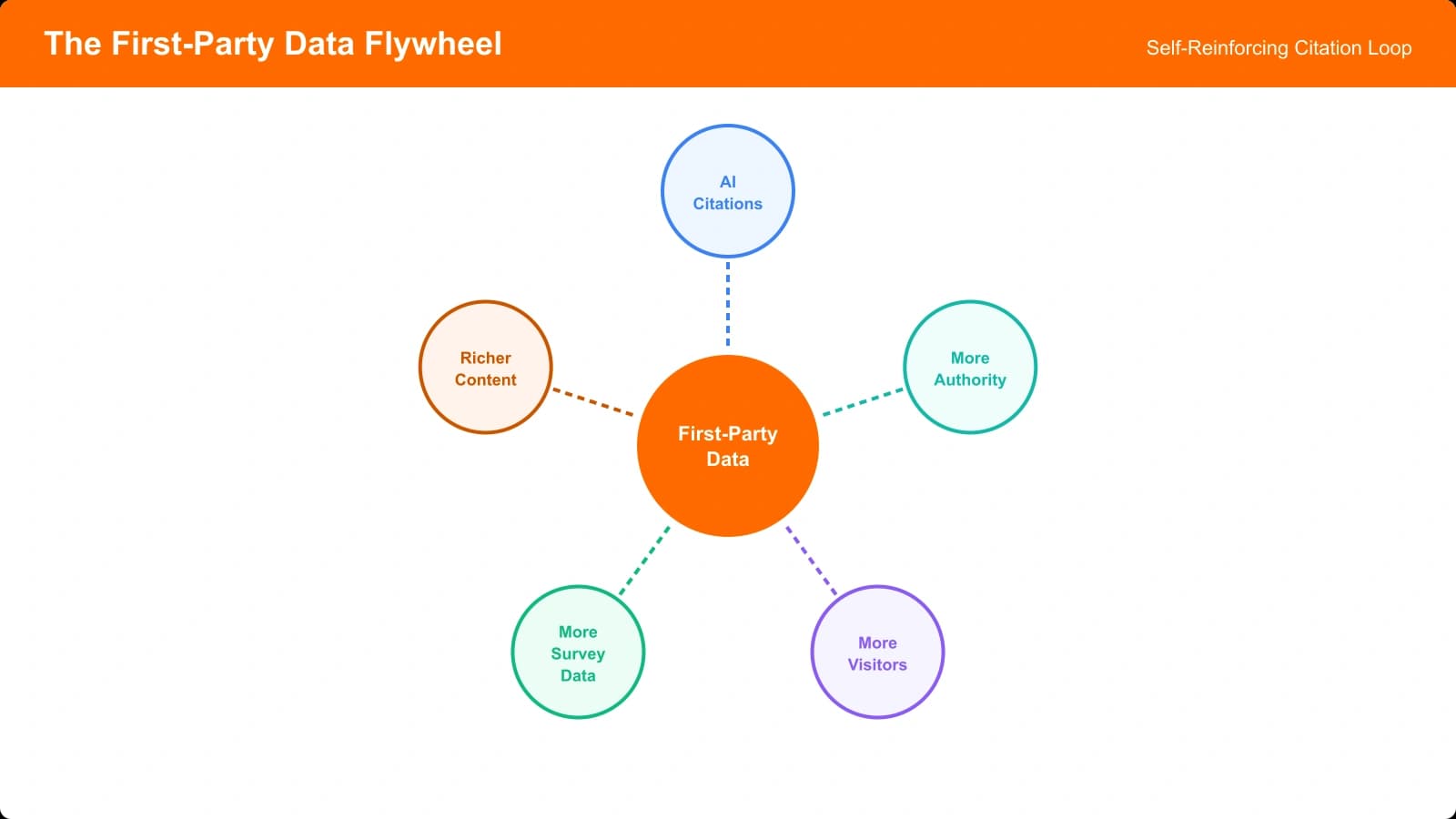
In a world where AI can synthesize commodity information from infinite sources, first-party data is your defense. It's the moat that makes your content citable rather than replaceable.
Start here:
- Audit your existing listicles →What unique data do they contain? (Probably not much)
- Add lightweight testing →Actually use the products, document observations
- Build toward structured programs →Standardized testing, regular surveys
- Present data for extraction →Tables, clear attribution, methodology disclosure
- Maintain and update →Fresh data is more citable than stale data
The investment in first-party data pays off in ways that go beyond AI citation. It builds genuine expertise, differentiates your content, and creates assets that compound over time.
For the complete framework on AI visibility, see How Listicles Get Cited by AI Overviews. For a tactical checklist on improving citation potential, check AI Citation Audit: 15-Point Checklist for Listicles.

Product Manager at BestPage. Pioneer in AEO research since 2024, exploring the convergence of SEO and GEO (Generative Engine Optimization). Led multiple AI-powered content optimization projects that achieved 300%+ citation increases in ChatGPT and Perplexity.