

You've published a listicle. It ranks well in traditional search. But when you query Perplexity or check Google AI Overviews, you're nowhere to be found. What's missing?
Usually, it's several things. Listicles that earn AI citations have specific characteristics that most content lacks. This checklist breaks down those characteristics into an actionable audit you can run on any piece of comparison content.
For each item, score your content 0 (missing), 1 (partial), or 2 (fully present). Total your score at the end to see where you stand. More importantly, use the audit to identify specific improvements—each missing element is an optimization opportunity.
This checklist operationalizes the principles from How Listicles Get Cited by AI Overviews. Use it for pre-publish checks and quarterly content audits.
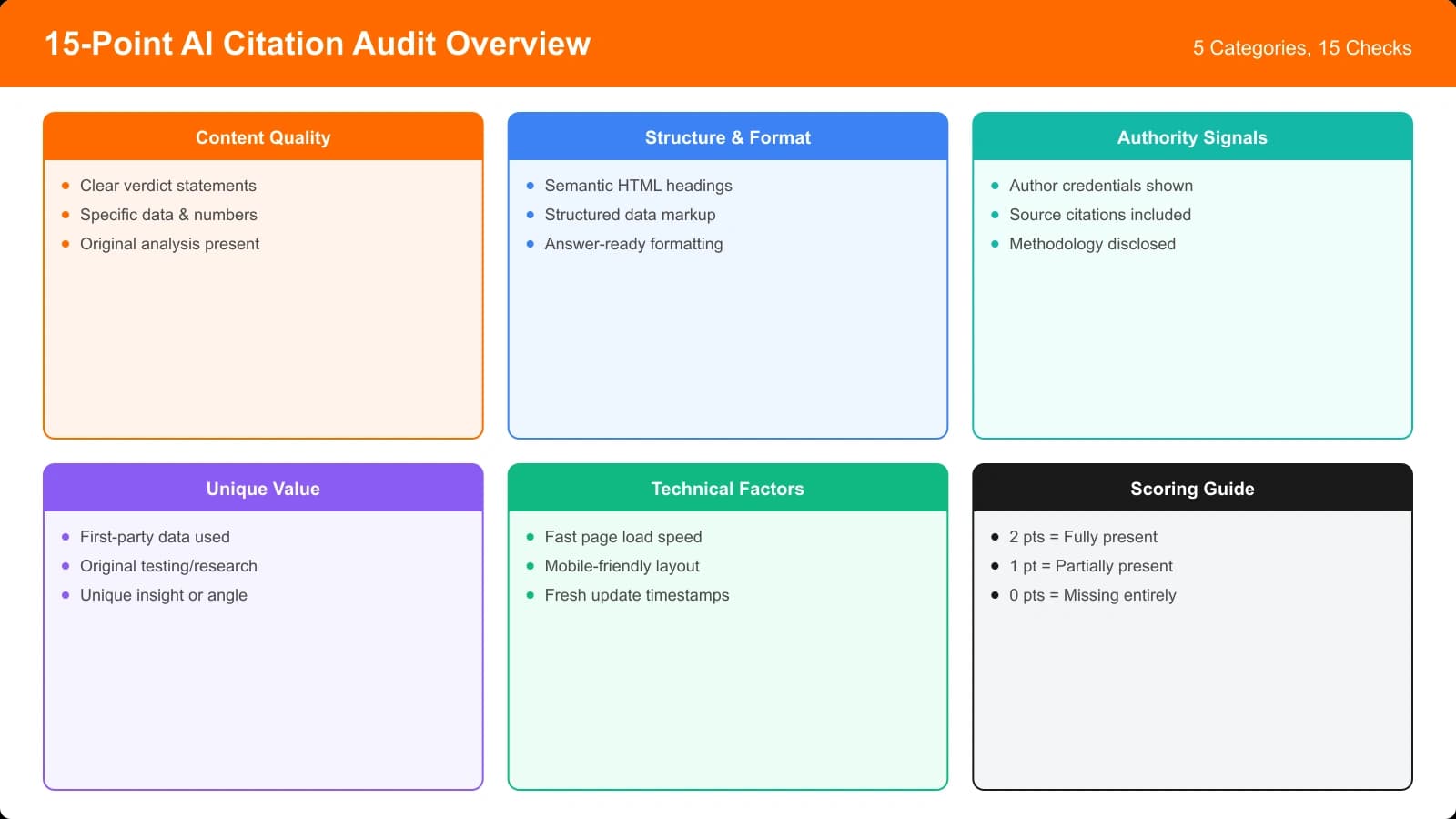
Section 1: Content Quality (Items 1-4)
1. Specific, Citable Claims
What to check: Does your content contain specific facts that AI would need to cite a source for? Or is it all general observations that could be synthesized from anywhere?
| Score | Criteria |
|---|---|
| 0 | All general observations, no specific citable facts |
| 1 | Some specific claims (pricing, features), but commonly available |
| 2 | Multiple specific, verifiable facts including unique data points |
How to improve: Add specific numbers, statistics, test results, or survey data. Replace vague statements like “fast performance” with “3.2 second average load time in our testing.”
2. Clear Rankings and Recommendations
What to check: Is there a clear #1 recommendation? Are rankings explicit and easy to extract?
| Score | Criteria |
|---|---|
| 0 | No clear ranking; “it depends” without guidance |
| 1 | General rankings present but reasoning unclear |
| 2 | Explicit #1/#2/#3 rankings with clear “best for” categorization |
How to improve: Add explicit “Best Overall,” “Best for [Use Case]” labels. State your top pick clearly in the introduction and conclusion.
3. Freshness and Currency
What to check: Is the content visibly current? Are dates, pricing, and features accurate as of now?
| Score | Criteria |
|---|---|
| 0 | No date visible; content appears potentially outdated |
| 1 | Date present but older than 6 months; some info may be stale |
| 2 | “Updated [recent date]” visible; all info current and verified |
How to improve: Add visible “Updated [Month Year]” badge. Verify all pricing and features. Add “pricing verified [date]” notes where applicable.
4. Comprehensive Coverage
What to check: Does the content cover the topic thoroughly, or does it feel thin?
| Score | Criteria |
|---|---|
| 0 | Surface-level coverage; missing major products or criteria |
| 1 | Adequate coverage but not definitive |
| 2 | Comprehensive coverage of all major options; definitive resource feel |
How to improve: Expand product coverage. Add comparison criteria. Include edge cases and niche options. Aim to be the most thorough resource on the topic.
Section 2: Structure & Format (Items 5-8)
5. Scannable Structure
What to check: Can AI (and humans) quickly extract key information without reading full paragraphs?
| Score | Criteria |
|---|---|
| 0 | Wall of text; no clear structure or visual hierarchy |
| 1 | Basic headings present but information buried in prose |
| 2 | Clear headings, bullet points, and summary sentences; scannable at a glance |
How to improve: Use descriptive H2/H3 headings. Start sections with summary sentences. Use bullet points for key details. Add bold for emphasis on key facts.
6. Comparison Tables
What to check: Are there structured comparison tables that enable easy feature x product analysis?
| Score | Criteria |
|---|---|
| 0 | No comparison tables |
| 1 | Basic tables present but incomplete or poorly structured |
| 2 | Comprehensive comparison tables with clear feature x product matrix |
How to improve: Add comparison tables for key criteria. Include pricing tables. Use consistent formatting across all tables.
7. Quick Picks / Summary Section
What to check: Is there a summary of top recommendations that AI can easily extract?
| Score | Criteria |
|---|---|
| 0 | No summary section; recommendations scattered throughout |
| 1 | Summary exists but buried or poorly formatted |
| 2 | Prominent Quick Picks or “Top 3” section with clear categorization |
How to improve: Add Quick Picks section near the top. Include category labels (“Best Overall,” “Best Value”). Make it visually distinct.
8. Semantic HTML Structure
What to check: Is the HTML structure semantic and machine-readable?
| Score | Criteria |
|---|---|
| 0 | Poor HTML structure; divs everywhere, no semantic markup |
| 1 | Basic semantic HTML but missing opportunities |
| 2 | Proper heading hierarchy, semantic elements, schema markup |
How to improve: Use proper H1 to H2 to H3 hierarchy. Implement structured data (Article, Review, FAQ schemas). Use semantic HTML elements.
Generate Audit-Ready Listicles
Create listicles that pass this audit from day one with built-in optimization.
Try for Free
Section 3: Authority Signals (Items 9-11)
9. Author Expertise
What to check: Is author expertise relevant to the topic clear and verifiable?
| Score | Criteria |
|---|---|
| 0 | No author attribution or generic “by Staff” |
| 1 | Author name present but no expertise signals |
| 2 | Named author with relevant credentials, bio, and verifiable profile |
How to improve: Add author byline with relevant credentials. Include author bio. Link to author's LinkedIn or professional profile.
10. Methodology Disclosure
What to check: Is it clear how products were evaluated and compared?
| Score | Criteria |
|---|---|
| 0 | No methodology disclosure; unclear how rankings were determined |
| 1 | Brief methodology mentioned but not detailed |
| 2 | Clear methodology section explaining evaluation criteria and process |
How to improve: Add “How We Tested” section. Explain evaluation criteria. Disclose limitations and caveats.
11. Third-Party Validation
What to check: Does the content reference or include third-party validation (ratings, reviews, awards)?
| Score | Criteria |
|---|---|
| 0 | No third-party validation referenced |
| 1 | Some third-party data mentioned but not consistently |
| 2 | G2/Capterra ratings, user counts, or other validation for each product |
How to improve: Include G2 or Capterra ratings. Add user/customer counts. Reference industry awards where relevant.
Section 4: Unique Value (Items 12-14)
12. First-Party Data
What to check: Does the content include original research, testing data, or proprietary insights?
| Score | Criteria |
|---|---|
| 0 | No original data; all information available elsewhere |
| 1 | Some original observations from hands-on testing |
| 2 | Substantive first-party data (surveys, benchmarks, unique testing) |
How to improve: Add hands-on testing results. Conduct user surveys. Build benchmark data. See Why First-Party Data Makes Your Listicle AI-Proof.
13. Unique Perspective or Angle
What to check: Does the content offer a unique angle or perspective not found elsewhere?
| Score | Criteria |
|---|---|
| 0 | Generic coverage; identical to competitor listicles |
| 1 | Some unique opinions but similar structure and coverage |
| 2 | Distinctive angle, unique criteria, or specialized focus |
How to improve: Focus on specific audience segment. Evaluate by unique criteria. Add specialized expertise (technical depth, industry focus).
14. Exclusive Information
What to check: Does the content contain information that can only be found here?
| Score | Criteria |
|---|---|
| 0 | All information can be found on multiple other sites |
| 1 | Some original analysis or synthesis |
| 2 | Exclusive data, unique insights, or proprietary information |
How to improve: Add proprietary research. Include exclusive interviews or quotes. Build data assets others can't replicate.
Section 5: Technical Factors (Item 15)
15. Crawlability and Indexing
What to check: Is the content fully crawlable and properly indexed?
| Score | Criteria |
|---|---|
| 0 | Indexing issues; content not fully accessible to crawlers |
| 1 | Indexed but with some technical issues |
| 2 | Fully indexed, fast loading, no render-blocking issues |
How to improve: Fix any indexing issues in Google Search Console. Ensure content is server-rendered or properly hydrated. Optimize page speed.
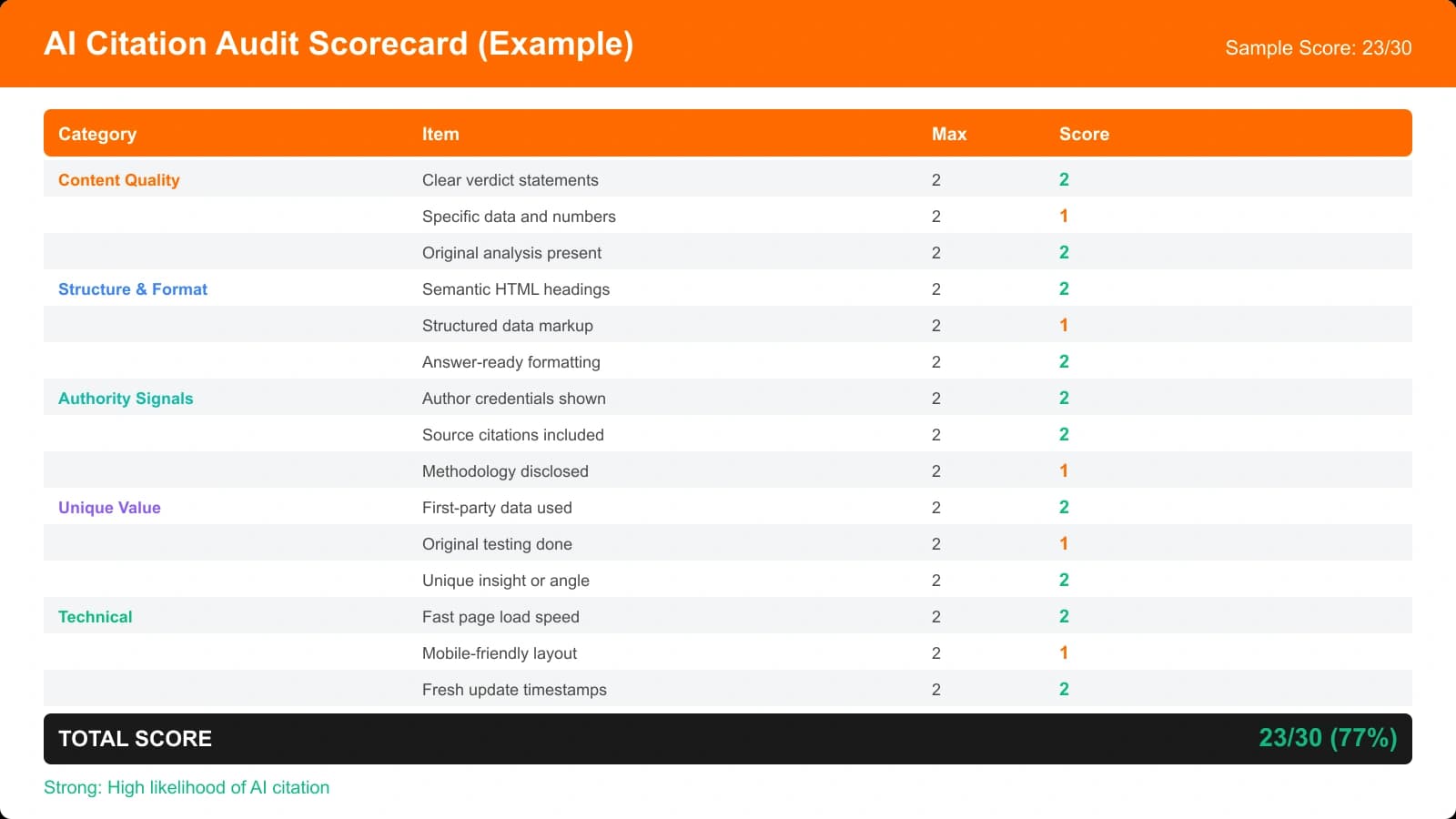
Interpreting Your Score
Add up your scores across all 15 items (maximum 30 points). Here's what your total means:
| Score Range | Assessment | Action |
|---|---|---|
| 25-30 | Excellent citation potential | Monitor and maintain; minor optimizations only |
| 20-24 | Good potential, room for improvement | Address items scoring 0-1; strong foundation |
| 15-19 | Moderate potential; significant gaps | Priority audit; address lowest-scoring categories |
| 10-14 | Low potential; major work needed | Consider comprehensive rewrite |
| 0-9 | Poor citation potential | Start over with citation-first approach |
Priority Areas by Category
Focus on the lowest-scoring categories first:
- Content Quality low? Add specific data, clear recommendations, freshen content
- Structure low? Restructure for scannability, add tables and summaries
- Authority low? Add author credentials, methodology, third-party validation
- Unique Value low? This is the hardest to fix; requires adding original research
- Technical issues? Quick fixes with potentially high impact
Using This Audit Effectively
This checklist is most valuable when used systematically:
- Pre-publish: Run the audit before publishing any new listicle
- Quarterly review: Audit your top-performing listicles quarterly
- Competitive analysis: Audit competitor content to identify their gaps
- Prioritization: Use scores to prioritize which content to improve first
Quick-win improvements (easy to implement, score points fast):
- Add “Updated [Date]” badge
- Create Quick Picks summary section
- Add comparison tables
- Include author credentials
- Add methodology disclosure
Long-term investments (harder but more impactful):
- Build first-party data collection
- Conduct original research
- Develop unique evaluation frameworks
- Create proprietary benchmarks
For deeper guidance on specific audit items, see How Listicles Get Cited by AI Overviews, Why First-Party Data Makes Your Listicle AI-Proof, and LLM-Friendly Writing: How to Get Parsed and Cited.

Product Manager at BestPage. Pioneer in AEO research since 2024, exploring the convergence of SEO and GEO (Generative Engine Optimization). Led multiple AI-powered content optimization projects that achieved 300%+ citation increases in ChatGPT and Perplexity.