
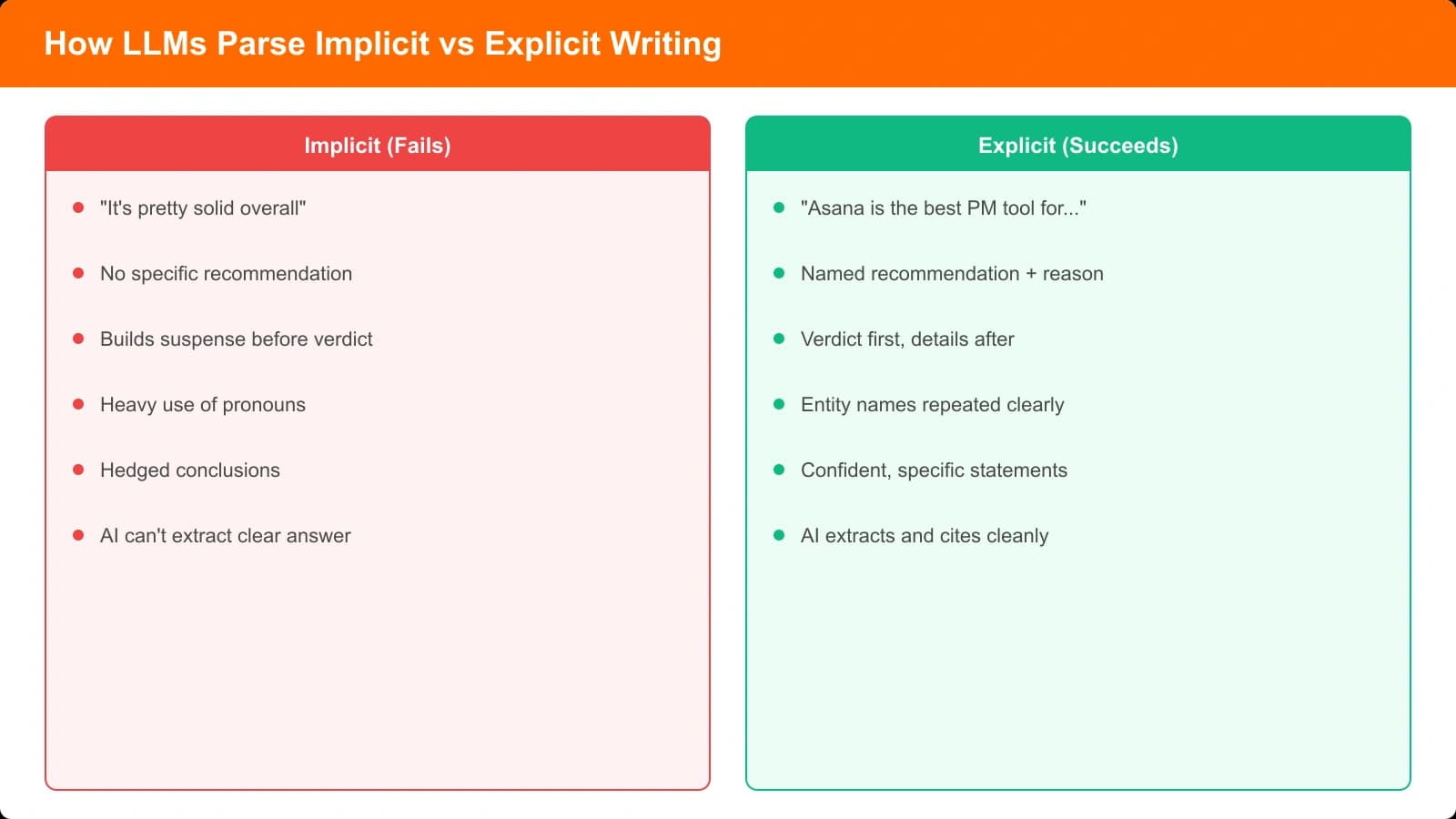
Here's something that might surprise you: LLMs are remarkably bad at extracting information from certain types of well-written content. Nuanced prose with subtle implications? An LLM might miss the point entirely. A clear, structured statement with explicit conclusions? That gets extracted and cited accurately.
This isn't a flaw in LLMs—it's how they're designed to work. They're optimized for extracting and synthesizing explicit information, not for reading between the lines. Content that works beautifully for human readers may be nearly invisible to AI systems.
For listicles and comparison content, this has direct implications. If you want your recommendations to be cited by Perplexity, ChatGPT, or Google AI Overviews, you need to write in ways that LLMs can reliably parse.
This guide covers the specific writing patterns that make content LLM-friendly—not dumbed down, but structured for machine extraction alongside human readability. For the broader AI visibility framework, see How Listicles Get Cited by AI Overviews.
How LLMs Parse and Extract Information
Understanding how LLMs process text helps explain why certain writing patterns work better than others for citation.
Tokenization and Context Windows
LLMs break text into tokens (roughly word parts) and process them within a context window. Key implications:
- Long documents may be truncated or chunked
- Information at the beginning and end of chunks is processed differently than the middle
- Explicit statements are more reliably captured than information spread across sentences
Retrieval and Extraction Patterns
When AI systems retrieve content to answer queries, they're looking for:
- Direct answers →Statements that explicitly answer the question
- Quotable passages →Self-contained information that can be extracted
- Structured data →Tables, lists, and formatted information
- Authority signals →Language indicating expertise and confidence
Content that requires inference, context from elsewhere in the document, or reading between the lines is much harder for LLMs to extract reliably.
The Citation Decision
When an LLM decides whether to cite a source, it's essentially asking:
- Does this source contain the specific information I need?
- Can I extract a clear statement to attribute?
- Is the source authoritative enough to cite?
- Is the information unique enough to require citation?
LLM-friendly writing makes the answers to questions 1 and 2 obviously “yes.”
Pattern 1: Lead With Conclusions
Traditional writing often builds to a conclusion. LLM-friendly writing states the conclusion first, then supports it.
The Inverted Pyramid for AI
Traditional pattern:
“We evaluated each CRM across five criteria. After testing with our team for three weeks, considering factors like ease of use, integrations, and pricing, we found that one platform consistently outperformed the others. For most small businesses, HubSpot is the best choice.”
LLM-friendly pattern:
“HubSpot is the best CRM for small businesses in 2026. In our three-week evaluation across five criteria—ease of use, integrations, pricing, support, and scalability—HubSpot consistently outperformed alternatives like Salesforce and Pipedrive.”
The conclusion appears in the first sentence, where it's most likely to be extracted and cited.
Section-Level Summaries
Apply this pattern at every level—not just the introduction, but each section:
- Start each product review with a verdict sentence
- Begin comparison sections with the winner statement
- Open feature analysis with the key finding
Pattern 2: Explicit Over Implicit
LLMs can't reliably infer what you mean—they extract what you explicitly say.
Implicit vs Explicit Examples
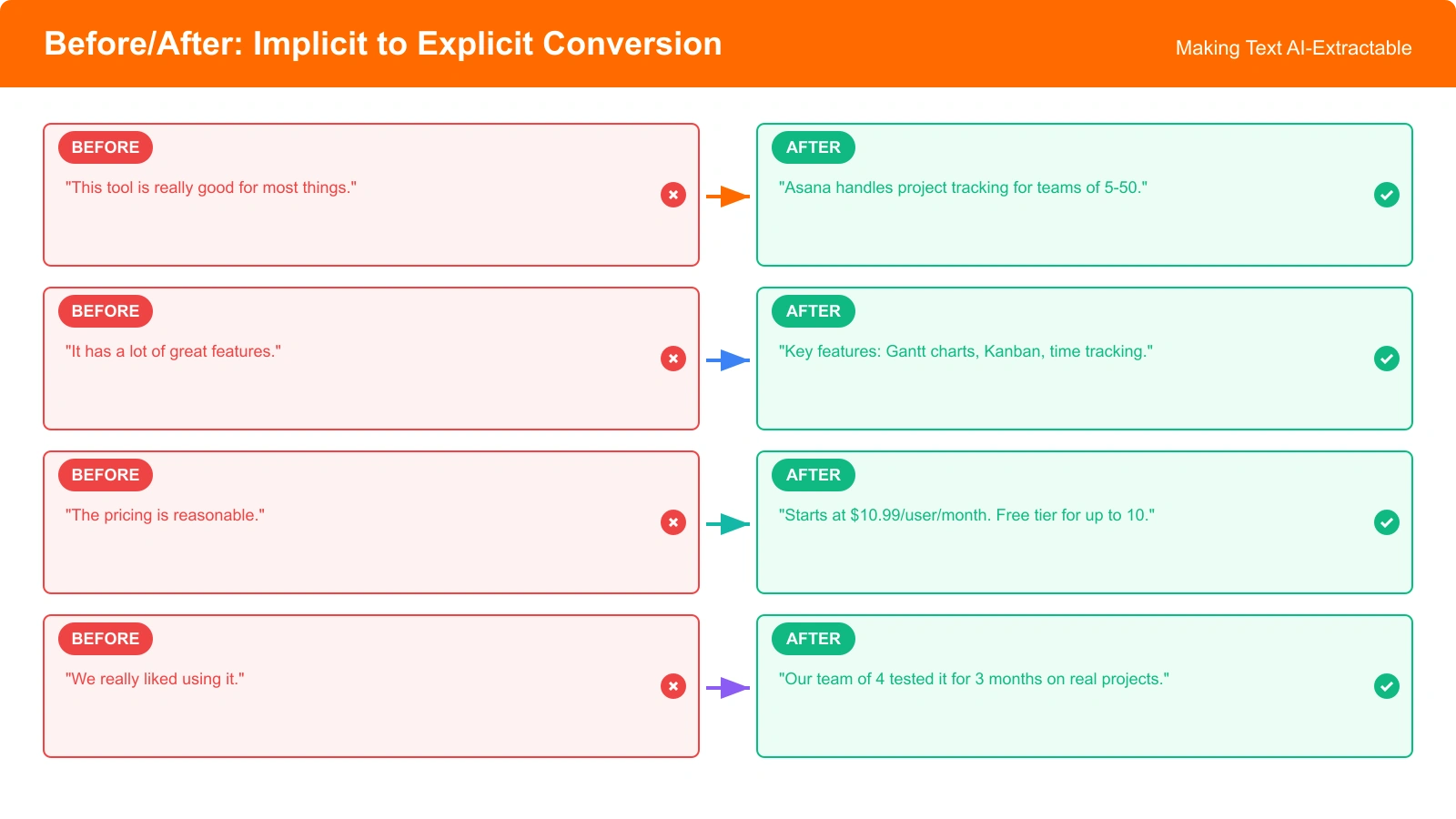
Implicit (hard to cite):
“Among the tools we tested, several stood out for different reasons. Price-sensitive buyers might appreciate what Pipedrive offers.”
Explicit (easy to cite):
“Pipedrive is the best CRM for budget-conscious buyers, offering core sales features at $14.90/month→0% less than comparable Salesforce plans.”
Avoiding Ambiguity
Common implicit patterns to avoid:
- “Many users find...” →“78% of users in our survey reported...”
- “It's worth considering...” →“We recommend [Product] for [use case] because...”
- “On the other hand...” →“[Product A] excels at X, while [Product B] is better for Y.”
- “This might be the right choice if...” →“Choose [Product] if you need [specific requirement].”
Quantify When Possible
Numbers are unambiguous and highly citable:
- “Fast setup” →“12-minute average setup time”
- “Affordable” →“Starting at $15/month”
- “Popular choice” →“Used by 50,000+ businesses”
- “Highly rated” →“4.7/5 stars on G2 (2,300+ reviews)”
Pattern 3: Structured, Extractable Formats
LLMs extract information more reliably from structured formats than from prose.
Tables for Comparisons
Tables are highly extractable because:
- Clear relationship between rows and columns
- Consistent data format
- Easy to quote specific cells
Effective table patterns:
- Feature comparison matrices
- Pricing tier breakdowns
- Pros/cons side-by-side
- Rating scorecards
Lists for Key Points
Bullet and numbered lists are easier to parse than equivalent information in paragraphs:
Harder to parse:
“HubSpot offers several advantages including a free tier for up to a million contacts, built-in email marketing, over 500 integrations, and excellent customer support with live chat.”
Easier to parse:
HubSpot key advantages:
- Free tier: Up to 1,000,000 contacts
- Built-in email marketing (no additional cost)
- 500+ native integrations
- 24/7 support with live chat
Descriptive Headings
Headings act as labels for content blocks. Make them descriptive:
- Vague: “Our Top Pick”
- Descriptive: “Best CRM for Small Business: HubSpot”
- Vague: “Pricing”
- Descriptive: “HubSpot Pricing: Free to $800/month”
Generate LLM-Optimized Listicles
Create comparison content with built-in parsing-friendly structure.
Try for Free
Pattern 4: Attribution-Ready Language
Make it easy for LLMs to cite you by using language patterns that invite attribution.
Signal That You're a Source
Include language that positions your content as citable:
- “According to our testing...”
- “Based on our 2026 analysis...”
- “In our evaluation of 15 CRMs...”
- “Our research shows that...”
- “[Your Brand]'s 2026 comparison found...”
These phrases make attribution natural. An LLM can easily write “According to [Your Brand]'s 2026 comparison...”
Create Quotable Statements
Write sentences that can be quoted verbatim:
Hard to quote:
“When you consider everything, and depending on your specific situation, you might find that HubSpot works better than the alternatives for certain use cases.”
Easy to quote:
“HubSpot is the best CRM for small businesses in 2026, combining ease of use with a generous free tier.”
Self-Contained Facts
Each key fact should be understandable without context from surrounding sentences:
Context-dependent:
“It also offers excellent value.” (What does “it” refer to?)
Self-contained:
“HubSpot offers excellent value with a free tier supporting up to 1M contacts.”
Common LLM-Unfriendly Patterns to Avoid
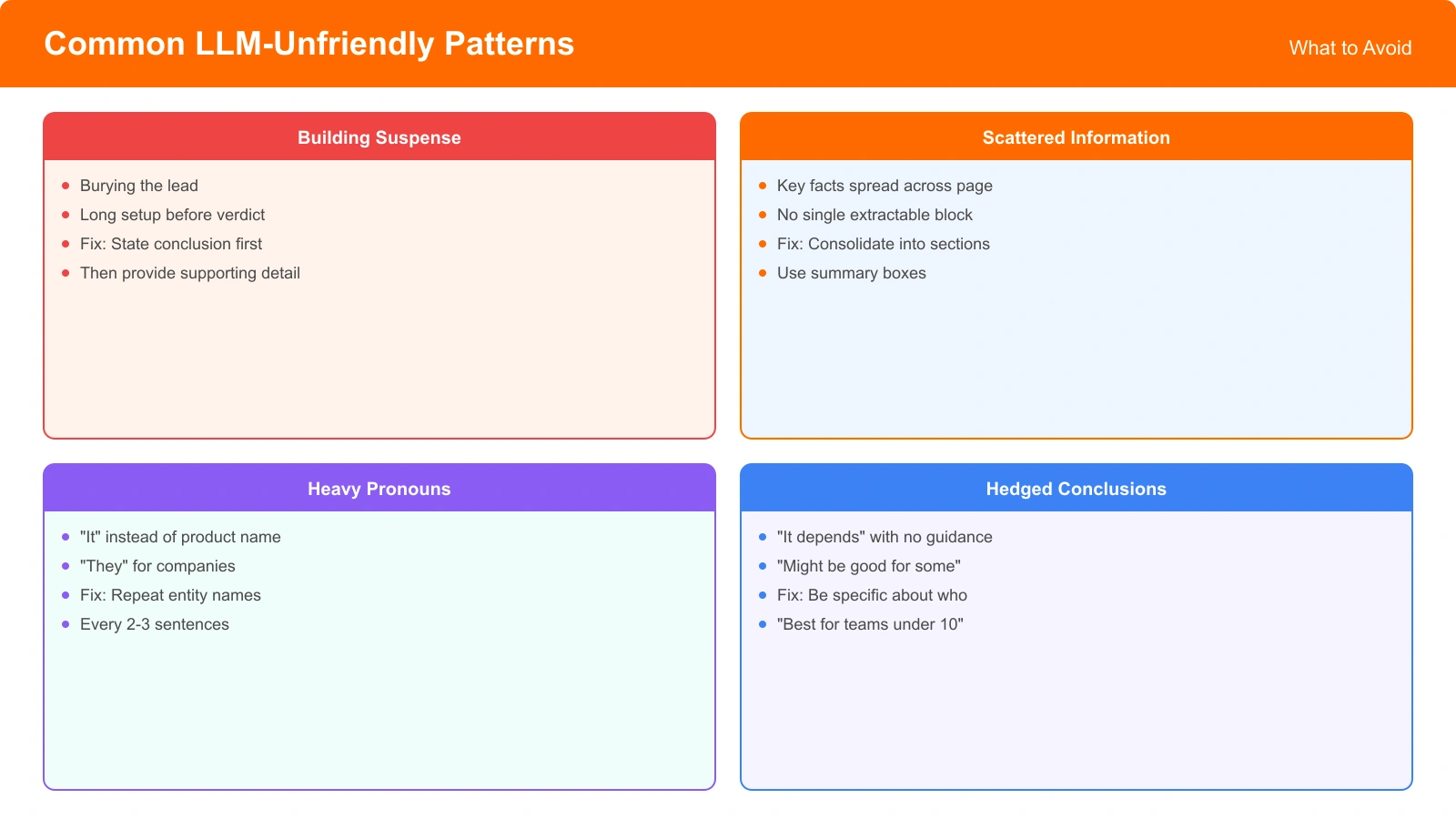
Some writing patterns that work well for humans actively hurt LLM extraction:
Building to Conclusions
Suspense and narrative tension work against extraction. Don't save the best for last—lead with it.
Scattering Related Information
Mentioning a product's price in paragraph 3, features in paragraph 7, and verdict in paragraph 12 makes extraction difficult. Group related information together.
Heavy Pronoun Usage
“It,” “this,” “they”—these require context to parse. Repeat nouns when in doubt.
Over-Hedged Conclusions
“Might be good,” “could work well,” “potentially a fit”—LLMs need confident statements to cite. Be direct.
Data Buried in Prose
Numbers and data points in the middle of long paragraphs are easy to miss. Use tables, callouts, or inline formatting.
Writing for Both Humans and LLMs
The good news: LLM-friendly writing doesn't mean sacrificing human readability. In fact, many of these patterns—clear conclusions, explicit statements, structured formats—make content better for human readers too.
Your LLM-friendly writing checklist:
- Lead with conclusions →State the answer before explaining it
- Be explicit →Say what you mean directly; don't imply
- Quantify →Use numbers instead of vague qualifiers
- Structure for extraction →Tables, lists, descriptive headings
- Use attribution language →“According to our research...”
- Create quotable statements →Self-contained, citable sentences
- Group related information →Don't scatter facts across the page
- Minimize pronouns →Repeat nouns for clarity
- Be confident →Avoid over-hedging conclusions
Think of it this way: write as if an AI will need to quote you directly to answer someone's question. Because increasingly, that's exactly what will happen.
For the complete AI visibility framework, see How Listicles Get Cited by AI Overviews. For an audit of your existing content, check AI Citation Audit: 15-Point Checklist for Listicles.

Product Manager at BestPage. Pioneer in AEO research since 2024, exploring the convergence of SEO and GEO (Generative Engine Optimization). Led multiple AI-powered content optimization projects that achieved 300%+ citation increases in ChatGPT and Perplexity.