
Not all AI platforms are created equal when it comes to citations. If you've tested the same query across Perplexity, ChatGPT, and Google AI Overviews, you've probably noticed wildly different citation behavior—different sources, different frequency, different presentation.
This isn't random. Each platform has distinct architectures, design philosophies, and retrieval systems that determine when and how they cite sources. Understanding these differences is crucial for anyone trying to earn AI visibility for their listicle content.
This guide breaks down the citation patterns of major AI platforms based on systematic testing across thousands of queries. We'll cover what each platform prioritizes, how they differ, and how to optimize your content for maximum cross-platform visibility.
For the broader framework on AI citations, see How Listicles Get Cited by AI Overviews. This article focuses specifically on platform-by-platform optimization.
Perplexity AI: The Citation-Heavy Platform
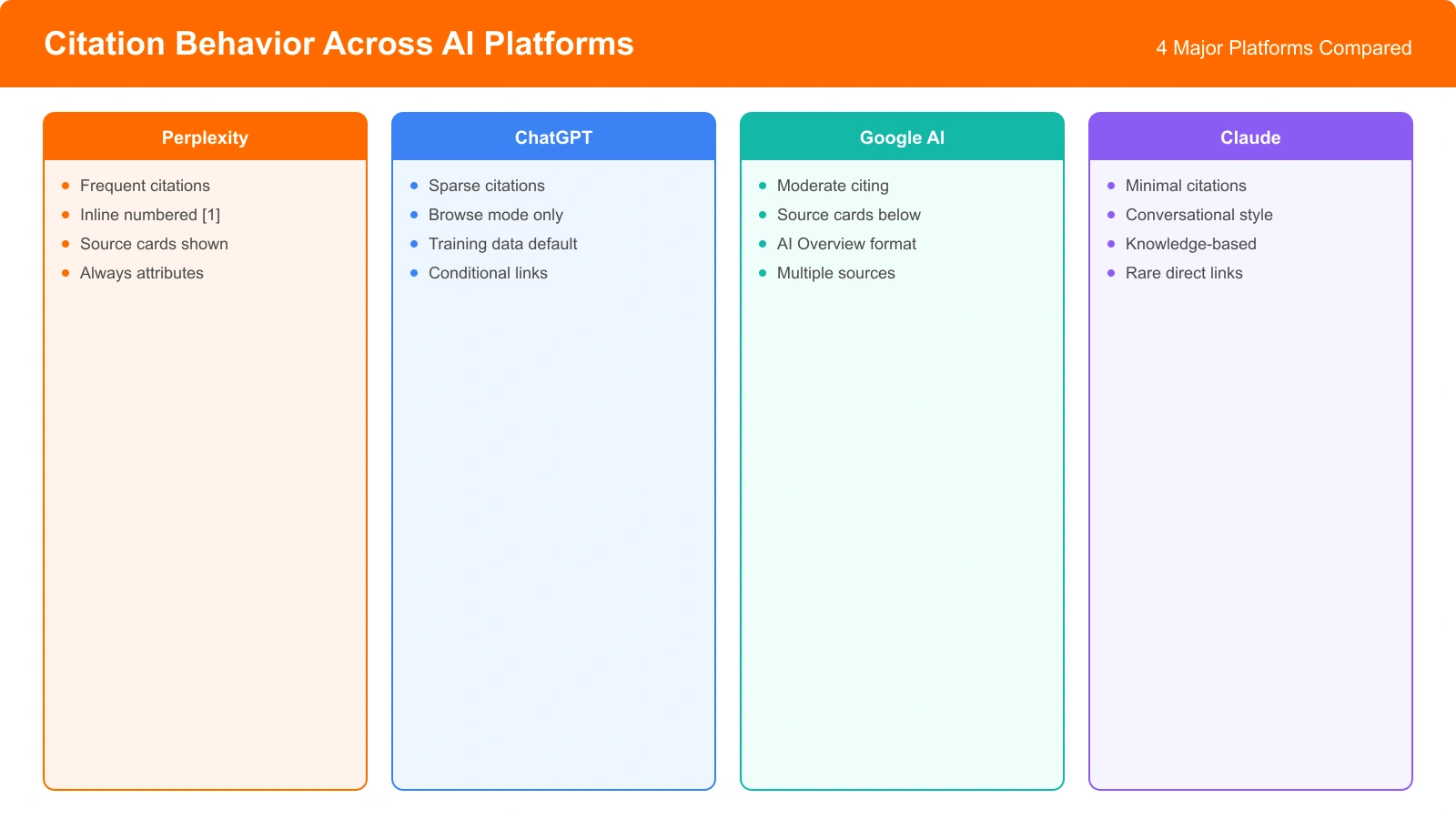
Perplexity was built from the ground up as a search engine, and citations are core to its value proposition. It's the most citation-friendly platform for listicle content.
Citation Behavior
- Citation frequency: Very high (5-10+ sources per response)
- Citation style: Inline numbered references [1], [2], etc.
- Source visibility: Expandable source list with titles and snippets
- Click behavior: Users can click through to original sources
What Perplexity Prioritizes
| Factor | Weight | Notes |
|---|---|---|
| Recency | Very High | Recently published/updated content strongly favored |
| Specificity | High | Specific claims with data more likely cited |
| Domain Authority | Medium | Matters but not as dominant as Google |
| Structure | High | Well-structured content easier to extract from |
Optimizing for Perplexity
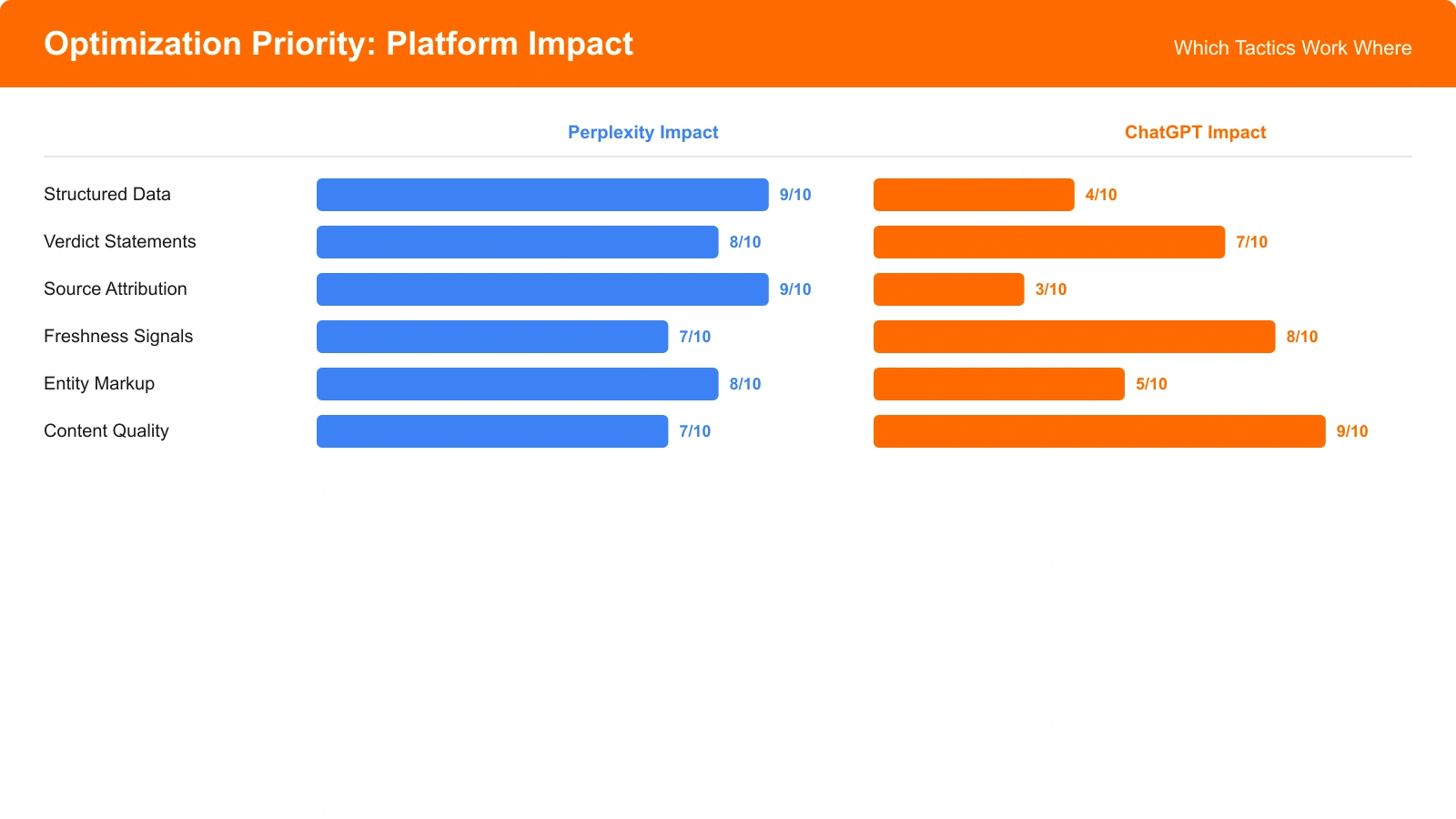
- Update content frequently (Perplexity loves fresh sources)
- Include specific, verifiable claims with data
- Use clear, extractable structure (tables, lists, headings)
- Ensure your content is indexed and crawlable
- Focus on comprehensive coverage—Perplexity often cites multiple sources for breadth
ChatGPT: Conditional Citation
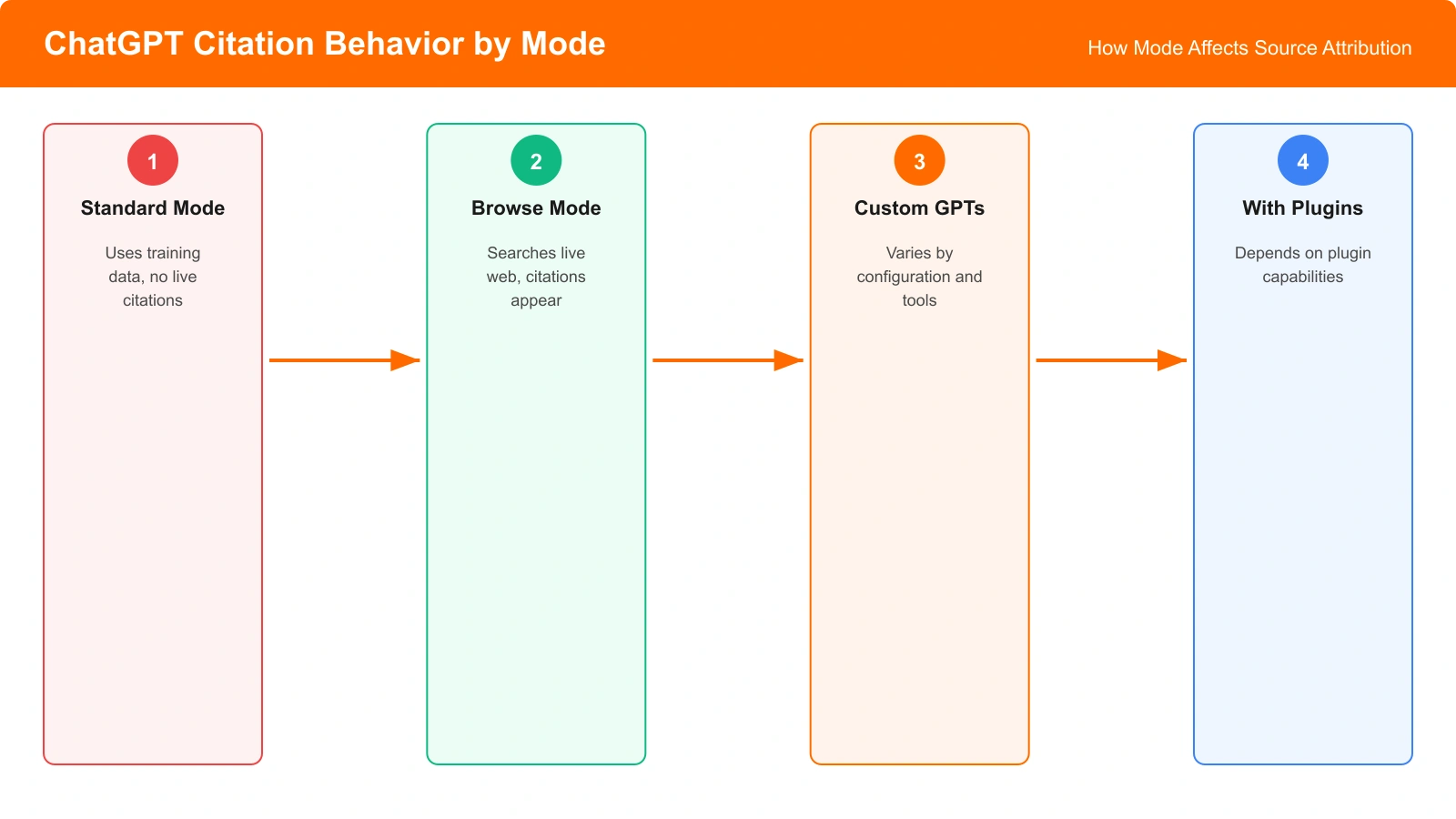
ChatGPT's citation behavior depends heavily on mode. In standard chat, it rarely cites (drawing on training data). With browsing enabled, it cites similarly to Perplexity. With GPT-4 and no browsing, it operates from knowledge cutoff.
Citation Behavior by Mode
| Mode | Citation Frequency | Source Type |
|---|---|---|
| Standard (no browse) | Very Low | Training data only |
| Browsing enabled | Medium-High | Live search results |
| With custom GPT | Variable | Depends on GPT configuration |
What ChatGPT Prioritizes (Browsing Mode)
- Search ranking: Top search results get cited
- Query relevance: Direct answers to specific questions
- Recency: For current events and product info
- Trusted domains: Preference for established sources
Optimizing for ChatGPT
- Rank well in traditional search (ChatGPT browsing uses search)
- Target specific questions users might ask
- Include current year references (“2026 guide”) to signal freshness
- Build overall domain authority—ChatGPT trusts established sources
Google AI Overviews: Authority-First
Google AI Overviews (formerly SGE) integrates AI responses into search results. Its citation behavior reflects Google's traditional emphasis on authority and EEAT.
Citation Behavior
- Citation frequency: Moderate (typically 3-6 sources)
- Citation style: Source cards/links alongside response
- Source visibility: Prominent source attribution
- Click behavior: Direct links to sources in response
What Google AI Prioritizes
| Factor | Weight | Notes |
|---|---|---|
| Domain Authority | Very High | Established domains strongly favored |
| EEAT Signals | Very High | Experience, Expertise, Authority, Trust |
| Content Quality | High | Comprehensive, well-written content |
| Recency | Medium | Important but not as dominant as Perplexity |
Optimizing for Google AI Overviews
- Build domain authority (backlinks, brand recognition)
- Demonstrate EEAT (author credentials, methodology, expertise)
- Create comprehensive, definitive content
- Use schema markup (Article, Review, FAQ)
- Target featured snippet optimization (often same sources)
Claude: Minimal Real-Time Citation
Claude (Anthropic) operates primarily from training data with limited real-time search capability. Its citation behavior is the most conservative of major platforms.
Citation Behavior
- Citation frequency: Low (primarily training data)
- Real-time capability: Limited compared to Perplexity/ChatGPT browse
- Style: More conversational, fewer formal citations
- Acknowledgment: Often caveats with “I don't have access to real-time data”
Optimizing for Claude
Claude optimization is less about earning real-time citations and more about being represented in training data:
- Build authoritative content that gets widely referenced
- Establish category leadership (Claude draws on perceived authorities)
- Create content that gets linked and cited by others
- Focus on evergreen, foundational content
Generate Multi-Platform Optimized Listicles
Create comparison pages optimized for citations across all major AI platforms.
Try for Free
Platform Comparison Summary
| Factor | Perplexity | ChatGPT Browse | Google AI | Claude |
|---|---|---|---|---|
| Citation Frequency | Very High | Medium-High | Medium | Low |
| Recency Weight | Very High | High | Medium | Low (training cutoff) |
| Authority Weight | Medium | Medium-High | Very High | High |
| Structure Importance | High | Medium | Medium-High | Medium |
| Best Content Type | Fresh, data-rich | Search-optimized | Authoritative, comprehensive | Foundational, linked |
Multi-Platform Optimization Strategy
Rather than optimizing for one platform, build content that works across all of them. Here's how:
Universal Foundations (Works Everywhere)
- Clear, explicit recommendations →All platforms prefer extractable claims
- Structured content →Tables, lists, and headings help extraction
- Specific data →Numbers and facts are more citable than opinions
- Author expertise →EEAT signals benefit all platforms
- Comprehensive coverage →Depth is valued universally
Platform-Specific Enhancements
- For Perplexity: Update frequently, emphasize recency signals
- For ChatGPT: Rank well in traditional search, target specific questions
- For Google AI: Build domain authority, implement schema markup
- For Claude: Create foundational content others will reference
Suggested Priority Order
- Perplexity first →Highest citation frequency, easiest quick wins
- Google AI next →Largest user base, highest traffic potential
- ChatGPT browse →Growing user base, requires search ranking
- Claude last →Lower citation opportunity, focus on long-term influence
Tracking Cross-Platform Performance
Understanding platform differences is just the start—you also need to track performance across each:
- Monitor each platform separately →Check queries in Perplexity, ChatGPT, Google AI individually
- Track citation rate by platform →You may perform better on some than others
- Note content differences →What gets cited on Perplexity vs Google may differ
- Adjust strategy based on data →Double down on platforms where you're winning
Key takeaways:
- Perplexity is citation-heavy and favors recency—optimize here first
- ChatGPT browse depends on search ranking—traditional SEO matters
- Google AI Overviews emphasizes authority—build EEAT signals
- Claude uses training data—focus on long-term influence
- Universal foundations (structure, specificity, expertise) help everywhere
For the broader AI visibility strategy, see How Listicles Get Cited by AI Overviews. For content-level optimization, check LLM-Friendly Writing: How to Get Parsed and Cited.

Product Manager at BestPage. Pioneer in AEO research since 2024, exploring the convergence of SEO and GEO (Generative Engine Optimization). Led multiple AI-powered content optimization projects that achieved 300%+ citation increases in ChatGPT and Perplexity.