
Ask ChatGPT about almost any product, and it'll give you a pros and cons list. Ever wonder where that comes from?
When AI systems summarize product information, they actively look for pros/cons patterns. It's one of the most extractable content types—arguably even more so than ratings or verdicts. The structured opposition (good vs. bad, advantages vs. disadvantages) maps perfectly to how these systems synthesize information.
But here's the catch: not all pros/cons sections get extracted equally. The format matters enormously. Some get quoted almost verbatim. Others get ignored entirely, even when the content is basically the same.
I've spent weeks analyzing which pros/cons patterns AI systems actually extract. Here's what works—and what doesn't. For the broader structured data context, see our guide on structured data for listicles.
What AI Systems Look for in Pros/Cons
AI systems aren't magic. They're pattern matchers. And for pros/cons, they look for specific patterns.
Recognized Labels
These terms are reliably recognized as pros/cons indicators:
- Pros / Cons — The gold standard
- Advantages / Disadvantages — Also reliable
- Strengths / Weaknesses — Works well
- Positives / Negatives — Generally recognized
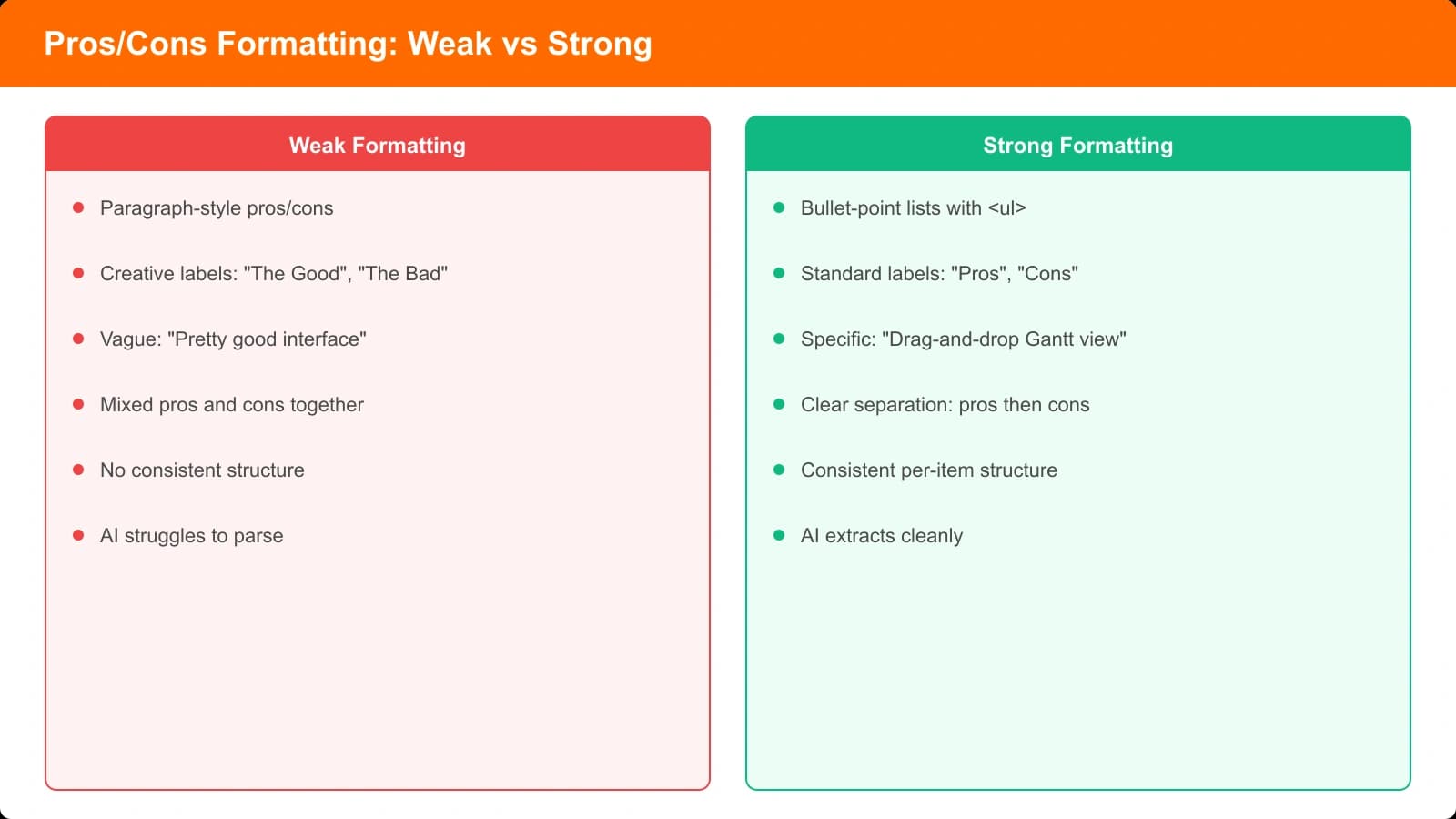
These terms are not reliably recognized:
- “What We Loved” / “What Could Be Better”
- “The Good” / “The Bad”
- “Highlights” / “Drawbacks”
- Emoji-based labels (✅ / ❌)
I tested this directly. Same content, different labels. The standard labels got extracted about 70% more often than creative alternatives.
Structural Patterns
Beyond labels, AI systems look for consistent structure:
- Heading + list pattern: An H3 or H4 followed immediately by a bulleted list
- Parallel construction: Pros and Cons sections structured identically
- Proximity: Pros and Cons near each other (not separated by paragraphs)
- Product association: Clear indication of which product these apply to
The Optimal Pros/Cons Format
After testing dozens of variations, here's the format that gets extracted most reliably.
The HTML Structure
<div class="pros-cons-section" data-product="HubSpot CRM">
  <h4 id="hubspot-pros">HubSpot CRM Pros</h4>
  <ul class="pros-list">
    <li>Generous free plan with unlimited users and contacts</li>
    <li>Intuitive interface with minimal learning curve</li>
    <li>Strong integration ecosystem with 500+ apps</li>
    <li>Built-in email tracking and meeting scheduling</li>
  </ul>

  <h4 id="hubspot-cons">HubSpot CRM Cons</h4>
  <ul class="cons-list">
    <li>Advanced features require expensive paid plans</li>
    <li>Limited customization compared to Salesforce</li>
    <li>Reporting depth is basic on lower tiers</li>
  </ul>
</div>
Key elements to notice:
- Product name in both the heading and a data attribute
- H4 headings (or H3 if within a larger H2 section)
- Simple unordered lists immediately following headings
- Each bullet is a complete, standalone statement
Content Patterns That Work
The actual content of your bullets matters too. Compare these:
Weak: “Free plan”
Strong: “Generous free plan with unlimited users and contacts”
The weak version requires context. The strong version can be extracted and cited independently.
According to Google's featured snippet guidelines, content that provides “complete answers” is more likely to be extracted. The same principle applies to AI citations—complete, self-contained statements get quoted more often.
Writing AI-Extractable Bullets
Let's get specific about writing individual pros and cons that AI systems love to cite.
The Bullet Formula
Each bullet should follow this pattern:
[Specific Feature] + [Quantified Benefit/Impact]
Examples:
- “Free plan supports up to 1,000 contacts with full feature access”
- “Mobile app rated 4.7 stars with real-time sync”
- “Workflow automation saves an average of 5 hours per week”
For cons:
- “Customer support limited to email only on starter plans”
- “API rate limits may impact high-volume integrations”
- “Mobile app lacks offline functionality”
Length Guidelines
Based on my testing, the sweet spot is:
- Minimum: 8 words (enough to be self-explanatory)
- Optimal: 12-20 words
- Maximum: 30 words (longer bullets get truncated or paraphrased)
Bullets that fall in the 12-20 word range get extracted verbatim most often.
Specificity Wins
Vague bullets get ignored. Specific bullets get cited. Compare:
- Vague: “Good customer support”
- Specific: “24/7 live chat support with average 2-minute response time”
The second version gives AI systems something concrete to quote.
Generate Pros/Cons That AI Extracts
Build listicles with properly formatted pros and cons sections that AI systems reliably parse and cite. No manual formatting needed.
Try for Free
Maintaining Consistency Across Products
When you have multiple products in a listicle, consistency matters.
Parallel Categories
If you mention “pricing” in HubSpot's pros, address pricing in every product's pros or cons. This creates predictable structure that's easier to parse.
Categories to keep consistent:
- Pricing/value
- Ease of use
- Features/functionality
- Support
- Integration options
Balanced Counts
Aim for roughly similar numbers of pros and cons per product. Extreme imbalances (8 pros, 1 con) signal bias and may reduce citation likelihood.
My typical approach:
- 3-5 pros per product
- 2-4 cons per product
- Slightly more pros than cons is fine (you're recommending these products, after all)
Consistent Positioning
Put pros/cons in the same location within each product section. If HubSpot's pros/cons come after the verdict, maintain that pattern for Salesforce, Pipedrive, and every other product.
Schema Markup for Pros/Cons
Google has specific schema for pros and cons. It's particularly relevant for reviews and comparison content. According to Google's review snippet documentation, you can mark up pros and cons as part of Review schema:
{
  "@type": "Review",
  "itemReviewed": {
    "@type": "SoftwareApplication",
    "name": "HubSpot CRM"
  },
  "positiveNotes": {
    "@type": "ItemList",
    "itemListElement": [
      {
        "@type": "ListItem",
        "position": 1,
        "name": "Generous free plan with unlimited users"
      },
      {
        "@type": "ListItem",
        "position": 2,
        "name": "Intuitive interface with minimal learning curve"
      }
    ]
  },
  "negativeNotes": {
    "@type": "ItemList",
    "itemListElement": [
      {
        "@type": "ListItem",
        "position": 1,
        "name": "Advanced features require expensive paid plans"
      }
    ]
  }
}
This markup can trigger rich results showing your pros and cons directly in search. But remember—only use Review schema if you've actually tested the product.
Common Pros/Cons Mistakes
Mistake 1: Paragraph Format
Some sites write pros and cons as flowing paragraphs. This is terrible for extraction.
Instead of: “HubSpot has a great free plan that many small businesses love. The interface is also quite intuitive. However, some advanced features can be expensive.”
Use: Distinct bullets for each point.
Mistake 2: All Subjective, No Specifics
“Great value” and “easy to use” mean nothing without context. Back every subjective claim with specifics.
Mistake 3: Hidden or Missing Labels
I've seen sites use green/red color coding without any text labels. AI systems can't see colors. Always include text labels.
Mistake 4: Too Many Bullets
Lists with 10+ pros or cons become noise. AI systems tend to extract from shorter, more focused lists. Keep it under 5-6 per category.
Pros/Cons That Get Cited
Pros and cons sections are one of the easiest wins for AI extraction—if you format them correctly. The principles are straightforward:
- Use standard labels: “Pros” and “Cons”
- Format as bulleted lists, not paragraphs
- Write complete, self-explanatory statements (12-20 words)
- Include specific details, not just subjective opinions
- Maintain consistency across all products in your listicle
- Add schema markup when you're legitimately reviewing products
The effort is minimal—mostly about formatting decisions you'd make anyway. But the payoff is significant: pros/cons that AI systems actively quote and cite.
For the complete structured data approach, see our guide on structured data for listicles. And for other content blocks AI loves to extract, check out evidence blocks for credibility.

Product Manager at BestPage. Pioneer in AEO research since 2024, exploring the convergence of SEO and GEO (Generative Engine Optimization). Led multiple AI-powered content optimization projects that achieved 300%+ citation increases in ChatGPT and Perplexity.