
When someone types into ChatGPT or asks Perplexity, they don't use SEO keywords. They ask questions the way they'd ask a knowledgeable friend. “What's the best CRM for a 5-person sales team?” “Which email marketing tool has the best automation features?” “Should I use Notion or Coda for team documentation?”
These conversational queries are longer, more specific, and more intent-rich than traditional search keywords. They contain context (team size, use case, constraints) that shapes what constitutes a good answer. Content optimized for “best CRM software” may not be the best match for the actual question being asked.
This guide covers question matching for AI search: understanding how users actually query AI assistants about comparisons, researching the specific questions in your space, and structuring content that directly answers those questions.
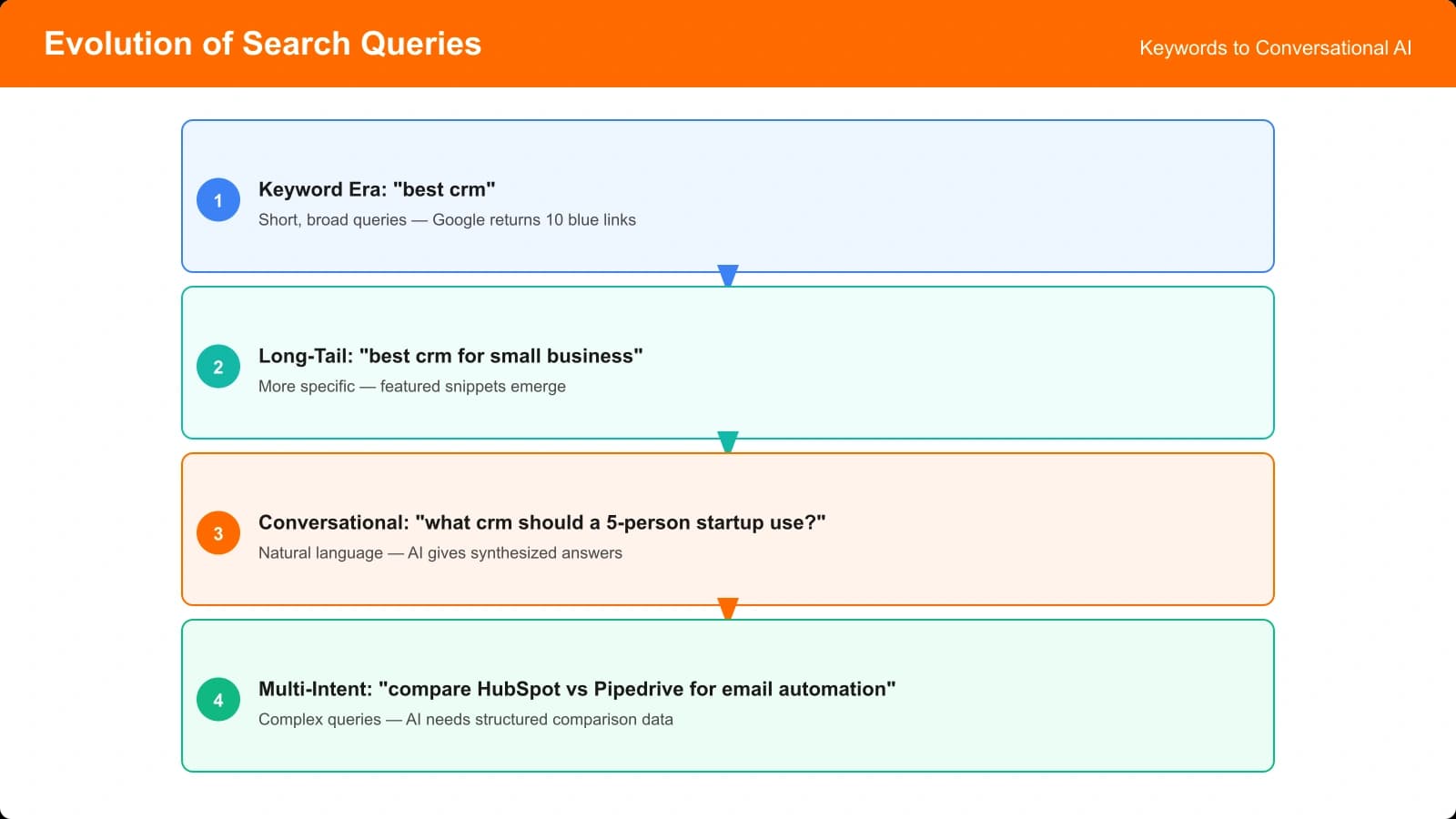
Understanding AI Query Patterns
AI queries for comparison content follow recognizable patterns. Understanding these patterns helps you anticipate and answer questions effectively.
Common Question Structures
Comparison queries to AI assistants typically fall into several categories:
“What's the best X for Y?”
Example: “What's the best project management tool for creative agencies?”
This pattern specifies both category and use case. Your content needs to explicitly address the use case, not just list products generically.
“Should I use A or B for Z?”
Example: “Should I use Airtable or Notion for project tracking?”
Direct comparison questions. Content should provide head-to-head analysis with clear guidance for the stated use case.
“What are the pros and cons of X?”
Example: “What are the pros and cons of using Monday.com?”
Evaluation questions seeking balanced assessment. Content should explicitly list pros and cons, not just describe features.
“Which X is cheapest/easiest/fastest for Y?”
Example: “Which CRM is easiest to set up for beginners?”
Criterion-specific questions. Content should explicitly rank or identify winners on the specific criterion asked.
Context Signals in Questions
AI queries often contain context that shapes the ideal answer:
- Team size: “for a team of 5” vs “for enterprise”
- Budget constraints: “free” or “under $50/month”
- Industry/use case: “for marketing agencies” or “for e-commerce”
- Experience level: “for beginners” or “for developers”
- Integration needs: “that works with Slack” or “with Salesforce integration”
Content that addresses these contextual factors explicitly is more likely to be cited when they appear in queries.
Researching Questions in Your Space
Before you can answer questions, you need to know what questions people actually ask.
Question Research Methods
| Method | How to Execute | What You Learn | Limitations |
|---|---|---|---|
| People Also Ask mining | Expand PAA boxes for your target keywords | Questions Google already knows users ask | Biased toward traditional search patterns |
| Reddit/forum analysis | Search subreddits for “best [category]” threads | Real user questions with context | May not represent AI query phrasing |
| AI assistant testing | Ask ChatGPT/Perplexity variations, note cited sources | What content currently gets cited for which questions | Time-consuming, results vary |
| Customer research | Survey/interview your audience about their questions | Actual questions from your target users | Small sample, effort required |
| Search Console queries | Analyze question-format queries driving traffic | Questions your content already attracts | Only shows what you already rank for |
Building a Question Inventory
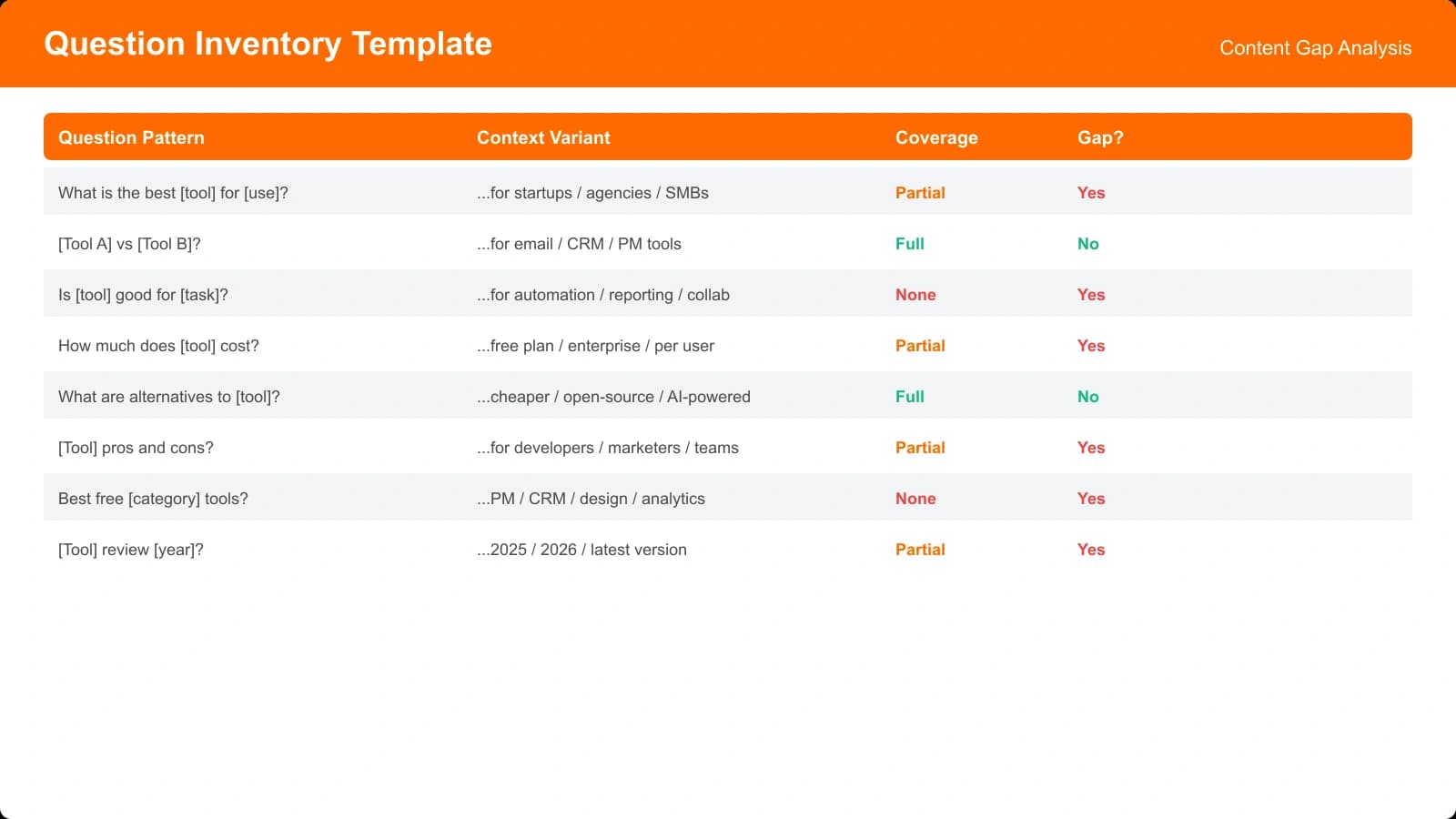
Systematically document questions for each comparison category you cover:
- Core comparison questions: Basic “what's the best X” variations
- Use-case questions: Best X for specific industries, team sizes, purposes
- Versus questions: Direct A vs B comparisons users commonly ask
- Criterion questions: Cheapest, easiest, most powerful variations
- Integration questions: Best X that works with Y
- Problem questions: What tool solves specific problem?
This inventory becomes your content planning guide. Each question cluster represents content that should exist—or sections within existing content that should be added.
Generate Question-Aligned Comparisons
Create listicles structured to answer the specific questions users ask AI assistants.
Try for Free
Aligning Content to Questions
Once you know the questions, structure your content to answer them directly.
The Direct Answer Pattern
For each key question, your content should provide a direct answer within the first sentence or two of the relevant section. Don't bury the answer—AI systems extract clear, upfront answers more reliably than conclusions buried in paragraphs.
Weak (answer buried): “Project management tools vary significantly in their approach to team collaboration. Some emphasize kanban boards, others focus on timelines. After evaluating many options, agencies often find that Monday.com provides the best balance of visual project tracking and client collaboration features.”
Strong (direct answer): “Monday.com is the best project management tool for creative agencies, primarily because of its visual client-facing dashboards and approval workflows. Here's why it beats alternatives for agency use cases...”
Question-Aligned Section Structure
Structure major sections around question patterns. If users commonly ask “which is best for small teams,” create a section explicitly titled “Best for Small Teams” or “Which [Category] Works Best for Small Teams?”
- Use question phrasing in H2/H3 headings where natural
- Open sections with direct answers before elaborating
- Include the context signals (team size, budget) in section content
- Provide clear recommendations, not just information
Covering Multiple Questions
A single comparison page can answer many questions if structured properly. Use question-rich subheadings, explicit use-case sections, and a quick-answer summary that addresses the most common questions upfront.
Structural Patterns for AI Matching
Certain structural patterns make your content easier for AI systems to parse and cite.
Answer-First Architecture
Structure your content so that answers appear before explanations. This inverts traditional journalistic structure (which builds to a conclusion) in favor of immediate answers followed by supporting context.
- TL;DR: Immediate summary with key recommendations
- Quick answer: The direct answer to the core question
- Reasoning: Why this is the answer
- Alternatives: When different answers apply
- Details: Full evaluation and evidence
Explicit Recommendation Statements
Make recommendations unmistakably clear. AI systems look for definitive statements they can cite. Hedged, wishy-washy content is harder to cite as an authoritative answer.
Citeable: “For remote teams under 20 people, Slack is the best team communication tool because of its async-friendly threading and deep integration ecosystem.”
Not citeable: “There are many good options for team communication, and the best choice depends on your specific needs and preferences.”
Context-Based Content Segmentation
Create explicit sections or recommendations for different contexts. “Best for Beginners,” “Best for Enterprise,” “Best Budget Option”—these segment your content so AI can cite the relevant portion for context-specific questions.
Building Question-First Content
Question matching isn't about stuffing questions into content—it's about understanding what users actually ask and structuring content that provides clear, direct answers. Research the questions in your space. Build content that addresses them explicitly. Structure for answer extraction.
The shift from keyword-first to question-first content creation is fundamental to AI search success. Pages optimized for keywords may rank in traditional search but fail to get cited when users ask AI assistants natural language questions.
For understanding how AI search intent differs from traditional search, see AI Search Intent. For platform-specific optimization, see Optimizing for Perplexity.

Product Manager at BestPage. Pioneer in AEO research since 2024, exploring the convergence of SEO and GEO (Generative Engine Optimization). Led multiple AI-powered content optimization projects that achieved 300%+ citation increases in ChatGPT and Perplexity.