
“Best project management software” entered into Google and ChatGPT represents fundamentally different user needs—even though the words are identical. The Google user expects a list of links to explore. The ChatGPT user expects an answer, possibly a final decision. Same query, different intent.
This distinction matters because content optimized for Google intent may fail for AI intent—and vice versa. Understanding how intent differs between these channels helps you create content that serves both effectively, rather than accidentally optimizing for one at the expense of the other.
This guide explores the intent differences between traditional and AI search for comparison queries, and how those differences should shape your content strategy.
Fundamental Intent Differences
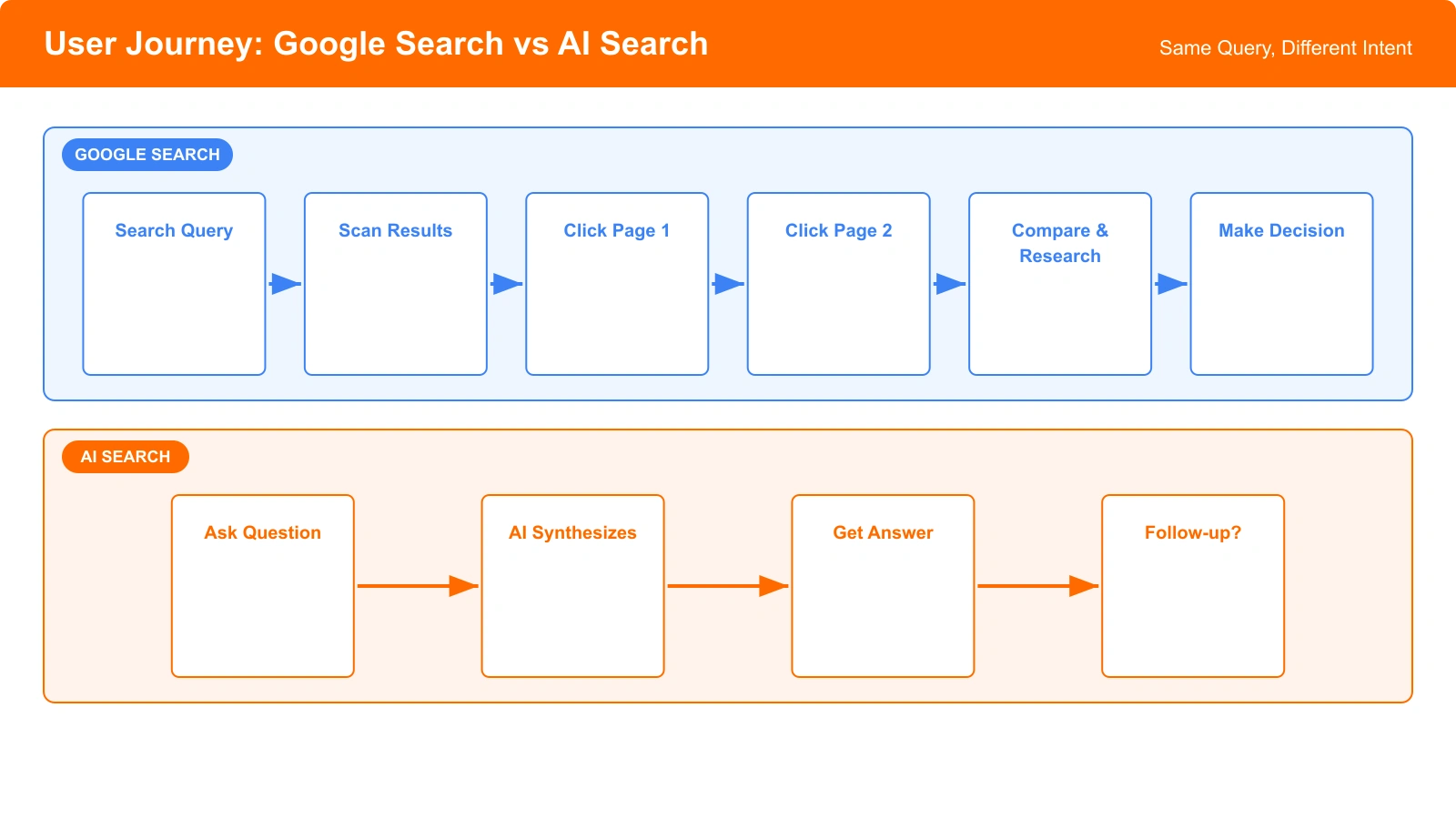
The core behavioral shift between traditional and AI search affects every aspect of how users approach comparison queries.
Browsing Intent vs. Answering Intent
Google users expect to browse. They know they'll click multiple results, read several perspectives, and synthesize their own conclusion. The search engine provides options; the user does the synthesis work.
AI users expect answers. They've asked a question and want it answered—not pointed toward places where they might find answers. The AI assistant handles synthesis; the user receives a conclusion.
Exploration vs. Decision
Many Google searches begin exploration. “What project management tools exist?” The user doesn't expect to make a decision from the first search—they're gathering options for further research.
AI queries more often seek decisions. “What should I use?” The conversational nature invites asking for recommendations, not just information. Users ask AI what to do, not just what exists.
| Dimension | Traditional Google Search | AI Assistant Search |
|---|---|---|
| Query format | Keywords, short phrases | Natural language questions |
| Expected response | List of links to explore | Direct answer with reasoning |
| User synthesis | User reads multiple sources, synthesizes | AI synthesizes, user receives conclusion |
| Context provision | Limited—keywords lack context | Rich—natural questions include context |
| Follow-up behavior | New searches, refine keywords | Conversational follow-ups in same thread |
| Trust model | User evaluates source credibility | User trusts AI's synthesis and citations |
| Decision stage | Often early-stage research | Often decision-seeking or confirming |
Query Behavior Differences
How users formulate queries differs significantly between channels.
Context Richness
AI queries naturally include context because conversation invites elaboration. Users don't just ask “best CRM”—they ask “best CRM for a B2B startup with a 5-person sales team and tight budget.” The context that would feel awkward in a keyword search flows naturally in conversation.
This context richness means AI queries are often more specific and actionable. They contain constraints and requirements that the answer should address. Content that explicitly addresses these contextual factors is more likely to match and be cited.
Follow-Up Patterns
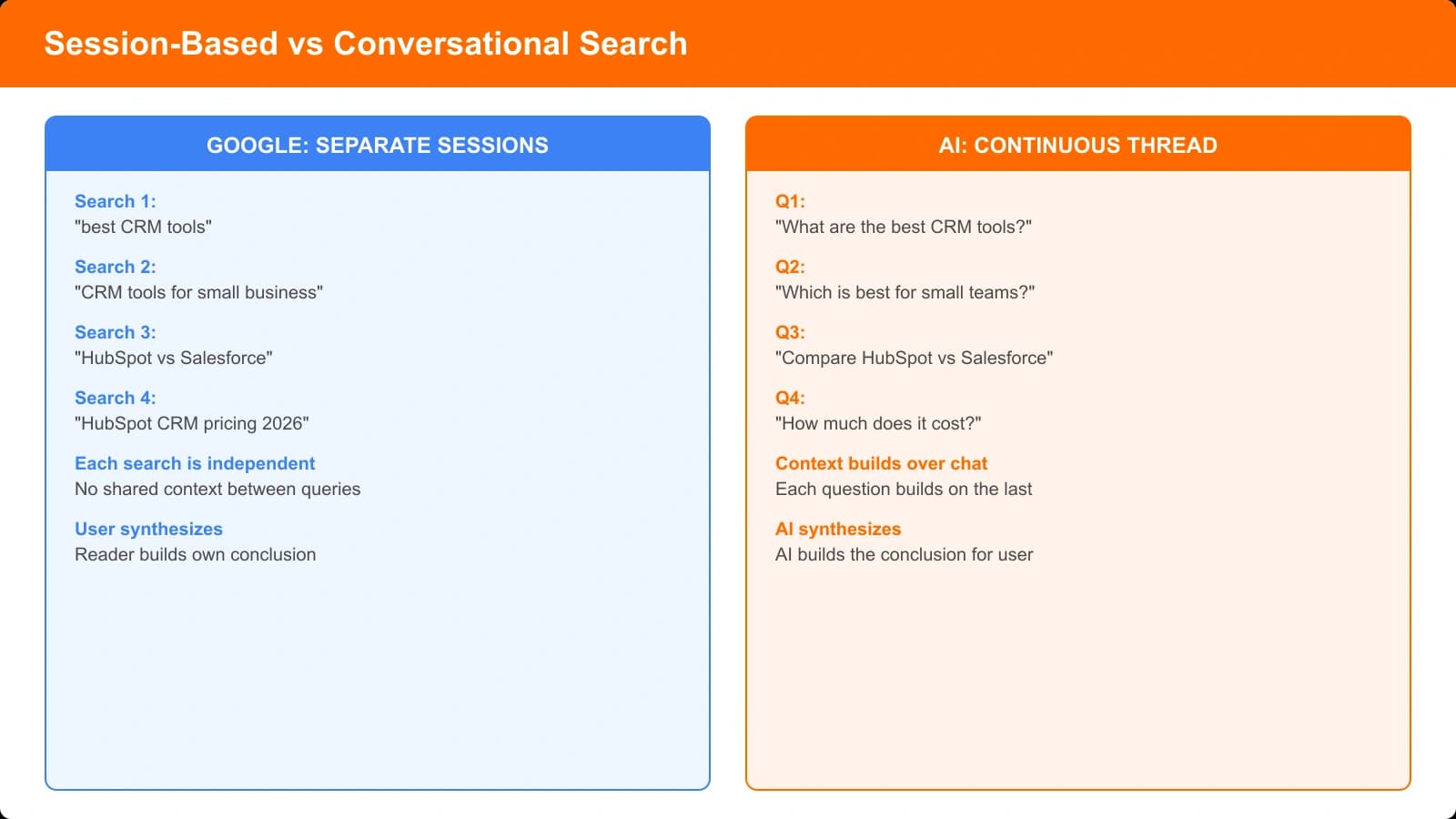
Google users refine through new searches. “Best CRM” becomes “best CRM for small business” becomes “HubSpot vs Pipedrive.” Each is a separate search session.
AI users refine through conversation. “What about if we need Salesforce integration?” “How does pricing work for teams under 10?” The conversation builds on previous context without restarting.
AI conversation pattern:
User: “What's the best email marketing tool?”
AI: [Answer citing sources]
User: “What if I need advanced automation?”
AI: [Refined answer, potentially different citation]
User: “Which of those integrates with Shopify?”
AI: [Further refined answer]
Content that anticipates and addresses follow-up questions within the same piece has more citation opportunities across the conversational thread.
Create Content for Both Search Paradigms
Generate comparison pages optimized for traditional search and AI citation.
Try for Free
Content Strategy Implications
These intent differences have concrete implications for how you create comparison content.
Structuring for Both Intents
The good news: you don't need entirely separate content for each channel. A well-structured comparison page can serve both—but it requires intentional design.
- For Google intent: Comprehensive coverage, multiple options presented, navigation to detailed sections, links for further exploration
- For AI intent: Clear direct answers, explicit recommendations, reasoning that supports citations, context-specific guidance
The structure that works: lead with direct answers (serves AI), then provide the comprehensive detail (serves Google). Users who want quick answers get them upfront. Users who want to browse find rich content below.
Answer Explicitness
Google-optimized content can afford ambiguity—users will read and interpret. AI-optimized content requires explicit answers the model can extract and cite.
Google-sufficient: “The right project management tool depends on your team size, budget, and specific workflow needs. Here are the top options to consider...”
AI-optimized: “For most teams, Monday.com is the best overall project management tool. For budget-conscious small teams, Trello offers the best value. For developer teams, Linear provides superior issue tracking. Here's the detailed breakdown...”
The second version provides citeable answers for multiple contexts. The first requires the AI to infer, which is less reliable for generating citations.
Context Coverage
Because AI queries include context, your content should explicitly address common contexts:
- Team size variations (solo, small team, enterprise)
- Budget categories (free, budget, premium)
- Use case specifics (marketing, sales, development, etc.)
- Experience levels (beginner, intermediate, expert)
- Integration requirements (common platforms)
Content that explicitly addresses “for beginners” or “for enterprise teams” can be cited when AI receives context-rich queries matching those segments.
Optimizing for Intent Evolution
The shift from keyword-based exploration to conversational decision-seeking represents a fundamental evolution in how users approach comparison research. Content that succeeds in this new environment provides direct answers while maintaining the depth that traditional search rewards.
The winning strategy isn't choosing between Google optimization and AI optimization—it's structuring content that serves both intents effectively. Answer-first structure, explicit recommendations, and context-aware coverage create content that ranks in traditional search and gets cited in AI responses.
For practical implementation of these principles, see Question Matching. For platform-specific tactics, see Perplexity Optimization and ChatGPT Browse Optimization.

Product Manager at BestPage. Pioneer in AEO research since 2024, exploring the convergence of SEO and GEO (Generative Engine Optimization). Led multiple AI-powered content optimization projects that achieved 300%+ citation increases in ChatGPT and Perplexity.