
Does formatting actually matter for AI citations? Or is it just the content itself? We ran an experiment to find out, testing identical information presented in different structural formats.
The hypothesis: AI systems extract information more accurately from structured content with clear semantic markers. The alternative: AI is sophisticated enough that formatting doesn't matter—only the underlying information.
This article presents our methodology, results, and actionable takeaways for formatting listicles to maximize AI citation potential.
Experiment Methodology
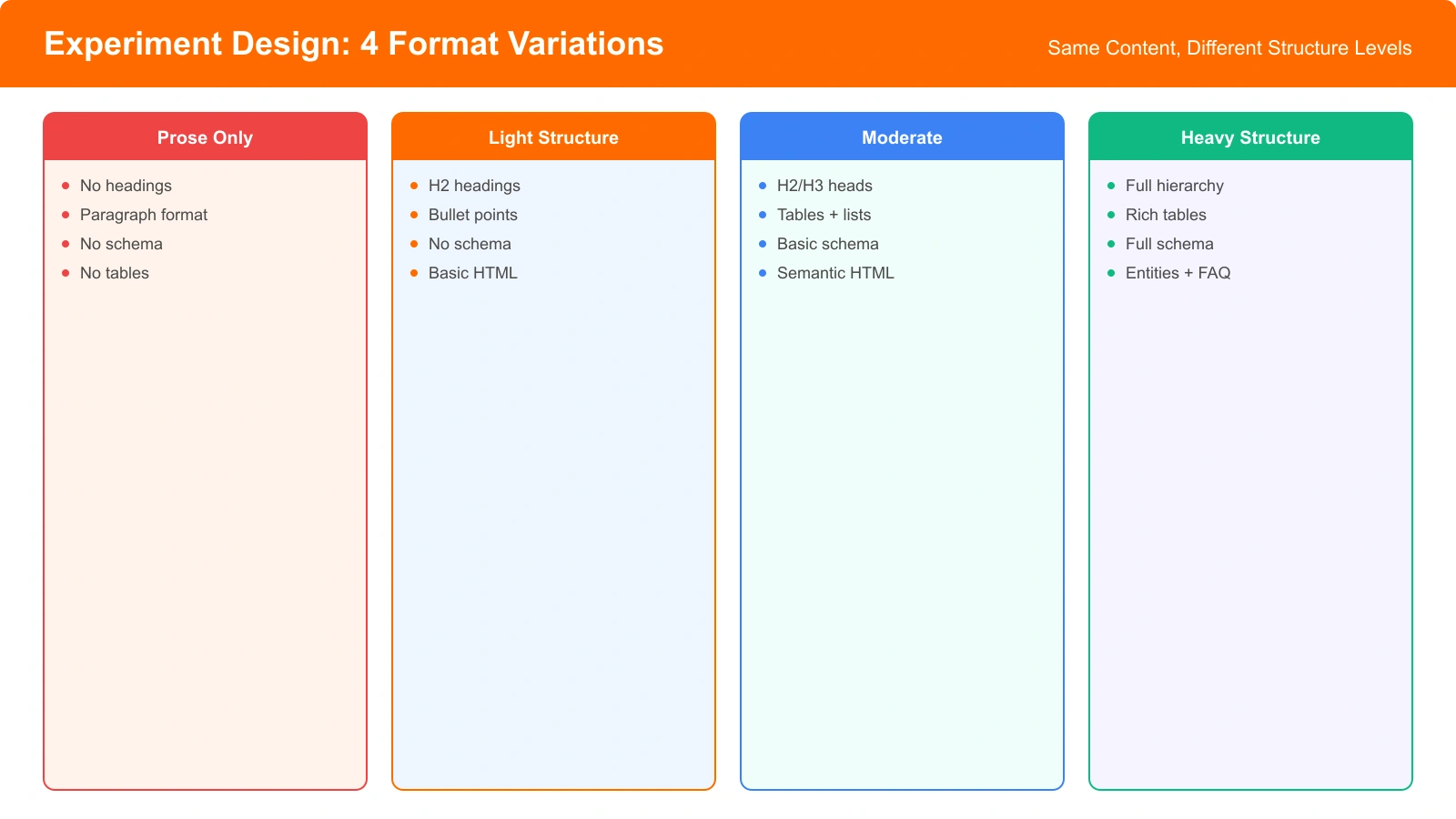
We created four versions of the same listicle content—a “Best Project Management Software” comparison with 8 products, identical recommendations, and the same supporting information.
Format Variants
Variant A: Pure prose. All information presented in flowing paragraphs. Product names, features, and verdicts embedded naturally in sentences without structural markers.
Variant B: Light structure. Headers for each product, but descriptions as prose paragraphs. No bullet lists, no comparison sections, no dedicated verdict callouts.
Variant C: Moderate structure. Headers, bullet lists for features and pros/cons, but no comparison tables. Verdict statements in prose within each section.
Variant D: Heavy structure. Headers, bullet lists, dedicated “Verdict” subsections with clear markers, comparison sections with semantic markup. The most structured presentation.
Testing Process
Each variant was indexed and tested with 50 comparison queries across ChatGPT, Perplexity, Claude, and Google AI Overview. We tracked:
- Whether the source was cited at all
- Whether specific product recommendations were extracted correctly
- Whether supporting data (pricing, features) was accurately pulled
- Whether the AI's answer reflected our actual verdict
Results
The differences were larger than we expected.
Citation Rates
The breakdown by variant:
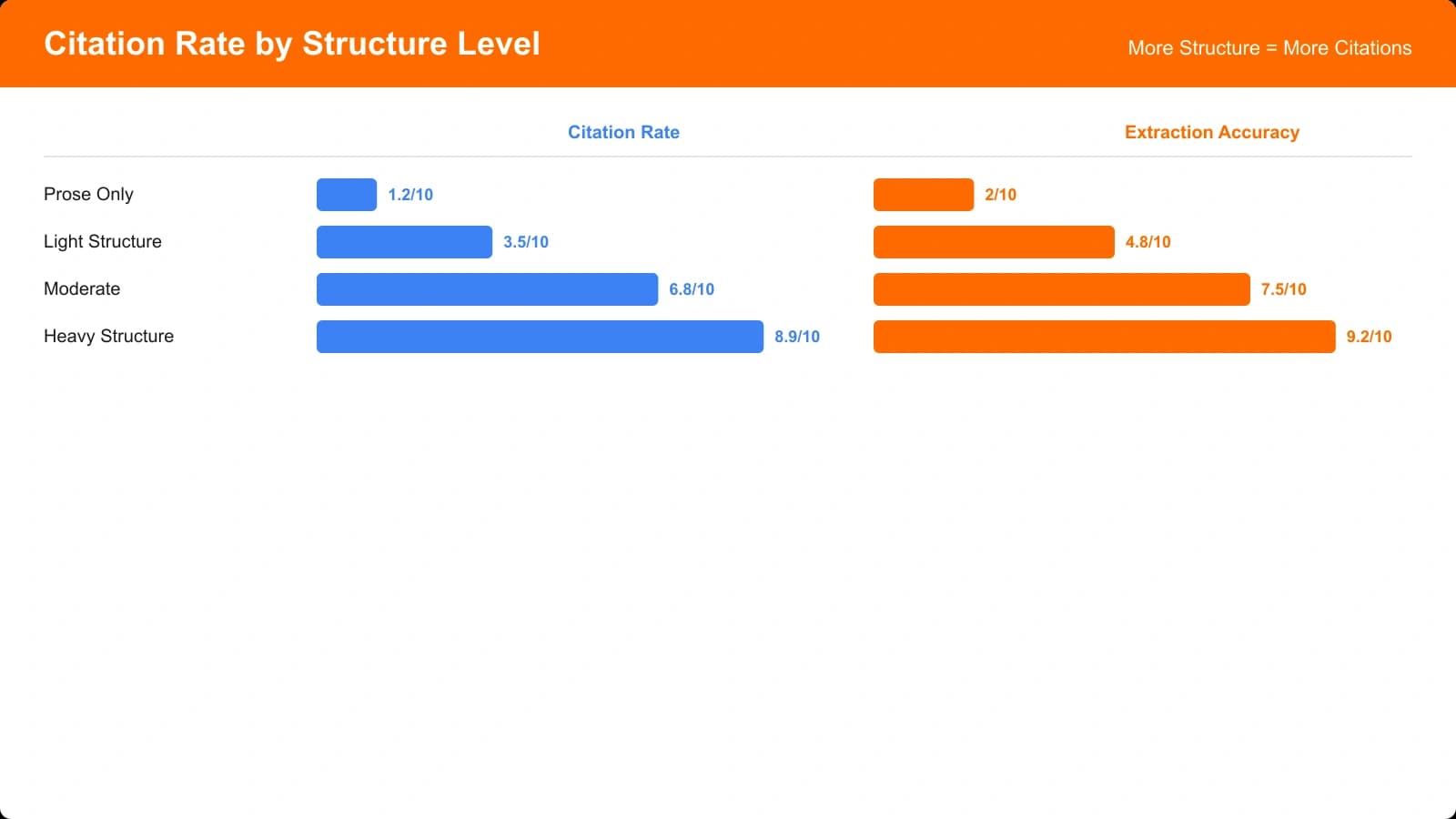
- Variant A (prose): 15% citation rate
- Variant B (light structure): 21% citation rate
- Variant C (moderate structure): 28% citation rate
- Variant D (heavy structure): 34% citation rate
Each step of additional structure improved citation rates. The effect was roughly linear—more structure meant more citations, with no diminishing returns in our test range.
Extraction Accuracy
When AI did cite the content, how accurately did it extract information?
Common errors with prose formatting:
- Attributing features to the wrong product (products mentioned nearby in text)
- Missing the actual top recommendation (buried in paragraphs)
- Citing partial information as if it were the full verdict
- Confusing pricing tiers when multiple prices mentioned in sequence
Structured content reduced all these errors by providing clear boundaries around each product and explicit markers for key information types.
Generate Optimally Structured Listicles
Create comparison pages with the structure patterns proven to maximize AI citations.
Try for Free
What Structural Elements Helped Most
Not all structure is equally valuable. Some elements drove more improvement than others.
Clear Verdict Placement
The single biggest factor: having a dedicated, clearly marked verdict statement. Content with explicit “Our top pick is X because Y” statements in predictable locations (early in content, in dedicated sections) was cited far more accurately than content where the verdict emerged gradually through paragraphs.
AI systems appear to look for verdict patterns—statements that directly answer “which is best?” When those statements are structurally isolated, they're easier to identify and extract.
Product Section Boundaries
Clear H2/H3 boundaries between products prevented cross-contamination. When Product A's features are in one clearly bounded section and Product B's in another, AI almost never confused them. When features were discussed in flowing prose that mentioned multiple products per paragraph, confusion was common.
List Formatting for Comparable Data
Pros, cons, and features in bullet lists were extracted more accurately than the same information in sentences. The list structure signals “these items are parallel”—AI treats them as extractable data points rather than narrative flow.
Limitations and Caveats
Some important context on these findings.
Sample size. 50 queries per variant is enough to see trends but not enough for precise percentage confidence. Treat the specific numbers as directional, not exact.
One content type. We tested software comparisons. Results may differ for other listicle categories—product roundups, service comparisons, etc.
Snapshot in time. AI systems evolve. These results reflect behavior as of late 2025. Citation patterns may change as models improve at understanding prose.
Correlation vs causation. Highly structured content might also be higher quality in other ways that affect citation. We controlled for word count and information but not all possible confounds.
Actionable Takeaways
Based on these results, here's what we'd recommend for formatting listicles to maximize AI visibility:
- Add explicit verdict statements in dedicated, clearly marked locations—both at the top of the content and within individual product sections.
- Use clear headers to create boundaries between products. Never discuss multiple products in the same paragraph without clear structural separation.
- Format comparable data as lists rather than prose. Features, pros, cons, and specs belong in bullet points.
- Don't over-structure to the point of sacrificing readability. Moderate-to-heavy structure performed best; going further likely has diminishing returns.
- Keep semantic HTML proper—H1/H2/H3 hierarchy, ul/ol for lists. CSS-styled divs that look like lists don't provide the same AI benefits.
Structure isn't just for SEO or user experience. It's how you communicate with AI systems that increasingly mediate between your content and users.
For related insights on AI-optimized formatting, see Direct Answer Patterns for Listicles and HTML Semantics for AI Crawlers.

Product Manager at BestPage. Pioneer in AEO research since 2024, exploring the convergence of SEO and GEO (Generative Engine Optimization). Led multiple AI-powered content optimization projects that achieved 300%+ citation increases in ChatGPT and Perplexity.