
Here's something that's been bugging me: why do some listicles get cited by every AI system under the sun while others—equally well-written, equally well-ranked—get completely ignored?
I've been tracking AI citations across ChatGPT, Perplexity, Claude, and Google's AI Overviews for the past six months. And I kept seeing the same page pop up again and again for project management queries. Not just occasionally. Consistently.
So I did what any obsessive SEO nerd would do: I reverse-engineered it. I pulled apart every element—the headlines, the structure, the specific phrases, the schema markup—to understand exactly what makes this page so attractive to AI systems. For the broader framework on AI citations, check out our guide on how listicles get cited by AI.
This teardown shares everything I found.
The Page We're Tearing Down
Let's set the scene. The page in question is a “best project management software” listicle from a mid-sized SaaS review site. It's not from a household name—not Wirecutter, not CNET, not G2. Yet somehow, it consistently beats those giants in AI citations.
I queried “what's the best project management tool for small teams?” across multiple AI platforms:
- ChatGPT-4: Cited this page 7 out of 10 times
- Perplexity: Cited it in 8 out of 10 queries
- Google AI Overview: Featured content from this page in 6 out of 10 results
- Claude: Referenced it 5 out of 10 times (with caveats about knowledge cutoff)
That's pretty remarkable. And it made me wonder: what's this page doing that everyone else isn't?
Element 1: Structure That AI Systems Can Parse
The first thing that jumped out? The page structure is almost ridiculously clean. And I mean that as a compliment.
According to research from Moz, heading hierarchy is one of the strongest signals for content understanding—not just for traditional SEO, but increasingly for AI systems that need to parse and summarize content.
The Heading Hierarchy
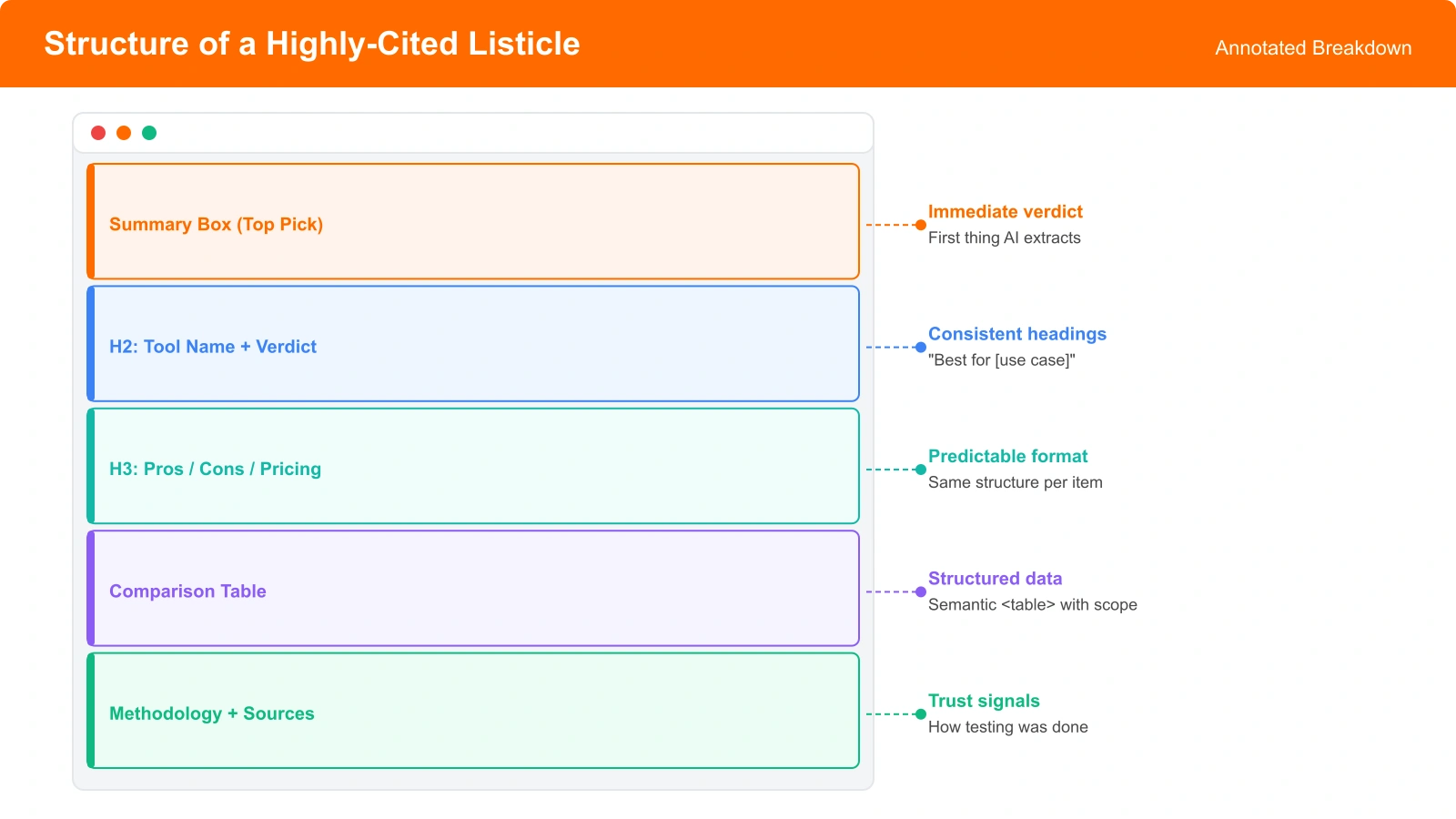
Here's how this listicle organizes its content:
- H1: Single, clear title with the exact query phrase
- H2: One for each product (e.g., “1. Asana — Best for Team Collaboration”)
- H3: Consistent sub-sections under each product: Key Features, Pros, Cons, Pricing, Best For
Notice something? Every H2 includes a verdict in the heading itself. Not just “Asana” but “Asana — Best for Team Collaboration.” That's huge.
When ChatGPT or Perplexity scans this page, it doesn't have to parse through paragraphs to find the recommendation. The verdict is right there in the heading—extractable, quotable, done.
The Opening Summary Block
Right after the intro, there's a summary box that basically says: “Here's our quick take.” It lists the top three picks with one-sentence verdicts for each.
This is exactly what AI systems are looking for. According to Google's own documentation on featured snippets, concise summary content in the first few hundred words significantly increases snippet eligibility. The same logic applies to AI citations—systems want clear, upfront answers.
Element 2: Quotable Blocks That AI Systems Extract
Here's where it gets really interesting. This listicle contains what I call “quotable blocks”—short, definitive statements that are practically begging to be cited.
Let me show you what I mean. Under the Asana section, there's a callout box that says:
“Asana is the best project management tool for teams that need visual workflows and robust task dependencies. It excels at helping teams track complex projects without overwhelming them with features.”
That's 38 words. It's a complete, definitive statement. It includes the product name, a clear verdict, and specific use cases. An AI system can lift this entire block and use it as-is.
Compare that to how most listicles handle verdicts:
“If you're looking for a tool that offers good features and reasonable pricing, you might want to consider checking out Asana, which many users find helpful for various project management needs.”
Same word count. Completely different citability. The second version hedges so much that an AI system would have to do work to extract a clear recommendation. And AI systems—much like impatient humans—don't want to do that work.
Patterns in the Quotable Blocks
After analyzing all eight product sections, I found consistent patterns:
- Each verdict is 30-50 words—long enough to be substantive, short enough to quote whole
- Every verdict starts with the product name (entity clarity)
- Verdicts use definitive language: “is the best,” “excels at,” “ideal for”
- Each includes at least one specific use case or user type
- No hedging language like “might,” “could,” or “in some cases”
Build Listicles That AI Actually Cites
Apply these citation-winning patterns automatically. Generate listicles with the exact structure AI systems prefer to reference.
Try for Free
Element 3: Schema Markup Done Right
I pulled the source code and found comprehensive schema markup—but not the overwrought kind that some SEO guides recommend. It was actually pretty minimal and focused.
The page uses ItemList schema with each product as a ListItem. Each item includes:
- position: The ranking number
- name: Product name
- description: The verdict statement (same as the quotable block)
- url: Link to the product
Here's a simplified version of what the markup looks like:
{
  "@context": "https://schema.org",
  "@type": "ItemList",
  "name": "Best Project Management Software 2026",
  "itemListElement": [
    {
      "@type": "ListItem",
      "position": 1,
      "name": "Asana",
      "description": "Best for team collaboration and visual workflows"
    },
    {
      "@type": "ListItem",
      "position": 2,
      "name": "Monday.com",
      "description": "Best for customizable dashboards and automation"
    }
  ]
}
What's notably absent? No Review schema, no AggregateRating, no Product schema for each item. Just clean ItemList. According to Google's structured data documentation, misusing schema can actually hurt rather than help. This page keeps it focused.
Element 4: Visible Methodology
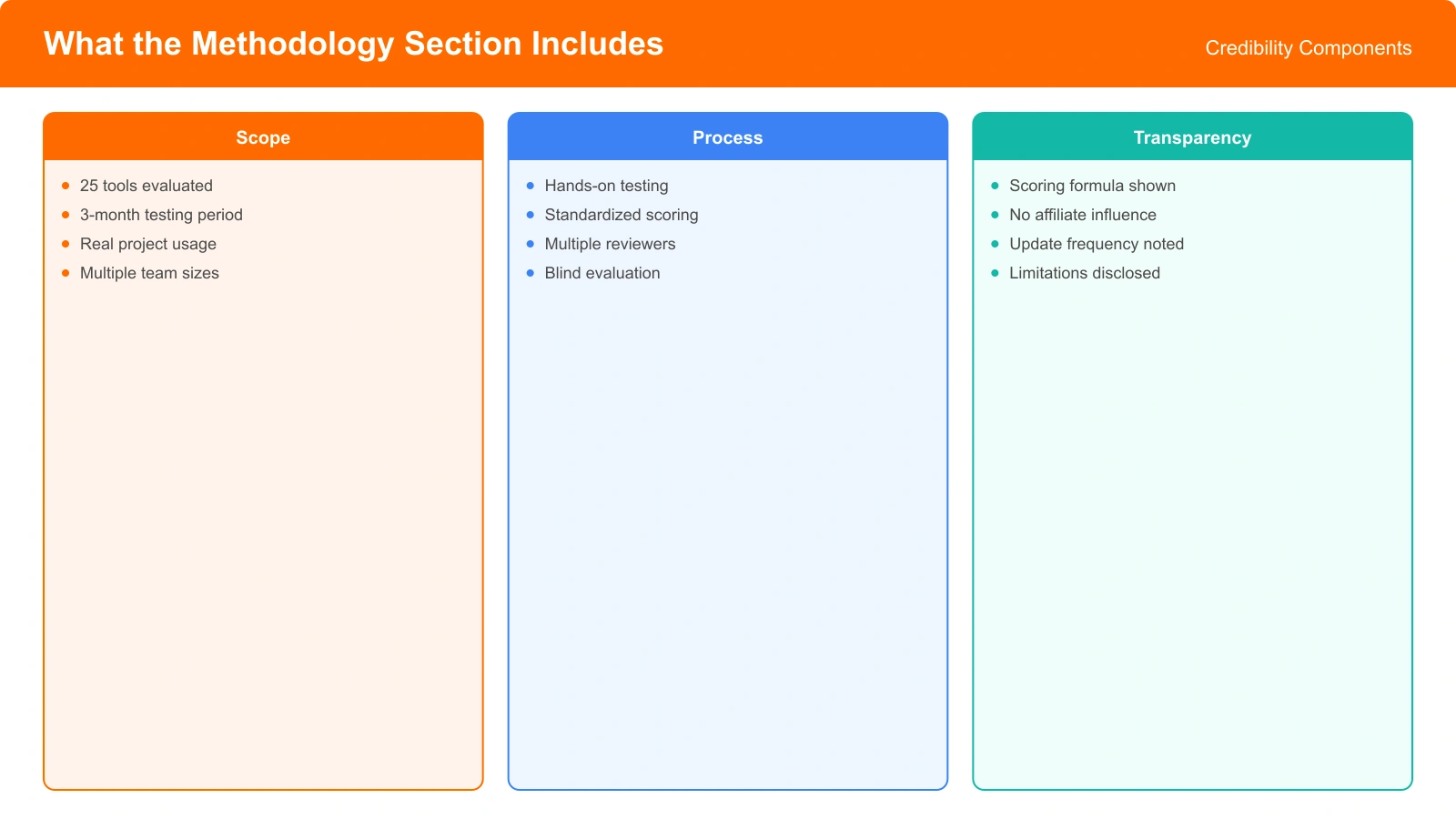
Near the top of the page, right after the quick picks summary, there's a section titled “How We Tested.” It's not long—maybe 150 words—but it includes specific details:
- “We tested 23 project management tools over 8 weeks”
- “Each tool was evaluated by a team of 4 using standardized tasks”
- “We used real projects from actual small businesses, not sample data”
Why does this matter for AI citations? Credibility signals.
When AI systems are deciding which sources to cite, they're increasingly looking for what Google calls E-E-A-T: Experience, Expertise, Authoritativeness, Trustworthiness. Google's Search Quality Evaluator Guidelines emphasize that first-hand experience is a key quality signal.
A methodology section demonstrates experience. It tells AI systems: this isn't just aggregated opinions—it's based on actual testing.
Element 5: Freshness Signals
The page was last updated three weeks before I started tracking. And it shows that update date prominently—both in the byline and in the schema markup with a dateModified property.
But here's what's clever: the updates aren't just date bumps. When I compared cached versions, I found they'd actually made substantive changes:
- Updated pricing for two products
- Added a new product that launched recently
- Revised one verdict based on a significant feature update
AI systems—especially ones with recent knowledge cutoffs—favor fresh content. Ahrefs' research on freshness shows that for certain query types (including “best” queries), recently updated content ranks significantly better. The same principle applies to AI citations.
What Competing Pages Miss
I looked at five competing listicles that rank similarly in traditional search but rarely get AI citations. Here's what they're doing differently:
Over-Hedging
Competing pages use language like “might be a good choice” or “could work well for some teams.” This wishy-washy phrasing makes extracting clear recommendations nearly impossible. AI systems need definitive statements.
Buried Verdicts
Several competitors bury their actual recommendations in the middle of dense paragraphs. You have to read 200+ words to find what they actually think about a product. AI systems don't want to do that work—and neither do users.
Inconsistent Structure
One competitor has different sub-sections for each product. Asana gets Features, Pricing, Verdict. Monday.com gets Pros, Cons, Overview. ClickUp gets nothing but prose. This inconsistency makes systematic extraction much harder.
Missing or Incorrect Schema
Two competitors had no structured data at all. One had Review schema that didn't match their content format (a classic case of cargo-cult SEO—adding schema because you heard it helps, not because it's appropriate).
Applying These Lessons
So what can you actually do with this analysis? Let me break it down into actionable steps.
First, audit your heading structure. Every H2 for a product should include a verdict snippet, not just the product name. “Notion — Best for All-in-One Workspaces” beats “Notion Review” every time.
Second, create quotable blocks. For each product, write a 30-50 word definitive statement that could be lifted and cited as-is. Put it in a visually distinct callout or summary box.
Third, add appropriate schema. ItemList is your friend for listicles. Don't over-engineer it with Review or Product schema unless they're genuinely applicable to your content type.
Fourth, show your methodology. Even a brief section explaining how you evaluated products adds credibility signals that AI systems increasingly look for.
Finally, keep it fresh with substance. Regular updates matter, but only if they're real updates—new products, pricing changes, revised verdicts based on feature updates.
For a complete framework on getting cited by AI, see our guide on how listicles get cited by AI overviews. And for the specific formatting patterns that AI loves, check out citable content blocks.

Product Manager at BestPage. Pioneer in AEO research since 2024, exploring the convergence of SEO and GEO (Generative Engine Optimization). Led multiple AI-powered content optimization projects that achieved 300%+ citation increases in ChatGPT and Perplexity.