
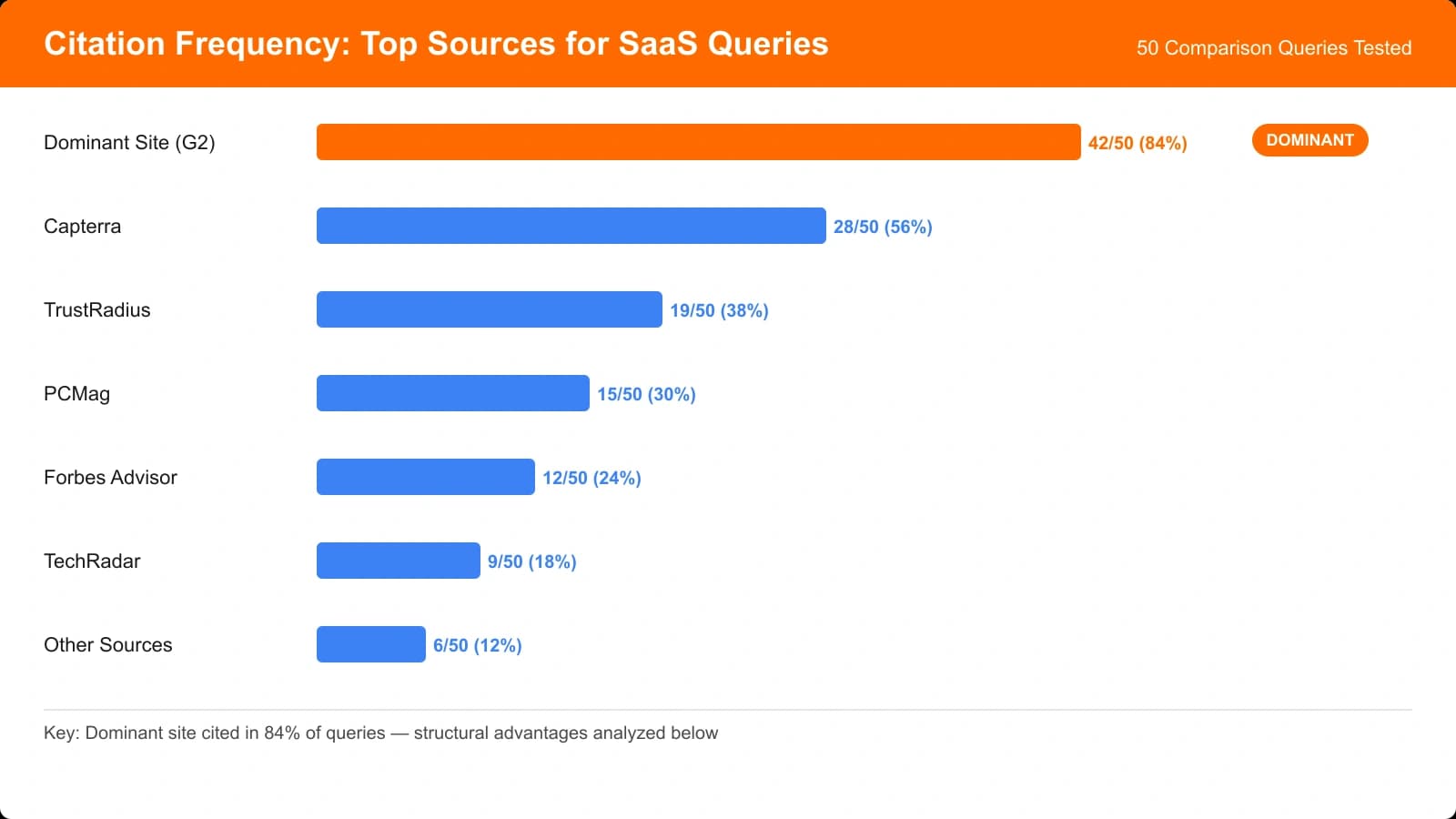
When we started researching Perplexity citation patterns for SaaS comparison queries, one site kept appearing. Query after query—“best CRM for startups,” “project management tool comparison,” “marketing automation platforms”—the same source showed up in citations with striking frequency. While other comparison sites appeared sporadically, this one achieved near-constant presence.
That observation sparked this teardown. What is this site doing that others aren't? Is their Perplexity dominance a result of specific optimization choices, or simply a function of their size and authority? And most importantly: what lessons can other comparison publishers extract and apply?
We analyzed the site's content structure, technical implementation, authority profile, and update patterns. We compared their approach to competitors who appear less frequently. And we identified specific, actionable patterns that appear to drive their AI search success. This teardown shares those findings.
A note on methodology: we're not naming the specific site to focus on transferable lessons rather than competitive analysis. The patterns we identify are observable across successful AI-cited sites; this particular site simply exemplifies them most consistently in the SaaS category.
Finding 1: Content Structure Patterns
The first thing that stands out is content structure. This site's comparison pages follow a remarkably consistent pattern that appears optimized for AI extraction.
Predictable Information Architecture
Every comparison page follows the same template:
- Executive summary: 50-word TL;DR with clear top recommendations
- Selection methodology: Brief explanation of how tools were evaluated
- Top picks section: 3-5 recommendations with one-paragraph summaries
- Individual reviews: 300-500 words per product with consistent subsections
- Comparison dimension: Section comparing all options on specific criteria
- FAQ section: 8-12 conversational questions and answers
- Methodology details: Extended explanation of evaluation process
This consistency matters for AI parsing. Perplexity can reliably extract recommendations from the top picks section, detailed comparisons from individual reviews, and specific answers from the FAQ. The predictable structure makes content more parseable than less organized competitors.
Extractable Conclusions
Every section contains clear, quotable conclusions:
Example conclusion patterns observed:
“For small sales teams under 10 people, Pipedrive offers the best balance of simplicity and capability.”
“HubSpot CRM is our top pick for growing companies that need marketing-sales alignment.”
“If integration with accounting software is your priority, Freshsales provides the deepest connectivity.”
These conclusions are structured to be independently extractable. Each makes sense without surrounding context, which is exactly how AI systems cite content. Competitors often bury recommendations in paragraphs of context that dilute citability.
Finding 2: Authority Signal Density
The site invests heavily in visible authority signals that AI systems appear to weight.
Transparent, Detailed Methodology
Unlike competitors who vaguely mention “research”, this site provides extensive methodology documentation:
- Specific evaluation criteria with weighted scoring
- Number of products reviewed and time spent testing
- Testing conditions and limitations acknowledged
- Update frequency and verification processes
- Author qualifications for each category
This methodology transparency serves two purposes: it builds trust with human readers, and it provides AI systems with signals of genuine evaluation rather than superficial aggregation. The detail level distinguishes authoritative comparisons from content-farmed listicles.
Visible Author Expertise
Each comparison page has a clearly identified author with:
Author page elements:
• Professional headshot and name
• Relevant experience (years in category, companies worked with)
• Number of products personally tested
• Links to other reviews in their expertise area
• Social profiles and professional credentials
This aligns with E-E-A-T signals that both Google and AI systems increasingly weight. Anonymous content or generic bylines appear to receive less citation preference than content with clear, qualified authorship.
External Authority Indicators
The site has cultivated substantial external authority signals:
- Strong backlink profile from industry publications
- Citations from vendors they review (interesting dynamic)
- Media mentions and press coverage
- Social following and engagement in target verticals
- Speaking and conference presence in relevant industries
These signals appear to influence Perplexity's source selection. Sites with stronger external authority appear more frequently in citations, suggesting AI systems consider domain reputation alongside content quality.
Finding 3: Update and Freshness Patterns
The site maintains aggressive update schedules that appear to influence citation selection.
Observable Update Patterns
Tracking their comparison pages over time revealed:
- Monthly verification: Key pages show monthly “last verified” dates
- Quarterly refreshes: Major content updates every 3 months
- Event-triggered updates: Updates within days of major product announcements
- Transparent change logs: Some pages include visible update histories
This freshness investment appears to matter for Perplexity. When we tested queries where their content was outdated (rare), competing sources with newer information sometimes appeared instead. Their citation dominance correlates with content currency.
Visible Freshness Signals
Beyond actual updates, the site prominently displays freshness:
Freshness signal examples:
“Last updated: January 2026” (visible near page top)
“Pricing verified: January 15, 2026” (in pricing sections)
“New for 2026: We've added 3 emerging tools this quarter”
“Update: HubSpot released new pricing tiers in December”
These signals serve both humans (confidence in current information) and AI systems (recency indicators that may influence source selection).
Build AI-Citable Comparisons
Generate listicles with the structure and authority signals that drive AI search citations.
Try for Free
Finding 4: Technical Implementation
Technical factors also appear to contribute to citation success.
Comprehensive Structured Data
The site implements extensive schema markup:
- Article schema with author and publisher details
- ItemList schema for product rankings
- Product/SoftwareApplication schema for reviewed tools
- FAQ schema for question-answer sections
- Review/AggregateRating schema where applicable
While we can't prove Perplexity uses schema directly, structured data helps AI systems understand content relationships and extract information accurately. The investment in comprehensive markup correlates with citation success.
Clean Crawlability
Technical analysis revealed strong fundamentals:
- Fast page load times (sub-2-second LCP)
- Clean HTML without excessive JavaScript requirements
- Proper heading hierarchy (H1 → H2 → H3)
- No content hidden behind interactions or tabs
- Mobile-responsive design with consistent content
These technical factors ensure AI systems can access and parse content effectively. Sites with heavy JavaScript rendering, slow loads, or hidden content may be disadvantaged in citation selection.
What Competitors Do Differently
Comparing to less-frequently-cited competitors reveals instructive contrasts.
Common Gaps in Less-Cited Sites
Sites that appear less frequently in Perplexity citations tend to share certain characteristics:
- Inconsistent structure: Different comparison pages follow different formats
- Vague methodology: No explanation of how tools were evaluated
- Anonymous authorship: No clear author or generic bylines
- Stale content: No visible update dates or obviously outdated information
- Buried conclusions: Recommendations hidden in dense paragraphs
- Thin coverage: Fewer products, less depth per product
Each gap represents an opportunity for improvement. Sites addressing these gaps may see citation frequency improvements.
It's Not Just About Size
An important observation: the dominant site isn't the largest in the space by traffic or backlink count. Several competitors have comparable or greater traditional SEO metrics but appear less frequently in Perplexity citations. This suggests AI search citation is influenced by content-specific factors, not just domain authority alone.
The lesson is encouraging: smaller publishers can compete for AI citations by optimizing the specific factors that appear to drive citation selection, rather than simply hoping domain authority alone will translate to AI visibility.
Actionable Lessons
Synthesizing the teardown findings into actionable improvements:
- Adopt consistent templates: Every comparison should follow a predictable, AI-parseable structure
- Write extractable conclusions: Make recommendations quotable without context
- Document methodology: Explain how you evaluate—transparency builds trust
- Invest in authorship: Real authors with visible credentials outperform anonymous content
- Maintain freshness: Update regularly and display freshness signals prominently
- Implement structured data: Comprehensive schema helps AI systems parse content
- Ensure technical soundness: Fast, clean, crawlable pages get cited more
None of these factors work in isolation. The dominant site succeeds through consistent execution across all dimensions simultaneously. Improving one area helps; improving all areas compounds into citation dominance.
For practical implementation of these lessons, see Optimizing for Perplexity and SearchGPT. For content structure guidance, see LLM-Friendly Writing for Listicles.

Product Manager at BestPage. Pioneer in AEO research since 2024, exploring the convergence of SEO and GEO (Generative Engine Optimization). Led multiple AI-powered content optimization projects that achieved 300%+ citation increases in ChatGPT and Perplexity.