

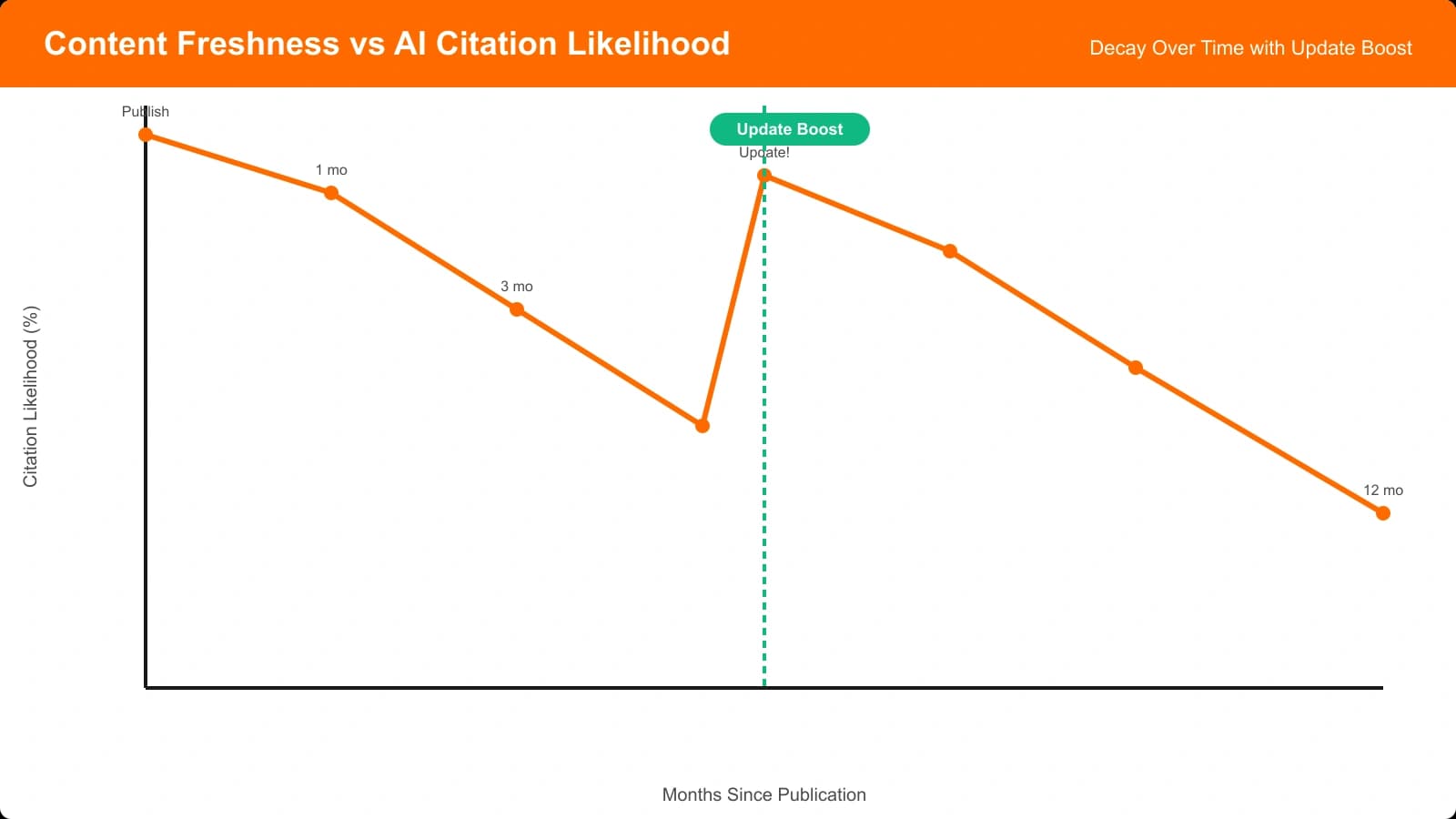
When a user asks an AI system “What's the best CRM in 2026?” the system needs to decide between citing a comprehensive article from 2024 or a recently-updated article from January 2026. For many comparison queries, freshness wins.
AI systems have been trained to understand that product information changes. Pricing updates, features launch, companies merge or shut down. Content with clear freshness signals—recent publication dates, visible “last updated” timestamps, current year references—provides stronger confidence that information is accurate.
This guide examines how freshness signals affect AI citation decisions, how to implement proper timestamp signals, and when freshness should (and shouldn't) be your priority.
Why Freshness Matters for AI
Understanding the AI perspective on freshness helps you prioritize where to invest in updates.
How AI Detects Freshness
| Signal Type | What AI Looks For | Reliability |
|---|---|---|
| Schema dateModified | Structured data timestamp | High: machine-readable, explicit |
| Visible “Last updated” | Text showing update date | High: visible to users and AI |
| Year in title/content | “Best CRM 2026” | Medium: can indicate currency |
| Current year references | References to recent events, prices | Medium: content-based signal |
| HTTP Last-Modified | Server-level timestamp | Low: not always exposed |
Queries Where Freshness Matters Most
Freshness importance varies by query type:
- Pricing queries: Very high—prices change frequently
- Feature comparisons: High—products update regularly
- “Best of 2026” queries: Very high—explicit year requirement
- Market leader questions: High—rankings shift
- Conceptual explanations: Low—“What is CRM?” is evergreen
- Historical information: Low—past events don't change
The Staleness Penalty
Content with old dates faces an implicit penalty for time-sensitive queries:
- AI may explicitly note the source is dated
- Newer sources may be preferred even if less comprehensive
- Users may distrust recommendations from years-old content
- Outdated pricing or features reduce citation accuracy
Implementing Proper Timestamps
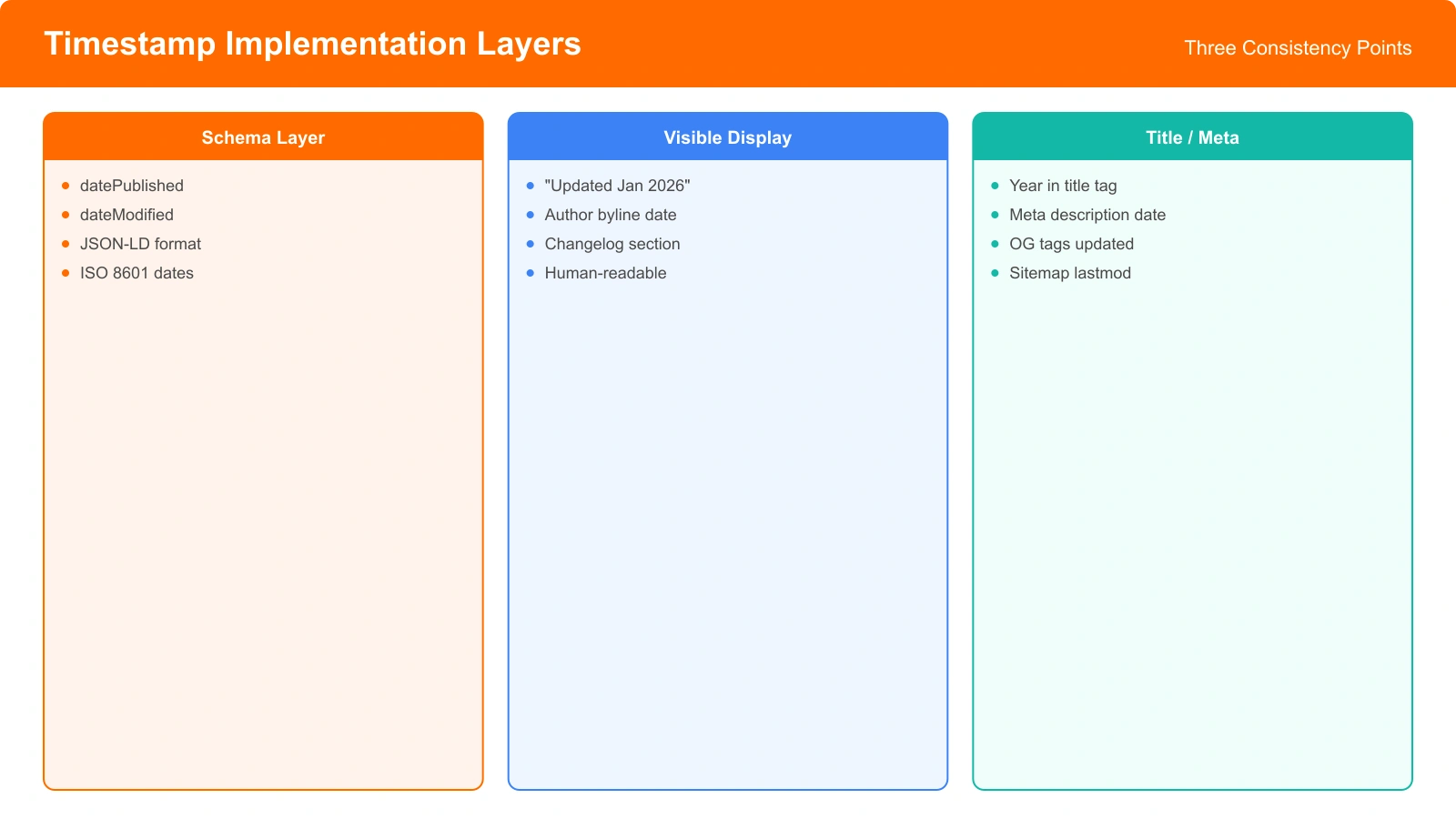
Effective freshness signaling requires consistent implementation across multiple layers.
Schema Markup Dates
Your Article schema should include proper date fields:
| Property | Purpose | Format |
|---|---|---|
| datePublished | Original publication date | ISO 8601 (YYYY-MM-DD) |
| dateModified | Most recent substantial update | ISO 8601 (YYYY-MM-DD) |
| dateCreated | When content was first created | ISO 8601 (optional) |
Critical: Update dateModified when you make substantive changes, not on every minor edit.
Visible Date Display
Users and AI both see visible dates. Best practices:
- Show “Last updated” prominently: Near the title or byline
- Include original publish date: For context on content history
- Use clear date format: “January 30, 2026” not “1/30/26”
- Match visible to schema: Dates should be consistent
Year in Titles
Including the year in titles signals currency:
- Do: “Best CRM Software in 2026”
- Do: “Project Management Tools: 2026 Comparison”
- Don't: Update year without updating content
- Consider: Remove year from evergreen content
Keep Comparisons Current
Build comparison content with proper freshness signals for AI visibility.
Try for Free
Strategic Update Approach
Freshness signals are only valuable when backed by actual updates. Here's how to update strategically.
What Counts as Substantive
| Update Type | Update dateModified? | Reasoning |
|---|---|---|
| New pricing information | Yes | Factual update users care about |
| New product added to list | Yes | Significant content addition |
| Product feature updates | Yes | Changes evaluation or recommendation |
| Ranking changes | Yes | Core content changed |
| Typo fixes | No | Not substantive |
| Formatting changes | No | Not substantive |
| Adding a sentence | Maybe | Depends on importance |
Establishing Update Cadence
Different content types need different update frequencies:
- Pricing-focused comparisons: Monthly or quarterly reviews
- Feature comparisons: Quarterly reviews
- Market leader rankings: Semi-annual reviews
- Methodology explainers: Annual reviews unless landscape changes
Avoiding Timestamp Manipulation
Updating dates without updating content is manipulation that can backfire:
- Users who click through see stale content despite fresh date
- AI systems may eventually detect patterns of fake freshness
- Credibility damage if caught
- Google explicitly warns against date manipulation
Freshness vs. Authority Trade-offs
Sometimes older, authoritative content beats newer content. Understanding when helps you make strategic decisions.
When Authority Beats Freshness
- Evergreen topics: “What is CRM?” doesn't need 2026 date
- Historical information: Past events don't change
- Methodological content: How to evaluate software doesn't change yearly
- Authoritative sources: Wikipedia article may beat recent blog post
When Freshness Beats Authority
- Current year queries: “Best X in 2026” needs 2026 content
- Pricing questions: Old pricing is wrong pricing
- Feature availability: Products change too fast for old content
- Market conditions: Company acquisitions, shutdowns change recommendations
Balancing Both Signals
The ideal position: authoritative AND fresh. Strategies:
- Regular refresh schedule: Maintain authority while staying current
- Evergreen structure with fresh data: Framework stays, numbers update
- Clear update log: Show history of maintenance
- Separate evergreen from time-sensitive: Different pages for different needs
Implementation Checklist
Use this checklist to ensure proper freshness signaling:
- Add datePublished and dateModified to Article schema: Both required
- Display visible “Last updated” date: Near title or byline
- Match schema dates to visible dates: Consistency matters
- Use ISO 8601 format in schema: YYYY-MM-DD
- Consider year in titles for annual content: “2026 Guide”
- Establish update schedule: Define cadence by content type
- Update dates only with substantive changes: Don't manipulate
- Document what changed: Consider changelog or “What's new” section
- Review older content for staleness: Proactive freshness maintenance
- Monitor for outdated information: Set alerts for product changes
Freshness is a powerful signal for AI citation, but it must be backed by actual content currency. Strategic timestamp implementation combined with genuine content maintenance creates the best outcomes for AI search visibility.
For content refresh workflows, see our guide on Listicle Refresh System: Stay Current Automatically. For content decay detection, check out Content Decay: Catch Declining Listicles Early.

Product Manager at BestPage. Pioneer in AEO research since 2024, exploring the convergence of SEO and GEO (Generative Engine Optimization). Led multiple AI-powered content optimization projects that achieved 300%+ citation increases in ChatGPT and Perplexity.