
Marketing agencies and consultancies face a content paradox. They advise clients on content marketing, but their own websites often read like capability brochures rather than valuable resources. Meanwhile, comparison queries for agency services go to directories and review sites—traffic that could be captured directly.
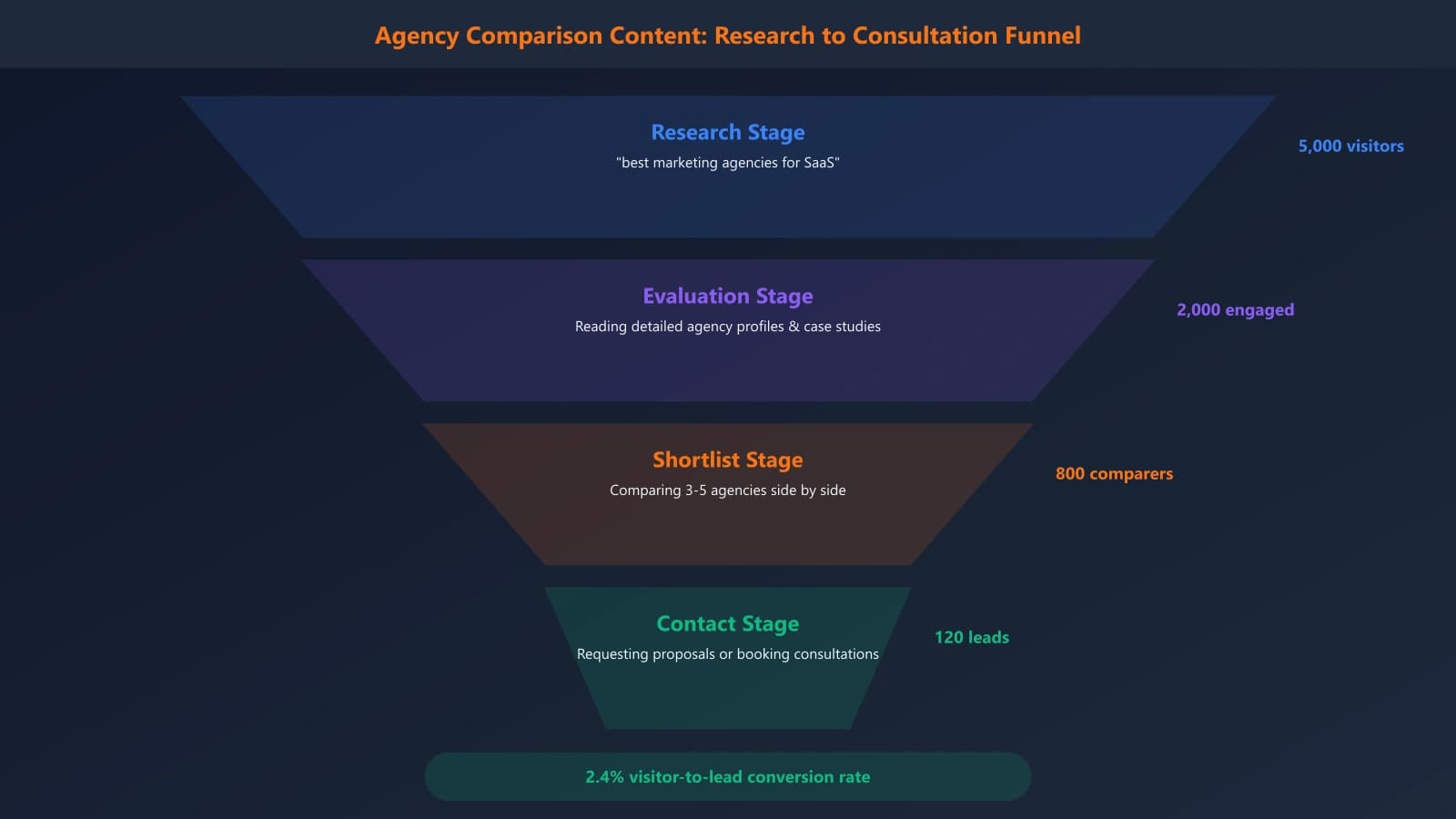
Comparison pages offer agencies a way to intercept decision-stage traffic. When a prospect searches “best digital marketing agencies in Chicago” or “top B2B SEO consultants,” they're actively evaluating options. A well-executed comparison page positions your agency as a helpful guide—and a viable choice.
This playbook covers how agencies can build comparison content that generates qualified leads while maintaining credibility and avoiding self-promotion pitfalls.
Comparison Content Types for Agencies
Not all agency comparison content follows the same format. The right approach depends on where you want to position yourself.
Category-Level Comparisons
These pages compare types of agencies or service approaches rather than specific competitors. “Full-Service Agency vs Specialized Boutique: Which Is Right for Your Business?” or “In-House Marketing Team vs Agency: Complete Comparison.”
Category comparisons are the safest starting point. You're providing genuinely useful decision-making frameworks without directly naming competitors. This builds thought leadership while capturing comparison-intent traffic.
The conversion path here is education-to-consultation: readers who find your framework helpful are likely to trust your expertise when they're ready to evaluate specific options.
Market-Level Comparisons
These pages compare specific agencies in a market—including your own. “Best Healthcare Marketing Agencies in the Midwest” or “Top 10 B2B SaaS Marketing Agencies (2026).”
Market comparisons are more aggressive but also more valuable for lead capture. Prospects searching these queries are typically in active evaluation mode. Appearing on your own comparison page—with appropriate transparency—signals confidence.
The key is editorial integrity. Include genuine competitors, provide balanced assessments, and be transparent about your own placement. A comparison page that reads like a sales brochure destroys credibility.
Alternatives to [Competitor]
These pages target searches for alternatives to well-known agencies. “Agencies Like WebFX” or “Alternatives to Neil Patel Digital.”
Alternatives pages are particularly effective when a dominant competitor has frustrated clients or when your positioning offers a clear contrast. They capture prospects who've already decided against one option and are actively seeking alternatives.
Including Yourself: The Credibility Balance
The most sensitive question in agency comparison content: should you include yourself, and how?
The Transparency Approach
The most credible approach: include yourself with explicit disclosure. “Disclosure: We're one of the agencies on this list. We've aimed to present each option fairly, including our own limitations.”
This transparency signals confidence and honesty. Readers understand everyone has incentives; acknowledging yours builds trust rather than undermining it. The alternative—pretending to be a neutral third party while recommending yourself—is obvious and damaging when detected.
Honest Self-Assessment
When you include your agency, treat it like any other entry. Document genuine strengths and real limitations. If you're not the best fit for certain clients, say so—and explain who is.
This honesty actually improves lead quality. Prospects who read your limitations and still inquire are better qualified than those who expect things you can't deliver.
Content Structure for Agency Comparisons
Agency comparisons require different structural elements than product comparisons.
Evaluation Criteria Section
Start with how you evaluated agencies. What factors matter when choosing a marketing agency? This section establishes your expertise and helps readers think systematically about their decision.
Common criteria for agency evaluation include industry specialization, team size and structure, pricing models, case studies and results, client retention rates, and cultural fit indicators. Explain why each matters and how you weighted them.
Agency Profiles
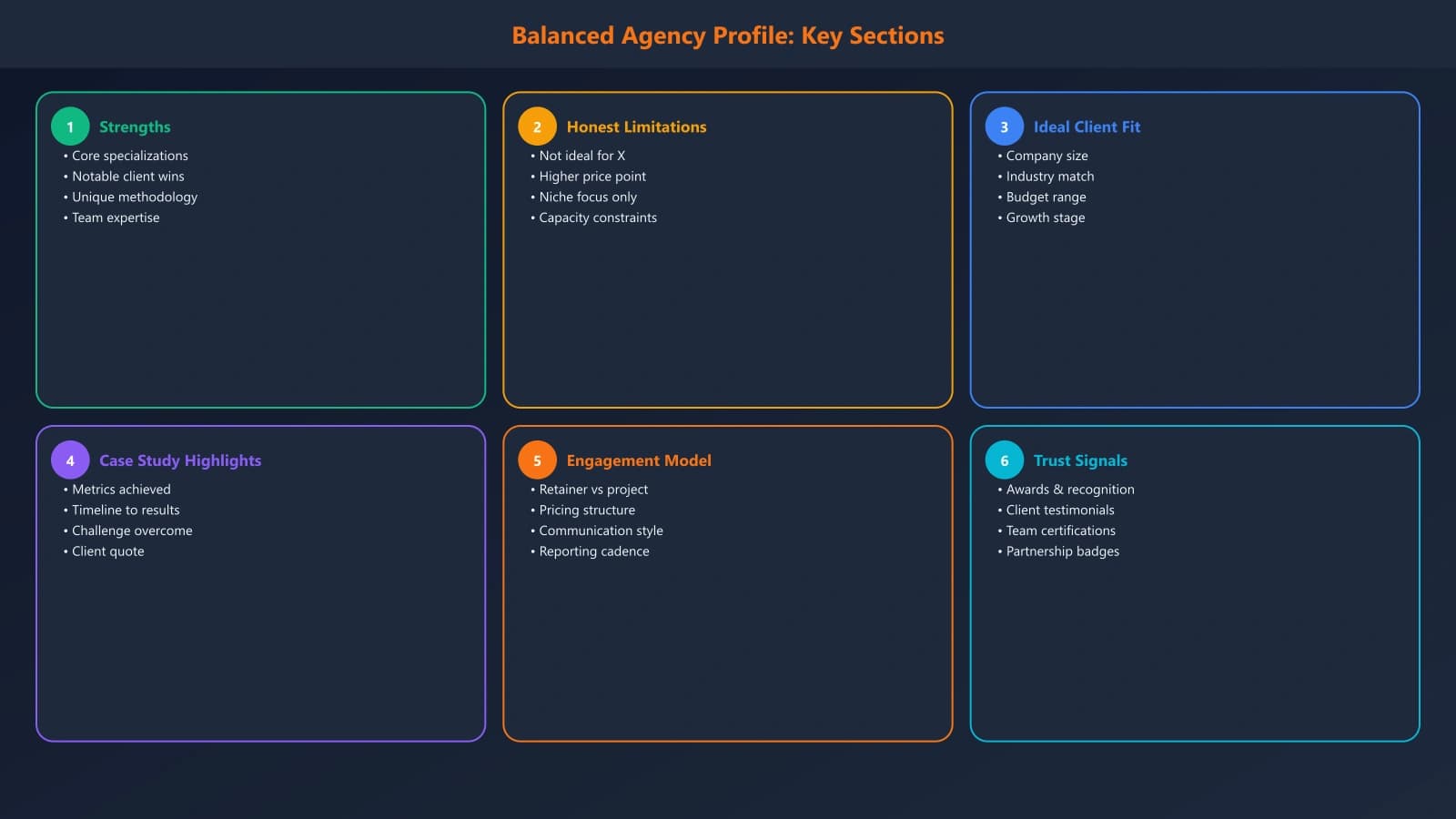
For each agency, provide balanced profiles covering strengths, limitations, ideal client fit, notable clients or case studies, and approximate pricing or engagement models. Keep profiles consistent in structure so prospects can compare easily.
Avoid generic descriptions. “Full-service digital marketing agency with excellent results” describes everyone. “Specializes in B2B SaaS with a content-led approach; not ideal for e-commerce or local businesses” actually helps readers.
Fit-Based Recommendations
Rather than declaring a single “best,” provide fit-based recommendations. Best for enterprise companies. Best for startups with limited budgets. Best for specific industries. This approach is more honest—there rarely is a universally best agency—and more useful for readers with different needs.
Generate Agency Comparison Pages
Create credible service comparisons that position your agency as a trusted advisor.
Try for Free
Converting Readers to Leads
Unlike affiliate content that converts through purchase links, agency comparison content converts through consultation offers.
Soft Conversion Paths
Not every reader is ready for a sales conversation. Offer lower-commitment conversion paths: agency selection guides, evaluation checklists, or comparison worksheets. These capture email addresses from earlier-stage prospects.
The gated content should be genuinely useful, not thinly-veiled sales materials. A “Questions to Ask When Evaluating Agencies” PDF that helps them evaluate everyone—including your competitors—builds more trust than a branded pitch deck.
Consultation Offers
For readers ready to talk, offer free consultations framed as helpful rather than salesy. “Not sure which type of agency is right for you? Schedule a 15-minute fit call—no pitch, just guidance.”
The consultation should genuinely help the prospect, even if they're not a fit. Referring them to a better-suited competitor (and mentioning you did so in the consultation) builds referral relationships and long-term reputation.
Retargeting Strategy
Readers who don't convert immediately are still valuable. Build retargeting audiences from comparison page visitors and nurture them with case studies, thought leadership, and gentle reminders. Many agency decisions take weeks or months; staying visible throughout that process matters.
Building Your Agency Comparison Strategy
Agency comparison content works when it prioritizes genuine helpfulness over self-promotion. The goal is positioning your agency as a knowledgeable guide to the market—someone prospects can trust to give honest advice.
Start with category-level comparisons where you're clearly the expert without directly competing. As you build credibility, expand into market-level comparisons where you include yourself transparently. Measure success not just by leads captured but by lead quality—comparison content should attract prospects who are good fits.
For related local strategies, see our guides on Local Service Comparisons and City Best-Of Pages.

Product Manager at BestPage. Pioneer in AEO research since 2024, exploring the convergence of SEO and GEO (Generative Engine Optimization). Led multiple AI-powered content optimization projects that achieved 300%+ citation increases in ChatGPT and Perplexity.